Summer is upon us, and this is the time of year when so many of us begin to travel, take long weekends, go on road trips, spend more time outdoors, and generally live a little more “on the go” than usual. Whether you are traveling across the world, heading to the beach for the weekend, taking family vacations, planning a girls trip, or simply spending more time out of the house during the warmer months, having the right functional accessories with you can make a huge difference in how smooth and enjoyable your days feel.
I’ve always believed that organization doesn’t just apply to your planner, your schedule, or your home — it also applies to the systems and tools you use while moving through everyday life. In fact, I think some of the most stressful travel experiences happen simply because we are unprepared, disorganized, carrying too much, forgetting important items, dealing with dead electronics, or constantly trying to find things buried at the bottom of a bag.
The older I get, the more I appreciate functional items that reduce friction in my life. I want things to feel easier. I want less chaos, less scrambling, less inconvenience, and fewer moments where I’m paying inflated “vacation prices” for things I could have easily packed ahead of time. I also love products that help me maintain some sense of routine, productivity, and comfort while I’m away from home because I genuinely think that helps travel feel more relaxing and enjoyable overall.
Over the years, I’ve slowly built a collection of accessories and travel essentials that I now pretty much refuse to leave home without. These are the items that help me stay charged, organized, comfortable, productive, hydrated, prepared, and generally a little more sane while traveling or spending long days out and about.
So today I wanted to share some of my favorite functional accessories that help keep me organized and productive on the go. Some of these are simple little conveniences, some are productivity-focused, and some are just practical upgrades that quietly make life easier without you realizing how much you needed them until you start using them regularly.
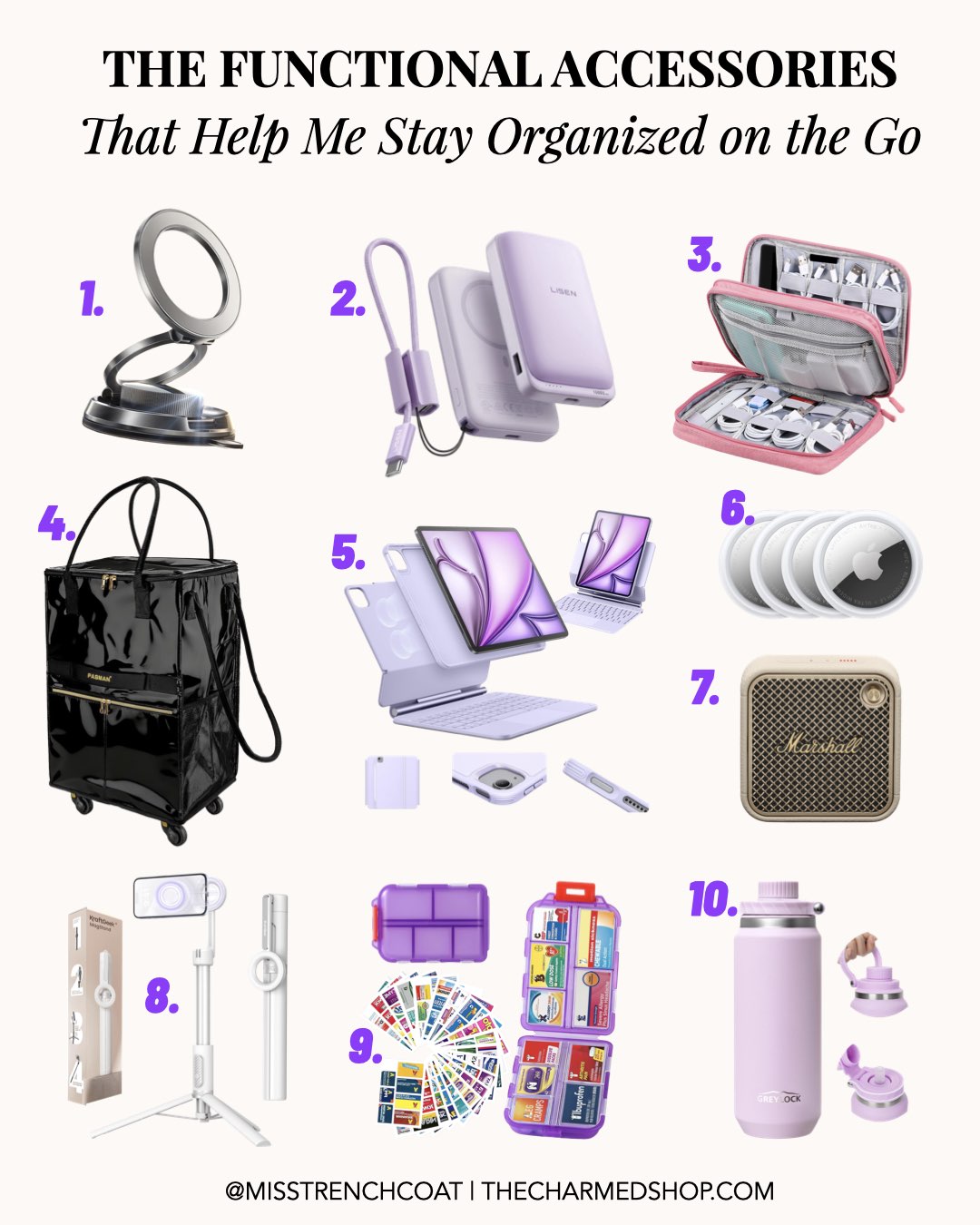
Long car trips are made so much easier when I can mount my phone to my dashboard area to keep an eye on directions, notifications, music selection, podcasts, and hands-free calls. I hate keeping my phone in my center console area or in the cup holder because it takes up valuable real estate and can slide around while I’m driving, which means I lose easy access to my phone when I need it.
A phone mount for your car is honestly a must at this point, and this flexible mount from Lisen gives you multiple options for where to position your phone depending on your setup and comfort level. I also appreciate that it has a sleek, minimal design that doesn’t make your car look cluttered.
With all the electronics we travel with these days, whether it’s a short weekend trip or a longer vacation, I think having at least one portable power bank is essential.
I often travel with a mix of magnetic phone chargers, portable power banks, and larger battery packs that can charge multiple accessories at once, but I recently got this Lisen Portable Power Bank that can do both. It connects directly to the MagSafe on your phone for wireless charging, and it also includes a built-in USB-C cable that doubles as a wrist strap so you can charge devices via cable as well.
It also includes a USB-A input so you can charge up to three electronics at once, plus it has a larger 10,000 mAh battery capacity, which means it can charge your phone or other devices multiple times before needing to be recharged itself. This is especially useful during long travel days, airport layovers, road trips, or days where you know you’ll be away from an outlet for long periods of time.
For organizing small electronics like your phone, earbuds, chargers, power banks, memory cards, and charging cables, it’s nice to have everything in one organized place instead of digging through your bag trying to find one tiny cord at the bottom.
An electronics pouch also helps protect your accessories from damage while traveling and makes unpacking at hotels or Airbnbs so much easier because everything already has a dedicated place.
I think traveling with reusable bags is a must because you can use them for extra goods, dirty laundry, shopping in different states or countries where they may charge for bags, or even carrying snacks and essentials during day trips.
But I especially love having a wheeled shopping tote with me because you can use it for groceries, shopping, laundry, beach supplies, or even carrying your necessities around a city comfortably without straining your shoulders.
I know there’s a popular designer version of these bags that’s significantly more expensive, but these alternatives are just as functional and save you quite a bit of money.
Because I work for myself, I’m usually working at some point during my trips. But most of the time, I don’t travel with my laptop — I travel with my iPad and my favorite ESR keyboard case.
I love this case because it includes a hardshell magnetic case for your iPad that detaches from the keyboard itself, so I don’t need to keep my iPad connected to the keyboard the entire time. I often use my iPad for reading ebooks while traveling, journaling, planning, or simply enjoying content handheld, and it’s nice to have both protection and functionality built into one setup.
It honestly turns your iPad into a lightweight travel workstation without the bulk of carrying a full laptop.
Another great accessory I recommend for traveling is Apple AirTags. Especially if you are part of the Apple ecosystem, they make it incredibly easy to track your bags, luggage, keys, wallet, or other important items while traveling.
It gives you such peace of mind, especially during air travel. I’ve heard so many stories about delayed luggage, lost bags, or even people accidentally taking the wrong suitcase at baggage claim. Having an AirTag inside your luggage helps you quickly confirm where your belongings are and gives you an extra layer of security while traveling.
A portable Bluetooth speaker that can stand up to the elements and even some water exposure is a must for traveling. I’ve taken mine to the beach, skiing, outdoor restaurants, hotels, other people’s homes, and even just used it while getting ready in a hotel room.
My absolute favorite portable speaker is my Marshall Willen because it’s compact enough to permanently live inside my travel bag, but still has incredible sound quality. It also has a built-in strap that lets you attach it to bags, bicycles, chairs, or hooks, which makes it super versatile while traveling.
You don’t need to be a content creator to get good use out of a portable tripod for your smartphone. A tripod like this KraftGeek option doubles as both a tripod and a selfie stick, making it perfect for travel photos, videos, group pictures, or documenting your trip memories.
This one even includes a Bluetooth remote so you can set up your phone, step into the frame, and get everyone in the picture without asking strangers to take your photo.
Why do I always get sick when I travel? I seriously have the worst track record with this, so I’ve learned to travel with basically any medication I might need.
Yes, you can usually buy medicine wherever you go, but you’ll often end up paying more for convenience, especially in hotels, airports, or tourist areas. So I prefer to keep everything with me.
It really helps to use one of those portable pill organizers that includes labels for common medications so you know exactly what you packed in each compartment. Because I usually travel with at least five different medications or supplements, and honestly, I don’t always remember which pill is which.
It’s no surprise that when you’re traveling, beverages are likely to cost significantly more — especially when staying at hotels, airports, amusement parks, or tourist destinations.
So I’ve started bringing a portable water bottle with me everywhere. I prefer a high-quality insulated bottle that can fit into a tote bag, backpack pocket, or clip onto a bag with a carabiner.
I also make sure to pack drink packets with me. Specifically, I like traveling with Gatorade packets, iced tea concentrate, electrolyte mixes, and protein powder sticks.
The Gatorade packet trick is honestly such a wallet saver when traveling to hot climates or on trips where you’re very active. I brought several boxes of sugar-free Gatorade packets on my ski trips this year because they were easy to pack and saved me from spending $8 every time I wanted a sports drink on the mountain.
I also intentionally choose sugar-free drink options because it helps me stay on track with my health goals when healthier beverage choices might not be easily available while traveling.
I hope this post inspired you to get a little more organized for your summer travels. In my opinion, the more organized you are while traveling, the more relaxed and enjoyable your trips end up being because you spend less time stressed, searching for things, or paying for overpriced convenience items you forgot to bring.
Let me know where you’re headed this summer. Are you traveling internationally, spending weekends at the beach, taking road trips, or simply planning a few relaxing staycations? I’d love to hear about your plans and which of these recommendations would help make your travels easier and more enjoyable.
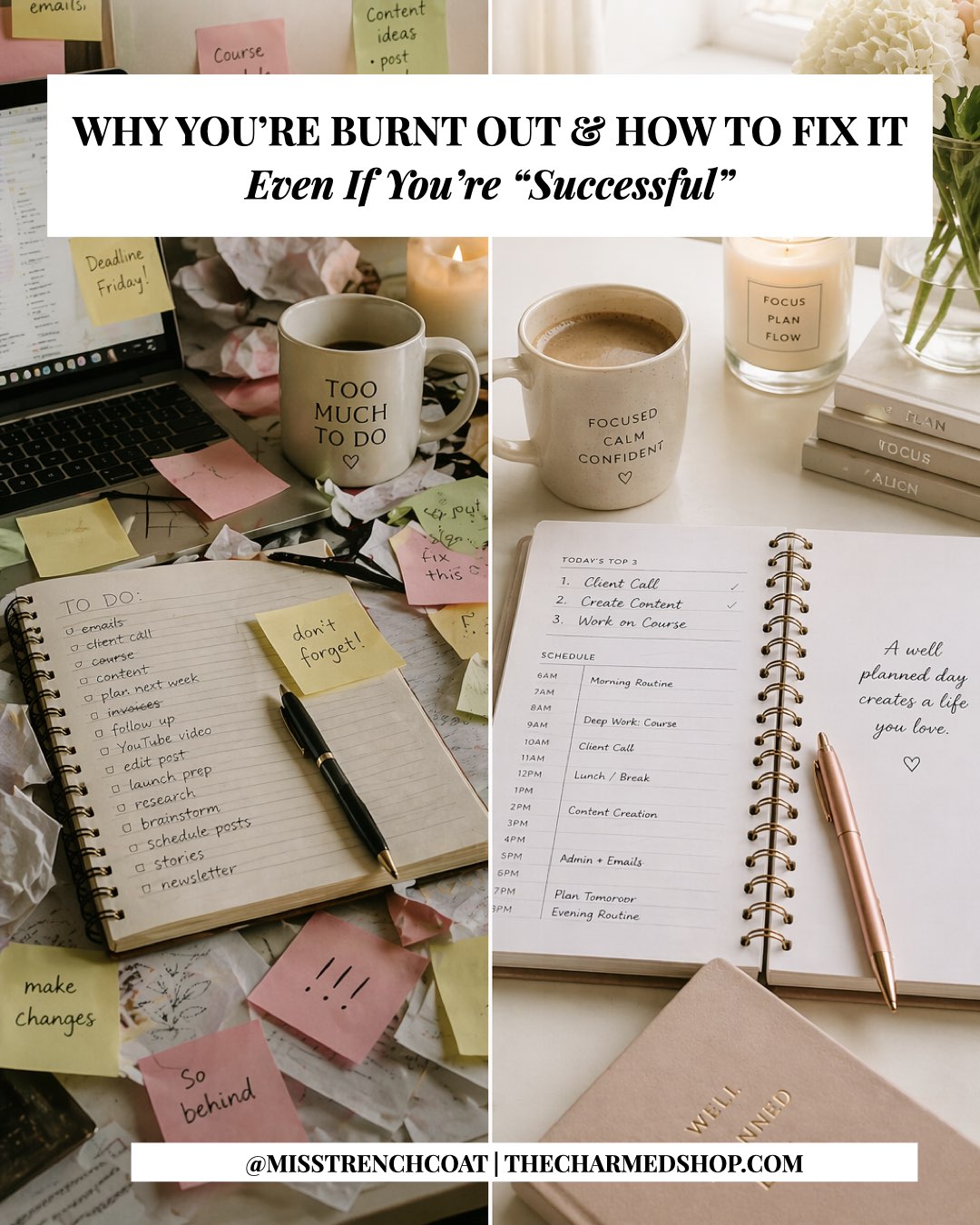
There is a particular kind of exhaustion that many high-achieving women carry quietly.
From the outside, they appear capable, dependable, organized, and ambitious. They are the women who remember birthdays, keep households functioning, meet deadlines, show up for everyone else, and somehow continue moving forward even when life becomes overwhelming. They are often praised for how much they manage and admired for how “together” they seem.
Yet internally, many of these same women feel like they are failing.
They feel behind on everything. They struggle to relax. Their minds are constantly tracking unfinished tasks, upcoming responsibilities, and all the things they should be doing better. No matter how much they accomplish in a single day, there is often a lingering sense that it still was not enough.
For years, productivity advice has framed this experience as a problem of discipline, time management, or motivation. Women are told they need better habits, stronger routines, more consistency, or improved focus. But for many high-achieving women, the issue is not laziness or a lack of ambition. In fact, the opposite is usually true.
The real productivity problem many women face is that they are chronically over-functioning while simultaneously invalidating the enormous amount they already do.
Modern productivity culture rarely acknowledges invisible labor, emotional labor, or mental load. It celebrates visible achievement while ignoring the relentless behind-the-scenes work required to keep a life running. As a result, many women have developed a distorted perception of what productivity actually is.
They do not see themselves as productive because they have been conditioned to dismiss the very work consuming most of their energy.
1. You’re Always Willing to Help Others, But Rarely Ask for Help Yourself
One of the clearest signs of this pattern is the way many women instinctively show up for others while struggling to ask for help themselves. They are often the first person people call when something goes wrong. They help solve problems, carry emotional weight for others, manage logistics, offer support, and make themselves available whenever they are needed. Yet when they need support themselves, asking for help can feel uncomfortable or even shameful.
Somewhere along the way, many women absorbed the belief that independence equals worthiness. They learned that needing help is weakness, that competent people should be able to handle everything alone, or that asking for support makes them a burden. Over time, this creates lives where women are carrying overwhelming amounts of responsibility with very little support, all while believing they should somehow be managing it better.
2. You Constantly Feel Behind — Even When You’re Accomplishing a Lot
Many high-achieving women live with a constant sense of being behind, even during seasons where they are accomplishing far more than most people realize. Their attention naturally gravitates toward unfinished tasks, future responsibilities, and everything left undone. Their minds remain focused on what still needs attention rather than what has already been completed.
As a result, their nervous systems rarely register completion or success. There is no emotional feeling of “done.” Only pressure. Even highly productive days can feel emotionally unsatisfying because their internal focus remains locked onto what still has not been accomplished.
3. You Minimize Things That “Don’t Count” as Productivity
Many women dismiss large portions of their daily labor because they do not view those responsibilities as “real productivity.” Managing schedules, planning meals, coordinating appointments, organizing households, remembering details for other people, caregiving, cleaning, emotional support, and handling life administration are often treated as ordinary obligations rather than recognized as the significant cognitive and emotional labor they actually are.
But mental load is still labor.
Executive functioning requires energy. Decision-making requires energy. Constantly anticipating needs, solving problems, remembering details, and managing the moving pieces of life requires energy. Many women are expending extraordinary amounts of mental bandwidth every single day while telling themselves they have not done enough because their effort does not resemble the narrow version of productivity promoted online.
4. You Only Feel Productive When You’re Exhausted
This is one reason so many women only feel productive when they are exhausted.
Rest can begin to feel uncomfortable. Ease feels suspicious. A calm, spacious day can trigger guilt rather than satisfaction because productivity has become psychologically associated with depletion. If a woman is not overwhelmed, pushing herself to the limit, or operating under pressure, she may feel as though she is not doing enough.
Burnout becomes normalized and eventually mistaken for ambition. The problem is that exhaustion is not proof of effectiveness. It is often proof that someone has been operating without enough support, boundaries, recovery, or sustainability for far too long.
5. You’re Productive in Crisis, But Struggle With Sustainability
Many high-achieving women become exceptionally skilled at functioning in crisis. They know how to push through difficult seasons, perform under pressure, hold everything together temporarily, and continue producing results regardless of how overwhelmed they feel internally.
The problem is that survival mode is not the same thing as sustainability.
A nervous system that has adapted to constant urgency may struggle with slower, steadier routines. Calm can feel unfamiliar. Sustainable systems can initially feel ineffective simply because they lack the intensity the brain has learned to associate with productivity. This often leads women to believe they lack discipline when in reality they have spent years conditioning themselves to operate through stress hormones and pressure.
6. You Overload Yourself, Then Blame Yourself for Feeling Overwhelmed
Another painful pattern many women experience is overloading themselves and then blaming themselves for feeling overwhelmed by the weight of it all. Instead of stepping back and recognizing that the workload itself may be unrealistic, they internalize the struggle as a personal failure.
They think they need to become more organized, more disciplined, more efficient, or better at managing their time. Rarely do they stop to ask whether one person should reasonably be expected to carry this much in the first place.
This is not necessarily a productivity issue. Often, it is an expectations issue.
Many women are trying to function at impossibly high levels across every category of life simultaneously while receiving very little support. No planner, routine, or productivity app can compensate for chronic overload forever.
7. You Keep Searching for Better Tools Instead of Better Support
Many women believe the solution to feeling overwhelmed is finding the perfect system. So they continue purchasing planners, apps, courses, notebooks, and productivity tools in hopes that the next strategy will finally make everything feel manageable.
While tools can absolutely help, tools alone cannot replace support.
What many women actually need is accountability, structure, mentorship, delegation, community, and systems that reduce cognitive overload rather than simply organizing it more beautifully. Productivity becomes much more sustainable when women stop trying to carry everything entirely alone.
8. You Feel Guilty Resting Because There’s Always More To Do
For many women, rest feels conditional. There is always another task waiting, another responsibility unfinished, another message unanswered, another obligation looming in the background. Because the to-do list never fully ends, rest starts to feel like something that must be earned rather than something fundamentally necessary.
This creates a difficult dynamic where women may technically stop working while never feeling mentally at rest. Even during downtime, their minds remain occupied with planning, remembering, anticipating, or mentally organizing future tasks.
Without intentional boundaries, productivity can quietly consume the ability to be fully present inside one’s own life.
9. You’re Extremely Competent, But Secretly Feel Like You’re Failing
One of the most confusing aspects of this experience is the disconnect between how women are perceived externally and how they feel internally. Other people often view them as highly capable, organized, dependable, ambitious, and productive.
Meanwhile, internally, they may feel scattered, overwhelmed, emotionally exhausted, and like they are barely keeping up.
This disconnect is incredibly common among high-achieving women because competence often increases responsibility. The more capable someone appears, the more likely they are to become the person everyone relies on. Over time, this can create a life where outward success masks chronic internal depletion.
10. You’re Holding Yourself to Impossible Standards
Many women are operating under expectations that no human being could consistently sustain.
They expect themselves to remember everything, manage everything, optimize everything, support everyone, maintain routines perfectly, pursue ambitious goals, and handle every responsibility gracefully while remaining calm, healthy, and emotionally available at all times.
When these standards inevitably become overwhelming, they blame themselves instead of questioning whether the expectations themselves are realistic.
Perfectionism often disguises itself as productivity. But in reality, impossible standards create chronic feelings of inadequacy no matter how much someone accomplishes.
11. You Spend So Much Time Managing Life That You Rarely Feel Present Inside It
Many women spend so much of their mental energy planning, organizing, anticipating, preparing, caretaking, and problem-solving that they rarely feel fully present inside their own lives.
Even moments intended for rest can feel mentally crowded. Their brains remain occupied by future logistics, unfinished responsibilities, and the constant management of daily life. They become highly efficient at running life while simultaneously struggling to fully experience it.
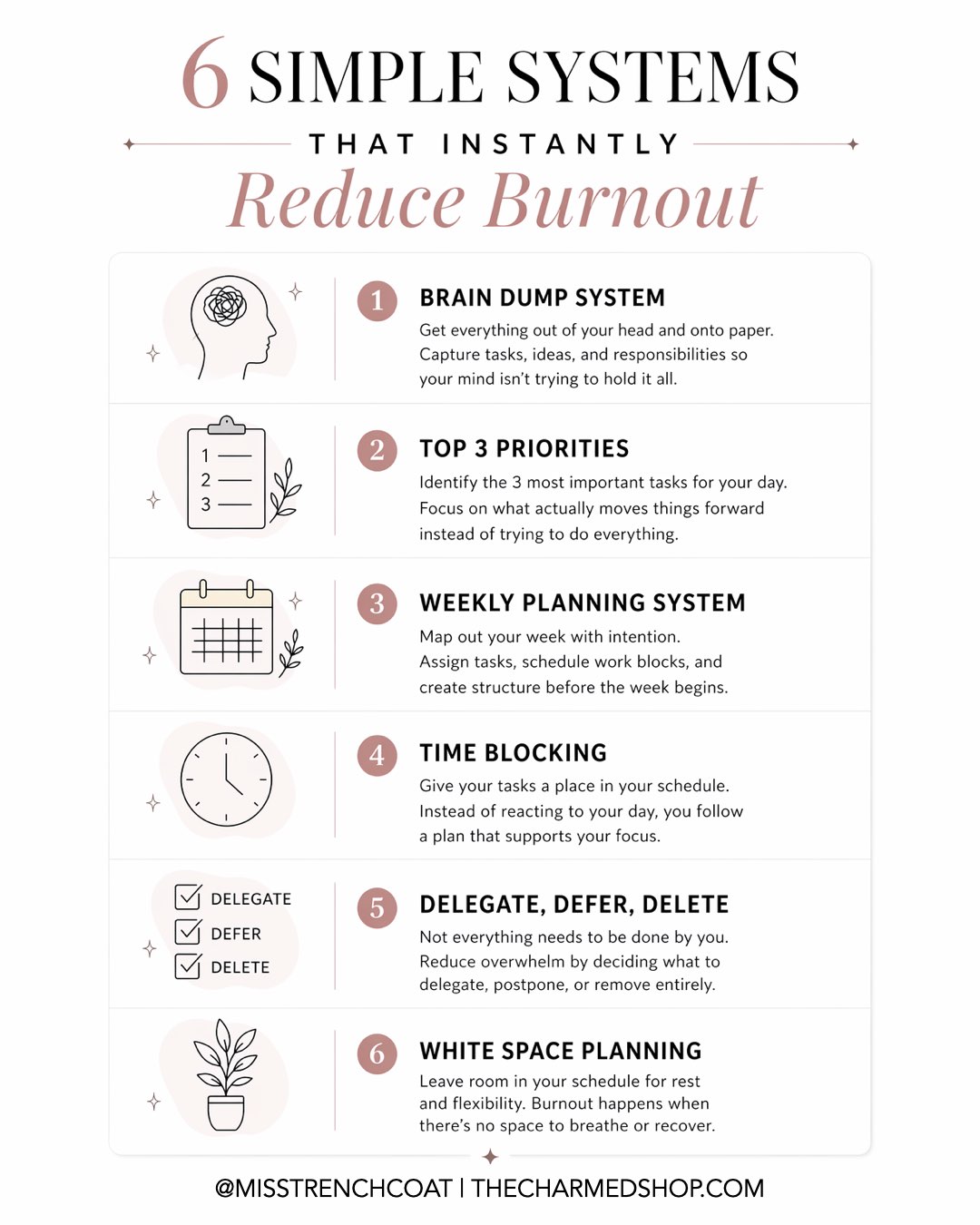
This is one reason functional planning matters so much. The purpose of good systems is not simply to help women accomplish more. It is to reduce mental clutter so they can reclaim energy, attention, peace, and presence.
12. You Think You Need to Become “Better” Before You Deserve Support
Perhaps one of the most damaging beliefs many women carry is the idea that they need to become more organized, more disciplined, more healed, or more consistent before they are worthy of receiving support.
They tell themselves that once they finally get everything together, then they will ask for help, hire support, join the program, create systems, or allow themselves to lean on others.
But support is often the thing that helps people become consistent in the first place.
No one is meant to navigate every responsibility, decision, and emotional burden entirely alone. Sustainable productivity is not created through self-punishment or endless optimization. It is created through support, systems, boundaries, self-awareness, and realistic expectations.
The truth is that many high-achieving women are already extraordinarily productive. The problem is that they have been conditioned to measure themselves against impossible standards while dismissing the invisible labor consuming most of their energy.
They do not need to become machines. They do not need to earn rest. They do not need to prove their worth through exhaustion.
What they often need most is permission to stop carrying everything alone.
That is why true productivity is not about doing more. It is about creating systems, routines, and support structures that allow women to build meaningful lives more sustainably. It is about making space for what matters without sacrificing themselves in the process.
Because the goal was never to become someone who can do everything perfectly.
The goal is to create a life that feels functional, intentional, supported, and fully lived.
If you could see yourself in many of these patterns, I want you to know something:
You are not failing at productivity.
You are likely carrying far more than you give yourself credit for while holding yourself to unrealistic standards with very little support.
You do not need to become more disciplined in order to deserve help. You do not need to earn rest by exhausting yourself first. And you do not need to prove your worth by carrying everything alone.
This is exactly why I believe so deeply in creating functional systems, supportive routines, and sustainable structures that reduce mental overload instead of adding more pressure to your life.
Whether that looks like using a planner as your second brain, building better routines, or surrounding yourself with support and accountability through spaces like The Charmed Life Master Mind, the goal is not to become someone who can endlessly do more.
The goal is to create a life that feels calmer, more intentional, more supported, and far more sustainable.
Because productivity should help you enjoy your life — not disappear inside of managing it.
There are seasons where life doesn’t feel dramatically off, but it also doesn’t feel quite right either. Things start to slip in subtle ways. Your routines become inconsistent, your space feels a little more cluttered than usual, and your mind begins holding more than it should. Nothing is completely broken, but everything feels slightly heavier.
That’s usually the point where the instinct is to start over. To fix everything at once. To reset your entire life in a single burst of motivation.
But that approach rarely lasts.
In my experience, what you actually need isn’t a complete overhaul. You need a way to come back to yourself—gradually, intentionally, and without pressure. A reset that unfolds in layers instead of all at once.
This is the process I return to whenever things feel off. It’s simple, but it works because it gives each part of your life the attention it needs, one step at a time.
Why a 7-Day Reset Works
Trying to change everything in a single day creates more friction than progress. It might feel productive in the moment, but it often leads to burnout or inconsistency within a few days.
A week, on the other hand, gives you space to move differently. It allows you to focus on one area at a time—your thoughts, your priorities, your environment, your routines—without overwhelming yourself.
More importantly, it creates momentum.
Each small step builds on the one before it. By the time you reach the end of the week, you’re no longer trying to fix your life—you’re already living in a version of it that feels more clear, more organized, and more intentional.
Day 1: Clear Your Mind
The first step is always the most important, even though it looks the simplest.
You sit down and write everything out. Not just your tasks, but anything that has been sitting in your mind—ideas, reminders, things you’ve been putting off, things you don’t want to forget.
There’s no structure here yet. No sorting or organizing. The goal is simply to get it out.
Because when your mind is holding too much, everything starts to feel harder than it needs to be. Clearing that mental space creates a sense of relief that makes every step after this easier.
Day 2: Decide What Matters
Once everything is out of your head, you’ll likely notice that not all of it deserves your attention right now.
This is where you begin to choose.
Instead of trying to tackle everything, you ask a more grounded question: what actually matters this week? What would make things feel more stable, more complete, more in order?
You narrow your focus to a few meaningful priorities. Not a long list, just a handful of things that genuinely move your life forward.
This is the moment where overwhelm begins to shift into clarity.
Day 3: Reset Your Environment
With your mind clearer and your priorities defined, your environment becomes easier to address.
This isn’t about deep cleaning your entire life. It’s about creating a space that supports you.
You might start with your desk, your main living area, or wherever you spend the most time. You clear surfaces, put things back where they belong, and remove anything that feels like unnecessary noise.
Even small changes here can have a noticeable impact. When your environment feels lighter, it becomes easier to think clearly and move through your day with more ease.
Day 4: Rebuild Your Routines
By the fourth day, you’re ready to reintroduce structure in a way that feels manageable.
This isn’t about creating the perfect routine. It’s about giving your day a rhythm again.
You might start with a simple morning routine that helps you ease into the day, a loose structure for your work hours, and a way to close your day in the evening so you’re not carrying everything into tomorrow.
Routines don’t need to be complex to be effective. They simply need to exist, so you have something steady to return to.
Day 5: Plan Your Week
At this point, everything begins to come together.
Your mind is clearer, your priorities are defined, your space feels more supportive, and your routines are beginning to take shape. Now, you can plan your week from a completely different place.
You take what matters and give it a place in your schedule. You assign tasks to days, space out your responsibilities, and decide what your focus will be ahead of time.
Instead of approaching your week with uncertainty, you begin it with a sense of direction.
Day 6: Begin, Gently
This is where action begins, but without pressure.
You’re not trying to prove anything to yourself. You’re simply following through on what you’ve already planned.
You complete a few meaningful tasks, allow yourself to move at a steady pace, and resist the urge to overdo it. The goal here is not intensity, but consistency.
Starting gently builds confidence. And that confidence makes it easier to keep going.
Day 7: Reflect and Refine
The final day is quieter, but just as important.
You take a moment to look back on the week and notice what worked. Where did things feel easier? What felt supportive? What still needs adjustment?
This reflection isn’t about judgment. It’s about awareness.
Because the more you understand what works for you, the easier it becomes to create systems that actually fit your life.
What This Process Really Creates
By the end of the week, the shift is noticeable—but it doesn’t feel forced.
Things feel calmer. More organized. More manageable.
Not because everything is perfect, but because everything has a place.
This is what planning is meant to do. Not help you do more, but help you focus on what matters and make space for it in a way that feels natural and sustainable.
If You Want to Build This Into Your Life
If this process resonates with you, the next step is making it something you can return to consistently.
The Well Planned & Productive Woman Essential Planning Guide will walk you through how to build a system like this in a way that fits your life, not someone else’s routine.
And the Charmed Life Master Planner gives you a place to hold everything—so your plans, priorities, and routines live outside your head, where they can actually support you.
Final Thought
You don’t need to start over.
You don’t need to fix everything at once.
You just need a way to come back to what matters, one step at a time.
And sometimes, that begins with a single week—and a simple plan to reset.
One thing I talked about during the Planner Peace Masterclass is that I think many women are exhausted not because they’re lazy or “bad at productivity,” but because society has handed them an impossible amount of responsibility and then convinced them they still aren’t doing enough.
And honestly… this is something I’ve quietly rebelled against for a very long time.
Long before I started talking about “soft productivity,” I was already teaching that productivity should support your life — not consume it.
I’ve never believed in hustle culture.
I’ve never believed women needed to wake up earlier, work harder, sleep less, optimize every second of the day and run themselves into the ground just to feel worthy or successful.
What I have always believed in is strategic productivity.
Functional productivity.
The kind of productivity that helps you get the greatest result from the least amount of unnecessary effort.
I intentionally created a planner centered around time, task and energy management strategies that help you become more focused, intentional and productive simply through the way you use it.
Because most planners don’t actually teach you how to plan strategically.
They give you empty boxes and open-ended space that often leads to endless to-do lists, overpacked schedules, mental clutter and spending all your time and energy on low impact tasks while the things that actually matter most keep getting pushed aside.
The Charmed Life Master Planner was designed differently.
It helps you identify what’s actually important. It encourages focused prioritization instead of overwhelm. It helps you organize your objectives strategically instead of reacting to everything at once.
Many of the planning strategies built into the system are rooted in concepts like the Pareto Principle — focusing on the small percentage of tasks that create the biggest results — and Parkinson’s Law, which reminds us that tasks will endlessly expand to fill the time we give them unless we create intentional structure around our work.
In other words, the planner was designed to help you work smarter, not harder.
Because productivity should not feel chaotic.
It should feel supportive.
And honestly, now that I’m 40, I think I’m just more unapologetic about that belief than ever before.
Let me make this next part crystal clear for you:
→ It’s time to stop romanticizing overwhelm. → It’s time to stop glorifying overworking. → It’s time to stop believing being exhausted is proof that you’re doing enough.
It’s time for your productivity to feel softer. More intentional. More focused. More sustainable. More supportive of the actual life I’m trying to create.
It’s time for you to enter your soft productivity era alongside me!
Are you with me on this?
If you missed the Planner Peace Masterclass, or you want to revisit this conversation, you can still watch the replay here:
or convinced yourself were finally going to “fix your life”?
And maybe the better question is…
How many planners are you currently trying to use at one time right now?
Because if you currently have:
a paper planner,
a digital planner,
sticky notes,
random notebooks,
lists in your phone,
screenshots you meant to revisit,
and at least one half-used planner sitting in a drawer…
You are absolutely not alone.
In fact, this is one of the most common struggles I see among ambitious women trying to become more organized, productive and in control of their lives.
And honestly? It makes sense.
Because buying a new planner feels productive.
A fresh planner gives you:
dopamine,
hope,
excitement,
motivation,
and the comforting illusion of a fresh start.
For a moment, it feels like: “This is the planner that’s finally going to help me get my life together.”
But then reality sets back in.
You forget to use it consistently.
Your to-do lists become overwhelming.
You try to cram too much into one day.
You fall behind.
You stop trusting your system.
And eventually you start looking for another planner again.
Not because you’re lazy.
Not because you lack ambition.
But because no one ever taught you how to create a functional planning system.
Most women don’t actually need another planner.
What they need is:
a better planning strategy,
a more supportive system,
realistic routines,
and a methodology they can trust consistently.
That’s exactly why I’m hosting my brand new Planner Peace Master Class this week.
✨ FREE LIVE MASTERCLASS
Planner Peace Master Class
📅 Wednesday, May 13th 🕐 1PM EDT / 10AM PDT
This free live workshop is designed to help you finally understand:
why your planning system hasn’t been working,
what’s actually causing your overwhelm,
why you keep planner hopping,
and how to build a planning system that creates calm, clarity and consistency in your life.
Inside this class, I’ll be teaching:
The 5 Reasons You’re Not Finding Planner Peace
The biggest planning mistakes women make
What I stopped doing when I finally found planner peace
The Functional Planning Methodology I use to organize my life and business
How to stop feeling busy all the time while still making meaningful progress
We’re also going to talk about:
endless to-do lists,
overcommitting your schedule,
relying on memory,
inconsistent planning habits,
shiny object syndrome,
productivity overwhelm,
and why most planners are actually incomplete systems.
Because planner peace isn’t about finding the perfect planner.
It’s about creating a system that actually supports your real life.
And honestly?
I want this class to feel less like a formal productivity workshop and more like a mid-week lunch date with your planner girlfriends.
A little reset.
A little strategy session.
A little “let’s get our lives back together” energy.
So grab your planner, your iced coffee, your lunch, and come spend the afternoon with me while we talk about:
productivity,
planning,
organization,
routines,
overwhelm,
and creating a life that feels more intentional and manageable.
If you’ve been craving:
more clarity,
more structure,
more consistency,
and a greater sense of control over your time and responsibilities…
There was a time when the start of every week felt heavier than it should have. I would sit down with the intention to get organized, look at everything I needed to do, and almost immediately feel behind before I had even begun. It wasn’t a lack of motivation or discipline. It was something much quieter, but far more disruptive—everything I needed to manage was living in too many places at once, without any real structure holding it together.
What I’ve come to understand is that most women are not struggling with productivity because they aren’t capable. They’re struggling because they don’t have a system that supports how they think, plan, and move through their lives. When everything stays in your head, or scattered across lists and notes, it creates a constant background noise that makes even simple decisions feel overwhelming.
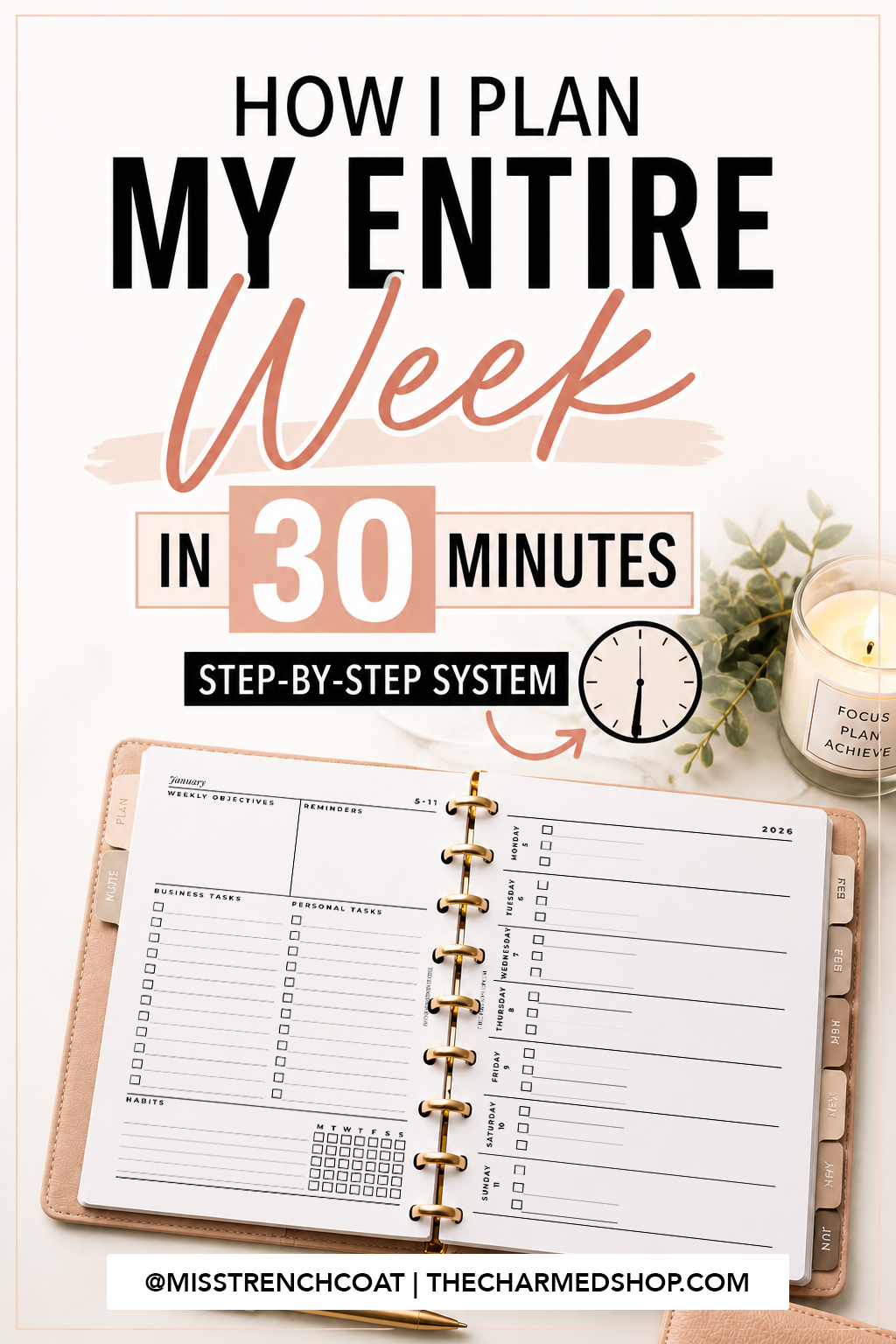
Once I shifted my focus from trying to “be more productive” to building a planning system that actually worked, everything began to feel different. Now, I plan my entire week in about thirty minutes. Not in a rigid or overly structured way, but in a way that gives my week shape, direction, and clarity.
Why Most Weekly Planning Doesn’t Work
Most planning routines fail not because they’re wrong, but because they’re incomplete. They focus on writing things down without ever organizing them in a meaningful way.
Planning without structure tends to look like:
Long to-do lists with no clear priority
Tasks that get moved from day to day
Constantly deciding what to do next
This creates decision fatigue before the work even begins. Planning should reduce mental load, not add to it. What’s missing is a system that allows you to see your time clearly and make intentional decisions about how you use it.
The 30-Minute Weekly Planning System
The process I use is simple, but it’s built on a deeper principle: everything needs a place. Once your tasks, priorities, and time are organized within a system, execution becomes much more natural.
Step 1: Capture Everything
The first step is always to clear your mind completely. Before organizing anything, take a few minutes to write everything down.
This includes:
Tasks you need to complete
Ideas that have been lingering
Personal and work responsibilities
Things you’ve been putting off
There is no need to filter or prioritize at this stage. The goal is simply to move everything out of your head and onto paper. When you can see everything in one place, the pressure to remember it disappears, and clarity begins to take its place.
Step 2: Define What Actually Matters
Once everything is captured, the next step is to bring intention into the process. Instead of treating every task as equally important, take a step back and decide what truly matters for the week ahead.
A helpful way to approach this is to identify a few key areas of focus:
Personal priorities
Work or business goals
Life administration and maintenance
From there, begin grouping your tasks into these categories. This transforms your list into something more purposeful, where each task supports a larger objective. Rather than trying to do everything, you are choosing what deserves your time and attention.
Step 3: Allocate Your Week
With your priorities defined, you can begin mapping them into your week. Start by placing any fixed commitments—appointments, meetings, or events—into your schedule.
Then, begin assigning tasks around them.
This step works best when approached with flexibility. Instead of trying to fill every hour, focus on giving each day a general direction. Some days may be more work-focused, while others are lighter or more personal. Allowing your week to have variation makes the plan feel more realistic and easier to follow.
A few guiding principles to keep in mind:
Spread tasks across the week instead of overloading one day
Group similar tasks where possible
Leave space for flexibility and unexpected changes
Step 4: Set Your Daily Top Three
The final step is where planning becomes actionable. For each day, identify three tasks that matter most.
These should be:
Aligned with your weekly priorities
Realistic for your time and energy
Meaningful enough to move things forward
Having a clear “Top Three” removes the need to constantly decide what to focus on. It gives your day structure without making it feel rigid, allowing you to move through your work with more clarity and less friction.
What Changes When You Plan This Way
The shift that happens with this system is subtle, but powerful. Productivity stops feeling chaotic and starts to feel intentional.
You’re no longer:
Wondering what to do next
Trying to remember everything
Feeling behind before the day begins
Instead, you move through your week with a sense of direction. Even when plans change, you are adjusting from a place of clarity rather than starting over.
This is what most women are actually looking for—not more productivity, but a calmer, more grounded way of managing their time.
Making This Your Weekly Ritual
Planning your week doesn’t need to be complicated or time-consuming. With the right structure, it becomes a simple ritual that supports everything else in your life.
And if you want a tool designed to hold everything in one place, the Charmed Life Master Planner acts as your second brain—so you can stay organized, focused, and consistent without overthinking it.
Remember: You don’t need more time. You need a way to see your time clearly.
When you have that, everything begins to feel lighter, more manageable, and more aligned with the life you’re creating.
There comes a point where doing more, trying harder, and pushing yourself to stay on top of everything simply stops working.
Not because you’re incapable.
But because you’re unsupported.
For so many women, productivity feels exhausting—not because they aren’t productive, but because they are constantly making decisions. What to wear. What to eat. What to focus on. What they forgot. What’s falling through the cracks.
It’s not the work that’s overwhelming.
It’s the lack of systems supporting it.
This is where your soft productivity era begins.
Soft productivity is not about doing less for the sake of it. It’s about doing things in a way that feels more intentional, more supported, and more sustainable. It’s about removing friction, reducing decision fatigue, and creating a life where consistency feels natural instead of forced.
And that shift doesn’t come from motivation.
It comes from systems.
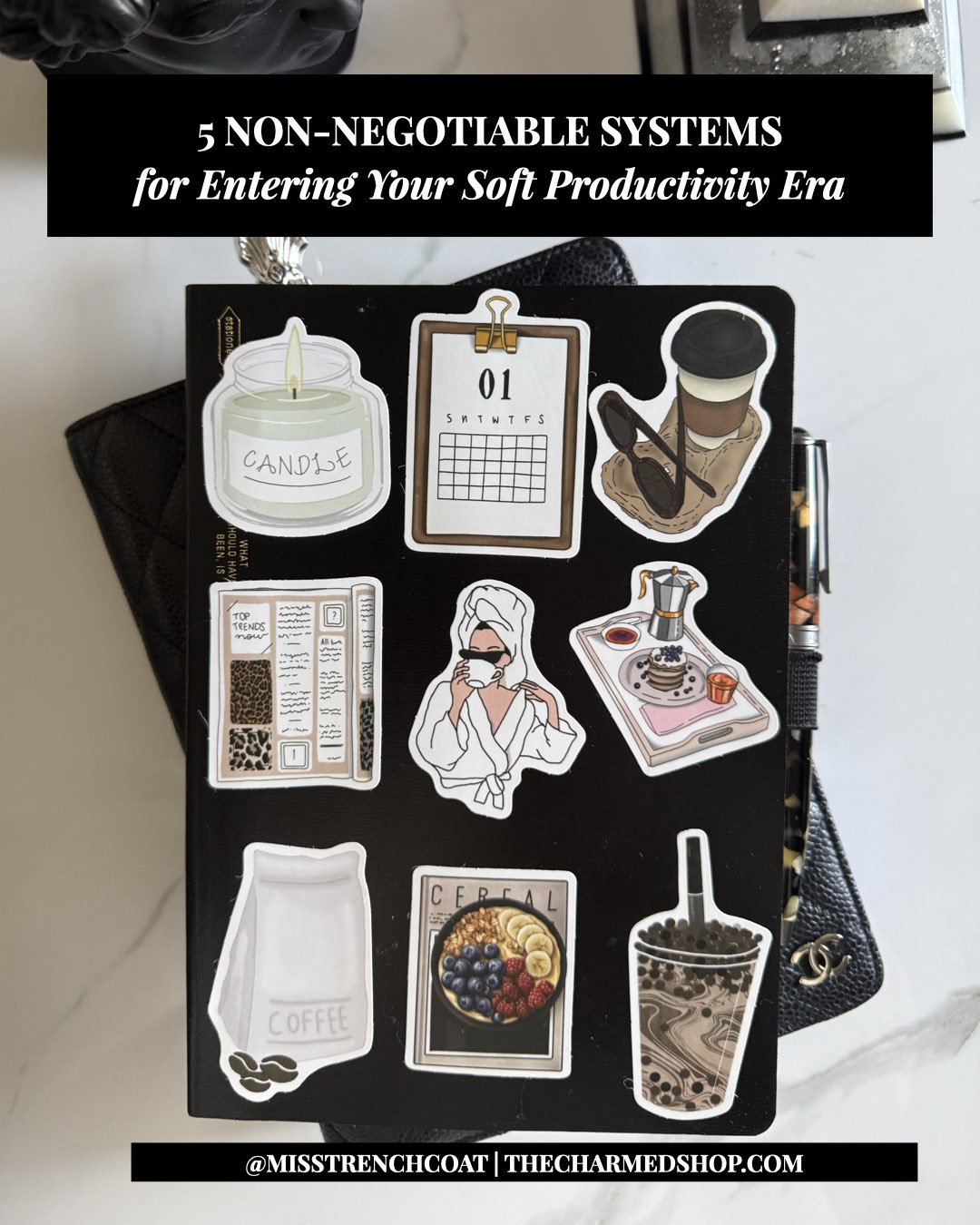
Here are five non-negotiable systems that will help you enter your soft productivity era—where your life feels structured, supported, and aligned.
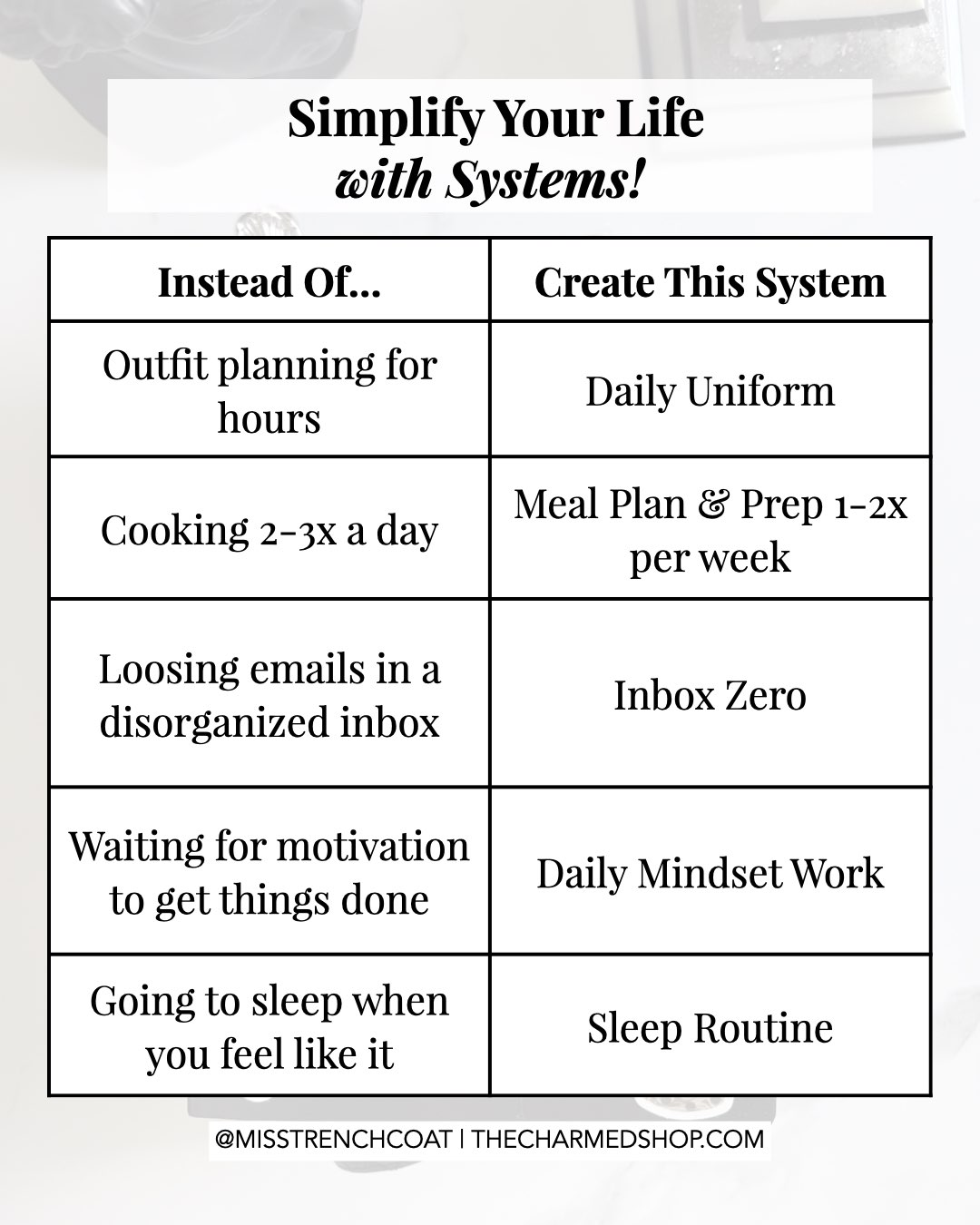
1. The Daily Uniform System
One of the most underestimated sources of decision fatigue is getting dressed.
Every day, you are asking yourself: What should I wear? Does this match? Do I feel good in this?
And while it may seem small, these micro-decisions add up—especially when you’re already managing a full life.
The Daily Uniform System removes that friction entirely.
Instead of creating a brand new outfit every day, you define 1–3 outfit formulas that you know you feel comfortable and confident in. These become your go-to combinations that you can repeat and rotate effortlessly.
For example:
Sweater + wide leg work pants + pointed toe flats
Blazer + trousers + fitted tee
Knit dress + boots
These are not restrictive—they are supportive.
They give you a framework so you can get dressed quickly, feel put together, and move on with your day without overthinking it.
Soft productivity swap: Stop spending energy on daily outfit decisions. Start relying on a system that already works for you.
Ease, not endless variety, is what creates consistency.
2. The Meal Planning + Prep System
Cooking every single day may seem like the “normal” way to manage meals—but it is one of the most time-consuming and mentally draining parts of your routine.
It’s not just the cooking.
It’s:
Deciding what to eat
Grocery shopping multiple times
Cleaning dishes repeatedly
Starting from scratch every day
This is where a Meal Planning + Prep System becomes transformational.
By planning your meals in advance and preparing them in batches, you shift from daily effort to intentional, front-loaded effort.
Instead of cooking every day, you cook 1–3 times per week.
You reduce:
Decision fatigue
Time spent in the kitchen
Daily cleanup
And you create a level of consistency that supports your energy and your schedule.
Soft productivity swap: Stop cooking from scratch every day. Start batching your effort so your week flows more easily.
This is how you simplify one of the most repetitive areas of your life.
3. The Inbox Zero System
Open loops are one of the biggest sources of mental clutter.
Unread emails. Messages you haven’t responded to. Things you’ve seen but haven’t acted on yet.
Even when you’re not actively thinking about them, they sit in the background—creating a low level of stress that builds over time.
The Inbox Zero System is about removing that mental weight.
At least once a week, you fully process your inbox so that every message has a clear next step.
A simple system looks like this:
Inbox: Unread messages only
In Progress: You’ve read it, identified the action, and added it to your planner
Reference: Information you may need later
Completed: Fully handled, saved for record
Delete: Everything else
The goal is not perfection—it’s clarity.
When your inbox is processed, you know exactly what needs your attention and what doesn’t.
Soft productivity swap: Stop letting things linger in your mind. Start giving everything a place and a next action.
Clarity replaces chaos.
4. The Mindset Work System
One of the biggest misconceptions about productivity is that it’s driven by motivation.
But motivation is unreliable.
It comes and goes. It fluctuates based on your energy, your mood, your environment. And when you rely on it, your consistency becomes unpredictable.
Instead of waiting to feel motivated, you can create it.
That’s where a Mindset Work System comes in.
This is a daily or regular practice that helps you clear your mind, regulate your energy, and intentionally step into your day.
This might look like:
Journaling to process thoughts and gain clarity
Guided meditation to calm your nervous system
Breathwork to reset your energy
Listening to affirmations or a “morning rampage” audio
The specific method matters less than the consistency.
Because when your mind is clear, your actions become more focused.
Soft productivity swap: Stop waiting to feel motivated. Start creating a mental environment that supports action.
A calm, clear mind is one of your greatest productivity tools.
5. The Sleep Routine System
If there is one system that impacts everything else, it is your sleep routine.
Your energy, focus, mood, and ability to follow through are all directly connected to how well you rest.
And yet, sleep is often treated as an afterthought.
A Sleep Routine System changes that.
It creates a consistent process for how you wind down, disconnect, and prepare your body for rest.
For example, a routine might include:
Using a pillow spray to signal relaxation
Turning off lights and screens
Eliminating distractions from your environment
Using a satin eye mask with Bluetooth audio
Playing a long-form sleep soundtrack
When you follow a consistent routine like this, your body begins to recognize the cues.
Sleep becomes easier. Deeper. More restorative.
And the difference is noticeable.
Soft productivity swap: Stop leaving your energy up to chance. Start protecting it with a system that supports rest.
When your sleep improves, everything else becomes easier.
The Truth About Soft Productivity
Soft productivity is not about doing less.
It’s about doing things in a way that feels supported.
It’s about removing unnecessary decisions, reducing friction, and creating systems that carry you through your day without constant effort.
When these systems are in place:
You spend less time deciding
You conserve your energy
You follow through more consistently
And perhaps most importantly…
You begin to trust yourself.
Your Next Step
If you’re ready to build a life that feels structured, supported, and aligned, the next step is to start implementing systems like these into your daily routine.
The exact planning routines to follow throughout the year
Prompts to help you get clear on your goals and priorities
A functional system you can return to daily
And if you want support while you build and maintain these systems, inside the Charmed Life Master Mind, we show up together to implement them in real time—creating consistency, accountability, and momentum as a community.
Because soft productivity isn’t something you hope for.
It’s something you build.
And once you do, everything begins to feel easier.
If you’ve ever told yourself, “I just need to be more consistent with my planner,” you’re not alone.
For most women, the intention to plan is not the problem. In fact, it’s usually quite strong. You want to feel organized. You want to follow through on your goals. You want to have a clear sense of direction when you start your day.
And yet, daily planning is often one of the first habits to fall off.
You start with the best intentions. You plan for a few days—maybe even a full week. But then life gets busy. You skip a day, then another. Suddenly your planner feels out of date, and instead of picking it back up where you left off, you disconnect from it entirely.
Not because you don’t care—but because it never quite became something that felt natural to return to.
This is where most advice falls short.
You’re told to be more disciplined. To try harder. To “just be consistent.”
But consistency is not built through pressure.
It’s built through experience.
And if your planning routine feels like just another task on your to-do list—something you have to do rather than something you want to do—it will always feel optional. Easy to skip. Easy to postpone.
That’s why the real shift isn’t about becoming more disciplined.
It’s about changing the way planning feels.
Because when something feels grounding, intentional, and even enjoyable… you don’t have to force yourself to do it.
You return to it naturally.
And that’s where ritual comes in.
A ritual transforms planning from a task into an experience. It gives it structure, meaning, and a sense of presence. It creates a moment in your day where you pause, reset, and reconnect with what actually matters.
Instead of rushing into your day or reacting to whatever comes your way, you begin from a place of clarity and intention.
And over time, that small shift becomes something much more powerful.
It becomes consistency—without force.
In this post, I’m going to show you how to turn your daily planning into a ritual you actually look forward to, using simple elements you can layer into your routine to make it feel grounded, focused, and aligned with the life you’re creating.
Because you don’t need to try harder to plan.
You need to make it something you don’t want to miss.
The Real Reason You Can’t Stick With Planning
If you’ve struggled to stay consistent with daily planning, it’s easy to assume the problem is you.
That you need more discipline. More motivation. A better routine.
But in reality, the issue is much simpler—and much more fixable than that.
Planning doesn’t feel good.
For most people, daily planning exists in the same category as brushing emails, organizing files, or catching up on tasks. It’s something you know you should do, but it doesn’t feel particularly enjoyable or meaningful in the moment. It feels like another responsibility—another thing to keep up with.
And because of that, it becomes optional.
When your day gets busy, it’s the first thing you skip. When your energy is low, it’s the easiest thing to postpone. And when you fall out of the habit, it’s difficult to return to because there’s no emotional pull bringing you back.
This is where the disconnect happens.
You’re expecting consistency from something that hasn’t been designed to hold your attention, your energy, or your intention.
Most planning routines are built around function alone:
Write your tasks
Organize your schedule
Move on with your day
And while that may be efficient, it’s not engaging. It doesn’t create a moment. It doesn’t anchor you. It doesn’t give your brain a reason to return to it consistently.
So instead of becoming a habit, it remains a task.
And tasks are easy to skip.
The truth is, consistency is not just about logic—it’s about experience.
If something feels grounding, calming, or even enjoyable, you naturally return to it. You don’t need to remind yourself or force yourself to do it. It becomes part of your rhythm.
This is why simply telling yourself to “be more consistent” rarely works. You’re trying to apply pressure to something that lacks emotional connection.
What you actually need is a shift in how planning fits into your day.
Not as something you squeeze in when you remember—but as something that holds a dedicated space. Something that signals a transition. Something that helps you pause, reset, and move forward with intention.
Because when planning becomes a meaningful part of your day—not just a functional one—consistency stops feeling like something you have to chase.
It becomes something that naturally follows.
Routine vs. Ritual: The Shift That Changes Everything
At first glance, a routine and a ritual can look exactly the same.
Both involve repeating an action. Both can happen at the same time each day. Both can become habits over time.
But the difference between them is what determines whether you stick with something—or slowly fall away from it.
A routine is mechanical.
It’s something you do because you’re supposed to. It often feels automatic, sometimes even rushed, and it’s usually focused on efficiency. Routines are helpful, but they don’t always hold your attention. They don’t require your presence. And because of that, they are easy to skip when life gets busy or your energy is low.
A ritual, on the other hand, is intentional.
It’s not just about what you’re doing—it’s about how you’re doing it, and the meaning you bring to the experience. A ritual invites you to slow down, to be present, and to engage with the moment in a more grounded way. It creates a sense of structure, but also a sense of connection.
This is the shift most people are missing when it comes to planning.
If your daily planning exists as a routine—something you quickly check off or squeeze in between other tasks—it will always feel optional. It will depend on your mood, your energy, and how busy your day feels. And over time, that inconsistency makes it harder to maintain.
But when you turn planning into a ritual, it becomes something entirely different.
It becomes a moment you return to.
A pause in your day where you clear your mind, reconnect with your priorities, and intentionally decide how you want to move forward. It’s no longer just about writing down tasks—it’s about creating clarity, focus, and direction.
And because rituals are grounded in intention, they create a different kind of experience.
They feel calming instead of rushed. Grounding instead of overwhelming. Supportive instead of demanding.
This is why rituals are so much more powerful than routines when it comes to building consistency.
They give your brain a reason to come back.
Instead of relying on discipline to force the habit, you begin to associate the experience with something positive—something that helps you feel more in control, more centered, and more aligned with your life.
In other words, you’re no longer trying to “be consistent.”
You’re creating something worth returning to.
And once that shift happens, everything about your planning begins to change.
One of the biggest misconceptions about consistency is that it comes from discipline.
That if you could just try harder, be more focused, or stay more committed, you would naturally follow through on your habits every day.
But consistency is not built through force.
It’s built through structure—and more importantly, through anchoring.
This is where rituals become so powerful.
A well-designed ritual removes the need to constantly decide whether or not you’re going to plan. Instead of relying on motivation in the moment, the behavior becomes tied to something that already exists in your day. It becomes part of a sequence, rather than a standalone task you have to remember.
This is the principle behind habit stacking.
Habit stacking simply means attaching a new habit to something you already do consistently. Instead of creating something from scratch, you layer it into an existing rhythm. This makes it significantly easier to maintain, because it no longer depends on memory or motivation—it becomes part of a pattern your brain already recognizes.
For example, you might attach your planning ritual to something like:
Making your morning coffee
Sitting down at your desk to start work
Finishing your workday and preparing for tomorrow
In this context, planning is no longer something you have to remember to do. It becomes something that naturally follows another action.
Over time, this creates a powerful association.
Your brain begins to link that existing habit—like making your coffee—with the act of planning. The moment one happens, the next feels like the natural continuation. This reduces resistance, eliminates decision fatigue, and makes the behavior feel automatic in a way that is both structured and supportive.
But rituals go one step further than habit stacking alone.
They don’t just anchor the behavior—they enhance the experience.
By adding intentional elements—like creating a clear space, setting an intention, or pairing the moment with something you enjoy—you give your brain multiple cues that reinforce the habit. These cues signal that this is a specific kind of moment. A transition. A reset.
Instead of rushing into your day or reacting to what’s in front of you, you begin from a place of clarity and control.
And because the experience feels grounding, you are far more likely to return to it.
This is what makes rituals sustainable.
They reduce friction, create structure, and introduce a level of enjoyment that makes consistency feel natural instead of forced.
So rather than asking yourself to be more disciplined, the question becomes:
What can I anchor this to?
Because once your planning is attached to something stable—and supported by an experience that feels good—you no longer have to chase consistency.
You’ve built it into your day.
Your Daily Planning Ritual: A Simple Framework That Changes Everything
Now that you understand why rituals create consistency, the next step is to make this practical.
Because the goal is not to create something complicated or time-consuming. It’s to create something simple, repeatable, and enjoyable—something you can return to every day without resistance.
Think of this as a sequence. A set of small, intentional actions that signal to your mind and body: this is the moment where I reset, refocus, and plan my day.
When done consistently, these actions begin to work together. They create an environment, a feeling, and a rhythm that makes planning feel natural instead of forced.
Here is a simple five-step ritual you can use as your foundation:
1. Clear Your Space
Before you begin planning, take a moment to reset your environment.
This doesn’t need to be a full cleaning session. It can be as simple as straightening your desk, putting away distractions, or wiping down your surface. The goal is to create a space that feels calm and uncluttered.
There is a direct connection between your external environment and your internal state. When your space feels chaotic, your mind often follows. But when your space is clear, it becomes much easier to think clearly and focus on what matters.
This small act signals the beginning of your ritual. It creates a transition from whatever you were doing before into a more intentional state.
2. Set an Intention
Once your space is clear, take a moment to pause before you begin.
This can be as simple as lighting a candle, taking a deep breath, or mentally deciding how you want to approach your day. The purpose is not to overcomplicate it, but to create a moment of awareness.
Instead of jumping straight into your to-do list, you are grounding yourself first.
You might ask:
What do I want today to feel like?
What matters most today?
How do I want to show up?
This step shifts your planning from reactive to intentional. You’re no longer just responding to what needs to be done—you’re choosing how you want to move through your day.
3. Pair It With a Beverage
One of the easiest ways to reinforce a habit is to pair it with something you already enjoy.
This could be your morning coffee, tea, or even something like a protein shake. The specific drink doesn’t matter as much as the consistency of the pairing.
Over time, your brain begins to associate that beverage with your planning ritual. It becomes a cue that signals, this is the moment where I sit down and plan.
It also adds an element of comfort.
Instead of planning feeling like a task, it starts to feel like a small, enjoyable pause in your day—something you look forward to rather than something you try to remember.
4. Create a Focus Environment
Next, you want to signal to your brain that it’s time to focus.
This is where you can use sensory cues, like music or sound, to create a consistent environment. Many people find that instrumental music—such as classical or lo-fi—helps them concentrate without distraction.
You might put on headphones, play the same playlist each day, or simply create a quiet, intentional atmosphere.
These cues may seem small, but they are powerful.
When repeated consistently, they train your brain to recognize that this is a specific kind of moment—one where you slow down, think clearly, and engage with your planner.
5. Connect to Your Vision
Before you finalize your plans, take a moment to zoom out.
Look at your goals, your vision board, or anything that represents what you are working toward. This step is what connects your daily planning to your bigger picture.
Without this connection, tasks can feel disconnected and transactional. But when you take a moment to remind yourself why you’re doing what you’re doing, your planning becomes more meaningful.
You begin to see how your daily actions contribute to your long-term life.
This creates alignment.
Instead of simply getting through your to-do list, you are intentionally building something.
Bringing It All Together
Individually, each of these steps is simple.
But together, they create something much more powerful.
They create a ritual.
A moment in your day where you:
Clear your space
Ground your mind
Create comfort
Enter focus
Align with your vision
And when this becomes part of your daily rhythm, planning no longer feels like something you have to force.
It becomes something you return to—naturally, consistently, and with intention.
Because it’s no longer just about getting organized.
It’s about creating a moment that supports the life you’re building.
How to Make Your Planning Ritual Stick
Creating a ritual is one thing.
Sticking with it—especially beyond the first few days—is where the real transformation happens.
And this is often where people fall back into old patterns. Not because the ritual isn’t effective, but because it hasn’t been fully integrated into their life yet. It still feels like something new, something separate, something they have to remember.
The key to making your planning ritual last is not to rely on willpower.
It’s to make it inevitable.
Anchor It to Something You Already Do
The most effective way to make your ritual stick is to attach it to a habit that already exists in your day.
This removes the need to remember or decide when to plan. Instead, it becomes part of a sequence—something that naturally follows another action.
For example, your ritual might begin:
After you make your morning coffee
When you sit down at your desk to start work
At the end of your workday before you transition into your evening
By anchoring your planning to something consistent, you create a reliable entry point. Over time, this connection becomes automatic. One action leads to the next without resistance.
Keep It Simple and Repeatable
One of the biggest mistakes people make when building new habits is overcomplicating them.
Your ritual does not need to be long or elaborate to be effective. In fact, the simpler it is, the more likely you are to stick with it.
Focus on consistency over perfection.
Even if you only have a few minutes, you can still:
Clear your space
Set a quick intention
Review your priorities
The goal is not to create the “perfect” ritual every day—it’s to return to it consistently.
Remove Friction From the Process
If something feels difficult to start, you’re less likely to do it.
Take a moment to look at your environment and ask yourself: What might be getting in the way?
This could be:
A cluttered workspace
Not having your planner easily accessible
Too many steps before you begin
Small adjustments can make a big difference. Keeping your planner visible, having your tools ready, and simplifying your setup all reduce resistance and make it easier to begin.
Make It Something You Look Forward To
This is where your ritual becomes powerful.
When you pair your planning with elements you genuinely enjoy—your favorite drink, calming music, a quiet moment to yourself—it stops feeling like a task and starts feeling like an experience.
And experiences are something we return to naturally.
You’re not just planning your day—you’re creating a moment of calm, clarity, and control.
Allow It to Be Imperfect
There will be days when your ritual feels rushed.
Days when you don’t have time for every step. Days when your focus isn’t perfect.
That’s okay.
Consistency is not built on perfect execution—it’s built on returning, again and again, even when it’s not ideal.
The moment you remove the pressure to do it perfectly, you make it easier to keep going.
The Real Goal
The goal is not to create a rigid routine that you have to follow exactly.
It’s to create a rhythm.
Something that fits into your life, adapts with you, and supports you consistently over time.
Because once your planning ritual feels natural—something that belongs in your day—you no longer have to rely on reminders or motivation.
You simply show up.
And that’s what makes it sustainable.
Make It Enjoyable: The Key to Effortless Consistency
At the heart of all of this is something simple, but often overlooked:
You are far more consistent with what you enjoy.
This is where many planning systems fall short. They focus entirely on function—what needs to get done, how to organize it, how to be more efficient. And while those things matter, they are not enough on their own to sustain a daily habit.
Because no matter how effective a system is, if it feels cold, rushed, or purely transactional, it will always feel optional.
Enjoyment is what changes that.
When your planning ritual feels calm, grounding, and even a little indulgent, it stops being something you have to remind yourself to do. It becomes something you look forward to. A moment that belongs to you—before the demands of the day take over or as a way to reset and close things out.
This doesn’t mean your ritual needs to be elaborate or time-consuming. It simply means being intentional about how it feels.
You might notice the small details:
The way your space looks when it’s clean and uncluttered
The comfort of your drink beside you
The familiarity of your playlist
The quiet satisfaction of writing things down and creating clarity
These elements may seem simple, but together, they create an experience your brain begins to associate with calm and control.
And that association matters.
Because over time, your planning ritual becomes more than just a habit—it becomes a cue for a specific state of mind. A signal that says: this is where I reset, refocus, and take ownership of my day.
This is also where it’s helpful to let go of the idea that planning has to look a certain way.
Your ritual can evolve with you. Some days it may be quick and minimal. Other days it may feel slower, more reflective, or more creative. What matters is not the exact format—it’s the consistency of returning to it and the experience you create around it.
When you allow your planning to feel personal, flexible, and even enjoyable, you remove the resistance that often makes it difficult to maintain.
Instead of forcing yourself to sit down and plan, you begin to want to.
And that is the shift that makes consistency feel effortless.
Because you’re no longer relying on discipline to carry you through.
You’ve created a system—and an experience—that supports you naturally.
The Shift: From Trying to Plan… to Becoming Someone Who Does
At a certain point, this stops being about your planner.
It stops being about finding the right routine, the right timing, or even the right strategy.
It becomes about identity.
Because the women who feel organized, clear, and in control of their time are not constantly trying to figure out how to plan. They are not relying on motivation or waiting to “feel ready.” They have built a rhythm into their lives that supports them—one that they return to consistently, almost without thinking.
Planning is simply part of who they are.
And that identity is not something they were born with.
It’s something they built—through small, repeated actions that eventually became second nature.
This is the real shift that happens when you turn planning into a ritual.
You move from being someone who is trying to be consistent… to someone who naturally is consistent.
You move from:
Starting and stopping
Feeling behind and disconnected
Relying on motivation to get back on track
To:
Returning to your planner daily
Feeling grounded and clear
Trusting yourself to follow through
And the difference between those two versions of you is not discipline.
It’s the systems and experiences you’ve created around your habits.
What This Looks Like in Practice
When your planning becomes a ritual, you begin to notice small but powerful changes in your day-to-day life:
You don’t question whether or not you’re going to plan—you just sit down and begin
You feel more clear and focused before your day even starts
Your tasks feel connected to something bigger, not just a list to get through
You recover more easily from missed days because your system still feels familiar
Over time, these small shifts compound.
You start to feel more in control of your time. More intentional with your energy. More aligned with the life you’re building.
And perhaps most importantly, you begin to trust yourself.
The Bigger Picture
This is what functional planning is really about.
It’s not just about organizing your schedule or managing your tasks.
It’s about creating a life that feels structured, supported, and intentional.
Your daily planning ritual becomes the anchor for that.
A moment where you pause, reconnect, and decide—again and again—how you want to move forward.
Your Next Step
If you’re ready to move beyond inconsistency and start building a planning system that actually supports your life, the next step is to strengthen your foundation.
Inside my Well Planned & Productive Woman Essential Planning Guide, I walk you through how to:
Build a functional planning system that works in your real life
Create consistency without relying on motivation
Design routines and rituals that actually stick
Start building momentum with clarity and intention
Because you don’t need to try harder to stay consistent.
You need a system—and a rhythm—that supports the woman you’re becoming.
If you’re ready to stop relying on motivation and finally create a planning system that supports you consistently, this is where you begin.
Thoughtful planning prompts to help you get clear on your goals and priorities
Step-by-step planning routines to follow throughout the year
A simple, functional structure you can return to again and again
Guidance on how to build consistency without starting over
This is not about giving you more to do.
It’s about giving you a system you can trust—one that supports you through every season, not just the beginning.
And if you’re someone who knows you thrive with support, accountability, and structure already built into your life…
Inside the Charmed Life Master Mind, we don’t just talk about these routines—we actually show up and do them together.
From monthly and quarterly planning to resetting and refining your systems throughout the year, you’re supported inside a community of women who are committed to doing the work alongside you.
Because consistency becomes so much easier when you’re not doing it alone.
Whether you start with the guide or join us inside the Master Mind, the goal is the same:
To help you build a system—and a rhythm—that supports the life you’re creating.
Take a moment and really consider this—how many planners have you used so far this year?
Not how many you’ve purchased with the intention of using, but how many you’ve actually started, set up, and then eventually set aside. For many women, the answer is more than one. And if that’s the case for you, it’s not something to feel embarrassed about—it’s something to pay attention to.
Because this pattern is incredibly common among women who genuinely care about their lives. Women who want to feel organized, who want to follow through on their goals, and who are actively trying to create more structure, clarity, and control over their time. The intention is not the problem. In fact, the intention is often very strong.
What tends to happen instead is something much more subtle.
There’s a moment—usually when life starts to feel overwhelming or scattered—where the desire for a reset begins to build. You start thinking about how good it would feel to have everything in one place, to feel clear again, to feel on top of things. And in that moment, choosing a new planner feels like a solution.
So you start fresh.
You pick something new, you set it up, and for a brief period of time, everything feels aligned. You feel motivated, focused, and optimistic. It feels like you’ve finally found something that will work.
But then, slowly, that feeling begins to fade.
The planner that once felt exciting starts to feel neutral. Life interrupts your plans. A few days get missed, then a week. The structure you were trying to build starts to slip, and instead of adjusting or continuing imperfectly, a new thought takes its place:
Maybe this just isn’t the right planner.
And with that, the cycle begins again.
What’s important to understand is that this pattern doesn’t come from a lack of discipline or commitment. It doesn’t mean you’re disorganized or incapable of being consistent. More often than not, it’s the result of a deeper behavioral loop—one that keeps you in a constant state of starting over, without ever staying long enough in one system to experience real progress.
And that’s where the shift begins.
Because the truth is, you don’t need another planner.
You need a different relationship with planning.
The Cycle That’s Keeping You Stuck
For most women, switching planners doesn’t feel like a problem—it feels like a solution.
It often begins in a moment of overwhelm. Your schedule feels scattered, your tasks are piling up, and there’s a growing sense that things are slipping through the cracks. In response, you start craving clarity. You want a clean slate, a fresh start, something that will help you feel back in control of your time and your life.
That’s when the idea of a new planner begins to feel appealing.
You tell yourself that this time will be different. Maybe the layout will work better. Maybe the format will finally “click.” Maybe this is the tool that will help you stay consistent, focused, and organized in a way you haven’t been before.
So you commit to the reset.
You choose a new planner, you set it up thoughtfully, and almost immediately, you feel a shift. There’s a sense of relief, even excitement. Everything feels possible again. You map out your plans, you write down your goals, and for a brief period of time, you feel aligned and in control.
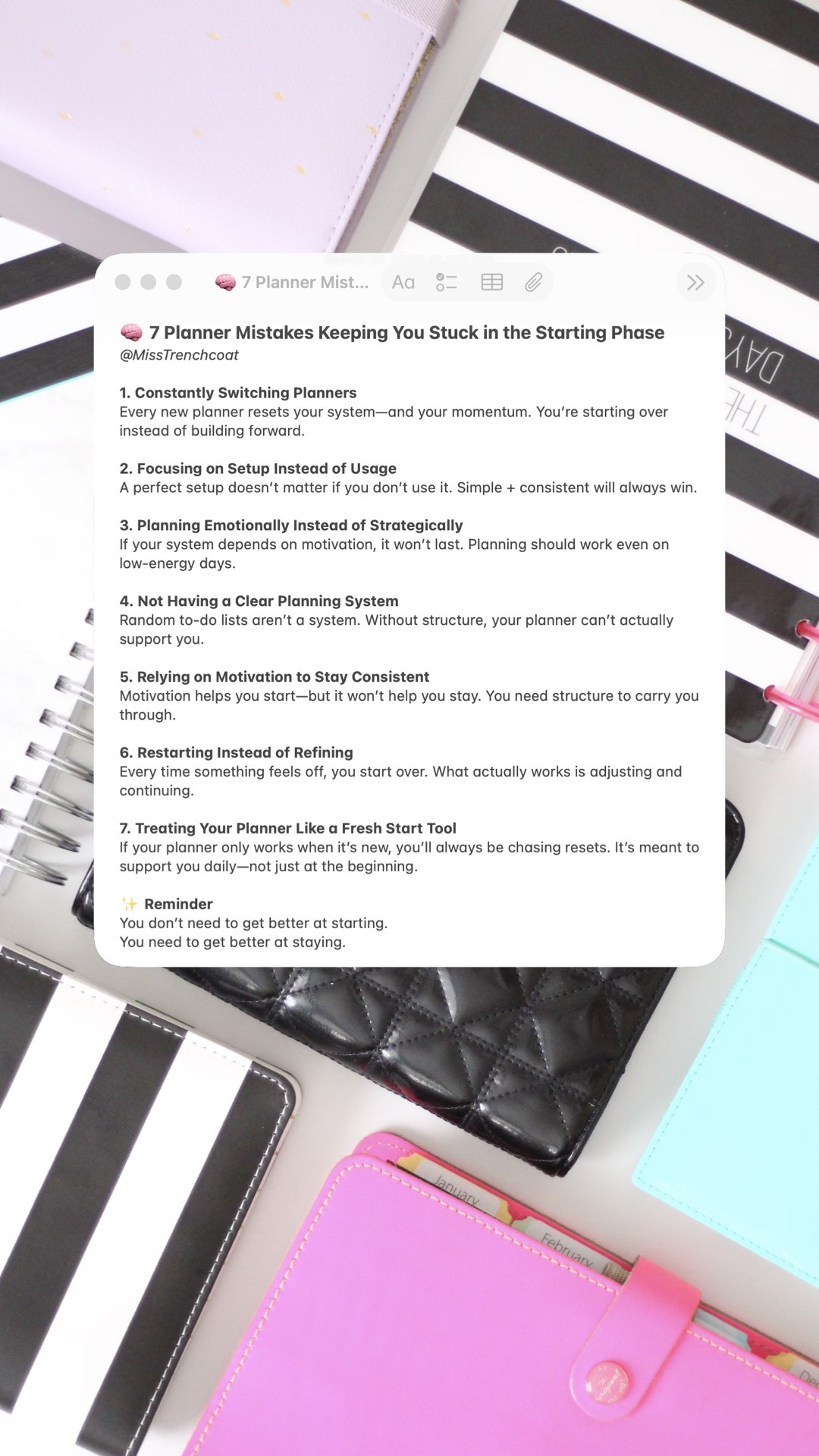
But this phase doesn’t last.
As the days pass, the initial excitement begins to wear off. The planner that once felt energizing starts to feel neutral. Life continues to demand your attention, and maintaining the system begins to require more intention than it did in the beginning. A few days get skipped. Maybe a week. The structure you were trying to build starts to loosen.
And instead of adjusting your approach or continuing imperfectly, a familiar thought returns:
This isn’t working.
At that point, it becomes very easy to assume that the problem is the planner itself. That something about the system isn’t quite right. That if you could just find a better layout, a more functional design, or a different format, everything would finally fall into place.
So you start over.
What’s important to recognize is that this cycle is not about the planner—it’s about the pattern.
Each time you restart, you interrupt whatever momentum you were beginning to build. You return to the beginning, where everything feels clear and promising, but nothing has had the chance to stabilize. Over time, this creates a habit of starting rather than sustaining. You become very familiar with the energy of a fresh start, but less experienced with the discipline of maintaining a system long enough for it to truly support you.
And because each reset feels productive in the moment, it’s easy to overlook the long-term impact. You feel like you’re taking action, when in reality, you’re staying in the earliest stage of the process.
This is what keeps so many women stuck—not a lack of effort, but a pattern of interruption.
Until that pattern is recognized and intentionally changed, no planner—no matter how beautiful or well-designed—will be able to create the consistency you’re looking for.
The Real Cause: You’re Chasing Dopamine
If you’ve ever felt a surge of motivation the moment you open a brand new planner, there’s a reason for that—and it has very little to do with the planner itself.
What you’re experiencing in that moment is a neurological response.
Dopamine is a chemical in the brain that is associated with anticipation, novelty, and reward. It’s released not just when we achieve something, but when we expect something positive to happen. It thrives on newness—the promise of change, the idea of a better version of ourselves, the possibility that things are about to improve.
And this is exactly what a new planner represents.
When you decide to start fresh, your brain interprets that decision as forward movement. It signals that you are about to become more organized, more disciplined, more in control. Before you’ve followed through on a single task, your brain rewards you with a feeling of progress.
That’s why setting up a new planner can feel so satisfying.
You haven’t actually changed your habits yet, but it feels like you have. You haven’t built consistency, but it feels like you’re on your way. You haven’t solved the underlying issue, but it feels like a solution is in motion.
This is where the disconnect begins.
Because while dopamine is powerful, it is also short-lived. It is designed to motivate action, not sustain it. Once the novelty wears off—once the planner is no longer new, once the setup is complete, once the reality of daily use sets in—that initial surge fades. What’s left behind is the actual work of maintaining a system.
And that work requires something different.
It requires structure. It requires repetition. It requires the ability to continue even when it no longer feels exciting.
Without those elements in place, the brain naturally begins to look for the next source of dopamine. And in the context of planning, that often means starting over again. A new layout. A different format. A fresh beginning.
Over time, this creates a subtle but powerful habit loop. You begin to associate the feeling of getting organized with the act of resetting, rather than the act of maintaining. Progress becomes something you start, not something you build.
This is why so many women find themselves stuck in a cycle of switching planners. It’s not a lack of discipline. It’s not a failure of effort. It’s a pattern reinforced by the brain’s natural preference for novelty over consistency.
Understanding this changes everything.
Because once you recognize that the urge to switch planners is often driven by dopamine—not by a true need for a better system—you can begin to pause before acting on it. You can question whether what you’re feeling is actually a sign that something isn’t working, or simply a sign that the newness has worn off.
And in that pause, you create space for a different choice.
One that isn’t driven by the excitement of starting over, but by the intention to keep going.
Dopamine vs. Momentum
Once you begin to understand the role dopamine plays in your planning habits, a deeper distinction starts to emerge—one that has the power to completely change how you approach consistency.
That distinction is the difference between dopamine and momentum.
Dopamine is what pulls you toward the beginning. It thrives on the idea of a fresh start, on the excitement of something new, on the belief that this next attempt will be the one that finally changes everything. It is fast, emotional, and compelling. It gives you energy quickly, but it does not sustain you.
Momentum, on the other hand, is something entirely different.
Momentum is built slowly, through repeated action. It is the result of showing up consistently, even when it feels ordinary. It doesn’t come with the same emotional intensity as a fresh start, and because of that, it is often overlooked or undervalued. But it is far more powerful.
The challenge is that momentum rarely feels exciting while it’s happening.
In fact, it often feels like boredom.
It feels like using the same planner day after day. It feels like writing similar tasks, following familiar routines, and making small, incremental progress that doesn’t immediately stand out. There is no dramatic reset, no surge of motivation, no sense of starting over with a clean slate.
And because we’ve been conditioned to associate excitement with progress, this phase can feel like something is wrong.
But this is the moment where everything is actually working.
What feels like boredom is often stability. What feels repetitive is actually reinforcement. What feels uneventful is where habits are being formed and systems are beginning to support you in a reliable way.
This is the phase where your planner starts to become useful—not because it’s new, but because it’s familiar. You know where things go. You trust the process. You begin to rely on it, not as a source of motivation, but as a tool that quietly supports your daily life.
When you interrupt this phase by switching planners, you don’t just change tools—you break momentum.
You remove yourself from the very conditions that allow consistency to develop, and you place yourself back at the beginning, where everything feels exciting but nothing is yet established. Over time, this creates a pattern where you repeatedly choose the emotional reward of dopamine over the long-term benefit of momentum.
And this is where the real shift needs to happen.
Instead of asking, “Does this still feel exciting?” the question becomes, “Is this still supporting me?”
Instead of seeking the energy of a fresh start, you begin to value the stability of a system that works.
Because the truth is, the women who experience consistency in their lives are not constantly starting over. They are not chasing new tools or reinventing their systems every few weeks. They are staying with what works, refining it over time, and allowing momentum to build.
They understand that progress is not found in the beginning—it is created in the continuation.
And when you begin to see consistency not as something that should feel exciting, but as something that should feel steady, grounded, and supportive, your entire relationship with planning begins to change.
What once felt boring starts to feel powerful.
Because you realize that you’re no longer starting over.
You’re finally moving forward.
Why You Haven’t Found Planner Peace
By this point, it’s important to gently but honestly acknowledge something: if you haven’t found “planner peace” yet, it’s not because the right planner doesn’t exist.
It’s because the foundation underneath your planning hasn’t been fully established.
This is where many women get stuck—not from a lack of effort, but from a mismatch between what they think will solve the problem and what actually will. It’s easy to assume that the issue lies in the tool itself—that something about the layout, format, or design isn’t quite right. But more often than not, the real issue is structural.
There are a few key patterns that tend to show up repeatedly in this cycle, and once you can clearly see them, you can begin to shift them.
1. You Keep Restarting Instead of Refining
When something feels off in your planner, the instinct is often to start over. A new layout, a different system, a clean slate. It feels productive, but it prevents you from ever improving what you already have.
Refinement is where systems become sustainable. It requires you to look at what’s working, what isn’t, and make small adjustments over time. Without that process, every attempt stays temporary, and you never give your system the chance to fully support you.
2. You Don’t Have a Functional Planning System
Many planners are used as collections of lists rather than as structured systems that guide action. Tasks are written down, but they aren’t connected to larger objectives. There is no clear flow from capturing ideas, to organizing them, to actually executing them.
Without that structure, your planner becomes reactive instead of intentional. And when your planning lacks direction, it’s easy to assume the problem is the tool—when in reality, it’s the missing system underneath it.
3. You Prioritize Aesthetics Over Execution
There’s nothing wrong with wanting your planner to look beautiful. In fact, aesthetic can be part of what draws you into using it. But when visual appeal becomes the priority over functionality, it can quietly create friction.
If your planner is too complicated to maintain, too time-consuming to set up, or too focused on appearance rather than usability, it becomes harder to return to consistently. Over time, this can make you feel like you’ve “fallen off,” when really, the system was never designed for sustainability.
4. You Don’t Have a Consistent Planning Routine
Planning is not a one-time event—it’s an ongoing practice. Without a regular rhythm, it becomes difficult to stay connected to your plans.
When you don’t have consistent touchpoints—whether daily check-ins or weekly resets—your planner quickly becomes outdated. Tasks get missed, priorities become unclear, and the system starts to feel unreliable. Once that connection is lost, it becomes much easier to abandon it altogether and look for something new.
5. You Rely on Motivation Instead of Structure
Motivation is often highest at the beginning, which is why starting a new planner feels so good. But motivation is not designed to sustain long-term behavior.
When your system depends on how you feel, consistency becomes fragile. On days when you’re tired, busy, or overwhelmed, there’s nothing holding the structure in place. Over time, this creates a pattern where you engage when you feel motivated and disengage when you don’t—making it difficult to build any real momentum.
When you look at these patterns together, a clearer picture begins to form.
Planner peace is not about finding something new—it’s about strengthening what’s already there.
It’s about shifting from a mindset of searching to a mindset of building. When you begin to focus on creating a system that is functional, flexible, and rooted in your real life, you remove the need to constantly start over.
And that is where planner peace begins—not in the discovery of the perfect planner, but in the development of a system that actually works.
What Your Planner Actually Needs to Work
Once you step out of the cycle of constantly switching planners, the next question becomes much more important: what actually makes a planner work?
Because the truth is, a planner alone is not what creates organization, clarity, or consistency. It is simply a tool. Its effectiveness depends entirely on whether it supports a system that is designed to function in your real life.
This is where functional planning becomes essential.
A functional planner is not defined by how it looks or how exciting it feels at the beginning. It is defined by whether it supports your ability to consistently capture, organize, and follow through on what matters. When those elements are in place, your planner becomes something you can rely on—not something you are constantly trying to fix.
At its core, there are six essential elements your planner must include in order to truly work:
1. Capture Space
Your planner needs a dedicated space to capture everything that is on your mind—tasks, ideas, reminders, and responsibilities.
Without this, you are forced to rely on memory, which quickly leads to overwhelm and mental clutter. A capture space acts as your external brain. It allows you to get everything out of your head and into a trusted system, so you can think more clearly and focus on execution instead of remembering.
2. Objective Planning
Your planner should give you a clear way to define what you are working toward and organize your responsibilities around those outcomes.
This is what shifts your planning from reactive to intentional. Instead of simply writing down tasks, you are creating structure around meaningful objectives. Your planner becomes a tool for direction, not just documentation.
3. Task Organization by Objective
Once your objectives are defined, your tasks should be grouped based on what they contribute to.
This creates clarity and focus. Instead of managing scattered to-do lists, you are working within organized categories that reflect your priorities. It becomes easier to see progress, make decisions, and stay aligned with what actually matters.
4. Task Allocation Across Time
A functional planner must allow you to assign tasks to specific days based on priority, urgency, and capacity.
Without allocation, tasks remain abstract—they exist on a list, but they are not anchored in your schedule. Allocation is what turns intention into action. It ensures that your plans have a place within your real life, not just on paper.
5. Daily Top 3 Priorities
Each day should have a clear set of priorities—typically three key tasks that must be completed in order to move your life forward.
This creates focus and direction. Instead of reacting to everything at once, you are anchored in what matters most. It simplifies your day and ensures that even in busy or unpredictable moments, you are still making meaningful progress.
6. Flexibility
Finally, your planner must allow for flexibility.
No system will ever be followed perfectly. Plans will shift, unexpected things will come up, and some days will not go as intended. A functional planner supports adjustment without requiring you to start over. It allows you to move things, reassess priorities, and continue forward without breaking your system.
When these six elements are in place, your planner begins to function very differently.
It no longer feels like something you are trying to “keep up with.” Instead, it becomes a system that supports you—consistently, reliably, and realistically.
And that is the shift that changes everything.
Your planner isn’t supposed to fix your life. It’s supposed to support a system that already makes sense.
When you have that system in place, you stop searching for something better—and start using what you already have in a way that actually works.
The Hidden Trigger: Your Self-Talk
Even with the right planner and a functional system in place, there is one factor that quietly influences your behavior more than anything else—your self-talk.
Before you switch planners, there is always a moment that happens internally first. It may feel quick or almost automatic, but there is a thought that justifies the decision. That thought creates the emotional shift that leads to action.
And most of the time, it sounds completely reasonable.
You might think to yourself that your current planner isn’t working, that something feels off, or that you would be more consistent if you just found a better setup. In the moment, these thoughts don’t feel like avoidance—they feel like problem-solving.
But in reality, they are often emotional responses to discomfort.
That discomfort might come from falling behind, from feeling disorganized, or even from the natural “boredom” that comes with consistency. Instead of recognizing those feelings as part of the process, your brain looks for relief. And the fastest way to create that relief is to start over.
This is why self-talk matters so much.
Because if the thought is not interrupted, the behavior will repeat.
Learning to recognize these patterns—and respond to them intentionally—is what allows you to stay in your system long enough for it to actually work.
🔍 The Thoughts That Keep You Stuck
These are some of the most common thoughts that trigger planner switching:
“This planner just isn’t working.”
“I need something better.”
“I’ll be more consistent with a different layout.”
“I’ve already fallen behind, so I might as well start fresh.”
Each of these thoughts feels logical on the surface. But if you look more closely, they all lead to the same outcome: starting over.
And starting over, as you’ve seen, is what keeps you stuck.
🔮 What to Tell Yourself Instead
The goal is not to ignore these thoughts—it’s to replace them with ones that support consistency instead of disruption.
The next time you feel the urge to switch planners, pause and consciously choose a different response.
You might remind yourself:
“A new planner won’t fix inconsistent habits.” The tool is not the issue—the behavior is.
“I don’t need a new system. I need to use the one I have.” Consistency comes from repetition, not replacement.
“This feels boring because it’s working.” What you’re feeling is not failure—it’s stability.
“Refining creates results. Restarting creates stress.” Progress comes from adjustment, not abandonment.
“Consistency is my advantage.” The longer you stay with your system, the more it works for you.
✨ How to Use This in Real Time
When the urge to switch planners comes up, it’s important to create a small pause between the thought and the action.
Instead of immediately searching for a new planner or redesigning your system, take a moment to check in with yourself.
Ask:
Am I reacting to discomfort or making a strategic decision?
Have I truly given this system time to work?
What would it look like to refine this instead of replace it?
This pause is where your power is.
Because over time, these small moments of awareness begin to shift your identity. You move from someone who is constantly searching for the right planner, to someone who knows how to use a system effectively.
And that shift is what ultimately creates consistency.
When your self-talk begins to support your goals instead of undermine them, planning becomes less about starting over—and more about staying the course.
And that is where real momentum begins.
How to Add Variety Without Starting Over
By this point, it’s important to acknowledge something that often goes unspoken: the desire for a new planner is not inherently a problem.
Wanting your planner to feel fresh, engaging, or even a little more fun is completely valid. In fact, that desire often comes from a deeper place—a desire to feel connected to your life, inspired by your routines, and creatively engaged with the systems you use every day.
The issue is not the desire for variety.
The issue is how you’ve been conditioned to respond to it.
For many women, that desire has been met with replacement. When things start to feel repetitive or uninspiring, the immediate instinct is to change the entire system. But as you’ve seen, this comes at the cost of your momentum. Each time you replace your planner, you reset the very structure that was beginning to support you.
The shift, then, is not to eliminate the desire for something new—but to meet it in a more intentional way.
Instead of replacing your planner, you begin to expand within it.
When your planner becomes a space that reflects not just your responsibilities, but your personality, your interests, and your life as a whole, it naturally becomes something you want to return to. It evolves from being a tool you “have to use” into something you are actively engaged with.
There are several ways to introduce this kind of variety without disrupting your system.
✨ 1. Add Memory-Keeping Pages
One of the simplest ways to bring more life into your planner is to create space for reflection and documentation.
This might look like setting aside a page or two each week where you capture highlights from your life—not tasks, but experiences. You can write about meaningful moments, small wins, or even things that made you feel good that day. Some women like to include photos, stickers, or visual elements, while others keep it more minimal and text-based.
The purpose of this is not perfection—it’s presence.
By incorporating memory-keeping into your planner, you begin to associate it with your life as a whole, not just your obligations. It becomes a record of both what you did and how you lived.
🎮 2. Create Hobby Inserts
Your planner should not exist solely as a space for productivity—it should also make room for enjoyment.
Adding pages dedicated to your hobbies is a powerful way to make your planner feel more personal and engaging. These pages can be simple or detailed, depending on your preference.
For example, you might create:
A video game journal where you track what you’re playing, your progress, or your thoughts
A reading log to document books you’ve finished or want to read
A creative project tracker for things you’re working on in your free time
These inserts allow your planner to reflect your identity beyond your responsibilities. They create a sense of balance and make your system feel more aligned with your actual life.
🖼️ 3. Build a Wishlist or Vision Page
Another way to introduce variety is by creating space for inspiration.
A wishlist or vision page gives you a place to collect ideas, items, or experiences you are working toward. This could include screenshots, photos, links, or even handwritten lists of things you want to purchase, try, or explore.
This serves two purposes.
First, it satisfies the desire to engage with something new and visually interesting. Second, it keeps that energy contained within your existing system, rather than pulling you toward creating or buying something entirely new.
Over time, this page becomes a reflection of your evolving tastes, goals, and desires.
📚 4. Track Collections You Care About
If you naturally enjoy collecting or curating things, your planner can become a space to organize and track those interests.
This might include:
Books you own or want to read
Beauty or skincare products
Fashion pieces you’re building into a wardrobe
Home items or decor ideas
By creating dedicated pages for these collections, you add another layer of personalization to your planner. It becomes something you engage with not just out of necessity, but out of interest.
This also reinforces the idea that your planner is a central hub for your life—not just your to-do list.
🌿 5. Add Seasonal or Lifestyle Pages
Finally, you can introduce variety by rotating in pages that reflect your current season of life.
These pages can shift month to month or season to season, depending on what feels relevant to you. They allow your planner to feel fresh without requiring a complete reset.
Examples of this might include:
A “Things I’m Loving This Month” page
A seasonal reset or intention-setting page
A list of habits, routines, or experiences you want to focus on
Mood-based planning pages that reflect your energy or priorities
These additions create a sense of renewal within your existing system. Instead of chasing a fresh start, you create one intentionally—without losing your progress.
The Real Shift
When you begin to approach your planner this way, something important changes.
You no longer rely on a new planner to create excitement or inspiration. Instead, you build those elements into a system that is already working.
This allows you to meet both needs at once:
The need for structure and consistency
The desire for creativity and variety
And when those two things coexist, your planner becomes something you don’t want to replace.
It becomes something you want to return to.
Because it finally feels like it was designed for you.
The Truth About Planner Peace
By now, you may be starting to see your planning habits in a different light.
What once felt like a series of disconnected attempts—trying new planners, starting over, searching for something that would finally work—begins to reveal itself as a pattern. Not a failure, but a cycle. One that was driven by good intentions, but reinforced by habits that kept you in a constant state of beginning.
And with that awareness comes an important realization:
Planner peace is not something you find.
It’s something you build.
It is not hidden inside the perfect planner, waiting to be discovered. It is created through the way you use the tools you already have, the way you respond to discomfort, and the way you choose to stay consistent even when it no longer feels new or exciting.
For most women, this is the shift that changes everything.
Instead of asking, “What planner will finally work for me?” the question becomes:
“How can I create a system that supports me consistently?”
That shift moves you out of a mindset of searching and into a mindset of ownership.
What Planner Peace Is Actually Built On
Planner peace is not about perfection. It is not about having the most aesthetic setup or following your system flawlessly every single day.
It is built on a few key foundations:
Consistency Returning to your planner regularly, even when you’ve fallen behind or missed a few days. Consistency is not about never slipping—it’s about always coming back.
Structure Having a system that supports how you capture, organize, and execute your responsibilities. Structure removes the guesswork and creates clarity.
Self-Trust Knowing that you can rely on yourself to follow through, adjust when needed, and continue forward without abandoning your system.
Flexibility Allowing your planner to adapt to your life, rather than expecting your life to perfectly fit your planner.
When these elements are in place, something begins to shift.
You stop feeling like you’re constantly trying to “get it right.” You stop searching for a better tool or a more perfect setup. And instead, you begin to experience a sense of stability.
Your planner becomes familiar. Supportive. Reliable.
It becomes a place you return to, not because it’s exciting, but because it works.
And perhaps most importantly, you begin to trust yourself within your system.
You know how to reset without starting over. You know how to adjust without abandoning everything. You know how to keep going, even when things aren’t perfect.
From Starting Over to Moving Forward
This is the moment where the cycle finally begins to break.
You are no longer someone who is constantly starting over.
You are someone who refines, adjusts, and continues.
You are someone who understands that progress is not found in the beginning, but in the continuation.
And that shift—while subtle at first—is what creates real, lasting change.
Because when you stay with a system long enough to see it work, you begin to experience something that no new planner can give you:
Momentum.
Clarity.
Confidence.
Your Next Step
If you’re ready to step out of the cycle of starting over and finally build a planning system that supports your life in a consistent, sustainable way, the next step is to focus on your foundation.