
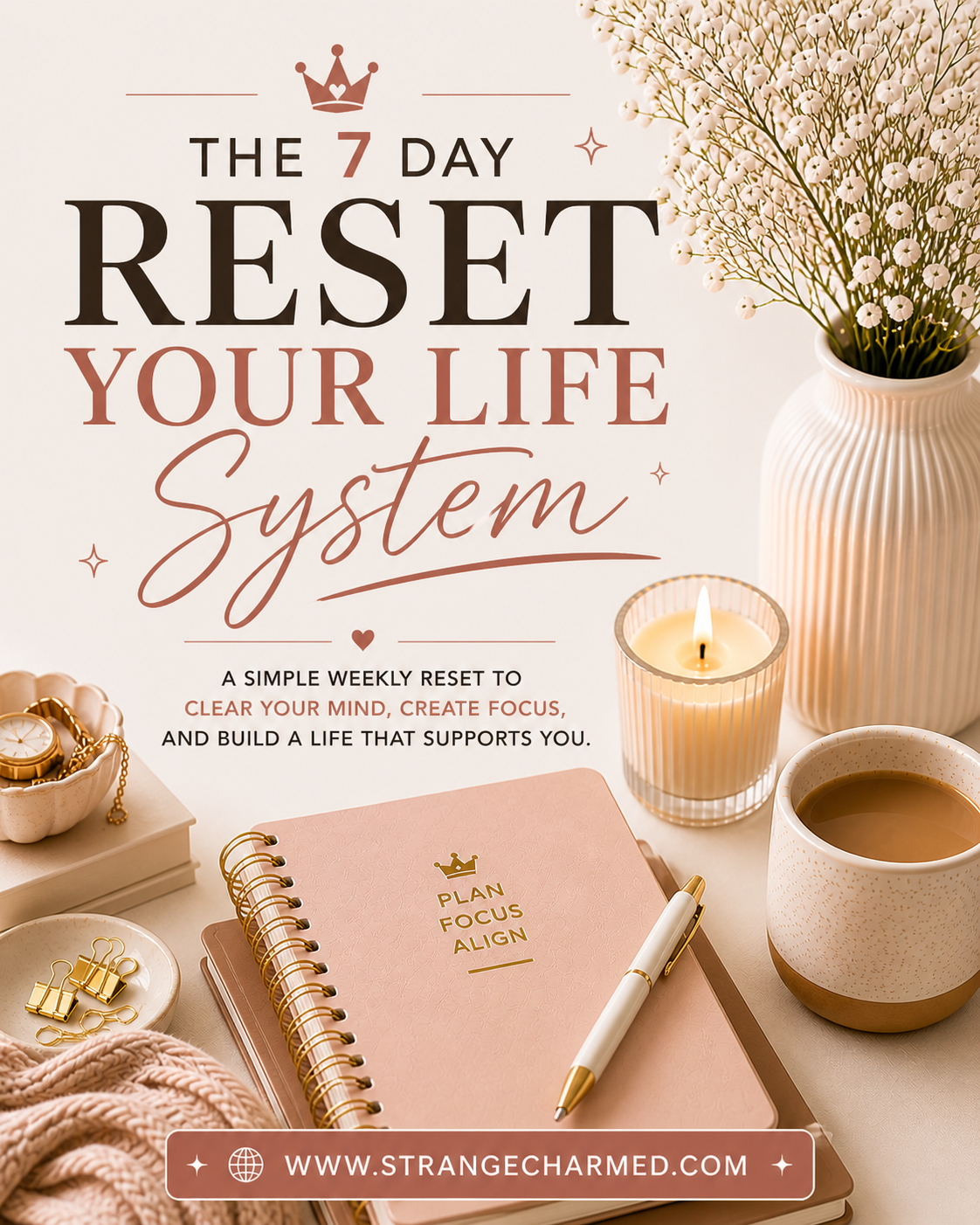
There are seasons where life doesn’t feel dramatically off, but it also doesn’t feel quite right either. Things start to slip in subtle ways. Your routines become inconsistent, your space feels a little more cluttered than usual, and your mind begins holding more than it should. Nothing is completely broken, but everything feels slightly heavier.
That’s usually the point where the instinct is to start over. To fix everything at once. To reset your entire life in a single burst of motivation.
But that approach rarely lasts.
In my experience, what you actually need isn’t a complete overhaul. You need a way to come back to yourself—gradually, intentionally, and without pressure. A reset that unfolds in layers instead of all at once.
This is the process I return to whenever things feel off. It’s simple, but it works because it gives each part of your life the attention it needs, one step at a time.
Why a 7-Day Reset Works
Trying to change everything in a single day creates more friction than progress. It might feel productive in the moment, but it often leads to burnout or inconsistency within a few days.
A week, on the other hand, gives you space to move differently. It allows you to focus on one area at a time—your thoughts, your priorities, your environment, your routines—without overwhelming yourself.
More importantly, it creates momentum.
Each small step builds on the one before it. By the time you reach the end of the week, you’re no longer trying to fix your life—you’re already living in a version of it that feels more clear, more organized, and more intentional.
Day 1: Clear Your Mind
The first step is always the most important, even though it looks the simplest.
You sit down and write everything out. Not just your tasks, but anything that has been sitting in your mind—ideas, reminders, things you’ve been putting off, things you don’t want to forget.
There’s no structure here yet. No sorting or organizing. The goal is simply to get it out.
Because when your mind is holding too much, everything starts to feel harder than it needs to be. Clearing that mental space creates a sense of relief that makes every step after this easier.
Day 2: Decide What Matters
Once everything is out of your head, you’ll likely notice that not all of it deserves your attention right now.
This is where you begin to choose.
Instead of trying to tackle everything, you ask a more grounded question: what actually matters this week? What would make things feel more stable, more complete, more in order?
You narrow your focus to a few meaningful priorities. Not a long list, just a handful of things that genuinely move your life forward.
This is the moment where overwhelm begins to shift into clarity.
Day 3: Reset Your Environment
With your mind clearer and your priorities defined, your environment becomes easier to address.
This isn’t about deep cleaning your entire life. It’s about creating a space that supports you.
You might start with your desk, your main living area, or wherever you spend the most time. You clear surfaces, put things back where they belong, and remove anything that feels like unnecessary noise.
Even small changes here can have a noticeable impact. When your environment feels lighter, it becomes easier to think clearly and move through your day with more ease.
Day 4: Rebuild Your Routines
By the fourth day, you’re ready to reintroduce structure in a way that feels manageable.
This isn’t about creating the perfect routine. It’s about giving your day a rhythm again.
You might start with a simple morning routine that helps you ease into the day, a loose structure for your work hours, and a way to close your day in the evening so you’re not carrying everything into tomorrow.
Routines don’t need to be complex to be effective. They simply need to exist, so you have something steady to return to.
Day 5: Plan Your Week
At this point, everything begins to come together.
Your mind is clearer, your priorities are defined, your space feels more supportive, and your routines are beginning to take shape. Now, you can plan your week from a completely different place.
You take what matters and give it a place in your schedule. You assign tasks to days, space out your responsibilities, and decide what your focus will be ahead of time.
Instead of approaching your week with uncertainty, you begin it with a sense of direction.
Day 6: Begin, Gently
This is where action begins, but without pressure.
You’re not trying to prove anything to yourself. You’re simply following through on what you’ve already planned.
You complete a few meaningful tasks, allow yourself to move at a steady pace, and resist the urge to overdo it. The goal here is not intensity, but consistency.
Starting gently builds confidence. And that confidence makes it easier to keep going.
Day 7: Reflect and Refine
The final day is quieter, but just as important.
You take a moment to look back on the week and notice what worked. Where did things feel easier? What felt supportive? What still needs adjustment?
This reflection isn’t about judgment. It’s about awareness.
Because the more you understand what works for you, the easier it becomes to create systems that actually fit your life.
What This Process Really Creates
By the end of the week, the shift is noticeable—but it doesn’t feel forced.
Things feel calmer. More organized. More manageable.
Not because everything is perfect, but because everything has a place.
This is what planning is meant to do. Not help you do more, but help you focus on what matters and make space for it in a way that feels natural and sustainable.
If You Want to Build This Into Your Life
If this process resonates with you, the next step is making it something you can return to consistently.
The Well Planned & Productive Woman Essential Planning Guide will walk you through how to build a system like this in a way that fits your life, not someone else’s routine.
And the Charmed Life Master Planner gives you a place to hold everything—so your plans, priorities, and routines live outside your head, where they can actually support you.
Final Thought
You don’t need to start over.
You don’t need to fix everything at once.
You just need a way to come back to what matters, one step at a time.
And sometimes, that begins with a single week—and a simple plan to reset.
xoxo,