As we come to the end of March, we’re also closing out the first quarter of the year.
And while most people are already thinking about what they want to do next…
I always pause here first.
Before I plan Q2, before I set new goals, before I make any changes…
I review.
Because this moment, right here, is where clarity is created.
Not from starting over. But from looking back.
And if you’ve been feeling a little off track, overwhelmed, or unsure of what to focus on next… this is exactly the process that will bring you back into alignment.
Why This Process Matters
I want to be clear about something.
This isn’t about replacing your monthly planning, your weekly routines, or your daily systems.
Each of those has its place.
This is something different.
Your quarterly review is a pause point.
A moment to zoom out and ask:
What actually happened these past 90 days?
What worked?
What didn’t?
And most importantly… does the direction I’m heading still feel aligned?
Because without this kind of reflection, it’s very easy to move into the next quarter carrying:
goals that no longer fit
systems that aren’t working
expectations that don’t match your reality
And that’s how people end up feeling stuck, even when they’re doing “all the right things.”
A quarterly reset brings you back into awareness.
And awareness is what allows you to move forward with intention.
My Quarterly Review Process (Step-by-Step)
This is the exact process I use at the end of every quarter, and the same one I guide my Master Mind members through inside The Charmed Life Master Mind.
You don’t need to reinvent this.
Just walk through it step by step.
Step 1: Review Your Goals
Start by looking at the goals you set at the beginning of the quarter.
Not what you intended to do… but what actually happened.
What progress did you make?
What moved forward?
What stayed the same?
This step is about honest awareness without judgment.
You’re gathering data, not grading yourself.
Step 2: Reflect on What Worked
Next, look at what supported you.
What habits stuck? What routines made your life easier? What felt good, natural, or sustainable?
These are your success patterns.
And they’re important because they show you what already works for you, which is something you want to carry forward.
Step 3: Identify What Didn’t Work
Now gently look at what didn’t.
This might include:
goals that felt unclear
habits you couldn’t maintain
systems that didn’t fit your lifestyle
periods where you felt overwhelmed or off track
This isn’t failure.
This is feedback.
Every friction point is showing you something that needs to be simplified, adjusted, or released.
Step 4: Assess Alignment
This is one of the most important steps.
Ask yourself:
Do these goals still feel relevant?
Because sometimes the version of you who set those goals… is not the same version of you sitting here now.
Your circumstances may have shifted. Your priorities may have evolved. Your energy may be different.
And that’s allowed.
Not all goals are meant to be carried forward.
Some are meant to be completed. Some are meant to be refined. And some are meant to be released.
Step 5: Review Your Systems
This is where we shift from goals to execution.
Look at your:
daily habits
weekly routines
monthly systems
What actually supported your life?
What felt realistic?
What felt like too much?
Because your results don’t come from your goals.
They come from your systems.
And this is your opportunity to refine them.
Step 6: Extract Your Lessons
From everything you’ve just reviewed, pull out your biggest takeaways.
What did this quarter teach you?
What would you do differently next time?
What surprised you?
I like to identify my top 3 lessons.
These become the foundation for how I move forward into the next quarter.
Step 7: Audit Your Energy
This is the step most people skip — and it’s one of the most important.
Ask yourself:
What gave me energy this quarter? What drained me?
Because your energy determines your capacity.
You can have the best plan in the world… but if it doesn’t align with your energy, it won’t work long term.
This is where soft productivity comes in.
We’re not just optimizing for output.
We’re optimizing for sustainability.
Step 8: Reset for the Next Quarter
Only after you’ve done all of this…
Then you move forward.
Now you can:
refine your goals
adjust your systems
make aligned decisions
From a place of clarity, not pressure.
The Power of Doing This in a Container
One of the things I’ve found over the years is that this process is incredibly powerful…
It includes prompts you can use to move from reflection into planning your next quarter in a way that actually feels aligned.
And if you want deeper support, and a space where this kind of work is built into your life, you’re always welcome inside The Charmed Life Master Mind.
A Final Reminder
As you close out this quarter, I want you to remember:
In the first post, I shared why becoming a cozy gamer might be one of the most underrated ways to bring more calm, joy, and intentional play into your life—and how to get started if you’re completely new to gaming.
Today, I want to take you a little deeper behind the scenes and share my recent upgrade from a Nintendo Switch Lite to a Nintendo Switch OLED. If you’ve been thinking about getting into cozy gaming—or upgrading your current setup—this is exactly the kind of post I wish I had when I was making my decision.
Because here’s the thing: in 2026, the newest option isn’t always the best option.
Why I Upgraded from the Switch Lite
For Christmas 2025, I asked for a Nintendo Switch OLED, and my partner graciously got it for me.
I had been using my Nintendo Switch Lite since 2020, and I truly loved it. It was my introduction to gaming as an adult, and it served me so well for years. The Lite is simple, lightweight, and perfect if you only want to play handheld.
But over time, I started to feel the limitations of it.
I knew I wanted more flexibility.
I could picture myself playing in different ways—curled up on the couch in handheld mode, propping it up in tabletop mode, or even connecting it to a larger screen for a more immersive experience. In my office, I use a projector as a TV, and I loved the idea of being able to play my games on a bigger display when I wanted to.
So this wasn’t about replacing something that didn’t work.
It was about expanding how I experience something I already love.
The Switch Options in 2026 (And Why I Didn’t Choose the Newest One)
When I was making this decision in Fall 2025, Nintendo had three main options:
The original Nintendo Switch
The Nintendo Switch OLED
The Nintendo Switch 2 (launched Summer 2025)
And I know what you’re probably thinking…
Why wouldn’t you just get the newest one?
But after really thinking through how I actually use my device—and not just what sounds best on paper—I realized the OLED was the better choice for me.
Why I Chose the Switch OLED
The Screen Size Sweet Spot
Coming from the Switch Lite, one of the biggest upgrades I wanted was a larger screen.
The OLED gives you that. It’s noticeably bigger than the Lite, but still smaller and more manageable than the Switch 2. It feels like the perfect in-between.
Big enough to feel immersive. Small enough to still feel cozy.
The OLED Display Is Beautiful
The screen itself is one of the biggest reasons people love this model.
OLED technology gives you richer colors, deeper contrast, and just an overall more visually satisfying experience. Cozy games in particular really benefit from this—soft lighting, warm tones, and detailed environments look incredible.
There’s actually a common opinion that the OLED screen looks better than the Switch 2 in some cases, which surprised me at first, but after seeing it in person, I completely understand why.
It Fits My Hands Perfectly
This was a huge factor for me that I don’t think gets talked about enough.
I’m petite and have smaller hands. When I tested both the OLED and the Switch 2, the difference was immediately noticeable.
The Switch 2 felt big. Not unusable, but not as comfortable—especially for long sessions.
The OLED, on the other hand, felt balanced and easy to hold. It’s the same general size as the original Switch, and for me, it just worked.
Comfort matters more than specs when you’re actually using something every day.
The Weight Makes a Difference
Because the OLED is smaller than the Switch 2, it’s also lighter.
And since I knew I would be using it primarily in handheld mode, that really mattered to me.
There’s nothing cozy about your hands getting tired halfway through a relaxing game session.
The 720p Resolution (This Might Surprise You)
This is one of those details that sounds counterintuitive at first.
The OLED has a 720p handheld resolution, while the Switch 2 has a 1080p screen.
So technically, the Switch 2 is “better.”
But here’s why that didn’t matter to me…
I already own a large library of Switch 1 games, and those games were designed for 720p.
A lot of early feedback from Switch 2 users mentioned that games not optimized for the new resolution sometimes looked off—slightly pixelated or harder to read.
I didn’t want to compromise the experience of the games I already love.
So in this case, “less” was actually better.
The Game Library Is Already Mature
This was probably the most important factor overall.
Whenever a new console launches, it takes time for the game library to catch up.
That’s just how it works.
Right now, the Switch 1 ecosystem (which includes the OLED) has years of games behind it. There are so many cozy titles available, and I already own quite a few of them.
Developers are also still creating games for the original Switch models because there are simply more users on those systems.
So instead of buying into a newer console that still needs time to mature, I chose one that I could fully enjoy right now.
And maybe in 3–5 years, when the next version of the Switch 2 comes out, I’ll upgrade again.
Nintendo Consoles Age Well
Another thing I kept in mind is that Nintendo consoles don’t become irrelevant overnight.
They hold their value. They stay supported. They remain popular.
Even with the Switch 2 release, Nintendo is still supporting the original Switch models.
So choosing the OLED didn’t feel like settling.
It felt like choosing something reliable, established, and fully developed.
My Cozy Switch OLED Setup (Accessories I Love)
One of the most fun parts of getting my Switch OLED was customizing it.
I really leaned into making it feel cozy, aesthetic, and personal.
I bought a tempered glass screen protector right away, along with several hard shell cases to protect the device. I have a few different designs, but my favorite is a rose print case that also has a matching dock cover—it’s very soft, feminine, and a little romantic.
I also have an endless collection of Joy-Con thumb grips (I can’t help myself). Right now I’m using a pink and white bow set that feels very girly and pairs perfectly with the rose case.
For longer play sessions, I use a Gripcon, which makes the console much more comfortable to hold, especially for games that require more precision. A gripcon is a mix between a grip and a controller. It makes it easier for you to hold the switch for longer play sessions with its extra heft and some extra remappable buttons for extra function.
For storage and travel, I have a hard carry case in a purple moon print, as well as a soft Pusheen gamer case that’s honestly just adorable.
I also use a travel sleeve made from a cozy witch-print fabric. Even when I’m not traveling, I use it at home to keep my Switch protected when it’s not docked.
One of my favorite little details is my audio jack charm. I had a shop on Etsy create a tiny almond croissant charm that sits right on top of my device—it looks like it’s resting there, and it’s so cute. I’ve also made a few DIY charms myself using beads, including macarons, Labubu heads, roses, and bows.
I keep a reusable microfiber screen cleaning pad nearby to wipe away fingerprints (very necessary), and I use a device holder pillow—originally meant for a Kindle or iPad—to hold my Switch in tabletop mode.
For audio, I use inexpensive JLab earbuds (around $20), especially when I’m traveling or lying down in bed and don’t want to wear larger headphones.
Cozy Switch Games I Love (and What I’m Playing Right Now)
Of course, a cozy gaming setup is only as good as the games you play on it.
Over the past few years, I’ve built a sizable collection of cozy games with several that I come back to again and again. These are the kinds of games that feel immersive without being overwhelming—games you can get lost in for an hour or two and come out feeling calmer, not overstimulated.
Right now, these are some of my favorites:
The Cosmic Wheel Sisterhood is one of the most unique games I’ve played. It’s deeply atmospheric, a little mystical, and very narrative-driven. If you love witchy themes and storytelling, this one is a must.
Ritual of Raven feels like a natural extension of that same magical, cozy energy. It leans into ritual, mystery, and a slightly darker aesthetic while still feeling calm and intentional.
Cozy Caravan is exactly what it sounds like—soft, charming, and comforting. It’s one of those games you can play when you just want to unwind.
Wytchwood is one of my all-time favorites. It has a beautiful storybook art style and revolves around crafting, gathering, and completing small tasks in a magical world.
The Coffee Talk series is perfect for slower evenings. You play as a barista serving drinks and listening to stories. It’s simple, soothing, and surprisingly emotional.
Strange Horticulture (and the sequel Strange Antiquities) is another standout. It’s a puzzle-based game where you identify plants and uncover a larger mystery. It feels intellectual but still very cozy.
Cozy Grove and Animal Crossing are classics for a reason. They’re both built around daily play, small routines, and gentle progression—perfect for creating a sense of calm structure in your day.
Tiny Bookshop is one I’ve been loving for its aesthetic alone. Books, cozy environments, and slow gameplay—it checks all my boxes.
The Monument Valley series is visually stunning and incredibly calming. It’s more of a puzzle experience, but it feels almost meditative.
The Atelier series is a little more involved, but if you enjoy crafting systems, alchemy, and beautiful worlds, it’s worth exploring.
And finally, Garden Story is such a sweet, wholesome game that blends exploration, light combat, and community-building in a way that still feels soft and approachable.
Each of these games gives me that same feeling I’ve been talking about throughout this post—focused, intentional play that engages my brain without overwhelming it.
Cozy Games I’m Excited for in 2026
One of the best parts about getting into cozy gaming right now is how many beautiful games are on the horizon.
There’s something really exciting about knowing that this space is growing—and that more developers are creating experiences that prioritize calm, creativity, and storytelling over intensity.
Here are a few games I’m especially excited about this year:
Grimoire Groves is at the top of my list. It’s releasing in March, and I’ve already preordered it. It has strong cozy witchy energy, beautiful visuals, and looks like the kind of game I’ll completely lose myself in.
Moonlight in Garland is another March release that feels very aligned with the aesthetic I love—soft, cozy, and immersive life sim in a city.
Little Witch in the Woods is expected in Summer 2026, and I’ve been waiting for this one for a while. It looks like the perfect blend of cozy exploration and light storytelling.
The Witches Bakery, coming in July 2026, already feels like it’s going to be a favorite. Cozy baking, magic, and a warm, whimsical Parisian environment—it’s everything I want in a game.
Witchbrook (expected sometime in early to mid 2026) is one of the most anticipated cozy games overall. It’s giving magical school, life simulation, and beautiful pixel art.
And finally, Fields of Mistria hasn’t officially been announced for Switch yet, but there’s a good chance it could come to the platform. If it does, it will absolutely be on my list.
How I’ve Been Using My Switch OLED
Most of the time, I use it in handheld mode.
That’s my default.
Sometimes I’ll set it up in tabletop mode using my device holder pillow, and I love playing with the Joy-Cons detached so my arms can rest comfortably at my sides. It feels so relaxed and cozy.
For longer or more intense sessions, I’ll use the Gripcon.
And occasionally, I’ll dock it to my projector for a bigger-screen experience, which feels like such a fun little upgrade when I’m in the mood for it.
Why I Love Cozy Gaming So Much
What I love most about my Switch OLED isn’t just the device itself.
It’s how it fits into my life.
Even though it’s technically an online device, it doesn’t feel like the internet.
I’m not scrolling endlessly. I’m not consuming random content. I’m not jumping between a million things.
I’m focused on one thing.
The game.
And there’s something really powerful about that.
It allows my brain to turn on and off at the same time.
Engaged… but calm.
Stimulated… but not overwhelmed.
In a world where our attention is constantly being pulled in every direction, that kind of focus feels like a luxury.
Final Thoughts: You Don’t Need the Newest Thing
If you’re thinking about getting into cozy gaming or upgrading your current setup, my biggest piece of advice is this:
Don’t just choose what’s newest.
Choose what fits your life.
The best console is the one that:
• feels good in your hands • supports how you actually play • works with the games you love • and fits your lifestyle
And instead of having some dramatic midlife crisis or feeling the pressure to reinvent myself, I’ve found myself doing something… a little unexpected.
I’ve started collecting toys.
Not luxury items. Not productivity tools. Not things that make me more efficient or successful.
Actual toys.
Plush dolls. Digital pets. Video games.
If you had told me even a year ago that this would be part of my life at 40, I probably would have laughed. But the truth is, these hobbies have quietly become some of the most enjoyable, calming, and mentally refreshing parts of my day.
So yes, I’m basically 40 going on 14 right now.
And honestly? It feels pretty great.
But the funny thing is, fourteen-year-old Alexis probably wouldn’t even recognize this version of me.
Because she didn’t really get to be a kid.
The “Old Soul” Kid Who Grew Up Too Fast
If you were a parentified oldest child, you probably know the exact kind of compliments I’m talking about.
The ones adults love to give children who seem unusually mature:
“She’s so wise beyond her years.” “She’s such a joy to have in class.” “She’s so mature.” “She’s such an old soul.”
At the time, those things sound like praise. They make you feel special. Responsible. Capable.
But what those compliments often mean is that a child learned very early how to behave like an adult.
That was me.
As the oldest child, I believed it was my job to take care of things. To help my parents. To look out for my younger siblings. To be the good kid who did well in school and impressed teachers. I tried very hard to do everything right.
I believed that growing up quickly was the goal.
Being mature was the achievement.
Being responsible was the identity.
What that didn’t leave much room for… was play.
There wasn’t much time for toys or silly hobbies. I wasn’t the kid building collections or spending hours absorbed in games just for fun. I was busy trying to be good, capable, impressive.
So it doesn’t surprise me at all that forty-year-old Alexis is suddenly rediscovering something she skipped over earlier in life.
Play.
Real Hobbies… For the First Time in a Long Time
One of the things I’ve noticed recently is that I actually have hobbies again.
Not productivity hobbies.
Not “this could become content” hobbies.
Not “maybe I can monetize this” hobbies.
Just hobbies.
Things I do because they are enjoyable and relaxing.
And some of them are admittedly a little childish.
Right now my cozy hobby lineup includes:
• Labubu plush dolls • Tamagotchi digital pets • Video games on my Nintendo Switch OLED
When I first realized this, part of me wondered if it was a little random. Or maybe even a little silly.
But the more I thought about it, the more I realized these hobbies are actually doing something really important for my brain.
They aren’t just distractions.
They’re restoration.
Fighting Brain Rot and Doom Scrolling
We live in a time where it’s incredibly easy to spend hours consuming content without even realizing it.
Scrolling.
Short videos.
News.
More scrolling.
Even when you know it’s not making you feel good, it’s hard to stop. The algorithms are designed to keep you hooked, and the constant novelty fragments your attention.
This kind of passive content consumption can leave your brain feeling strangely tired and overstimulated at the same time.
What I’ve noticed about my cozy hobbies is that they break that pattern completely.
They are either analog or mostly offline.
They are contained.
They have clear boundaries.
Instead of endlessly consuming random content, I’m interacting with something intentional. I’m focused on one small activity at a time.
And the result is that my overall screen time has actually gone down.
Even though technically some of these hobbies involve screens.
The difference is how they engage my brain.
And interestingly, each one seems to activate a slightly different kind of mental reward.
Labubu Dolls and the Power of Oxytocin
One of my newest little obsessions is Labubu plush dolls.
If you’re not familiar, Labubu is a whimsical character with a mischievous little smile and a surprisingly expressive personality. The plush versions are soft, cuddly, and honestly just really delightful to look at.
They sit on my shelves, my desk, and sometimes next to me while I’m working.
And yes, I know that sounds a little ridiculous.
But every time I look at them, I feel a tiny spark of happiness.
That warm, fuzzy feeling.
It’s the same feeling you get when you hug a pet or spend time with someone you love.
There’s actually a chemical explanation for that feeling: oxytocin.
Oxytocin is often called the “bonding hormone.” It’s released when we experience closeness, comfort, and affection. It’s associated with relationships, caregiving, and emotional safety.
But interestingly, our brains can also release oxytocin when interacting with comforting objects—especially ones that trigger feelings of warmth or nostalgia.
And oxytocin is incredibly protective for the body. It helps regulate stress, supports emotional resilience, and promotes overall well-being.
So these little plush toys that seem childish on the surface?
They’re actually giving my nervous system something it missed earlier in life.
Comfort.
Tamagotchi and Non-Productivity Dopamine
Another one of my favorite little daily joys right now is my Tamagotchi.
If you grew up in the 90s or early 2000s, you probably remember them. Tiny digital pets that you feed, clean, and take care of throughout the day.
At first glance, it seems like the most random hobby for an adult.
But it’s actually become one of the most useful little mental breaks in my workday.
When you’re working on something challenging, your brain naturally wants a break every so often. The problem is that most breaks are dangerously distracting.
You pick up your phone to check something quickly… and suddenly you’ve been scrolling for twenty minutes.
Tamagotchi work differently.
They require about three to five minutes of interaction.
You check on your pet. Feed it. Play a tiny game.
And then you’re done.
It’s a quick little reset.
What I love about it is that it gives me a small dopamine hit that has nothing to do with productivity.
Most adults only get dopamine from finishing tasks, completing projects, or achieving goals. But our brains actually benefit from small, low-stakes sources of enjoyment too.
These little moments help my brain reset so I can return to work more focused.
Video Games and the Satisfaction of Progress
The third hobby in my cozy trifecta is video games.
Specifically, cozy games on my Nintendo Switch OLED.
And the feeling I get while playing them is different from the quick dopamine of something like social media.
It’s slower.
More satisfying.
When I advance in a game, complete a puzzle, or finish a quest, the feeling is closer to contentment than excitement.
It feels like the quiet satisfaction of progress.
That feeling is likely connected to serotonin, a neurotransmitter associated with mood regulation, confidence, and a sense of accomplishment.
Video games create small cycles of challenge and completion.
You solve problems. You explore environments. You learn new mechanics.
And your brain gets to experience the reward of finishing something.
Video Games Are Actually Good for Your Brain
This month inside The Charmed Life Master Mind, I taught a masterclass called Optimizing Your Brain.
I spent quite a bit of time researching evidence-based strategies for improving focus, memory, and long-term brain health.
One of the things that kept coming up in the research was something that surprised a lot of people:
Video games can actually be beneficial for your brain.
Certain types of games improve:
• problem solving • strategic thinking • hand-eye coordination • reaction time • working memory
Many games also involve puzzles, resource management, or exploration, all of which challenge the brain in different ways.
Activities like these stimulate neuroplasticity, which is the brain’s ability to form new connections and adapt over time.
In simple terms, they keep your brain flexible and active.
So yes, technically I’m playing video games.
But in a very real way, I’m also giving my brain a workout.
Maybe 40 Going on 14 Isn’t a Bad Thing
So when I say I’m 40 going on 14, I don’t mean that I’m regressing.
I mean that I’m rediscovering something.
I’m collecting toys.
I’m playing games.
I’m taking care of digital pets.
But those little hobbies are also doing something much bigger.
They’re helping me:
• protect my attention • balance my brain chemistry • stimulate my mind • heal my inner child • and honestly… enjoy life more
For someone who spent childhood trying to be an adult as quickly as possible, it feels surprisingly healing to finally do the opposite.
To slow down.
To play.
To allow a little whimsy back into my life.
Play Is Not a Waste of Time
One of the strange messages adulthood teaches us is that play is childish.
That if something isn’t productive, profitable, or impressive… it must be a waste of time.
But play is actually incredibly important.
Play restores your creativity. Play regulates your nervous system. Play gives your brain space to breathe.
And sometimes the most productive thing you can do is step away from the seriousness of adult life for a little while.
Sometimes the best thing you can do is press start on a game, check on a tiny digital pet, or smile at a silly plush toy sitting on your desk.
A Little Birthday Gift From Me to You
Since last week was my birthday (March 13th 🎉), I wanted to celebrate turning 40 by sharing a little gift with you.
Not panicked. Not desperate. Not rushing to book a series of expensive treatments in an attempt to “fix” anything.
Just calm.
There’s something powerful about entering a new decade without feeling like you need to overhaul yourself. I’m not interested in chasing youth. I’m interested in refinement. I’m interested in feeling strong, clear, energized, and confident in my own skin.
Over the years, I’ve watched how the beauty industry positions aging as a problem to solve. There is always a new treatment, a new injectable, a new laser, a new subscription box promising transformation. And while I’m not anti-treatment or anti-aesthetic services, I am deeply aware of something most people don’t say out loud:
There are no magic wands.
Most beauty services “work” because of consistency, not because they permanently fix anything. You don’t get Botox once. You don’t get one facial and never need another. You don’t do one laser session and stay glowing forever.
The real secret? Maintenance.
And maintenance can be done at home — affordably — when you build simple systems and stick to them.
If you know me, you know this philosophy applies to everything in my life. Productivity. Business. Health. Beauty. It’s not about extreme effort. It’s about aligned, consistent action.
So as I step into 40, here are the 13 things I’m doing to look and feel my best — none of which require spending hundreds or thousands of dollars.
1. I Practice Intermittent Fasting — Because It Works for My Body
I’ve never naturally been someone who wants to eat the moment I wake up. I love breakfast foods, but eating first thing in the morning doesn’t feel good to me. For years, I tried to force it because that’s what you’re “supposed” to do.
Now, I listen to my body.
I typically wait until I’m actually hungry to eat, which usually means my first meal is around lunchtime. This natural rhythm has simplified my mornings, supported my digestion, and helped me maintain stable energy throughout the day.
Intermittent fasting isn’t about restriction for me. It’s about alignment. It’s about honoring my body’s cues instead of following arbitrary rules. That alignment alone creates more calm in my routine — and calm shows up on your face.
2. I Eat a Mostly Ketovore Diet
Over time, I’ve realized that my body feels best when my meals are simple and protein-focused. I follow what I’d describe as a “ketovore” approach — mostly carnivore, but with some keto-friendly treats integrated in.
This isn’t about trends. It’s about inflammation, energy, and mental clarity. When I eat this way consistently, my skin is clearer, my bloating is reduced, and my energy is steady.
One of the most underrated beauty strategies is stable blood sugar. When your energy is regulated, your mood improves, your cravings decrease, and your skin often reflects that balance.
The simplicity of this way of eating also reduces decision fatigue. Fewer choices, fewer swings, fewer regrets.
Consistency always outperforms perfection.
3. I Prioritize Hydration and Targeted Supplements
You cannot out-skincare dehydration.
No serum, no mask, no luxury cream can compensate for a lack of hydration or nutrient support.
I prioritize electrolytes daily, especially since I drink a lot of coffee. I also take vitamin C, creatine, a multivitamin, and magnesium.
Creatine supports muscle tone and strength. Magnesium supports sleep and nervous system regulation. Vitamin C supports skin and immune health.
None of these are glamorous. But they are foundational.
Beauty begins internally. Radiance is supported by the systems you don’t see.
4. I Stick to a Consistent Skincare Routine
I don’t try every new product that trends online. I don’t rotate my routine constantly. I stick to the basics, and I do them consistently.
My routine includes a gentle cleanser, chemical exfoliants, retinol, serum treatments, moisturizer, and SPF. Occasionally, I use my PMD device for manual exfoliation. I also use cryo sticks to refresh and depuff my skin.
None of this is revolutionary.
But it works because I do it repeatedly.
The difference between someone who sees results and someone who doesn’t is rarely the product. It’s the follow-through.
5. I Give Myself Regular At-Home Manicures and Pedicures
There is something powerful about well-maintained hands and feet.
I keep my nails short and clean. I prefer subtle shades that look polished and timeless. I use strengthening treatments to maintain the health of my natural nails, and I love brands like Manucurist for their more natural formulations.
Polished doesn’t require appointments.
It requires intention.
Small details elevate your overall appearance dramatically. And when you can maintain them yourself, you save both time and money.
6. I Use My LED Face Mask Consistently
This was a small investment — under $100 — and it’s one of those tools where I genuinely notice a difference when I use it regularly.
The key word is regularly.
Like most treatments, the benefit isn’t in one use. It’s in consistent use over time. When I stick to it, my skin tone looks more even and refreshed.
Again, this is about building habits, not chasing miracles.
7. I Practice Gua Sha Instead of Jumping to Injectables
Facial sculpting through gua sha has become part of my routine. I don’t feel the need to rush toward fillers or Botox because I’ve seen how manual sculpting and lymphatic drainage can create visible changes when done consistently.
Is it instant? No.
Is it dramatic overnight? No.
But with repetition, I’ve noticed improved definition and reduced puffiness.
There’s something empowering about being able to support your own appearance with your own hands.
8. I Do At-Home Workouts Through YouTube
I don’t have a gym membership, because I know myself — I wouldn’t use it consistently.
Instead, I use YouTube workout videos and simple home equipment. When I’m consistent, I get sweaty, toned, and strong.
The most effective workout plan is the one you’ll actually do.
Strength training, even in small doses, supports muscle tone, metabolism, posture, and long-term health. And posture alone dramatically affects how youthful and confident you appear.
Consistency beats convenience.
9. I Walk My Dog Every Day
Daily dog walks are one of the simplest glow-up habits I have.
Fresh air. Sunlight. Movement. Connection.
Sunlight regulates circadian rhythm. Movement supports circulation. Time outdoors reduces stress. And lower stress levels directly impact your skin and overall appearance.
Sometimes the most powerful anti-aging tool is a simple walk.
10. I Dye My Hair at Home with a Gentle Semi-Permanent Formula
In 2024, I started dyeing my hair at home using a semi-permanent formula that is gentle, affordable, and easy to apply every 8–12 weeks.
It saves money. It saves time. And it allows me to maintain consistency without scheduling appointments.
Maintenance doesn’t have to be expensive.
It just has to be intentional.
11. I Use Teeth Whitening Strips
As someone who drinks a lot of coffee, I’ve found that occasional whitening strips make a noticeable difference.
They’re inexpensive, accessible, and effective when used correctly.
A bright smile changes everything.
12. I Don’t Smoke and I Rarely Drink
I have never smoked, and I’m not a big drinker.
These are long-term choices that significantly impact skin health, aging, inflammation, and overall appearance.
Sometimes the best glow-up habits are the ones you simply avoid.
13. I Practice Mindset Work and Personal Development
This may be the most important one.
Youthfulness is not just about skin. It’s about mental flexibility. It’s about neuroplasticity. It’s about continuing to learn, grow, and regulate your emotions.
Reading. Studying. Reflecting. Evolving.
When you stay mentally sharp and emotionally grounded, it shows.
Confidence is magnetic.
And nothing ages you faster than chronic stress, negativity, and self-criticism.
The Real Secret to Looking Your Best at 40
None of what I shared is extreme.
None of it is shocking.
None of it requires thousands of dollars.
What it requires is consistency.
The same principle that builds a business builds beauty.
Small systems. Repeated often.
Turning 40 feels refined. It feels intentional. It feels like I understand what works — and I no longer feel tempted by every new promise.
Glow-ups are not purchased. They are practiced.
A Birthday Gift From Me to You 🎉
Because I’m turning 40 on March 13th, I’m celebrating with 40% off almost everything in my shop this week (excluding The Charmed Life Master Mind).
If you’ve been wanting to grab one of my planners, digital systems, or courses, this is the week.
Use code: Birthday40
Because glowing up isn’t just about skincare.
It’s about structure. Clarity. Systems.
The same way I build simple, consistent routines for my health and appearance, I build them for my life and business.
And instead of setting bigger goals, pushing harder, or trying to optimize every corner of my life… I’m doing something different.
I’m allowing myself to do less.
Intentionally. Strategically. Without guilt.
If you’ve been around Strange & Charmed for any amount of time, you know I believe in structure. I believe in aligned action. I believe in functional planning and building systems that support your dream life.
But here’s what I’ve learned after more than a decade of building businesses, achieving goals, and becoming the woman I once imagined:
Productivity isn’t about constant acceleration.
Sometimes, the most powerful move is to soften.
And I have a feeling… you might be feeling this shift too.
Entering My Soft Life Era (At 40)
For me, this “soft life era” isn’t about abandoning ambition.
It’s about refining it.
It’s about:
Doing less — but doing what matters most
Letting go of rigid timelines
Releasing specific outcomes
Enjoying my life while I build it
I’m not holding onto things so tightly anymore.
I still have goals. I still have vision. I still have standards.
But I’m not gripping them with white knuckles.
I’m letting things unfold.
And that shift alone has changed the way I wake up each day.
Instead of asking:
“How can I get more done?”
I’ve been asking:
“How can I enjoy this?”
That’s a very different energy.
And for women like us — the high-achieving, capable, responsible ones — that question can feel almost radical.
The Gentle January Experiment
To kick off 2026, inside The Charmed Life Master Mind, I hosted something called the Gentle January Challenge.
The entire theme was anti-hustle.
We focused on:
Let it be easy
Guilt-free rest
You can go slow and still achieve it all
Overwhelm is not a requirement for success
Because every year, January arrives with this unspoken pressure.
New year. New goals. New habits. New body. New business plan. New everything.
And yet… for those of us in the Northern Hemisphere, what is the season actually doing?
It’s cold. It’s dark. The trees are bare. The earth is resting.
Nature is not launching.
Nature is conserving.
And yet we expect ourselves to operate at full throttle.
This year, I questioned that.
What if January wasn’t for building?
What if it was for living off your reserves?
What if it was for reflection, restoration, and small, gentle movements forward?
Inside the Master Mind, we practiced:
Simplifying routines
Prioritizing sleep
Setting fewer goals
Celebrating small wins
Reducing inputs (less comparison, less noise)
And something beautiful happened.
Instead of burning out by February…
The women felt steadier.
Calmer.
Clearer.
And that’s when I realized this shift isn’t just personal.
It’s seasonal.
Why I’m Treating March 20th as My New Year
This year, I’ve decided that my real “new year” begins on March 20th — the start of Aries season and the astrological new year.
The first day of spring.
The shift from dormancy to bloom.
The moment when light returns.
This is when nature begins to move.
This is when seeds sprout.
This is when momentum feels natural — not forced.
And regardless of what Punxsutawney Phil says… spring always comes.
I’ve spent years teaching quarterly planning, yearly planning, functional systems.
And I still believe in them.
But I also believe in alignment.
And March feels aligned.
It feels like the true energetic reset.
Not because it’s trendy.
But because it makes sense.
A Soft Life Isn’t a Lazy Life
Let’s be clear.
Soft doesn’t mean passive. Soft doesn’t mean unmotivated. Soft doesn’t mean small.
Soft means:
Intentional
Self-aware
Regulated
Aligned
It means understanding that you have 168 hours in a week — and you don’t need to fill all of them.
It means recognizing that you can:
Delegate
Defer
Delete
It means asking:
What are my real objectives this season?
What actually matters?
What can wait?
Functional planning has always been about making space for what matters most.
Now I’m using it to make space for joy.
Integrating Play Back Into My Life
This is the part that might surprise you.
Lately, I’ve been playing more video games.
I bought a few Labubu dolls and dressed them up.
I’m getting into Tamagotchi and digital pets again… like I’m 14 not 40!
I’ve been enjoying my streaming services. Wearing the makeup I already own. Using the planners and notebooks I already have. Cooking at home. Re-reading books from my (digital) shelves.
Simple pleasures.
No productivity goal attached.
No monetization strategy. No content angle. No outcome.
Just enjoyment.
And do you know what I’ve realized?
So much of adult burnout comes from eliminating play.
We turn everything into optimization.
Even rest becomes strategic. Even hobbies become side hustles. Even fun becomes content.
And I don’t want to live like that.
At 40, I want delight.
The Trap of Buying Happiness
Another subtle shift I’ve been noticing…
When we feel disconnected or overwhelmed, we often buy something.
New planner. New wardrobe. New skincare. New program. New aesthetic.
But what if happiness isn’t in the new?
What if it’s in using what you already have?
This season, I’ve been asking myself:
What do I already own that could bring me joy?
What hobbies did I abandon?
What creative impulses have I ignored?
Instead of accumulating more…
I’m interacting more deeply with what’s already here.
That alone has created more abundance in my life than any purchase ever has.
One of the most profound shifts for me lately has been releasing tight control over specific outcomes.
I still set objectives. I still define action plans. I still allocate my Top 3.
But I’m not attaching my worth to results.
If something takes longer? Fine.
If something evolves? Even better.
If something doesn’t happen? Maybe it wasn’t meant for this season.
There is power in looseness.
There is confidence in flexibility.
And at 40, I trust myself enough to adapt.
The Season of Life I’m In
Every woman moves through seasons.
Career building. Motherhood. Reinvention. Healing. Expansion. Simplification.
Right now, I feel like I’m in a refinement season.
I’ve built. I’ve proven. I’ve achieved.
Now I’m curating.
Choosing. Softening. Enjoying.
And when I look at the messages I receive, I see so many of you in a similar transition.
Less hustle. More intention. Less noise. More clarity. Less proving. More living.
Is that you too?
Your Invitation
I want to hear from you.
Are you changing your relationship with productivity this year?
Are you redefining ambition?
Are you craving softness without sacrificing success?
And will you join me in celebrating the seasonal new year on March 20th — the start of Aries season — as our true reset?
Imagine beginning your year when the world is blooming.
Imagine setting goals when light is returning.
Imagine building momentum when energy feels natural.
It doesn’t mean you ignore January.
It just means you don’t force it.
What This Means Practically
Here’s how I’m approaching the next few weeks:
Light planning until March 20th
Gentle routines
Focus on rest and play
Clarifying vision for the next 90 days
Releasing anything that feels forced
Then on March 20th:
Quarterly reset
Clear objectives
Fresh momentum
Strategic aligned action
Structured. Intentional. Charmed.
That’s the balance.
You Can Do It All — Just Not All at Once
This has always been true.
You can build the business. Have the relationship. Prioritize your health. Enjoy your home. Read the books. Play the games. Wear the lipstick. Take the nap.
Just not all in the same season.
The Well Planned & Productive Woman knows when to push.
But she also knows when to soften.
And maybe turning 40 has simply made that truth louder for me.
A Final Thought
If you’ve been feeling:
Tired of hustle culture
Resistant to rigid timelines
Drawn toward slower mornings
Interested in hobbies again
Less attached to proving yourself
You’re not falling behind.
You’re evolving.
And maybe this March 20th can be your permission slip.
To begin again. To bloom slowly. To plan strategically. To live softly.
Because productivity was never meant to steal your joy.
It was meant to protect it.
So tell me…
What season are you in?
And will you celebrate the new year with me this spring?
A behind-the-scenes look at how I manage life, content, and business tasks without burning out
Running a business is a lot.
There are goals to set, content to create, clients to serve, offers to manage, and about a thousand decisions to make every week. Add in managing your home, your relationships, and your energy, and it’s no wonder so many creative entrepreneurs end up feeling overwhelmed.
After 12 years in business, I can tell you this with confidence:
✨ You don’t need more time. You need better systems.
In this post, I want to give you a behind-the-scenes look at the exact systems and tools I use to manage my life and business without burning out. These are the rhythms that keep me focused, the planners that keep me grounded, and the automations that multiply my energy.
If you’ve been struggling to stay consistent with your content, goals, or execution, this post will show you how to build the systems that support your vision.
Let’s dive in.
Why Systems Are the Secret to Consistency
Consistency isn’t about willpower. It’s about structure.
If you don’t have a system for planning your tasks, tracking your goals, and executing your ideas, you’ll always feel behind. You’ll always be reacting instead of leading.
And the truth is: most people don’t fail because they lack ambition—they fail because they lack structure.
Structure creates freedom. Systems create flow.
The good news? You can create simple systems that take the pressure off and help you show up consistently, even when life gets messy.
Here are the core systems I use to run my business.
System 1: My Planning Stack
This is where everything begins: with my planners.
I use two digital planners every single day:
🗓 The Charmed Life Master Planner This is my main life + time management hub. It holds:
My yearly, quarterly, monthly, weekly & daily planning routines
My master task lists, calendars, routines, and habits
My content plans and household systems
📘 The CEO Strategy Planner This is my business planning brain. It holds:
My business goals and revenue plans
Project outlines + task breakdowns
Launch plans, marketing strategies, and performance tracking
The key is integration: tasks from the CEO Strategy Planner always get scheduled into the Master Planner. That’s how I stay consistent and make sure everything gets done.
System 2: Functional Weekly Routines
Once I have my plan, I rely on simple weekly rhythms to help me follow through:
🧠 Weekly CEO Planning Session Every Sunday or Monday, I review my goals, assess last week, and make my plan for the week ahead. I block out time in my calendar and use my Top 3 method to stay focused.
📆 Themed Work Days To stay productive, I group my work into themed days:
Monday: Admin & Operations
Tuesday: Content Creation
Wednesday: Marketing & Visibility
Thursday: Product or Offer Development
Friday: CEO Visioning, Strategy, and Overflow
This helps me batch tasks, reduce decision fatigue, and stay in alignment with my priorities.
System 3: Content Planning Framework
My content doesn’t happen by accident. I use a structured monthly and weekly content calendar to guide what I publish, when, and where.
Each month, I:
Choose a focus or theme tied to my offers
Plan blog posts, email newsletters, and Instagram content
Align my content to introduce or lead into specific offers
I use a content planning template inside my CEO Strategy Planner to keep everything organized, and I repurpose core messages across platforms to work smarter, not harder.
Consistency in content is what builds trust. And trust is what drives sales.
System 4: Automation & Templates
To reduce decision fatigue and free up energy, I use automations and templates for recurring business tasks.
Examples:
Email welcome sequences + nurture funnels
Evergreen sales funnels tied to opt-ins
Social media templates + caption formulas
Client onboarding emails + workflows
These systems work for me while I focus on showing up, serving, and selling.
Inside IN BUSINESS, I share these behind-the-scenes templates and tools so you can copy what works and customize it for your business.
System 5: Reflection & Realignment
The final piece of my consistency system is the part most people skip: reflection.
Each month and quarter, I review:
What worked
What didn’t
What I want to do differently moving forward
This process helps me refine my systems, spot misalignments, and recommit to my vision.
There is no perfect plan. Only a commitment to keep coming back to the work.
Final Thoughts: Build Systems That Support You
You don’t need to be perfect. You don’t need to do it all.
You just need to build systems that support the life and business you actually want.
✨ The right systems give you structure, clarity, and breathing room. ✨ The right tools keep you focused and on track. ✨ The right mindset reminds you that progress happens in cycles.
If you’re ready to create your own systems for consistency, here’s where to start:
Why goal setting isn’t enough—and how to actually follow through.
If you’ve ever found yourself setting ambitious goals for your business and then losing momentum within weeks, you’re not alone.
You’re not broken. You’re not unmotivated. You’re just missing one key ingredient:
Alignment.
Alignment is what turns goals into action. It’s the bridge between the vision you set and the execution that creates results.
In this post, I want to share the real secret to taking consistent action in your business, based on over a decade of running my own business full time. We’ll talk about what alignment looks like, why traditional goal setting often leads to burnout, and how to build a structure that supports sustainable progress.
If you’ve been:
Overplanning but not taking action
Setting goals but falling off track quickly
Or feeling overwhelmed by how to manage your time and energy as a business owner…
This is for you.
Why Traditional Goal Setting Doesn’t Work
Let’s start here: Goal setting isn’t the problem. The way we approach it is.
Most entrepreneurs are taught to dream big and set clear goals—and that’s great. But then they try to tackle everything at once, with no realistic plan for follow-through.
You get excited, make a long to-do list, and try to hustle your way to the finish line.
But without:
A system to break things down
A routine to follow
And a mindset that supports consistency…
…you burn out or lose focus.
This is exactly why I created my IN BUSINESS program—to help women entrepreneurs stop the cycle of starting and stopping, and finally build the rhythm that helps them move forward month after month.
What It Means to Be in Alignment
Alignment in business means your goals, your plans, your schedule, and your energy are working together.
When you’re in alignment:
You know what to focus on each month
Your tasks feel purposeful, not scattered
You feel motivated because your actions are connected to your vision
When you’re not in alignment:
You’re constantly overwhelmed by your to-do list
You procrastinate or avoid the work
You set the same goals every year but never hit them
Alignment doesn’t happen by accident. It’s a system you build.
Here’s how I build that alignment inside my business year after year.
1. Start With a Braindump
Everything starts with clarity. And clarity begins with a braindump.
Before I plan anything, I do a full mental download using the CEO Braindump Triggers List. I use prompts to get all the tasks, ideas, to-dos, and mental clutter out of my head and onto the page.
Once I’ve cleared my mind, I sort my list and look for themes:
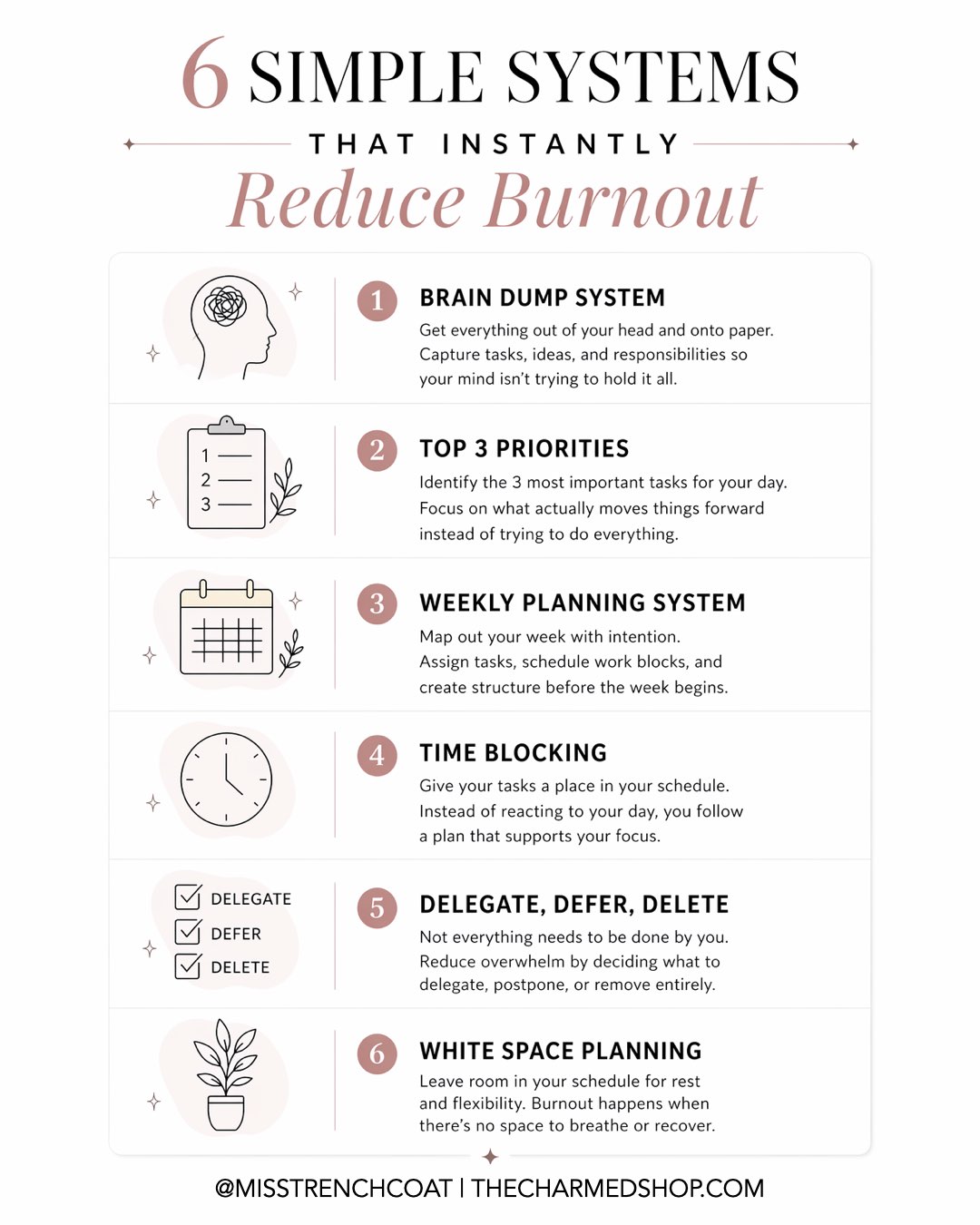
What projects are high priority?
What tasks actually move the needle?
What can I delegate, delay, or delete?
From there, I choose 1–3 core priorities to focus on for the month or quarter.
This is key. If everything is important, nothing is.
You don’t need to work on everything at once. You need to move the right things forward.
Inside IN BUSINESS, I walk members through my system for choosing aligned business projects based on their goals, energy, and season of life. This is where real momentum begins.
3. Create Structure That Supports You
Your goals need a home. That means planning routines, systems, and tools that hold your priorities and make space for execution.
My tools of choice:
Charmed Life Master Planner for scheduling and time management
CEO Strategy Planner for organizing my business plans and priorities
Each week, I:
Review my business goals
Set weekly priorities
Block time for action
Use my Top 3 system daily to move forward consistently
This isn’t about working harder. It’s about creating a rhythm that you can show up for even on imperfect days.
4. Anchor Back Into Your Vision
Whenever I feel off-track, I come back to my vision. I revisit my goals. I journal. I check in with how I want to feel.
Business isn’t just strategy. It’s energy. If something feels off, it probably is.
The solution? Reconnect with your why. Then recommit.
Inside IN BUSINESS, we build this reflection into the system. We use mindset tools, prompts, and monthly check-ins to help you come back into alignment and keep moving forward.
Action Follows Alignment
The secret to consistent action isn’t more motivation or more hours in the day. It’s alignment.
When you:
Clear your mental clutter
Choose aligned goals
Build supportive structure
And reconnect with your vision regularly…
You don’t just make progress. You become the kind of person who always follows through.
If that’s who you want to be in your business this year, I invite you to:
A behind-the-scenes breakdown of the functional planning system that helps me manage a multi-offer business and a well-balanced life year after year.
Being productive and organized is something that takes consistency. Like anything else you may want to find success at in life, you have to put systems in place and keep those systems up and running. Being a productive and organized person isn’t something that you set up once and then you’re done forever.
However, the systems you use can be decided on once, and then all you have to do is show up to maintain them. That’s what I’ve created for myself—a full-spectrum functional planning system that supports my business and my life.
Today I’m walking you through the planners and tools I use and the five core routines—yearly, quarterly, monthly, weekly, and daily—that make it all work.
If you’re someone who wants to:
Run your life and business with more ease and intention
Stay consistent and organized with your tasks and goals
Reduce decision fatigue and planning overwhelm
…this post will help you lay the foundation for your most productive and peaceful year yet.
Part 1: Yearly Planning — Setting the Vision
The purpose of my yearly planning routine is to set the vision and direction for the year. You can’t create the life or business you want unless you know what that looks like—and create a plan to get there.
Each December, I:
Set my goals for the new year
Break larger goals into milestones
Define objectives for how I’ll achieve each milestone
Assign major projects to quarters or months
Populate my planner with known events and timelines
This high-level planning ensures that my schedule reflects my priorities. It helps me visualize the big picture while grounding me in what’s most important.
My Tools:
You Got Goals Workshop + Planner: helps me clarify and break down annual goals
CEO Retreat Workshop + Workbook: outlines my business goals and sets strategic monthly focuses
2026 Charmed Life Master Planner (Vertical Digital): holds my schedule, routines, and life management
CEO Strategy Planner (Digital): organizes my business objectives, launch timelines, and offers
I view my CEO Strategy Planner as a supplementary tool. It gives me space to think deeply about business strategy, but the Charmed Life Master Planner is the hub for execution. Any business tasks or deadlines I define in the CEO planner ultimately get scheduled in my Master Planner.
This two-planner system creates a balance of big-picture thinking and daily focus.
Part 2: Quarterly Planning — Creating the 90-Day Focus
The purpose of my quarterly planning routine is to check in on my goals and break them down into manageable, actionable segments.
Too often people try to plan their whole year in detail from the start, but the truth is—you learn and adjust as you go. That’s why I plan my year broadly first, and then plan strategically one quarter at a time.
Each quarter (usually at the end of the previous one), I:
Review progress toward goals and milestones
Adjust any timelines or expectations
Define my business focus for the next 90 days
Break down large projects into smaller tasks
Assign tasks to the appropriate months
This quarterly check-in gives me a moment to breathe and re-align. I get to zoom in and ask:
What’s still relevant?
What’s no longer aligned?
What deserves my focus now?
My Tools:
Charmed Life Master Planner
CEO Strategy Planner
For example, if I scheduled a product launch in April during my yearly planning, my Q2 planning session is where I’ll map out the timeline, prepare assets, and distribute tasks into April’s monthly tracker.
Quarterly planning is also when I take stock of my time capacity. If life feels full or energy is low, I adjust accordingly. I’d rather scale back than push forward misaligned.
Part 3: Monthly Planning — Clarifying the Scope
Monthly planning is about setting clear expectations and managing scope.
It’s so common to see people overloaded with long lists of intentions, habits, and to-dos—and by week two of the month, they’re already overwhelmed and off track. That’s why my monthly routine includes intentional limitations to protect my time, energy, and momentum.
Each month, I:
Brain dump all new ideas, tasks, and obligations
Populate my calendar with key dates, events, and deadlines
Revisit any ongoing project plans
Fill out my monthly master task list
Prioritize the top 1–3 projects or habits to focus on
Begin distributing tasks to weeks of the month
In the Charmed Life Master Planner, I’ve designed structure around how many projects, systems, and habits you can reasonably track. This helps me—and my customers—self-edit.
Instead of juggling a dozen goals or routines at once, I choose a few things that matter. This lets me actually build momentum and success.
Everything I decide on in the CEO Strategy Planner, like launches or campaign prep, gets moved into my Master Planner for day-to-day execution.
This process makes my month feel like a strong container for progress—not a chaotic list of unfinished ideas.
Part 4: Weekly Planning — Structuring the Flow
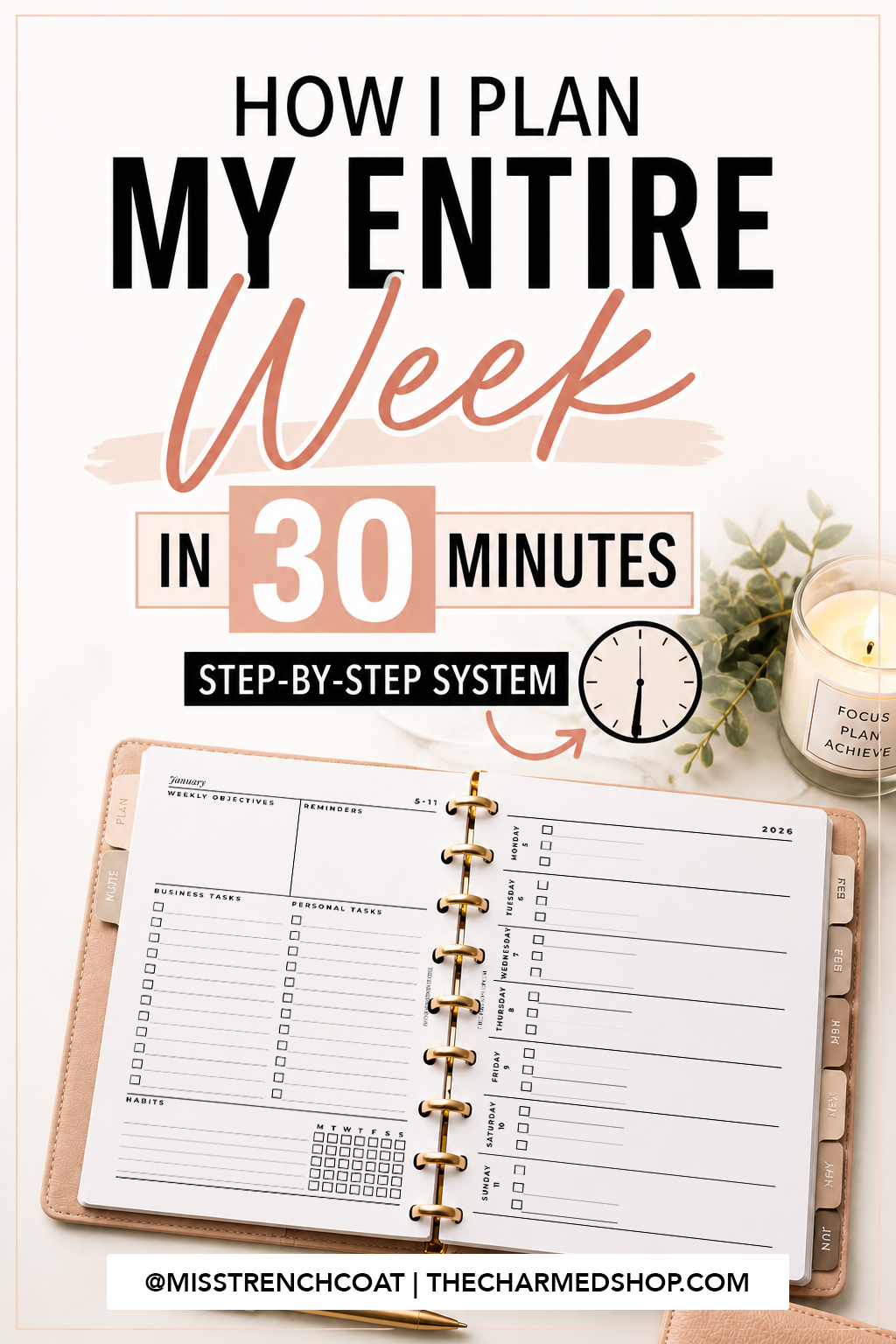
Weekly planning is where the magic happens. This is how I manage my energy and time across the 168 hours we all get in a week.
Each week, I:
Review my priorities for the month
Choose 3–5 main objectives for the week
Slot tasks and projects into daily blocks
Check my calendar for appointments and commitments
Make space for self-care, rest, and personal rituals
Confirm alignment with my partner, team, or collaborators
At the beginning of the year, I set up an Ideal Weekly Schedule inside my Charmed Life Master Planner. This template includes time blocks for household management, business admin, content creation, CEO work, errands, and personal routines.
Each week, I simply layer my current priorities on top of this template. This saves me time and energy and ensures my most important routines get done—even during busy seasons.
Themed workdays also help. I dedicate specific days for:
Admin and batching
Content creation
Coaching or calls
CEO deep work
Having this rhythm in place makes planning and showing up feel simple.
Part 5: Daily Planning — Taking Aligned Action
This is where it all comes together.
Daily planning is about knowing exactly what needs to happen today—and trusting the plan you’ve created.
Each day, I:
Review my weekly priorities and appointments
Assign a Top 3 for the day (the three tasks that move the needle)
Add any bonus or admin tasks if time allows
Reference my Ideal Daily Routine to keep the day structured
Leave white space for flexibility, rest, or unexpected events
Just like I use a weekly template, I also use a Daily Routine Template to hold the structure of my day. It includes:
Morning routine
Work blocks (deep work, meetings, batching)
Meals and breaks
Self-care and movement
Evening wind-down
This daily plan is flexible, but it creates guardrails. I don’t waste energy deciding what to do—I already know. And because my tasks are scoped and scheduled in advance, my daily list is realistic, achievable, and aligned.
If I ever need to map out a more intensive day, I use a Day on One Page spread from my planner. But most days, my Top 3 + Routine holds me steady.
Final Thoughts: Why This System Works
This system has been the key to building and sustaining my business for over a decade. And not just any business—a spacious business, one that supports my life instead of consuming it.
What makes this system powerful isn’t how much I plan. It’s how intentionally each layer supports the next:
My yearly vision gives me a sense of purpose
My quarterly plan keeps me focused
My monthly scope keeps me grounded
My weekly plan gives me flow
My daily plan drives action
This method is both strategic and self-honoring. It lets me stay productive without hustling. I get things done and I have space to rest, recharge, and enjoy life.
Want to Plan This Way Too?
You don’t need to guess or start from scratch. I’ve created tools to help you:
Start the year with clarity and structure using this simple business planning process.
If you’re a business owner or aspiring entrepreneur who feels overwhelmed by all the ideas, tasks, and goals swirling around your mind, you’re not alone. The beginning of the year brings a renewed sense of purpose and ambition—but without the right systems in place, that energy can quickly turn into chaos.
You may have a list of ideas for content you want to create, products you want to launch, or strategies you want to try. But when you sit down to plan or take action, you get stuck. The ideas are there, but they feel jumbled, disconnected, and disorganized.
This post is for you if:
You feel like your brain is constantly “on,” but you’re not making progress.
You have tons of notes, digital files, or half-started plans that don’t connect.
You’re excited about building your business this year but aren’t sure where to start.
Let me introduce you to one of the most foundational productivity and business planning tools I use: the CEO Braindump.
What Is a Business Braindump (and Why You Need One)?
A business braindump is exactly what it sounds like: it’s a process of taking everything in your head related to your business—ideas, tasks, goals, reminders, to-dos—and getting them out onto paper.
This practice gives your thoughts a home outside your mind so you can finally:
See what you’re working with
Organize your ideas
Prioritize what matters
Create plans that make sense
It’s the first step I take each year when planning for my business, and it’s something I return to monthly, weekly, or anytime I feel mentally cluttered.
Without this process, it’s easy to fall into the trap of idea overwhelm where everything feels urgent and nothing gets done.
Signs You Need to Braindump:
You procrastinate because you don’t know what to work on first
You start projects but abandon them midway
You can’t clearly explain your business plan or goals
You’re always “working” but not moving forward
Sound familiar?
It’s time to clear the clutter and get your business ideas organized.
Step 1: Capture Everything
Set aside 30-60 minutes of quiet time and grab a notebook or planner. This is your CEO meeting with yourself.
Start by writing down everything that comes to mind related to your business:
Project ideas
Content you want to create
Marketing strategies
Products or offers you want to launch
Admin or tech tasks you’ve been putting off
Education or resources you want to explore
This isn’t about filtering or judging what comes up—just let it flow. Think of this like a full brain sweep.
If you’re not sure where to begin, I created the CEO Braindump Triggers List, a free download with 50+ prompts to help jog your memory and make sure you capture everything. You can grab it [here].
Step 2: Categorize Your Thoughts
Once you have your big list of ideas, start grouping them into categories. This helps you make sense of the chaos.
Here are some simple categories to use:
Content (blog, YouTube, podcast, social posts)
Products/Offers (what you’re selling or want to sell)
Using colored pens, highlighters, or symbols can help you visually sort your thoughts. The goal here is to turn the raw data into a more organized view of your business.
Step 3: Prioritize Based on Your Goals
Once you’ve organized your list into categories, it’s time to identify what really matters.
Ask yourself:
What is essential to move my business forward right now?
What can wait?
What ideas are exciting but don’t align with my current direction?
Not every idea needs to be pursued immediately—or even at all. This step helps you discern what belongs in your business strategy and what’s just noise.
Tip: Choose 1-3 focus areas for the quarter and let the rest go (for now). This prevents burnout and builds momentum.
Step 4: Create an Actionable Plan
Now that you’ve filtered your list, you can start mapping out your next steps.
For each priority area, ask:
What is the goal?
What needs to happen to achieve it?
What specific tasks will move this forward?
Break larger goals down into manageable tasks. From here, you can assign them to specific weeks or days using a tool like the CEO Strategy Planner, which is what I personally use to manage my business goals and keep myself accountable.
Why This Works
This process may seem simple, but it’s incredibly effective. Here’s why:
It gives your ideas structure. Most people stay stuck because their thoughts are a swirl of inspiration, fear, and to-dos. This process helps you separate and structure them.
It calms your mind. Getting everything out on paper releases mental pressure. You don’t have to carry it all in your head.
It reveals priorities. Once everything is visible, it becomes easier to see what actually matters.
It sets you up for action. Clarity leads to confidence. And confidence leads to consistent action.
Tools I Recommend
If you’re ready to go deeper with your business planning, here are the tools and systems I recommend:
CEO Braindump Triggers List (Free Download): Use this every time you feel mentally cluttered. [Grab it here.]
CEO Strategy Planner: This is my ultimate tool for organizing goals, projects, and tasks in a streamlined system. Perfect for quarterly and monthly planning.
CEO Retreat Workshop: A guided experience where I walk you through the exact business planning process I use each year. Available on demand!
IN BUSINESS Program: If you’ve struggled to take consistent action on your business goals, this course will help you build the mindset and habits to follow through.
You Don’t Need to Do It All. You Just Need to Start.
If you’re still reading this, I know your heart is in the right place. You care about your business, your goals, and your potential. You’re just overwhelmed.
That doesn’t mean you’re unqualified or incapable. It just means you need a better system.
Start with a braindump. Get clear. Organize your thoughts. Choose your focus. Then build a plan.
You don’t have to get it perfect—you just have to get it out of your head.
And I promise, when you do, you’ll feel the shift.
You’ll go from chaos to clarity.
And that’s how you finally move in business.
Ready to clear your mind and organize your business ideas? Download my free CEO Business Braindump Triggers List and get started today.
If you’ve ever thought “Maybe I just haven’t found the right planner yet”—this post is for you.
Because here’s the truth most people don’t want to admit:
You don’t need another planner. You need Planner Peace.
Planner Peace isn’t about the perfect size, the perfect layout, or the prettiest aesthetic. It’s not found in a new launch, a TikTok recommendation, or your fifth planner setup of the year.
Planner Peace is what happens when your planner finally supports your life instead of distracting you from it.
Let’s talk about why so many women keep switching planners—and how to build a system that actually sticks.
Why Planner Hopping Feels Productive (But Isn’t)
In the planner community, buying a new planner feels productive.
There’s novelty. There’s dopamine. There’s the illusion of a fresh start.
But if you find yourself:
Constantly switching planners
Using multiple planners at once
Spending more time setting up than actually planning
Feeling excited… then overwhelmed… then behind
That’s not a planner problem. That’s a system problem.
Planner hopping interrupts momentum. Every time you switch, you reset your learning curve, your routines, and your trust in yourself.
Planner Peace comes from consistency, not novelty.
What Planner Peace Actually Means
Planner Peace is the calm confidence that:
You know where everything lives
You trust your system
Your planner supports your priorities
You stop second-guessing your setup
You use your planner as a tool, not a distraction
It’s not about doing more. It’s about thinking clearly and acting intentionally.
And that requires structure.
The 5 Reasons You Haven’t Found Planner Peace (Yet)
Let’s get honest—most planner struggles fall into one of these categories:
1. Shiny Object Syndrome
New planners promise transformation, but constant switching prevents follow-through. Fix: Commit to one planner for a set period (90 days minimum).
2. Relying on Other People’s Setups
What works for someone else’s life may not work for yours. Fix: Build a planner around your goals, energy, and responsibilities.
3. Valuing Form Over Function
A beautiful planner doesn’t mean a functional one. Fix: Prioritize clarity, planning, and decision-making over aesthetics.
4. Thinking You’re the Problem
If your planner doesn’t support real planning, of course it feels hard to use. Fix: Learn functional planning skills instead of blaming yourself.
5. Using an Incomplete System
Calendars alone don’t create clarity—they just record information. Fix: Use a planner that supports the entire planning process, not just scheduling.
What Makes a Planner System Actually Work
A planner that sticks doesn’t rely on motivation—it relies on structure.
A functional planning system supports three essential phases:
1️⃣ Capture
You need space to brain dump ideas, tasks, and thoughts so they’re not living in your head.
2️⃣ Organize
Your planner should help you group tasks into objectives, projects, and priorities.
3️⃣ Allocate
Only after planning should tasks be scheduled into your days and weeks.
Most planners skip the first two phases—and that’s why people feel overwhelmed, behind, or scattered even when they’re “using a planner.”
Planner Peace comes from having one system that supports all three.
Consistency Feels Boring… Until You See Results
Here’s something no one tells you:
Consistency can feel boring—especially if you’re used to novelty.
But boredom isn’t a sign something isn’t working. It’s a sign you’re building momentum.
When you stop switching planners:
You move faster
You think less about your system
You make better decisions
You trust yourself more
That’s Planner Peace.
Want Help Building a System That Sticks?
If you’re ready to stop planner hopping and start planning with confidence, I created a free resource to help you get started: