
Be Honest With Yourself First
Take a moment and really consider this—how many planners have you used so far this year?
Not how many you’ve purchased with the intention of using, but how many you’ve actually started, set up, and then eventually set aside. For many women, the answer is more than one. And if that’s the case for you, it’s not something to feel embarrassed about—it’s something to pay attention to.
Because this pattern is incredibly common among women who genuinely care about their lives. Women who want to feel organized, who want to follow through on their goals, and who are actively trying to create more structure, clarity, and control over their time. The intention is not the problem. In fact, the intention is often very strong.
What tends to happen instead is something much more subtle.
There’s a moment—usually when life starts to feel overwhelming or scattered—where the desire for a reset begins to build. You start thinking about how good it would feel to have everything in one place, to feel clear again, to feel on top of things. And in that moment, choosing a new planner feels like a solution.
So you start fresh.
You pick something new, you set it up, and for a brief period of time, everything feels aligned. You feel motivated, focused, and optimistic. It feels like you’ve finally found something that will work.
But then, slowly, that feeling begins to fade.
The planner that once felt exciting starts to feel neutral. Life interrupts your plans. A few days get missed, then a week. The structure you were trying to build starts to slip, and instead of adjusting or continuing imperfectly, a new thought takes its place:
Maybe this just isn’t the right planner.
And with that, the cycle begins again.
What’s important to understand is that this pattern doesn’t come from a lack of discipline or commitment. It doesn’t mean you’re disorganized or incapable of being consistent. More often than not, it’s the result of a deeper behavioral loop—one that keeps you in a constant state of starting over, without ever staying long enough in one system to experience real progress.
And that’s where the shift begins.
Because the truth is, you don’t need another planner.
You need a different relationship with planning.
The Cycle That’s Keeping You Stuck
For most women, switching planners doesn’t feel like a problem—it feels like a solution.
It often begins in a moment of overwhelm. Your schedule feels scattered, your tasks are piling up, and there’s a growing sense that things are slipping through the cracks. In response, you start craving clarity. You want a clean slate, a fresh start, something that will help you feel back in control of your time and your life.
That’s when the idea of a new planner begins to feel appealing.
You tell yourself that this time will be different. Maybe the layout will work better. Maybe the format will finally “click.” Maybe this is the tool that will help you stay consistent, focused, and organized in a way you haven’t been before.
So you commit to the reset.
You choose a new planner, you set it up thoughtfully, and almost immediately, you feel a shift. There’s a sense of relief, even excitement. Everything feels possible again. You map out your plans, you write down your goals, and for a brief period of time, you feel aligned and in control.
But this phase doesn’t last.
As the days pass, the initial excitement begins to wear off. The planner that once felt energizing starts to feel neutral. Life continues to demand your attention, and maintaining the system begins to require more intention than it did in the beginning. A few days get skipped. Maybe a week. The structure you were trying to build starts to loosen.
And instead of adjusting your approach or continuing imperfectly, a familiar thought returns:
This isn’t working.
At that point, it becomes very easy to assume that the problem is the planner itself. That something about the system isn’t quite right. That if you could just find a better layout, a more functional design, or a different format, everything would finally fall into place.
So you start over.
What’s important to recognize is that this cycle is not about the planner—it’s about the pattern.
Each time you restart, you interrupt whatever momentum you were beginning to build. You return to the beginning, where everything feels clear and promising, but nothing has had the chance to stabilize. Over time, this creates a habit of starting rather than sustaining. You become very familiar with the energy of a fresh start, but less experienced with the discipline of maintaining a system long enough for it to truly support you.
And because each reset feels productive in the moment, it’s easy to overlook the long-term impact. You feel like you’re taking action, when in reality, you’re staying in the earliest stage of the process.
This is what keeps so many women stuck—not a lack of effort, but a pattern of interruption.
Until that pattern is recognized and intentionally changed, no planner—no matter how beautiful or well-designed—will be able to create the consistency you’re looking for.
The Real Cause: You’re Chasing Dopamine
If you’ve ever felt a surge of motivation the moment you open a brand new planner, there’s a reason for that—and it has very little to do with the planner itself.
What you’re experiencing in that moment is a neurological response.
Dopamine is a chemical in the brain that is associated with anticipation, novelty, and reward. It’s released not just when we achieve something, but when we expect something positive to happen. It thrives on newness—the promise of change, the idea of a better version of ourselves, the possibility that things are about to improve.
And this is exactly what a new planner represents.
When you decide to start fresh, your brain interprets that decision as forward movement. It signals that you are about to become more organized, more disciplined, more in control. Before you’ve followed through on a single task, your brain rewards you with a feeling of progress.
That’s why setting up a new planner can feel so satisfying.
You haven’t actually changed your habits yet, but it feels like you have. You haven’t built consistency, but it feels like you’re on your way. You haven’t solved the underlying issue, but it feels like a solution is in motion.
This is where the disconnect begins.
Because while dopamine is powerful, it is also short-lived. It is designed to motivate action, not sustain it. Once the novelty wears off—once the planner is no longer new, once the setup is complete, once the reality of daily use sets in—that initial surge fades. What’s left behind is the actual work of maintaining a system.
And that work requires something different.
It requires structure. It requires repetition. It requires the ability to continue even when it no longer feels exciting.
Without those elements in place, the brain naturally begins to look for the next source of dopamine. And in the context of planning, that often means starting over again. A new layout. A different format. A fresh beginning.
Over time, this creates a subtle but powerful habit loop. You begin to associate the feeling of getting organized with the act of resetting, rather than the act of maintaining. Progress becomes something you start, not something you build.
This is why so many women find themselves stuck in a cycle of switching planners. It’s not a lack of discipline. It’s not a failure of effort. It’s a pattern reinforced by the brain’s natural preference for novelty over consistency.
Understanding this changes everything.
Because once you recognize that the urge to switch planners is often driven by dopamine—not by a true need for a better system—you can begin to pause before acting on it. You can question whether what you’re feeling is actually a sign that something isn’t working, or simply a sign that the newness has worn off.
And in that pause, you create space for a different choice.
One that isn’t driven by the excitement of starting over, but by the intention to keep going.
Dopamine vs. Momentum
Once you begin to understand the role dopamine plays in your planning habits, a deeper distinction starts to emerge—one that has the power to completely change how you approach consistency.
That distinction is the difference between dopamine and momentum.
Dopamine is what pulls you toward the beginning. It thrives on the idea of a fresh start, on the excitement of something new, on the belief that this next attempt will be the one that finally changes everything. It is fast, emotional, and compelling. It gives you energy quickly, but it does not sustain you.
Momentum, on the other hand, is something entirely different.
Momentum is built slowly, through repeated action. It is the result of showing up consistently, even when it feels ordinary. It doesn’t come with the same emotional intensity as a fresh start, and because of that, it is often overlooked or undervalued. But it is far more powerful.
The challenge is that momentum rarely feels exciting while it’s happening.
In fact, it often feels like boredom.
It feels like using the same planner day after day. It feels like writing similar tasks, following familiar routines, and making small, incremental progress that doesn’t immediately stand out. There is no dramatic reset, no surge of motivation, no sense of starting over with a clean slate.
And because we’ve been conditioned to associate excitement with progress, this phase can feel like something is wrong.
But this is the moment where everything is actually working.
What feels like boredom is often stability. What feels repetitive is actually reinforcement. What feels uneventful is where habits are being formed and systems are beginning to support you in a reliable way.
This is the phase where your planner starts to become useful—not because it’s new, but because it’s familiar. You know where things go. You trust the process. You begin to rely on it, not as a source of motivation, but as a tool that quietly supports your daily life.
When you interrupt this phase by switching planners, you don’t just change tools—you break momentum.
You remove yourself from the very conditions that allow consistency to develop, and you place yourself back at the beginning, where everything feels exciting but nothing is yet established. Over time, this creates a pattern where you repeatedly choose the emotional reward of dopamine over the long-term benefit of momentum.
And this is where the real shift needs to happen.
Instead of asking, “Does this still feel exciting?” the question becomes, “Is this still supporting me?”
Instead of seeking the energy of a fresh start, you begin to value the stability of a system that works.
Because the truth is, the women who experience consistency in their lives are not constantly starting over. They are not chasing new tools or reinventing their systems every few weeks. They are staying with what works, refining it over time, and allowing momentum to build.
They understand that progress is not found in the beginning—it is created in the continuation.
And when you begin to see consistency not as something that should feel exciting, but as something that should feel steady, grounded, and supportive, your entire relationship with planning begins to change.
What once felt boring starts to feel powerful.
Because you realize that you’re no longer starting over.
You’re finally moving forward.
Why You Haven’t Found Planner Peace
By this point, it’s important to gently but honestly acknowledge something: if you haven’t found “planner peace” yet, it’s not because the right planner doesn’t exist.
It’s because the foundation underneath your planning hasn’t been fully established.
This is where many women get stuck—not from a lack of effort, but from a mismatch between what they think will solve the problem and what actually will. It’s easy to assume that the issue lies in the tool itself—that something about the layout, format, or design isn’t quite right. But more often than not, the real issue is structural.
There are a few key patterns that tend to show up repeatedly in this cycle, and once you can clearly see them, you can begin to shift them.
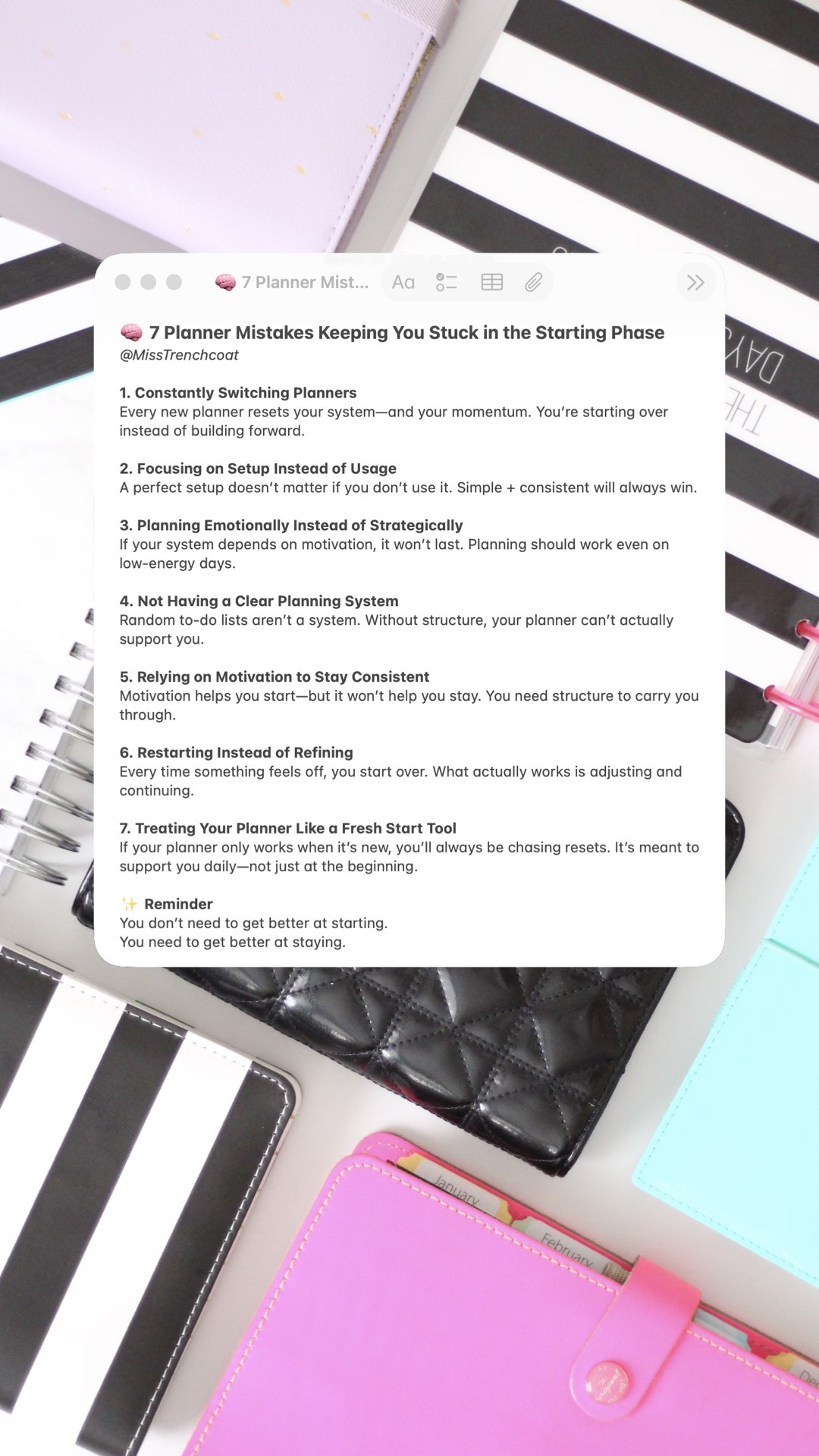
1. You Keep Restarting Instead of Refining
When something feels off in your planner, the instinct is often to start over. A new layout, a different system, a clean slate. It feels productive, but it prevents you from ever improving what you already have.
Refinement is where systems become sustainable. It requires you to look at what’s working, what isn’t, and make small adjustments over time. Without that process, every attempt stays temporary, and you never give your system the chance to fully support you.
2. You Don’t Have a Functional Planning System
Many planners are used as collections of lists rather than as structured systems that guide action. Tasks are written down, but they aren’t connected to larger objectives. There is no clear flow from capturing ideas, to organizing them, to actually executing them.
Without that structure, your planner becomes reactive instead of intentional. And when your planning lacks direction, it’s easy to assume the problem is the tool—when in reality, it’s the missing system underneath it.
3. You Prioritize Aesthetics Over Execution
There’s nothing wrong with wanting your planner to look beautiful. In fact, aesthetic can be part of what draws you into using it. But when visual appeal becomes the priority over functionality, it can quietly create friction.
If your planner is too complicated to maintain, too time-consuming to set up, or too focused on appearance rather than usability, it becomes harder to return to consistently. Over time, this can make you feel like you’ve “fallen off,” when really, the system was never designed for sustainability.
4. You Don’t Have a Consistent Planning Routine
Planning is not a one-time event—it’s an ongoing practice. Without a regular rhythm, it becomes difficult to stay connected to your plans.
When you don’t have consistent touchpoints—whether daily check-ins or weekly resets—your planner quickly becomes outdated. Tasks get missed, priorities become unclear, and the system starts to feel unreliable. Once that connection is lost, it becomes much easier to abandon it altogether and look for something new.
5. You Rely on Motivation Instead of Structure
Motivation is often highest at the beginning, which is why starting a new planner feels so good. But motivation is not designed to sustain long-term behavior.
When your system depends on how you feel, consistency becomes fragile. On days when you’re tired, busy, or overwhelmed, there’s nothing holding the structure in place. Over time, this creates a pattern where you engage when you feel motivated and disengage when you don’t—making it difficult to build any real momentum.
When you look at these patterns together, a clearer picture begins to form.
Planner peace is not about finding something new—it’s about strengthening what’s already there.
It’s about shifting from a mindset of searching to a mindset of building. When you begin to focus on creating a system that is functional, flexible, and rooted in your real life, you remove the need to constantly start over.
And that is where planner peace begins—not in the discovery of the perfect planner, but in the development of a system that actually works.
What Your Planner Actually Needs to Work
Once you step out of the cycle of constantly switching planners, the next question becomes much more important: what actually makes a planner work?
Because the truth is, a planner alone is not what creates organization, clarity, or consistency. It is simply a tool. Its effectiveness depends entirely on whether it supports a system that is designed to function in your real life.
This is where functional planning becomes essential.
A functional planner is not defined by how it looks or how exciting it feels at the beginning. It is defined by whether it supports your ability to consistently capture, organize, and follow through on what matters. When those elements are in place, your planner becomes something you can rely on—not something you are constantly trying to fix.
At its core, there are six essential elements your planner must include in order to truly work:
1. Capture Space
Your planner needs a dedicated space to capture everything that is on your mind—tasks, ideas, reminders, and responsibilities.
Without this, you are forced to rely on memory, which quickly leads to overwhelm and mental clutter. A capture space acts as your external brain. It allows you to get everything out of your head and into a trusted system, so you can think more clearly and focus on execution instead of remembering.
2. Objective Planning
Your planner should give you a clear way to define what you are working toward and organize your responsibilities around those outcomes.
This is what shifts your planning from reactive to intentional. Instead of simply writing down tasks, you are creating structure around meaningful objectives. Your planner becomes a tool for direction, not just documentation.
3. Task Organization by Objective
Once your objectives are defined, your tasks should be grouped based on what they contribute to.
This creates clarity and focus. Instead of managing scattered to-do lists, you are working within organized categories that reflect your priorities. It becomes easier to see progress, make decisions, and stay aligned with what actually matters.
4. Task Allocation Across Time
A functional planner must allow you to assign tasks to specific days based on priority, urgency, and capacity.
Without allocation, tasks remain abstract—they exist on a list, but they are not anchored in your schedule. Allocation is what turns intention into action. It ensures that your plans have a place within your real life, not just on paper.
5. Daily Top 3 Priorities
Each day should have a clear set of priorities—typically three key tasks that must be completed in order to move your life forward.
This creates focus and direction. Instead of reacting to everything at once, you are anchored in what matters most. It simplifies your day and ensures that even in busy or unpredictable moments, you are still making meaningful progress.
6. Flexibility
Finally, your planner must allow for flexibility.
No system will ever be followed perfectly. Plans will shift, unexpected things will come up, and some days will not go as intended. A functional planner supports adjustment without requiring you to start over. It allows you to move things, reassess priorities, and continue forward without breaking your system.
When these six elements are in place, your planner begins to function very differently.
It no longer feels like something you are trying to “keep up with.” Instead, it becomes a system that supports you—consistently, reliably, and realistically.
And that is the shift that changes everything.
Your planner isn’t supposed to fix your life.
It’s supposed to support a system that already makes sense.
When you have that system in place, you stop searching for something better—and start using what you already have in a way that actually works.
The Hidden Trigger: Your Self-Talk
Even with the right planner and a functional system in place, there is one factor that quietly influences your behavior more than anything else—your self-talk.
Before you switch planners, there is always a moment that happens internally first. It may feel quick or almost automatic, but there is a thought that justifies the decision. That thought creates the emotional shift that leads to action.
And most of the time, it sounds completely reasonable.
You might think to yourself that your current planner isn’t working, that something feels off, or that you would be more consistent if you just found a better setup. In the moment, these thoughts don’t feel like avoidance—they feel like problem-solving.
But in reality, they are often emotional responses to discomfort.
That discomfort might come from falling behind, from feeling disorganized, or even from the natural “boredom” that comes with consistency. Instead of recognizing those feelings as part of the process, your brain looks for relief. And the fastest way to create that relief is to start over.
This is why self-talk matters so much.
Because if the thought is not interrupted, the behavior will repeat.
Learning to recognize these patterns—and respond to them intentionally—is what allows you to stay in your system long enough for it to actually work.
🔍 The Thoughts That Keep You Stuck
These are some of the most common thoughts that trigger planner switching:
- “This planner just isn’t working.”
- “I need something better.”
- “I’ll be more consistent with a different layout.”
- “I’ve already fallen behind, so I might as well start fresh.”
Each of these thoughts feels logical on the surface. But if you look more closely, they all lead to the same outcome: starting over.
And starting over, as you’ve seen, is what keeps you stuck.
🔮 What to Tell Yourself Instead
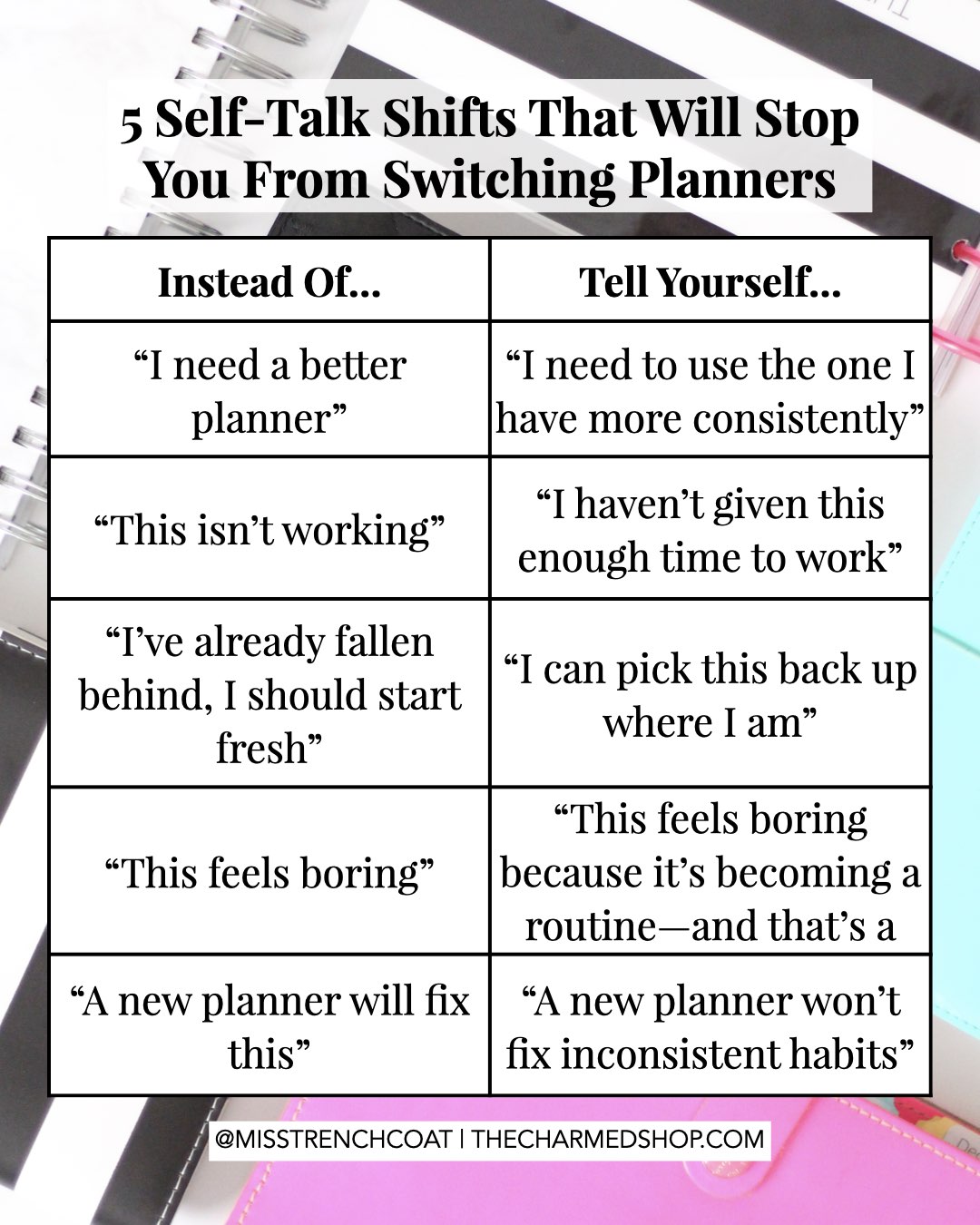
The goal is not to ignore these thoughts—it’s to replace them with ones that support consistency instead of disruption.
The next time you feel the urge to switch planners, pause and consciously choose a different response.
You might remind yourself:
- “A new planner won’t fix inconsistent habits.”
The tool is not the issue—the behavior is. - “I don’t need a new system. I need to use the one I have.”
Consistency comes from repetition, not replacement. - “This feels boring because it’s working.”
What you’re feeling is not failure—it’s stability. - “Refining creates results. Restarting creates stress.”
Progress comes from adjustment, not abandonment. - “Consistency is my advantage.”
The longer you stay with your system, the more it works for you.
✨ How to Use This in Real Time
When the urge to switch planners comes up, it’s important to create a small pause between the thought and the action.
Instead of immediately searching for a new planner or redesigning your system, take a moment to check in with yourself.
Ask:
- Am I reacting to discomfort or making a strategic decision?
- Have I truly given this system time to work?
- What would it look like to refine this instead of replace it?
This pause is where your power is.
Because over time, these small moments of awareness begin to shift your identity. You move from someone who is constantly searching for the right planner, to someone who knows how to use a system effectively.
And that shift is what ultimately creates consistency.
When your self-talk begins to support your goals instead of undermine them, planning becomes less about starting over—and more about staying the course.
And that is where real momentum begins.
How to Add Variety Without Starting Over
By this point, it’s important to acknowledge something that often goes unspoken: the desire for a new planner is not inherently a problem.
Wanting your planner to feel fresh, engaging, or even a little more fun is completely valid. In fact, that desire often comes from a deeper place—a desire to feel connected to your life, inspired by your routines, and creatively engaged with the systems you use every day.
The issue is not the desire for variety.
The issue is how you’ve been conditioned to respond to it.
For many women, that desire has been met with replacement. When things start to feel repetitive or uninspiring, the immediate instinct is to change the entire system. But as you’ve seen, this comes at the cost of your momentum. Each time you replace your planner, you reset the very structure that was beginning to support you.
The shift, then, is not to eliminate the desire for something new—but to meet it in a more intentional way.
Instead of replacing your planner, you begin to expand within it.
When your planner becomes a space that reflects not just your responsibilities, but your personality, your interests, and your life as a whole, it naturally becomes something you want to return to. It evolves from being a tool you “have to use” into something you are actively engaged with.
There are several ways to introduce this kind of variety without disrupting your system.
✨ 1. Add Memory-Keeping Pages
One of the simplest ways to bring more life into your planner is to create space for reflection and documentation.
This might look like setting aside a page or two each week where you capture highlights from your life—not tasks, but experiences. You can write about meaningful moments, small wins, or even things that made you feel good that day. Some women like to include photos, stickers, or visual elements, while others keep it more minimal and text-based.
The purpose of this is not perfection—it’s presence.
By incorporating memory-keeping into your planner, you begin to associate it with your life as a whole, not just your obligations. It becomes a record of both what you did and how you lived.
🎮 2. Create Hobby Inserts
Your planner should not exist solely as a space for productivity—it should also make room for enjoyment.
Adding pages dedicated to your hobbies is a powerful way to make your planner feel more personal and engaging. These pages can be simple or detailed, depending on your preference.
For example, you might create:
- A video game journal where you track what you’re playing, your progress, or your thoughts
- A reading log to document books you’ve finished or want to read
- A creative project tracker for things you’re working on in your free time
These inserts allow your planner to reflect your identity beyond your responsibilities. They create a sense of balance and make your system feel more aligned with your actual life.
🖼️ 3. Build a Wishlist or Vision Page
Another way to introduce variety is by creating space for inspiration.
A wishlist or vision page gives you a place to collect ideas, items, or experiences you are working toward. This could include screenshots, photos, links, or even handwritten lists of things you want to purchase, try, or explore.
This serves two purposes.
First, it satisfies the desire to engage with something new and visually interesting. Second, it keeps that energy contained within your existing system, rather than pulling you toward creating or buying something entirely new.
Over time, this page becomes a reflection of your evolving tastes, goals, and desires.
📚 4. Track Collections You Care About
If you naturally enjoy collecting or curating things, your planner can become a space to organize and track those interests.
This might include:
- Books you own or want to read
- Beauty or skincare products
- Fashion pieces you’re building into a wardrobe
- Home items or decor ideas
By creating dedicated pages for these collections, you add another layer of personalization to your planner. It becomes something you engage with not just out of necessity, but out of interest.
This also reinforces the idea that your planner is a central hub for your life—not just your to-do list.
🌿 5. Add Seasonal or Lifestyle Pages
Finally, you can introduce variety by rotating in pages that reflect your current season of life.
These pages can shift month to month or season to season, depending on what feels relevant to you. They allow your planner to feel fresh without requiring a complete reset.
Examples of this might include:
- A “Things I’m Loving This Month” page
- A seasonal reset or intention-setting page
- A list of habits, routines, or experiences you want to focus on
- Mood-based planning pages that reflect your energy or priorities
These additions create a sense of renewal within your existing system. Instead of chasing a fresh start, you create one intentionally—without losing your progress.
The Real Shift
When you begin to approach your planner this way, something important changes.
You no longer rely on a new planner to create excitement or inspiration. Instead, you build those elements into a system that is already working.
This allows you to meet both needs at once:
- The need for structure and consistency
- The desire for creativity and variety
And when those two things coexist, your planner becomes something you don’t want to replace.
It becomes something you want to return to.
Because it finally feels like it was designed for you.
The Truth About Planner Peace
By now, you may be starting to see your planning habits in a different light.
What once felt like a series of disconnected attempts—trying new planners, starting over, searching for something that would finally work—begins to reveal itself as a pattern. Not a failure, but a cycle. One that was driven by good intentions, but reinforced by habits that kept you in a constant state of beginning.
And with that awareness comes an important realization:
Planner peace is not something you find.
It’s something you build.
It is not hidden inside the perfect planner, waiting to be discovered. It is created through the way you use the tools you already have, the way you respond to discomfort, and the way you choose to stay consistent even when it no longer feels new or exciting.
For most women, this is the shift that changes everything.
Instead of asking, “What planner will finally work for me?” the question becomes:
“How can I create a system that supports me consistently?”
That shift moves you out of a mindset of searching and into a mindset of ownership.
What Planner Peace Is Actually Built On
Planner peace is not about perfection. It is not about having the most aesthetic setup or following your system flawlessly every single day.
It is built on a few key foundations:
- Consistency
Returning to your planner regularly, even when you’ve fallen behind or missed a few days. Consistency is not about never slipping—it’s about always coming back. - Structure
Having a system that supports how you capture, organize, and execute your responsibilities. Structure removes the guesswork and creates clarity. - Self-Trust
Knowing that you can rely on yourself to follow through, adjust when needed, and continue forward without abandoning your system. - Flexibility
Allowing your planner to adapt to your life, rather than expecting your life to perfectly fit your planner.
When these elements are in place, something begins to shift.
You stop feeling like you’re constantly trying to “get it right.” You stop searching for a better tool or a more perfect setup. And instead, you begin to experience a sense of stability.
Your planner becomes familiar. Supportive. Reliable.
It becomes a place you return to, not because it’s exciting, but because it works.
And perhaps most importantly, you begin to trust yourself within your system.
You know how to reset without starting over. You know how to adjust without abandoning everything. You know how to keep going, even when things aren’t perfect.
From Starting Over to Moving Forward
This is the moment where the cycle finally begins to break.
You are no longer someone who is constantly starting over.
You are someone who refines, adjusts, and continues.
You are someone who understands that progress is not found in the beginning, but in the continuation.
And that shift—while subtle at first—is what creates real, lasting change.
Because when you stay with a system long enough to see it work, you begin to experience something that no new planner can give you:
Momentum.
Clarity.
Confidence.
Your Next Step
If you’re ready to step out of the cycle of starting over and finally build a planning system that supports your life in a consistent, sustainable way, the next step is to focus on your foundation.
Inside my Well Planned & Productive Woman Essential Planning Guide, I walk you through how to:
- Create a functional planning system that actually works
- Stay consistent without relying on motivation
- Build structure that supports your real life
- Start creating momentum instead of constantly resetting
This is where everything begins to come together.
Because you don’t need another planner.
You need a system that supports the woman you’re becoming.
xoxo,