Each day of the week holds a different kind of energy—and when you understand the vibe, you can plan your time more intentionally.
Welcome to the magical practice of planetary planning—a soft, soulful approach to scheduling based on classical astrology. Each day is traditionally ruled by a planet that governs certain moods, actions, and outcomes. And while you don’t need to be fluent in astrology to use this, you can tap into the flow of each day to bring a little more alignment (and ease) to your productivity.
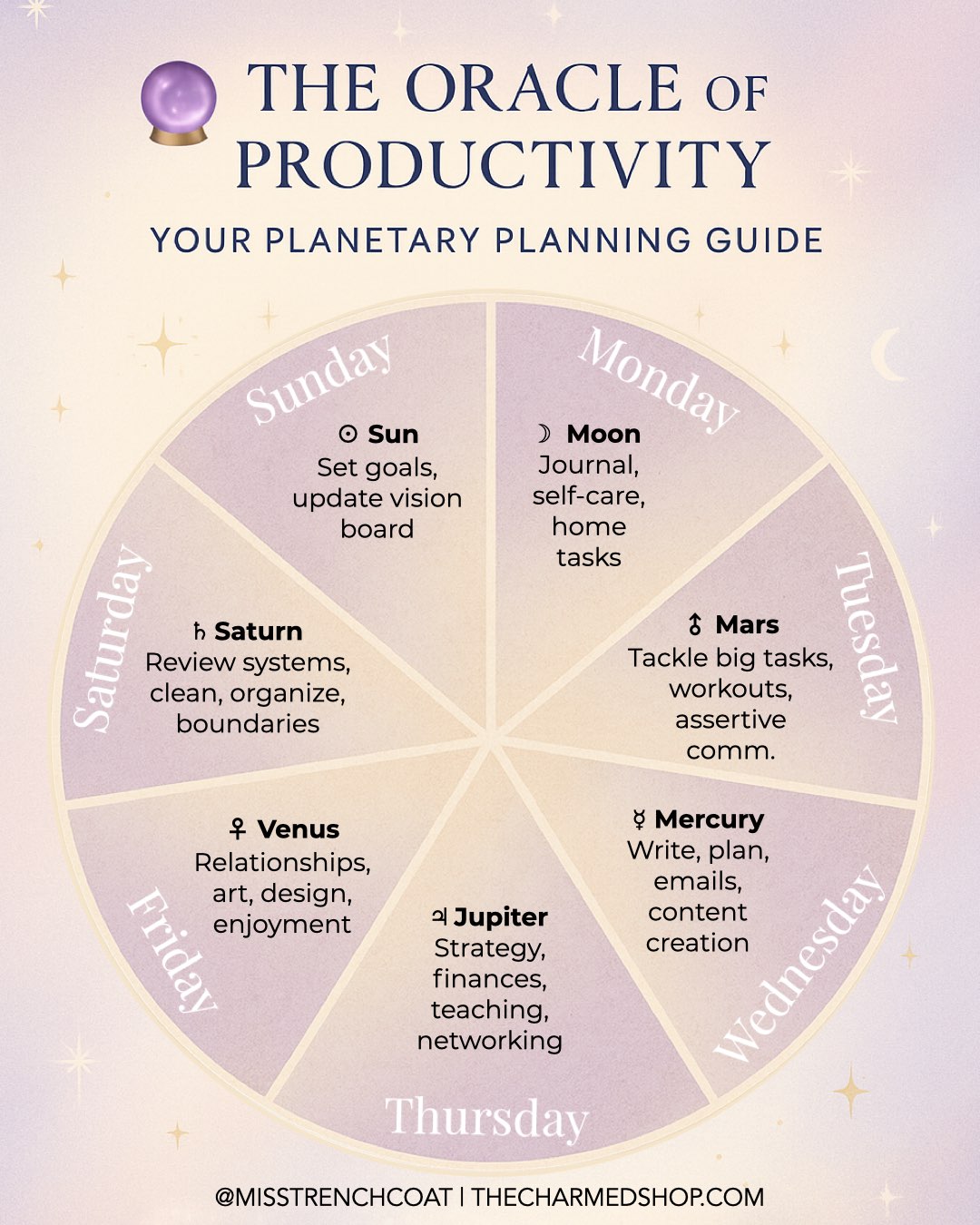
This post will guide you through all 7 days of the week with their corresponding planetary rulers, energetic themes, ideal tasks, and recommended planner inserts from the Charmed Life Master Planner System.
Let’s explore the cosmic calendar…
🌞 Sunday — Ruled by the Sun
Energy: Vitality, self-expression, visibility, creativity Ideal Activities: Set weekly goals, update your vision board, spend time outdoors, reconnect with your personal mission Planner Insert:Yearly Goals or Vision Board Bonus Magic: Wear gold, work with citrine or tiger’s eye
🌙 Monday — Ruled by the Moon
Energy: Emotions, intuition, nurturing, home life Ideal Activities: Journaling, home organization, reflection, intuitive planning Planner Insert:Monthly Review or Brain Dump Bonus Magic: Wear silver or white, work with moonstone or selenite
🔥 Tuesday — Ruled by Mars
Energy: Drive, courage, productivity, assertiveness Ideal Activities: Tackle hard tasks, make decisions, push forward on goals, strength training Planner Insert:Objective Tracker or Week on One Page Bonus Magic: Wear red, work with garnet or red jasper
🧠 Wednesday — Ruled by Mercury
Energy: Communication, clarity, mental focus, planning Ideal Activities: Admin work, meetings, writing, marketing, research Planner Insert:Week on Two Pages Horizontal or Brainstorm Bonus Magic: Wear yellow, work with clear quartz or citrine
💸 Thursday — Ruled by Jupiter
Energy: Growth, wisdom, abundance, optimism Ideal Activities: Strategic planning, education, financial review, visionary work Planner Insert:Yearly Objective Matrix or Productivity Strategy Reference Bonus Magic: Wear blue or purple, work with amethyst or lapis lazuli
💕 Friday — Ruled by Venus
Energy: Beauty, pleasure, connection, creativity Ideal Activities: Self-care, content creation, relationships, beauty rituals, creative projects Planner Insert:Ideal Daily Routine or Monthly Calendar Bonus Magic: Wear pink or green, work with rose quartz or emerald
🪨 Saturday — Ruled by Saturn
Energy: Structure, discipline, boundaries, responsibility Ideal Activities: Review long-term goals, clean and organize, complete unfinished tasks, build structure for next week Planner Insert:Monthly Objective Tracker or Day on One Page Bonus Magic: Wear black or navy, work with hematite or black tourmaline
✨ Final Thoughts
Astrology gives us an intuitive framework for flow. When you understand the energetic story each day is telling, you can plan your time more intentionally—and align your efforts with the universe.
You don’t have to change your entire system. Just start small. Assign one type of task to one day that feels aligned and notice how much smoother your week begins to feel.
And if you’re ready to bring more magic into your planning…
🪐 The Charmed Life Master Planner System was designed to work with your energy, not against it. With flexible inserts and strategic tools, you can create your own cosmic productivity ritual—one week at a time.
You weren’t meant to fit into someone else’s productivity system. And if you’ve ever felt like traditional productivity advice leaves you overwhelmed or uninspired, it might be time to look to the stars.
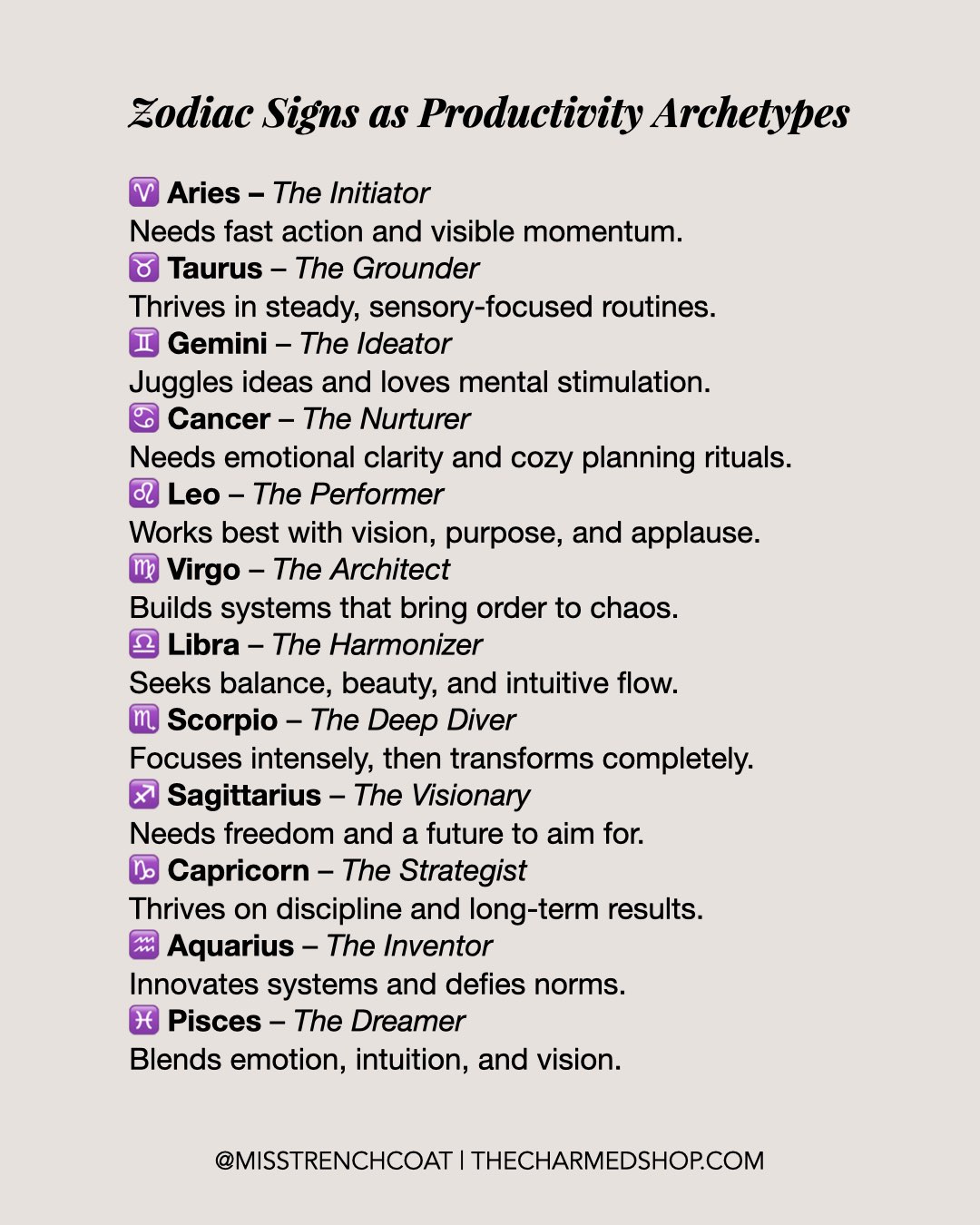
Your zodiac sign can be more than just a personality indicator—it can offer surprising insight into how you work best, where you struggle, and what kind of planning system will actually support your success. Whether you’re a fiery Aries who thrives on momentum or a thoughtful Virgo who lives for checklists, your sign might hold the key to unlocking your ideal workflow.
Don’t worry—if you’re not into astrology or don’t know your chart, this post is still for you. Simply read through the signs and choose the ones that speak to your specific strengths and struggles. You’ll find actionable productivity advice you can use—whether you believe in zodiac signs or not.
In this post, we’re breaking down each sign’s:
Productivity Superpower
Common Struggle
Ideal Weekly Reset Routine (3 steps)
Must-Have Insert from the Charmed Life Master Planner System
Let’s dive into the cosmos and create a planning system that aligns with your energy and helps you get things done like magic.
♈️ Aries (March 21 – April 19)
Productivity Superpower: Aries is bold, energetic, and thrives in motion. You’re a natural initiator with an eye for fast wins and the confidence to leap into action before others even make a plan.
Common Struggle: You may struggle with impulsivity, unfinished projects, and burnout from doing too much too quickly. Long-term consistency doesn’t come naturally, which can derail your momentum.
Ideal Weekly Reset Routine:
Brain Dump to Clear the Slate: Start your week with a clean mind. Use the Brain Dump insert to capture all your racing ideas, to-dos, and mental clutter. Don’t edit—just release.
Prioritize with the Objective Plan: Choose one key objective to focus on and map out your steps using the Objective Plan with Notes. Aries energy thrives on clarity and direction.
Schedule Quick Wins: Use the Week on One Page agenda to block in small tasks that give you fast progress. This keeps your energy high while maintaining focus on your goal.
Must-Have Insert:Objective Plan with Notes — helps transform impulsive energy into a focused strategy for completion.
♉️ Taurus (April 20 – May 20)
Productivity Superpower: Taurus is dependable, consistent, and thrives in grounded routines. You bring slow and steady progress, which leads to powerful long-term results.
Common Struggle: You may resist change or struggle with inertia—once you’re in a comfort zone, it’s hard to get moving again. New systems or tools can feel overwhelming.
Ideal Weekly Reset Routine:
Revisit Your Ideal Daily Routine: Use the Ideal Daily Routine insert to refine your rhythm and rebuild any habits that slipped. Taurus excels when anchored in predictability.
Plan in Spacious Blocks: Use the Monthly Calendar (Two Page) layout to create structure without pressure. Avoid overscheduling.
Add a Ritual to Your Week: Choose a small but meaningful upgrade—like a new candle, playlist, or coffee ritual—on your Vision Board to keep things feeling fresh.
Must-Have Insert:Ideal Daily Routine — supports comfort, stability, and repeatable success through grounded structure.
♊️ Gemini (May 21 – June 20)
Productivity Superpower: Gemini is mentally agile, communicative, and full of ideas. You shine when juggling multiple interests, connecting dots, and creating in short bursts.
Common Struggle: With so many interests, you may lose focus quickly, jump from project to project, and struggle with consistency or overcommitting your time.
Ideal Weekly Reset Routine:
Brainstorm Everything: Use the Brainstorm insert to capture all your ideas, plans, and inspirations in one place—no filter needed.
Theme Your Week: Use the Week on Two Pages Horizontal to assign a loose theme or category to each day (e.g., content, admin, meetings).
Track Quick Wins: Refer to your Productivity Strategy Reference to identify your best go-to tools for finishing tasks fast.
Must-Have Insert:Brainstorm — gives you a space to play with ideas before committing them to your plan.
♋️ Cancer (June 21 – July 22)
Productivity Superpower: Cancer is deeply intuitive and emotionally intelligent. You’re a nurturer at heart and do your best work when your environment feels safe, calm, and supportive.
Common Struggle: You may struggle with emotional overwhelm, overcommitting to others’ needs, or neglecting your own boundaries and energy levels.
Ideal Weekly Reset Routine:
Reflect Before You Plan: Use the Monthly Review to release emotional baggage and reconnect with your deeper goals.
Protect Your Energy: Block out self-care time first in your Ideal Weekly Schedule—rest, reflection, and gentle movement.
Set Gentle Intentions: Use the Monthly Objective Tracker to outline 1–2 meaningful goals and 2–3 supportive habits or routines.
Must-Have Insert:Monthly Objective Tracker — helps you track personal growth without pressure, and create habits that nourish your emotional well-being.
♌️ Leo (July 23 – August 22)
Productivity Superpower: Leo is bold, expressive, and motivated by purpose. You thrive when you’re inspired and have a spotlight-worthy goal to pursue.
Common Struggle: You may resist mundane tasks or lose interest when you’re not receiving recognition. Too much routine can dull your spark.
Ideal Weekly Reset Routine:
Reconnect with Your Vision: Use your Vision Board insert to revisit your big-picture dreams and refresh your “why.”
Break It Down Strategically: Use the Yearly Objective Matrix to map out key milestones and create a sense of structure around your goals.
Plan Visibility Moments: Schedule creative or performance-based tasks in your Monthly Task List—social posts, presentations, launches.
Must-Have Insert:Vision Board — keeps your goals visually and emotionally front-and-center, helping you lead with intention.
♍️ Virgo (August 23 – September 22)
Productivity Superpower: Virgo is methodical, detail-oriented, and naturally gifted at creating structure. You thrive when there’s a clear system and a checklist to follow.
Common Struggle: You may struggle with perfectionism, overthinking, or getting stuck in the planning phase instead of taking action.
Ideal Weekly Reset Routine:
Declutter Your Mind: Use the Brain Dump to clear your thoughts and then sort tasks by importance and urgency.
Track Your Systems: Use the Monthly Objective Tracker to log routines, habits, and incremental progress.
Plan for Precision: Use the Week on Two Pages Vertical layout to schedule your tasks clearly and efficiently.
Must-Have Insert:Monthly Objective Tracker — brings clarity and control to your high standards without the overwhelm.
♎️ Libra (September 23 – October 22)
Productivity Superpower: Libra is diplomatic, thoughtful, and great at creating harmony in their environment. You work best when your space and schedule feel balanced and beautiful.
Common Struggle: You may struggle with indecision, people-pleasing, or spending too much time weighing options instead of acting.
Ideal Weekly Reset Routine:
Visualize Your Week: Use the Ideal Weekly Schedule to block out a well-rounded plan with time for work, creativity, and connection.
Narrow Your Focus: Use the Objective Tracker to select one priority at a time and track small, steady progress.
Keep It Simple: Use the Monthly Calendar (One Page) to avoid clutter and decision fatigue.
Must-Have Insert:Ideal Weekly Schedule — helps you design a well-balanced week you can stick to with clarity and ease.
♏️ Scorpio (October 23 – November 21)
Productivity Superpower: Scorpio is focused, strategic, and fiercely committed to long-term transformation. You excel at deep work and pushing through resistance.
Common Struggle: You may struggle with intensity overload, burnout, or isolating yourself during difficult tasks. Your “all or nothing” approach can lead to imbalance.
Ideal Weekly Reset Routine:
Prioritize Depth, Not Volume: Use the Objective Plan with Notes to choose one high-impact goal and outline your path to completion.
Protect Your Focus Time: Schedule non-negotiable blocks in the Day on One Page insert for distraction-free work.
Create Space to Release: Use the Monthly Review to reflect on your energy and reset emotionally.
Must-Have Insert:Day on One Page — gives you space to manage intense focus, while still honoring emotional balance.
♐️ Sagittarius (November 22 – December 21)
Productivity Superpower: Sagittarius is optimistic, adventurous, and thrives on exploration. You’re energized by big ideas, freedom, and the opportunity to learn or grow.
Common Struggle: You may struggle with restlessness, staying committed to routines, or boredom with repetitive tasks. Long-term planning can feel too limiting.
Ideal Weekly Reset Routine:
Zoom Out First: Use the Yearly Tracker & Yearly Overview to remind yourself of your big-picture goals and how this week supports them.
Plan in Sprints: Use the Week on Two Pages Horizontal to plan blocks of creative focus with lots of open space in between.
Anchor to Adventure: Use the Yearly Objective Matrix to map out your next trip, course, or milestone that keeps you motivated.
Must-Have Insert:Yearly Tracker & Yearly Overview — keeps your goals flexible and future-focused, which supports your desire for inspired progress.
♑️ Capricorn (December 22 – January 19)
Productivity Superpower: Capricorn is ambitious, disciplined, and laser-focused on achieving long-term goals. You naturally structure your time and thrive when you’re working toward something meaningful.
Common Struggle: You may struggle with overworking, perfectionism, or becoming so task-focused that you forget to celebrate your wins or take meaningful breaks.
Ideal Weekly Reset Routine:
Clarify Priorities: Use the Productivity Strategy Reference to revisit your values and choose the most strategic priorities for the week.
Set a Realistic Objective: Plan a measurable, achievable outcome using the Objective Tracker, and map tasks accordingly.
Plan, Then Rest: Use the Week on Two Pages Vertical for detail-oriented scheduling—and block in non-negotiable rest.
Must-Have Insert:Productivity Strategy Reference — gives you a systems-based approach to goal setting and time management that fuels sustainable success.
♒️ Aquarius (January 20 – February 18)
Productivity Superpower: Aquarius is innovative, future-focused, and thrives on unconventional ideas. You’re a visionary thinker who works best when you feel free to challenge the status quo and create meaningful impact.
Common Struggle: You may struggle with follow-through, getting distracted by new ideas, or resisting structure that feels too restrictive or traditional.
Ideal Weekly Reset Routine:
Download Your Genius: Use the Notes insert to document your ideas, inspiration, and insights before they’re forgotten or scattered.
Balance Vision with Structure: Use the Yearly Objective Matrix to visualize how your innovative ideas ladder into long-term goals.
Stay Grounded with Planning: Use the Week on Two Pages Horizontal to lightly structure your time while leaving room for flexibility.
Must-Have Insert:Yearly Objective Matrix — allows you to map out your big-picture plans and organize them into meaningful action over time.
♓️ Pisces (February 19 – March 20)
Productivity Superpower: Pisces is intuitive, imaginative, and deeply inspired by beauty and emotion. You thrive when your planning process taps into your creativity and allows for flexibility and flow.
Common Struggle: You may struggle with staying grounded, following through on details, or getting distracted by dreams and ideas without taking consistent action.
Ideal Weekly Reset Routine:
Create a Vision Ritual: Use the Vision Board insert to visually anchor your weekly intentions and make your goals feel emotionally real.
Channel Intuition into Planning: Use the Brain Dump to free-write everything in your head, then gently organize tasks into manageable categories.
Design Dreamy Structure: Use the Week on Two Pages Horizontal to plan in flow-based time blocks rather than rigid schedules.
Must-Have Insert:Vision Board — turns abstract ideas into something tangible and motivating, keeping you emotionally connected to your goals.
✨ Final Thoughts: Your Cosmic Productivity Plan
Whether you’re a disciplined Capricorn or a dreamy Pisces, productivity isn’t one-size-fits-all. The most powerful system is one that aligns with your natural rhythms, honors your unique strengths, and supports your personal growth.
By using astrology as a lens, you gain permission to work with your energy—not against it. And with the right tools from the Charmed Life Master Planner, you can design a planning system that’s not just functional, but magical.
🪄 Ready to plan your week like it was written in the stars?
Explore the Charmed Life Master Planner System and get the inserts you need to bring your zodiac-aligned productivity style to life.
If you’ve ever reached the end of a quarter completely drained, you’re not alone. Most of us were taught to treat productivity like a sprint: push harder, go faster, hustle until you drop. But the truth is, your energy—not your time—is the real VIP resource when it comes to achieving goals.
Time is fixed. Energy is flexible. And when you learn to manage and protect your energy, you unlock the ability to stay consistent, make better decisions, and actually enjoy the process of pursuing your goals.
As we head into Q4—the busiest season of the year—it’s more important than ever to set rules around how you use and protect your energy. Here are 7 rules that will help you conserve your most valuable resource, paired with practical productivity strategies that actually work.
Rule 1: Go Slow to Go Far
Strategy: Theme Your Workdays (Default Weekly Schedule)
The culture of hustle tells us to go all-in, move faster, and get it all done yesterday. But real progress is built through rhythm, not sprints. Going slow doesn’t mean moving lazily—it means moving intentionally.
One of the best ways to apply this rule is to theme your workdays using a default weekly schedule. Instead of reacting to whatever comes your way, you assign each day a primary focus.
Examples of a themed week in Q4 might look like this:
Monday: Planning & administration
Tuesday: Deep work / big projects
Wednesday: Meetings & collaboration
Thursday: Content creation
Friday: Wrap-up & holiday/family prep
When you stick to a rhythm like this, you reduce decision fatigue, protect your focus, and ensure your energy is always aligned with meaningful progress.
Remember: You don’t need to sprint to the finish line. You just need a pace you can sustain.
Rule 2: Rest Before You’re Tired
Strategy: Take Strategic Breaks (Pomodoro & Micro-Breaks)
Most people rest only after they’ve hit a wall—but by then, recovery takes far longer. Protecting your energy means resting before you need to.
Use simple strategies like:
Pomodoro Technique: Work for 50 minutes, then rest for 10.
Micro-breaks: Stand up, stretch, or walk for 2–3 minutes every hour.
Daily pauses: Midday reset rituals (like a walk, journaling, or a short meditation).
These small, intentional breaks keep your energy consistent throughout the day. Think of it like fueling a car: you don’t wait until the tank is empty to fill up—you top off before you’re stranded.
Rule 3: Use Your Best Energy on Your Best Work
Strategy: Energy-Based Time Blocking
Not all hours of the day are equal. Some hours you’re sharp and focused; others, you’re sluggish and distracted. The key to energy management is to match your best energy to your most important priorities.
Schedule deep, creative, or strategic work during your natural peak hours (morning for many people, late evening for others).
Save routine or administrative tasks for lower-energy times.
Block your calendar around these rhythms so you’re not wasting prime energy on mundane tasks like emails or errands.
When you direct your best energy toward your highest-value work, you get better results in less time—without needing to push harder.
Rule 4: Guard Your Inner Dialogue
Strategy: Journaling & Affirmations
The way you speak to yourself can either energize you or drain you. Negative self-talk is one of the biggest energy leaks, quietly killing your motivation and confidence.
To protect your energy:
Start the day with affirmations. Simple reminders like “I honor my energy today” or “I don’t rush—I move with purpose” set the tone.
Journal your thoughts. Write down worries, doubts, or frustrations to release them from your mind instead of carrying them all day.
Reframe setbacks. Instead of “I failed,” shift to “I learned.”
Guarding your inner dialogue ensures that your energy isn’t wasted fighting battles with yourself.
Rule 5: Limit Inputs to Protect Output
Strategy: Create Before You Consume
In Q4, the flood of information—emails, news, social media—can feel endless. But every time you consume, you spend energy processing. The more input you allow in, the less energy you have left for output.
Flip the script:
Create before you consume. Work on your projects, writing, or goals before scrolling your phone or checking email.
Designate “consumption windows.” Check social media or email at specific times instead of all day.
Unsubscribe and unfollow. Limit the content you allow into your mental space.
When you manage your inputs, you preserve your focus and keep your energy directed toward what matters most.
Rule 6: Batch & Simplify to Conserve Focus
Strategy: Task Batching & Context Management
Switching between tasks drains mental energy—even more than you realize. Research shows it takes up to 20 minutes to regain focus after a distraction. That means constant context-switching is one of the biggest drains on your productivity.
Instead, batch similar tasks together:
Handle all emails in one or two blocks daily.
Group errands or phone calls.
Dedicate a specific day for content creation or client work.
By batching, you reduce mental switching, conserve focus, and protect your energy for deeper work.
Rule 7: Build Rest Into Your Routine
Strategy: Scheduled Rest Rituals
Rest isn’t a reward you earn when everything is finished. It’s a non-negotiable part of sustainable productivity.
In Q4, when schedules get busier, protecting your energy requires scheduling rest on purpose. Examples include:
Weekly yoga class or workout.
Friday evening bath with candles.
Sunday afternoon rest block with no commitments.
When you proactively schedule rest, you protect your energy reserves and avoid the crash-and-burn cycle.
Bonus Rule: Protect Your Boundaries
Strategy: Say No to Protect Your Yes
One of the fastest ways to drain your energy is by giving it away to everyone else. Protecting your energy requires setting boundaries around your time, access, and attention.
Ask yourself:
Does this request align with my goals?
Is this the best use of my energy right now?
What am I saying “no” to if I say “yes” to this?
When you protect your boundaries, you keep your energy aligned with your true priorities—not someone else’s agenda.
Bringing It All Together
Energy management isn’t about squeezing more productivity out of yourself—it’s about protecting your capacity to show up consistently, sustainably, and joyfully.
Here’s a recap of the 7+1 Rules for Protecting Your Energy in Q4:
Go slow to go far → Theme your workdays.
Rest before you’re tired → Strategic breaks.
Use your best energy on your best work → Energy-based time blocking.
Guard your inner dialogue → Journaling & affirmations.
Limit inputs to protect output → Create before consume.
Batch & simplify → Task batching.
Build rest into your routine → Scheduled rituals.
Bonus: Protect your boundaries → Say no to protect your yes.
When you apply these rules, you stop running on empty and start moving through your days with clarity and strength. In Q4 especially, protecting your energy is the difference between burning out and actually crossing the finish line with your goals intact.
Protecting your energy isn’t selfish—it’s strategic. Your energy is the foundation of your progress, and when you treat it like the VIP resource it is, you’ll notice not only that you get more done, but that you feel better while doing it.
Inside the Charmed Life Master Mind, we take these strategies even deeper, helping you build personalized routines, planning systems, and mindset shifts that keep you consistent all year long. If you’re ready to protect your energy and finish this year strong, everything you need is waiting for you inside.
✨ Save this post for later—and commit to protecting your energy like the VIP it is.
Every year, as Q4 rolls around, many women feel the same pressure: “I have to finish the year strong. I need to hustle harder. I need to do it all.”
The problem? That mindset leads straight into the burnout cycle. We sprint at the end of the year, trying to push every goal across the finish line, and end up exhausted by December. The irony is that sprinting in Q4 rarely works. Instead of creating lasting progress, it leaves us depleted—unable to fully enjoy the holiday season and starting the new year already behind.
Here’s the truth: progress isn’t built in sprints—it’s built in routines.
Your daily and weekly rhythms are what carry you steadily toward your goals. They help you stay grounded even when the calendar gets crowded. They give you a sense of control, even when life feels chaotic. And they allow you to build momentum day by day, week by week.
That’s exactly what we’ll be focusing on in the Q4 Crescendo Workshop—a free live class where I’ll show you how to set up your quarter with the right mindset, simplified goals, and a clear master plan. Think of it as creating a steady rhythm, instead of a frantic race.
But before we get there, let’s talk about how to use routines and schedules to make Q4 meaningful and productive without the hustle.
The Power of Daily Routines
Daily routines are the anchors of your life. They don’t need to be elaborate or rigid—in fact, the best routines are flexible frameworks that help you stay consistent with the things that matter most.
In Q4, daily routines become even more important because of the season’s natural busyness. When your days feel full, returning to a simple structure keeps you steady.
Morning Routine: Starting Grounded
A good morning routine sets the tone for the rest of the day. Instead of diving straight into emails or to-do lists, begin with rituals that anchor you.
Examples:
Mindset work: Journaling, affirmations, or meditation to align your thoughts for the day.
Movement: Gentle stretching, yoga, or a quick walk to energize your body.
Planning: Reviewing your Daily Top 3 so you know your priorities.
In Q4, mornings might mean sipping coffee by the window with a cozy blanket before you open your planner, or using a gratitude journal to help you stay present in the holiday season.
Workday Routine: Focused Productivity
Without boundaries, the workday can become a blur. Anchoring your day with blocks of focus ensures you get meaningful work done without overextending yourself.
Examples:
Morning deep work block: Two hours for your most important projects.
Midday reset: A real lunch break (yes, step away from your desk).
Afternoon calls/meetings: Batch them so they don’t interrupt your flow.
In Q4, layer in seasonal responsibilities—perhaps Friday afternoons become your “holiday prep block” where you shop online, wrap gifts, or write holiday cards.
Evening Routine: Winding Down with Intention
How you end the day matters as much as how you start it. Evening routines help your body and mind switch from “doing” to “resting.”
Examples:
Connection: Dinner with family or phone calls with friends.
Memory-making: Holiday movie nights, cozy reading, or baking with loved ones.
Sleep ritual: A warm shower, skincare routine, or light stretching before bed.
Even in the busiest Q4 weeks, a simple evening ritual ensures you recharge and end the day with peace.
The Self-Mastery 7 Daily Success Habits
Beyond routines, I encourage my community to weave in seven essential habits every single day. These aren’t about rigid productivity—they’re about becoming the woman who thrives because her foundation is strong.
Mindset Work – Guard your thoughts. Journal, visualize, or use affirmations.
Planning – Check in with your planner. Align actions to goals.
Cooking – Nourish yourself. Q4 can be hectic—meal prep saves time and health.
Learning – Read, listen to a podcast, or study something new. Growth matters.
Connection – Don’t neglect relationships. Text a friend, sit down for dinner.
Movement – Keep your body moving, whether it’s exercise or a walk through crunchy leaves.
Sleep – Protect your rest like it’s non-negotiable (because it is).
When these habits are built into your routines, Q4 feels less like a hustle and more like a season of alignment.
Weekly Schedules That Sustain Progress
While daily routines keep you grounded, weekly schedules give structure to your progress. They allow you to batch your work, balance your energy, and keep your goals on track.
Here’s how to create a weekly rhythm that works in Q4:
1. Theme Your Workdays
Instead of reacting to tasks, assign each day a “default focus.”
Examples:
Monday: Planning & administration
Tuesday: Deep work / big projects
Wednesday: Meetings & collaboration
Thursday: Content creation
Friday: Wrap-up & holiday/family prep
This approach reduces decision fatigue and ensures you’re always making progress in the areas that matter most.
2. Meal Planning & Prep
Food is one of the first things to fall apart in a busy season. Protect your health (and time) by setting aside one block per week to plan meals, grocery shop, and prep essentials.
This simple ritual ensures you’re fueling yourself well, even when schedules get hectic.
3. Protected Time Blocks for Goals
Big goals won’t move forward unless you schedule time for them. Decide what matters most this quarter and give it space on your calendar every week.
Examples:
Tuesday mornings for writing your book.
Wednesday afternoons for client outreach.
Friday mornings for creative projects.
Even two focused hours per week add up to massive progress over a quarter.
4. Self-Care as a Scheduled Non-Negotiable
Don’t treat self-care as “if I have time.” Block it into your schedule.
Examples:
A weekly yoga class.
Friday evening baths with candles.
Sunday afternoons reserved for rest.
When you protect these times, your energy stays high—and your progress becomes sustainable.
The Q4 Twist
Here’s where it all comes together: layering seasonal tasks into your routines and weekly schedule.
Instead of seeing Q4 as “extra work,” integrate the things you want to experience into your existing structure.
Examples:
Daily routines: Swap your morning scroll for a 15-minute gratitude journal by the Christmas tree.
Weekly schedule: Dedicate Friday afternoons to holiday prep—wrapping gifts, writing cards, or baking.
Memory-making blocks: Create weekly family traditions, like Sunday night holiday movies or Saturday morning fall hikes.
This way, you don’t burn out trying to “fit it all in.” Instead, you’re intentionally shaping your routines so the season feels rich, joyful, and realistic.
Your Q4 Crescendo
Progress doesn’t come from a frantic sprint—it comes from daily routines and weekly rhythms that build consistency.
When you lean on your morning rituals, your themed workdays, and your Self-Mastery 7 habits, you create a strong foundation. When you protect your time and integrate seasonal joy into your schedule, you move through Q4 with both productivity and presence.
Because in the end, it’s not about what you do once—it’s about what you do every day and every week.
✨ Want help setting this up for yourself? Join me for my Q4 Crescendo Workshop, where I’ll walk you through how to plan your final quarter with clarity, focus, and intention. Together, we’ll create a rhythm that helps you finish strong—without the hustle.
When was the last time you did something just for fun? No pressure, no productivity expectations—just pure, cozy delight. If you’re like most of the women I coach, your schedule is filled with responsibilities, your brain is juggling a hundred open tabs, and the idea of starting a new hobby feels like one more thing to manage. But what if I told you that playing video games—yes, video games—could be one of the most aligned, intentional, and even productive hobbies you could cultivate?
Now, I know what you might be thinking: video games? Isn’t that for kids, teenage boys, or hardcore gamers? I used to think the same. Growing up, my brother and I had a Nintendo and Super Nintendo that our parents gifted us. He kept gaming—I didn’t. I dabbled a little after college with computer games, but nothing really stuck.
It wasn’t until 2020, during the pandemic and the rise of Animal Crossing, that I dipped my toes back in. I bought a Switch Lite and played that one single game religiously for a few months… and then put it down again. It wasn’t until late 2023 that everything changed—when I discovered the cozy gaming community and realized just how many beautiful, calming, and creatively fulfilling games were out there, especially in digital form. I was hooked.
Since then, cozy gaming has become one of my favorite hobbies—a daily ritual that supports my mental well-being, stimulates my creativity, and yes, even makes me a more focused and productive planner.
Let’s break the stereotype and redefine what gaming can look like for women like us. If you’re craving a new way to decompress, rekindle your imagination, or simply create more intentional joy in your life, cozy gaming might just be your next aligned action step.
Gaming Is Not Just for the Guys (Or the Kids)
We’ve all seen the stereotypes: gaming as a boy’s club filled with shooters, racing simulators, or high-stakes competitions. But modern gaming is anything but that—and today, it’s one of the most creatively diverse, emotionally rich, and inclusive forms of entertainment available.
What many women don’t realize is just how many games exist outside of the mainstream titles you see on store shelves. Some of the most beautifully crafted, narrative-driven, and aesthetically designed games are quietly living in digital storefronts—waiting to be discovered, downloaded, and loved.
That shift is what changed everything for me. Once I realized the world of indie games available through the Nintendo eShop, I finally saw myself in gaming again—not just as a nostalgic pastime, but as a new creative hobby that aligns with how I want to feel: relaxed, inspired, and immersed in a story.
Gaming today isn’t about competition—it’s about connection. Connection to stories, to your creativity, and most importantly, to yourself.
The Surprising Benefits of Cozy Gaming for Your Mind and Productivity
One of the most misunderstood aspects of gaming—especially cozy gaming—is how good it actually is for your brain. This isn’t just downtime or escapism (though those have their place too). Cozy games are immersive, mentally engaging experiences that support your overall well-being and productivity in powerful ways.
Here’s how:
They Boost Your Brainpower
Many cozy games are puzzle-based, story-driven, or rooted in exploration. This naturally improves:
Memory and attention span
Problem-solving and logic
Spatial awareness and hand-eye coordination
You’re not just playing—you’re practicing how to think, focus, and adapt in new ways, which strengthens your mental agility.
They Support Your Nervous System
Calm, slow-paced games help your body shift out of stress mode. Playing a relaxing game at the end of the day can:
Lower cortisol levels
Improve mood and emotional regulation
Act as a buffer between your work brain and your rest brain
It’s an easy, enjoyable way to re-regulate after a high-focus day.
They Encourage Mindful Flow
One of the most powerful states you can enter for creativity and productivity is flow—and cozy games are excellent at getting you there. That calm, focused feeling you get while decorating your virtual garden or solving a quiet in-game puzzle? That’s flow. That’s your brain fully present and engaged.
Gaming, when chosen with intention, isn’t a distraction from your goals—it can be a practice that helps you approach them with more clarity, calm, and creativity.
You Need More Hobbies—And Cozy Gaming Counts
Let’s be real—most women I know are doing everything for everyone else and leaving little to no room for their own interests. It’s easy to fall into the cycle of wake, work, scroll, repeat. But the truth is, having hobbies—real ones you look forward to—isn’t a luxury. It’s essential for your well-being.
Cozy gaming is a hobby that meets you where you are. It doesn’t require a huge time investment or lots of gear. You can pick it up for 15 minutes at the end of the day or get lost in it on a slow Sunday afternoon. It’s flexible, calming, and creatively fulfilling.
What I love most about cozy games is how they reflect and expand on other hobbies. Many titles are built around things you may already love:
🧪 Alchemy and crafting (Potion Craft, Cottonville)
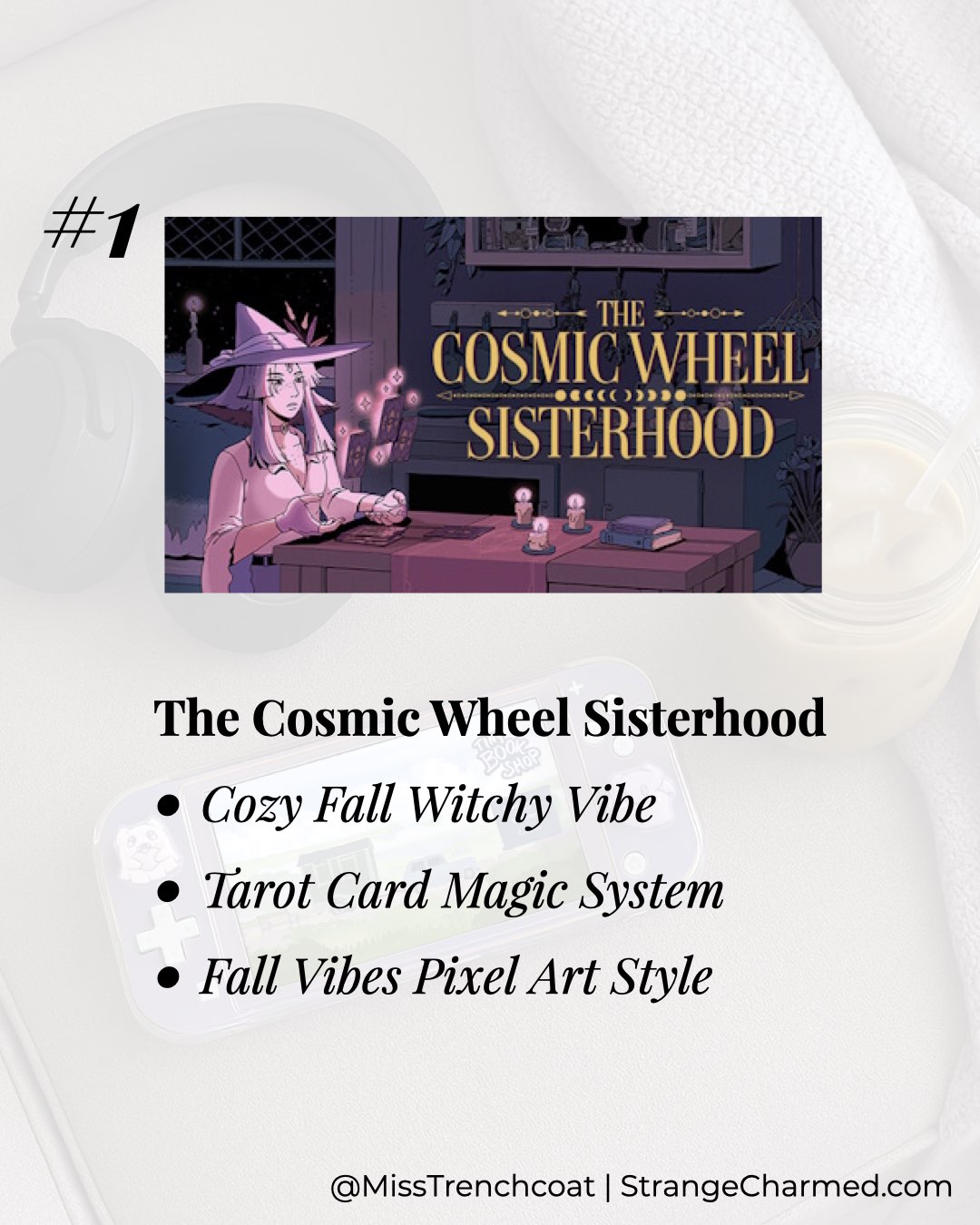
📚 Magical stories and lore (The Cosmic Wheel Sisterhood, Black Book)
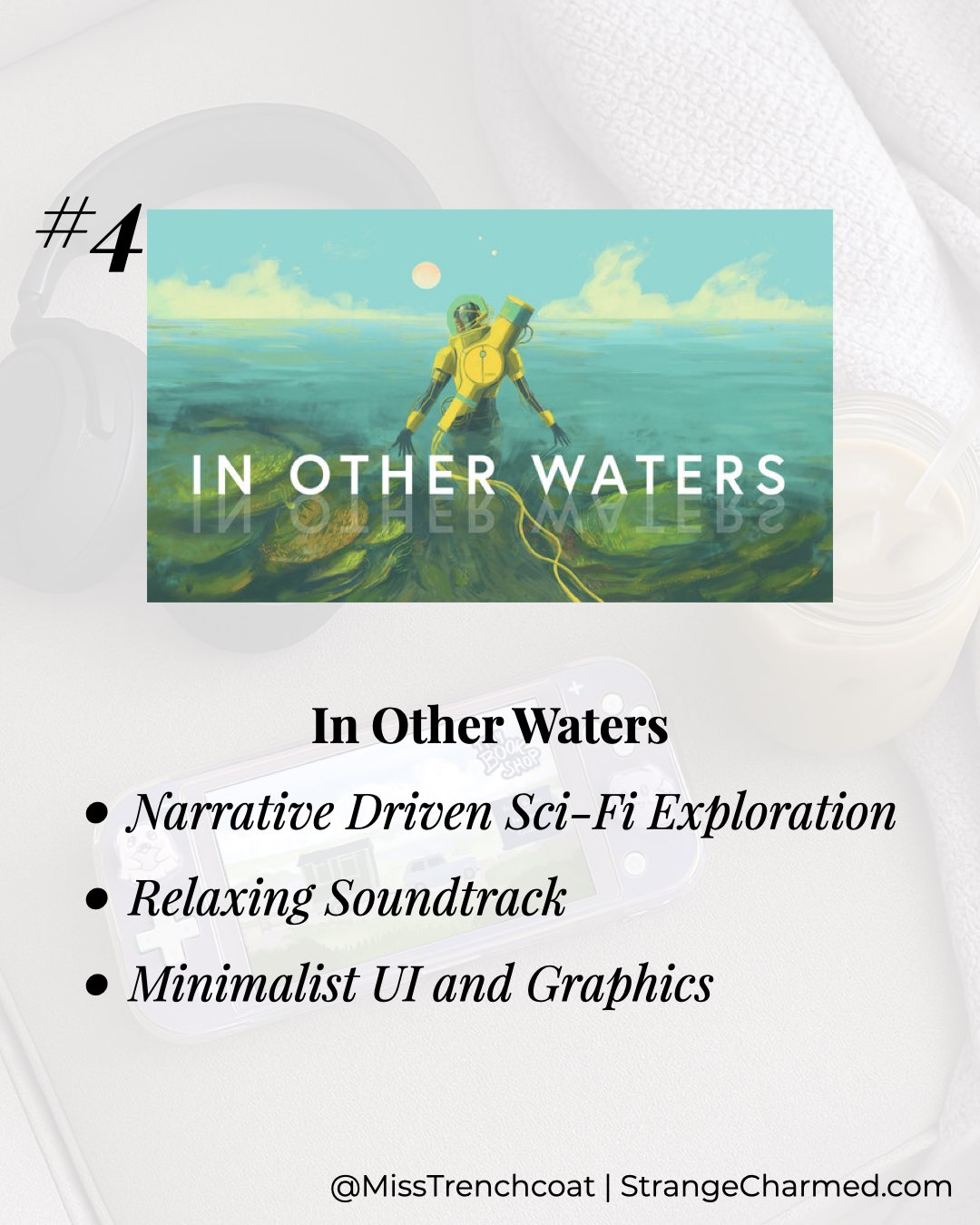
🐚 Exploration and slow travel (In Other Waters, Naiad, Dordogne)
🎨 Visual art and puzzles (Gris, Gorogoa, Moncage)
These games are not just entertainment—they’re digital reflections of the peaceful, introspective, and enchanting hobbies many of us dream about but don’t always have time or space to explore in real life.
The best part? You don’t need to be “good” at them. There are no high scores to beat or bosses to fight (unless you want to). Cozy gaming is about how it feels, not how you perform.
What Is Cozy Gaming?
If you’re new to the idea of cozy gaming, let me paint the picture: Imagine curling up under a blanket, sipping a warm drink, and stepping into a beautifully illustrated world where the stakes are low, the stories are rich, and the pace is calm and intentional.
That’s the heart of cozy gaming.
So what makes a game “cozy”?
For me, cozy games are defined by a few key qualities:
Relaxing or comforting themes
Low stress or minimal time pressure
Little to no combat (and if there is combat, it’s usually simple or turn based)
A focus on narrative, puzzles, or life simulation
Aesthetically pleasing art and immersive sound design
These games often feel like digital versions of journaling, gardening, or reading a beautiful novel. They’re quiet companions that invite you to unwind, think creatively, and engage with a world that feels nourishing—not draining.
What’s powerful about cozy games is how they make space for stillness and softness in a world that so often demands hustle and urgency. They’re a reminder that progress can be slow, joy can be simple, and success doesn’t always look like winning—it can look like planting a tree, solving a puzzle, or just taking a deep breath.
My Gaming Setup + Aesthetic Touches
Let’s be honest—half the fun of cozy gaming is the vibe. And because I’m me, of course my Nintendo Switch Lite setup is fully customized and styled to reflect my aesthetic: feminine, elegant and playful!
My Custom Switch Lite
I personally customized my Switch Lite with an iridescent vinyl skin that I made myself using:
My Silhouette Portrait cutting machine
An opalescent adhesive vinyl with a dreamy metallic sheen
A Switch Lite template I purchased from Etsy
If you’re not the DIY type, there are so many beautiful pre-made options available online. I’ve been using DecalGirl.com for years to customize my tech—it’s one of my favorite sources for unique, high-quality skins. You can also find a wide selection on Amazon. Here are a few you might want to check out:
That said, I vastly prefer buying games digitally—which is part of what made cozy gaming so accessible to me in the first place. Most indie cozy games don’t have physical cartridges, and I didn’t realize how many amazing titles were available exclusively through the Nintendo eShop until 2024. Discovering that changed everything.
A Note on Cost
People are often surprised by how affordable cozy gaming can be. Yes, big-name games can cost $60+ for physical copies—but most of the cozy indie games I’ve bought were on sale for $5 or less, and many were as low as $1.99. It’s one of the reasons my library has grown so quickly. Gaming can be a low-cost, high-value hobby when you know where to look.
How Cozy Gaming Supports My Productivity
It might sound counterintuitive, but cozy gaming has become one of the most productive habits in my life. Not because it helps me check more boxes or hustle harder, but because it gives me a reliable, low-effort way to rest, reset, and return to my work with more clarity and capacity.
Here’s how cozy gaming supports my productivity:
It helps regulate my nervous system: After a long day of focused work, cozy gaming provides a gentle transition out of task mode. It gives my brain space to breathe without completely checking out.
It keeps me present: Many cozy games are designed around mindfulness—whether you’re tending a garden, solving a puzzle, or guiding a character through a dreamy storyline. This invites a flow state that’s grounding and restorative.
It motivates me through reward cycles: I often use cozy gaming as a “treat” or transition after finishing my Top 3 tasks for the day. It’s a built-in reward system that keeps my motivation high without relying on endless scrolling or sugar.
It enhances creativity: Cozy games are full of beautiful art, music, stories, and world building. They refill my creative well and often inspire new ideas for content, products, or personal rituals.
It prevents doom-scrolling: Cozy gaming is a digital hobby that helps me cut back on negative screen time and endless scrolling on my devices. Yes, it’s another screen, but one that is helping me relax with low stimulation and a peaceful soundtrack.
It keeps me mentally sharp: Gaming isn’t a mindless activity, but one that can actually help keep your mind sharp through problem solving and puzzles. So it’s a great activity with real benefits that keeps your mind young and flexible.
In my planning system, I always emphasize the importance of white space and aligned hobbies. Gaming is one of mine—and I never feel guilty about the time I spend with it, because I know it’s part of the ecosystem that keeps me well planned and productive.
My Full Cozy Game Catalogue
One of my favorite parts of cozy gaming is curating my game library. Like a seasonal reading list or capsule wardrobe, I’ve organized the games on my Switch Lite by seasonal vibe—with folders for Spring, Summer, Fall, and Winter play. While I haven’t played every title yet (I do my research and tend to splurge during sales), each game reflects the kind of immersive, mindful experience I crave at different points across my year.
Here’s my full cozy game catalogue at the moment, I know it seems like a lot but most of these I scored during eShop sales—some for as little as $1.99. I calculated it once and the average price of the games I’ve purchased is $5.
A Monster’s Expedition
Abzu
Agent A
Alchemist Simulator
Animal Crossing: New Horizons
Arcade Spirits
Ashwood Valley
Aspire: Ina’s Tale
Beacon Pines
Black Book
Bloomtown: A Different Story
Botany Manor
Cabernet
Camper Van: Make it Home
Candivity
Carto
Catch the Stars
Child of Light
Children of Silentown
Chants of Sennaar
Clue
Cloud Gardens
Coffee Talk
Coffee Talk Episode 2: Hibiscus & Butterfly
Cosmic Wheel Sisterhood
Cottonville
Cozy Grove
Cult of the Lamb
Cereza and the Lost Demon
Disney Villains Cursed Cafe
Divination
Dordogne
Donut County
Down in Bermuda
Edna & Harvey: The Breakout
Edna & Harvey: Harvey’s New Eyes
Fe
Figment
First Time in Paris
Flood of Light
Flipping Death
Fran Bow
Fracter
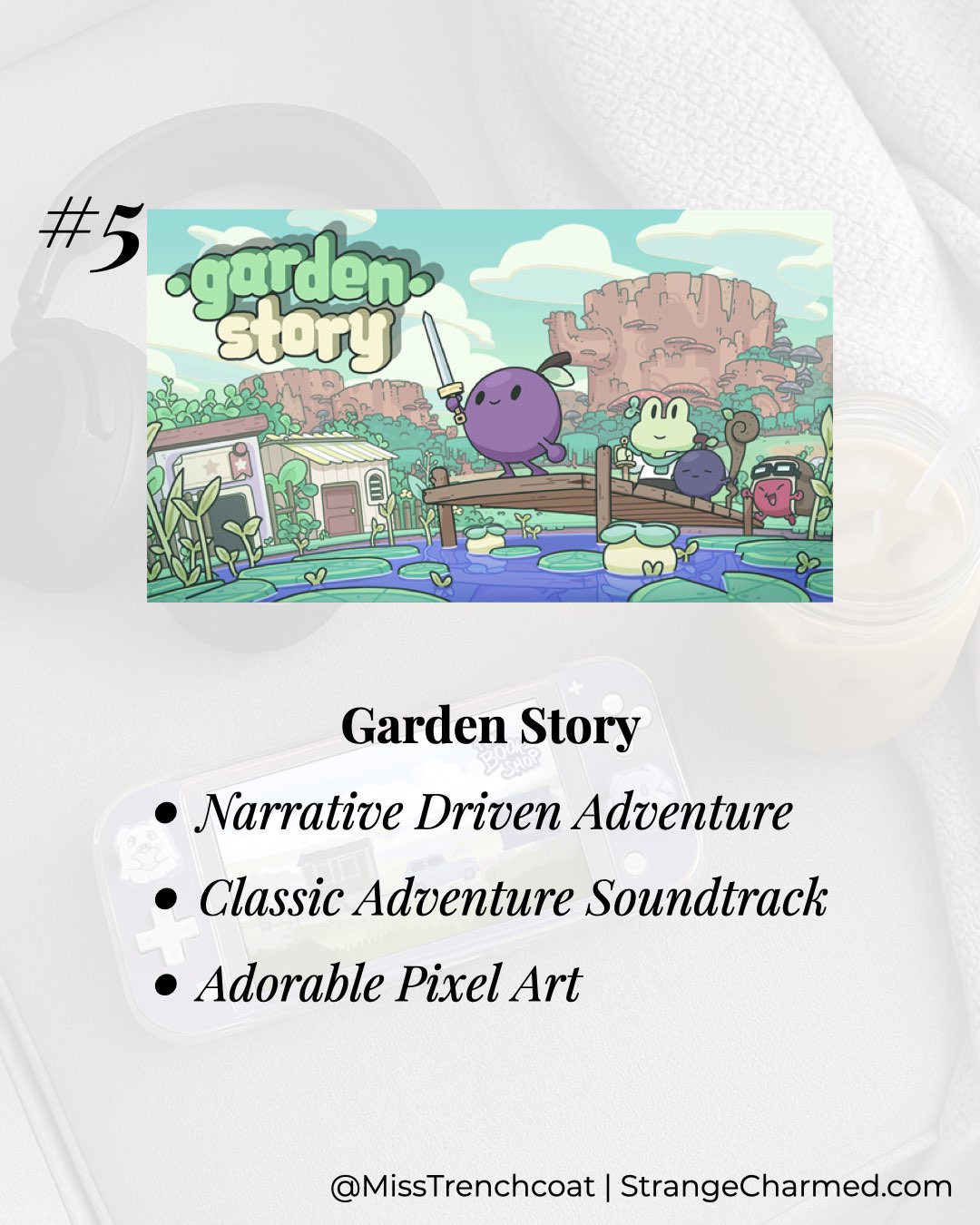
Garden Story
GardenBuddies
Gemini
Genesis Noir
Gibbous
Goetia
Gorogoa
Grow: Song of the Evertree
Growbot
Harmony: The Fall of Reverie
Hidden in My Paradise
Hook
Hogwarts Legacy
In Other Waters
InnerSpace
Islanders
Jenny LeClue
Journey of the Broken Circle
Kaichu
Lego Harry Potter Collection
Lines XL
Lila’s Sky Ark
Little Misfortune
Lost in Random
Luna: The Shadow Dust
Magic Klondike
Mazm: The Phantom of the Opera
Mind: Path to Thalamus
Moncage
MoonLight
Moonstone Island
Moonlighter
Murder on the Marine Express
Naiad
Nature Matters
Neko Bento
Neva
Night of Reverie
Nora the Wannabe Alchemist
O.W.L. Project
Ori and the Blind Forest
Ori and the Will of the Wisps
Paper Trail
Pendula Swing
Pentiment
Pheonotopia
Pinstripe
Pixel Cafe
Planet of Lana
Pokémon Cafe ReMix
Potion Craft
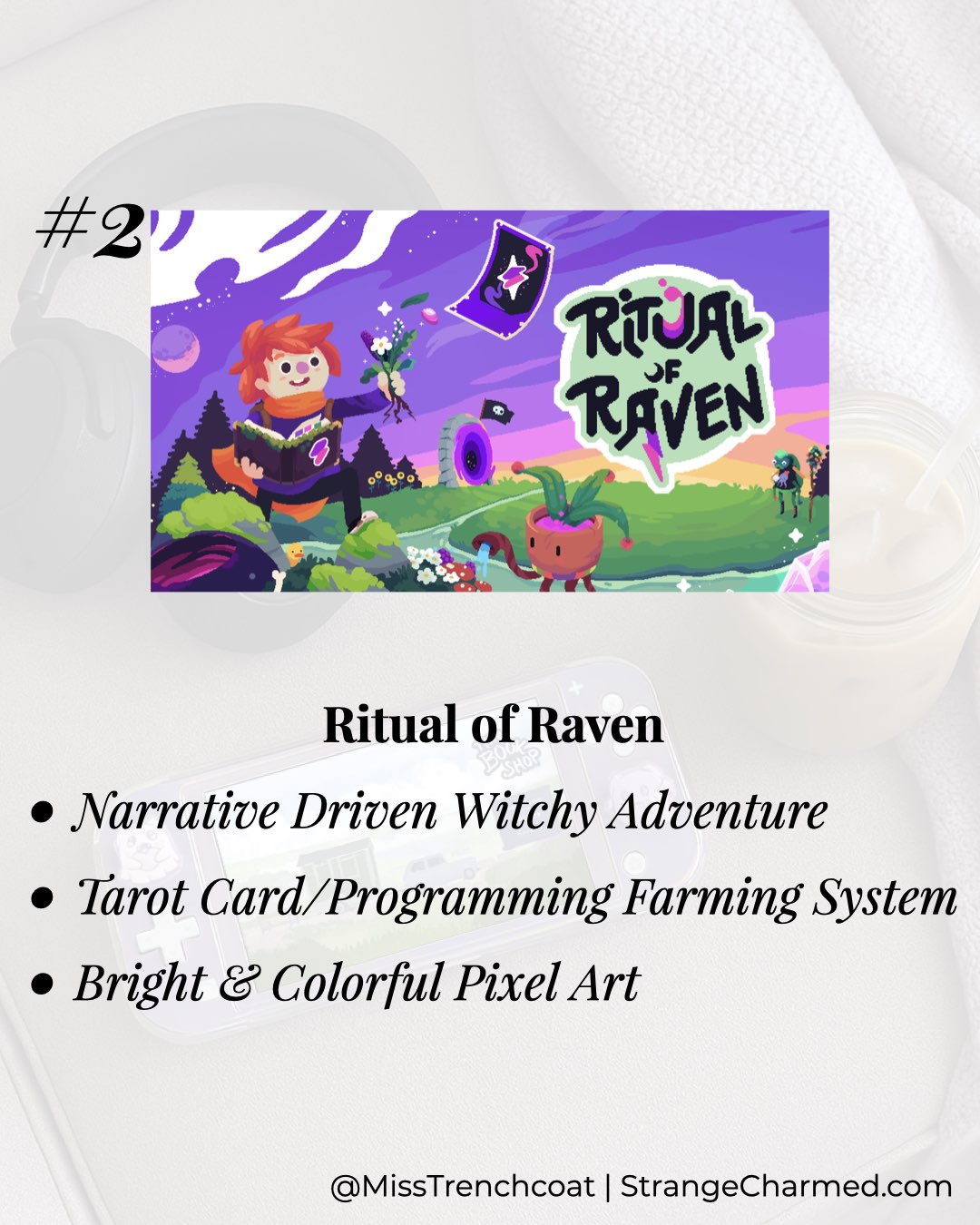
Ritual of Raven
Roki
Secrets of Magic 1: The Book of Spells
Shady Part of Me
Space Papers
Spirit of the North
Spiritfarer
Sprout Valley
Stories Untold
Strange Antiquities
Strange Horticulture
Strange Telephone
Stray Gods: The Roleplaying Musical
Tales from Candleforth
Tales of the Shire
Tangle Tower
Tavern Talk
The Companion
The Garden Path
The Holy Gosh Darn
The Last Campfire
The Last Door
The Lion’s Song
The Mahjong Huntress
The Pillars of the Earth
The Procession to Calvary
The Spirit & the Mouse
The Wanderer: Frankenstein’s Creature
Tiny Bookshop
Tiny Lands
To The Moon
Universe for Sale
Verne: The Shape of Fantasy
Viviette
What Comes After
Witchy Life Story
When the Past was Around
Wytchwood
If you’re feeling inspired to explore cozy gaming for yourself, I hope this list gives you a helpful head start. You don’t need a Nintendo Switch to enjoy many of these titles—most of them are indie games, which means they’re often available on other consoles or on PC via Steam.
I also want to mention that one of the reasons I have so many titles is because the cozy indie games I prefer tend to be shorter games that take anywhere from 3-10 hours to complete. So I can easily finish a game in a few days.
To help you build your own cozy game library without overspending, I highly recommend:
GG.Deals – A price tracker where you can search for games and set up alerts for discounts across platforms
Metacritic.com – A review aggregator that gives you a general sense of how a game performs and what others thought of it
That said, keep in mind: cozy games are often misunderstood by the broader gaming community. A game that’s slow-paced or whimsical might not score highly with traditional reviewers—but that doesn’t mean it won’t be exactly what you’re looking for. I personally use reviews to flag any technical issues, bugs, or incomplete features—not to determine if a game is “worth it” emotionally. I also like to watch game play videos on YouTube before I purchase a game, to ensure the content is what I am expecting.
Trust your vibe. Your cozy game collection should feel like a digital sanctuary—one that reflects you.
Creating a Cozy Gaming Ritual
Cozy gaming isn’t just a hobby—it’s a ritual. For me, it’s one of those small, sacred routines that helps me disconnect from the demands of the day and reconnect with myself.
I love setting the mood before I play:
My drink of choice, usually a coffee, soda, or my Stanley filled with ice water
Soft ambient music or the game’s own dreamy soundtrack playing through my headphones
A comfy blanket, soft lighting, and zero notifications
It becomes a moment of intentional rest—like journaling, reading, or lighting a candle. A pocket of stillness in an otherwise vibrant life. And because cozy games are so gentle and self-paced, I never feel rushed or pressured. It’s not about “winning”—it’s about relaxing.
This ritual has become a key part of my weekly rhythm. It helps me wind down after a workday, transition out of planner mode, and create space for creativity, inspiration, and ease.
Final Thoughts
Gaming might not be the first thing that comes to mind when you think about productivity, personal development, or living a well-planned life—but I truly believe it deserves a place in the conversation. Cozy gaming has brought me joy, calm, creative inspiration, and even helped me become more focused and intentional in my day-to-day routine.
If you’ve ever been curious about video games—or if you’ve dismissed them in the past as childish, chaotic, or not “your thing”—I hope this post opens up a new perspective. Cozy gaming is thoughtful, soothing, and entirely customizable to your lifestyle. It’s a hobby that supports your well-being, encourages rest, and gives your mind the kind of gentle stimulation we often forget we need.
So if you’re looking for a new hobby that’s affordable, accessible, and genuinely fulfilling—maybe it’s time to become a cozy gamer gal.
I’d love to know—do you game? What are your favorite cozy or story-driven games? Are there any hidden gems you think I should check out? Leave your recommendations in the comments—I’m always looking to add something new to my library.
Here’s to planning what matters, including space for play.
xoxo,
P.S. Another element of cozy gaming I’ve been loving as I play more games, is pairing video games with books that have a similar theme or vibe. I’ve been sharing those game and book pairings on my Instagram @MissTrenchcoat, but I will likely also share another post on the topic in the near future.
If there’s one word most women use to describe the last quarter of the year, it’s busy.
The final stretch of the year always seems to come with a whirlwind of expectations—work deadlines to hit before year-end, family traditions to uphold, travel to coordinate, and social invitations to juggle. Add in the pressure of wrapping up personal goals before December 31st, and suddenly Q4 feels less like a season of joy and more like a marathon of obligations.
We’ve been conditioned to believe that the only way to “make the most” of the season is to hustle harder, do more, and check off every seasonal bucket list item. But hustle steals the very joy it promises. Instead of feeling fulfilled, you’re left burnt out, scattered, and wondering where the season went.
Here’s the truth: you don’t need to do everything to have a meaningful Q4. You only need to do the right things—the commitments, activities, and rituals that align with your values and priorities. That’s where intentional action comes in.
Intentional planning isn’t about cramming more into your days. It’s about creating clarity, choosing deliberately, and making space for the experiences that matter most. In fact, the most joyful seasons come not from doing everything, but from intentionally choosing less—and savoring it more.
In this post, I’ll show you how to trade the hustle for intention by focusing on three key elements of seasonal planning: Expected Events, Seasonal Activities, and Memory Making. Together, they’ll help you craft a Q4 that feels abundant, not exhausting.
Key #1: Expected Events — Anchor Your Calendar With Fixed Commitments
The first step to planning a meaningful Q4 is to get clear on what’s already happening.
Expected events are your non-negotiables—the deadlines, obligations, and commitments that are going to take up space in your calendar whether you acknowledge them or not. Ignoring them doesn’t make them go away; it just makes everything else harder to plan.
Think of expected events as the anchor points for your season. When you identify them upfront, you create a realistic picture of the time and energy you actually have available. Without this step, it’s easy to fall into the trap of overcommitting and wondering later why you feel so overwhelmed.
Examples of expected events:
End-of-quarter work projects and reporting deadlines
Thanksgiving dinner or other family gatherings
Kids’ school concerts, sports, or recitals
Annual conferences or seasonal events at work
Pre-planned travel for the holidays
How to anchor your Q4 with expected events:
Open your planner or digital calendar. Block out October through December.
List every known commitment. Include work, family, and personal categories. Don’t forget travel days—they take more energy than you think.
Color code or categorize. Assign each commitment a label (Work, Family, Travel) to visualize balance.
Step back and review. Where are the heavy weeks? Where are the lighter weeks?
This step alone can reduce anxiety. Suddenly, you’re no longer reacting to what pops up—you’re acknowledging what’s already there.
Reframe: Instead of seeing expected events as obstacles, view them as guideposts. They’re not stealing your freedom; they’re giving you clarity. Once you’ve acknowledged them, you can plan the rest of your season with intention.
Key #2: Seasonal Activities — Choose What Lights You Up
Once you’ve identified the structure of your season, it’s time to decide what joy-filled activities you want to sprinkle in. These are your seasonal activities—the experiences that make Q4 feel magical and memorable.
Here’s the catch: you don’t need to do all of them. The fastest way to drain the magic out of the season is by treating it like a checklist. The goal isn’t quantity—it’s depth.
Examples of seasonal activities:
Fall:
🍂 Visiting a pumpkin patch
Apple picking with friends
Baking pumpkin bread or pies
Decorating the house with autumn touches
Winter/Holidays:
🎄 Strolling through a holiday market
Decorating the tree
Baking cookies as a tradition
Hosting or attending holiday gatherings
New Year:
Journaling your reflections from the past year
Setting intentions and goals for the year ahead
A cozy at-home celebration to mark the transition
How to choose seasonal activities intentionally:
Make a seasonal wish list. Write down everything that comes to mind that you’d like to do in Q4.
Circle 2–3 favorites. Ask yourself: Which ones truly light me up? Which ones would I be sad to miss?
Schedule them early. Don’t wait until December 23rd to decide if you want to visit that market—it won’t happen. Put it in the calendar now.
Release the rest. A season well-lived is not about maximizing—it’s about savoring.
Reframe: Seasonal activities don’t need to be elaborate to matter. Sometimes the simplest traditions—like lighting a candle every evening in December or baking bread on Sundays—are the ones that create the most lasting joy.
Key #3: Memory Making — Schedule Downtime & Rituals
Here’s where many women go wrong: they fill their calendars with obligations and activities but forget to create space.
Downtime isn’t wasted time. It’s where meaning lives. It’s in the quiet evenings, the simple rituals, and the pauses that we create our most cherished memories.
This is what I call memory making—the intentional practice of slowing down to soak in the season. These aren’t the big events or bucket-list activities. They’re the little moments you’ll remember long after the year has passed.
Examples of memory rituals:
Evening walks to enjoy the crisp fall air
Cozy reading nights with tea and candles
Watching holiday movies together every Friday in December
Journaling about your reflections before the New Year
Making soup and bread on Sundays as a seasonal rhythm
How to create memory making in Q4:
Block downtime into your calendar. Literally schedule blank space. Write “Family Night” or “Cozy Reading.” If you don’t, it will get filled.
Establish simple rituals. Pick one thing you can repeat weekly (movie night, journaling, baking) to create rhythm.
Protect this time. Treat it like any other non-negotiable. Just because it’s restful doesn’t make it optional.
Reframe: Busyness doesn’t create memories—presence does. Productivity isn’t about squeezing in more; it’s about protecting space for what matters most.
Hustle vs. Intention
At the heart of it, the difference between hustle and intention is simple:
Hustle says: Everything matters, so you must do it all.
Intention says: Only the right things matter, so you can focus deeply and joyfully.
When you hustle, you end the season exhausted and disconnected. When you plan with intention, you end it with clarity, peace, and memories that actually mean something.
So as you step into Q4, I encourage you to pause and ask yourself:
What’s already happening that I need to anchor into my calendar?
Which seasonal activities would bring me the most joy?
How can I schedule downtime and rituals that make the season memorable?
That’s it. That’s the plan. Everything else? You can let it go.
Because this season isn’t about proving you can do it all. It’s about living meaningfully.
And intentional action will always beat hustle—every time.
✨ Want support creating your intentional Q4 plan? Join me for the Q4 Crescendo Workshop where I’ll walk you through the exact mindset, goal-setting, and master planning process to end your year strong and aligned.
We’ve all had those days where the to-do list feels endless. You wake up with the best of intentions, but almost immediately, life feels like it’s happening faster than you can keep up. Emails flood your inbox, someone needs you at home, deadlines loom, and even the simple act of deciding what to do next feels impossible.
The first instinct many women have in moments like this is to assume they’re failing. That if they were more disciplined, more organized, or just “better” at balancing it all, the overwhelm wouldn’t be there. But that isn’t true.
Here’s what I want you to know: overwhelm isn’t failure — it’s feedback.
When you feel overwhelmed, it’s not a sign that you’re weak, behind, or incapable. It’s a signal. A message from your mind and body telling you something is out of alignment. Maybe you’re carrying too much, focusing on the wrong things, or pushing through when you really need to pause.
The problem isn’t the overwhelm itself. The problem is how we interpret it. When we shame ourselves for feeling overwhelmed, we spiral deeper into stress. But when we learn to reframe overwhelm, we can use it as a tool for clarity.
In this post, I’ll show you how to do exactly that. You’ll learn five powerful mindset shifts that transform overwhelm from a roadblock into a roadmap — helping you reset, realign, and find clarity when you need it most.
Overwhelm as a Signal, Not a Stop Sign
Think of overwhelm as a dashboard light in your car. When it turns on, it’s not telling you that you’ve failed at driving. It’s simply alerting you that something needs attention.
The same is true in life. Overwhelm is your signal that your current pace, plan, or perspective isn’t sustainable. Instead of pushing harder or trying to “outrun” it, the key is to pause and listen.
That pause is where mindset shifts become powerful. By reframing the thoughts that fuel overwhelm, you take back control of the narrative. Instead of telling yourself a story about why you’re not enough, you start asking: What’s this feedback trying to teach me?
Here are five mindset shifts that will help you do just that.
1. “I don’t have time.” → “I need a system for my time.”
This is one of the most common thoughts fueling overwhelm. You glance at your calendar, see back-to-back tasks, and immediately feel like there’s simply no way to fit it all in. The problem? Believing that time is the enemy.
The truth is, time is neutral. Everyone gets 24 hours in a day. What creates overwhelm isn’t the amount of time we have — it’s the way we’re using it.
When you say “I don’t have time,” what you’re really noticing is the absence of a system. Without structure, every task feels urgent, and everything competes for your attention at once.
The reframe: “I need a system for my time.”
Instead of trying to squeeze more into your day, create a framework that shows you where your time is going and how to protect it for what matters. This might mean:
Using time blocking to assign your top priorities to actual calendar space.
Choosing a daily Top 3 so you focus only on the tasks that move the needle.
Building white space into your schedule so you can reset instead of run on fumes.
Once you give your time structure, clarity emerges. You stop saying, “I don’t have time” and start saying, “Here’s how I’m choosing to spend my time.”
2. “I have too much on my plate.” → “Not everything deserves a place on my plate.”
Overwhelm often shows up as a sense that you’re juggling too many responsibilities. But here’s the truth: your plate isn’t the problem — it’s what you’ve chosen to put on it.
Many of us feel pressured to say yes to everything: work projects, family commitments, social obligations, household tasks, and endless small “shoulds.” But when everything gets treated as equally important, your energy scatters, and nothing gets the attention it truly deserves.
The reframe: “Not everything deserves a place on my plate.”
This mindset shift reminds you that you are the gatekeeper of your time and energy. You have the power to choose what stays and what goes.
Practical ways to apply this:
Do a weekly brain dump of everything on your mind.
Circle the 3–5 items that matter most for this season of your life.
Cross off, delegate, or defer the rest.
When you release what doesn’t belong, overwhelm dissolves, and alignment takes its place. You start focusing on what actually matters instead of drowning in what doesn’t.
3. “I should be further ahead.” → “I am exactly where I need to be.”
This mindset trap is one of the most painful. When you believe you’re behind, you create a spiral of shame that makes progress feel impossible. You measure yourself against others or against unrealistic expectations, and you conclude that you’re failing.
But here’s the truth: progress is never linear. Every season of your life has its own pace, its own lessons, and its own priorities. Being “behind” is an illusion.
The reframe: “I am exactly where I need to be.”
When you shift into this belief, overwhelm becomes an invitation to realign, not a judgment of your worth. Instead of beating yourself up for what you haven’t done, you get curious about what you need now.
Try reflecting with prompts like:
What progress have I already made this year that I haven’t celebrated?
What lesson is this season teaching me?
What one thing would feel good to move forward this week?
With this reframe, you stop chasing an invisible finish line and start honoring your actual path. That’s where alignment lives.
4. “I have to do everything.” → “I only need to do the things that matter.”
One of the sneakiest ways overwhelm creeps in is through the belief that you must handle everything yourself. Whether it’s work tasks, family responsibilities, or personal goals, the pressure to “do it all” leaves you drained and unfocused.
But here’s the truth: not everything matters.
The reframe: “I only need to do the things that matter.”
Productivity isn’t about cramming your day with more tasks. It’s about identifying the few actions that truly create impact and letting the rest go.
One of my favorite tools for this is the Daily Top 3. Each morning, I ask myself:
What three tasks will move me closer to my biggest goals today?
Which tasks would bring me a sense of calm and completion if they were done?
Which tasks have real consequences if I delay them?
By choosing just three, I give myself clarity and focus. And at the end of the day, even if nothing else got done, I can feel aligned and accomplished.
5. “I can’t stop now.” → “Pausing will give me the clarity to move forward faster.”
This mindset is one of the most dangerous. When you believe you can’t stop, you push yourself past your limits. You ignore your body, skip rest, and run headfirst into burnout.
But rest isn’t laziness — it’s a productivity tool.
The reframe: “Pausing will give me the clarity to move forward faster.”
Sometimes the most aligned thing you can do is step away. That pause gives your brain space to reset, your body space to recharge, and your heart space to realign with what matters.
Ways to practice this pause:
A 5-minute breathing break at your desk.
A journaling session to sort your thoughts.
Gratitude practice to shift your perspective.
Listening to a mindset rampage audio to reset your energy.
When you choose to pause, you don’t lose time — you gain clarity. And clarity saves more time than hustling ever could.
How Mindset Work Stops the Spiral
When overwhelm strikes, mindset work is your anchor. It interrupts the spiral of stress and self-doubt and brings you back into alignment with your values and goals.
Think of it as building a toolkit of clarity practices you can reach for anytime you feel overwhelmed:
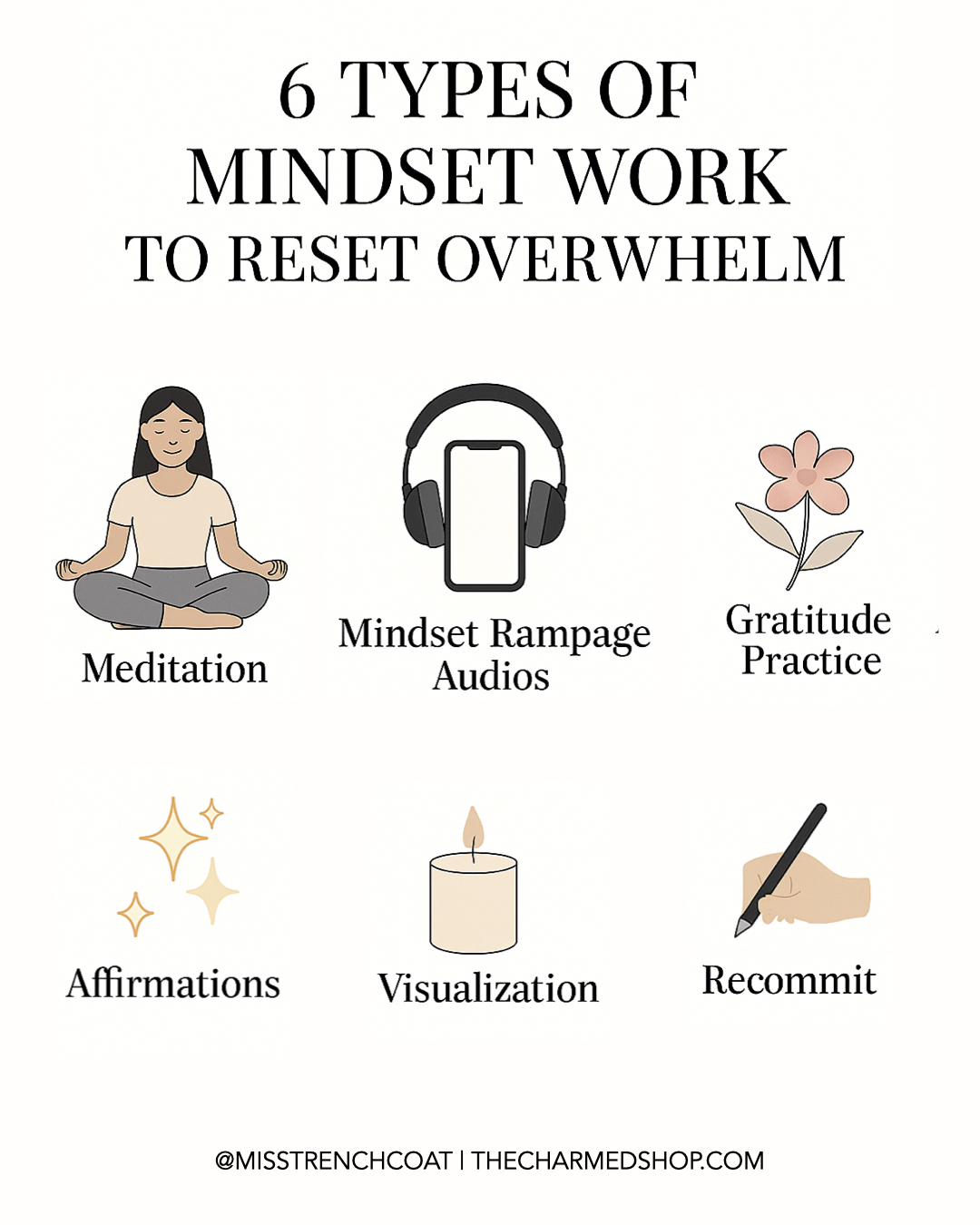
Meditation quiets the noise and grounds you in the present.
Journaling helps you release mental clutter and see your thoughts more clearly.
Mindset rampage audios flood your mind with empowering beliefs.
Gratitude rewires your perspective from lack to abundance.
Affirmations create new thought patterns that support your goals.
Visualization reminds you of the bigger picture you’re working toward.
By weaving these practices into your daily or weekly routine, you build resilience. Instead of spiraling deeper into overwhelm, you create pathways back to clarity and alignment every single time.
From Overwhelm to Alignment
Overwhelm isn’t a verdict on your worth. It’s simply feedback — a signal that something in your plan, pace, or perspective needs attention.
When you shift your mindset, you stop treating overwhelm as failure and start using it as a tool for alignment. By reframing your thoughts, you gain clarity, focus, and the ability to move forward with purpose.
✨ Remember:
You don’t need more hustle.
You don’t need more pressure.
You need structure, support, and mindset shifts that bring you back to alignment.
And if you’re ready to put these mindset shifts into practice and build a clear, structured plan for the final quarter of the year, I’d love for you to join me in the Q4 Crescendo Workshop.
On Saturday, September 13th at 12pm EDT, I’ll guide you step-by-step through creating your Q4 plan — identifying your priorities, setting aligned goals, and building the systems that will carry you into the new year with clarity and confidence.
As the days grow shorter and the air turns crisp, we enter one of the most pivotal moments of the year: the beginning of fall and the final stretch of the calendar. Q4 has a unique energy. On one hand, it’s full of opportunities—the chance to finally make progress on those lingering goals, to wrap up the year with momentum, to feel proud of what you’ve accomplished. On the other hand, it’s often when overwhelm peaks. Work deadlines pile up, family commitments multiply, and the holidays quickly fill our schedules.
It’s in this season that many of us start asking the same questions: Where did the year go? How will I get it all done? Is there even enough time left?
Here’s the truth: clarity doesn’t come from overthinking your goals or trying to push harder. Clarity comes from structure. When you take your priorities out of your head and give them a system, you instantly reduce overwhelm and gain direction.
That’s exactly what we’ll focus on today—how to transform the chaos of your to-do list into a clear, structured plan for the rest of the year. By the end of this post, you’ll know exactly how to identify your true priorities, map them into achievable goals, and create the routines that will carry you confidently through Q4.
Why Clarity Feels Hard to Find in Q4
If you’ve ever reached September and felt like the year slipped away from you, you’re not alone. Q4 is notorious for creating confusion and overwhelm.
The final months of the year bring a perfect storm of competing priorities: end-of-year deadlines at work, holiday commitments with family, personal goals you still want to achieve, and the never-ending stream of daily responsibilities. Suddenly, it feels like everything is important, everything is urgent, and there’s simply not enough time.
This is where many women get stuck. You have the desire to finish the year strong, but your goals feel scattered. You may even catch yourself falling into the trap of overthinking—replaying ideas in your head, debating what deserves your attention, and waiting for clarity to magically appear.
But here’s the hard truth: clarity doesn’t come from thinking harder. It doesn’t arrive in a burst of motivation or a sudden spark of inspiration. Clarity comes from structure.
When you take the chaos of your thoughts, tasks, and desires and organize them into a clear framework, the overwhelm lifts. Instead of juggling vague hopes, you have a structured system that tells you: Here’s what matters. Here’s what you’re focusing on this month, this week, and this day.
That’s why creating structure in Q4 isn’t just helpful—it’s essential. Without it, you’ll drift through the season in reaction mode. With it, you’ll end the year with direction, progress, and a sense of calm confidence.
The Goal Setting System That Brings Clarity
If you want to end the year feeling clear and confident, you can’t just “hope” your goals will come together. You need a structure that translates your big-picture vision into daily, doable actions. That’s exactly what my Goal Setting System is designed to do.
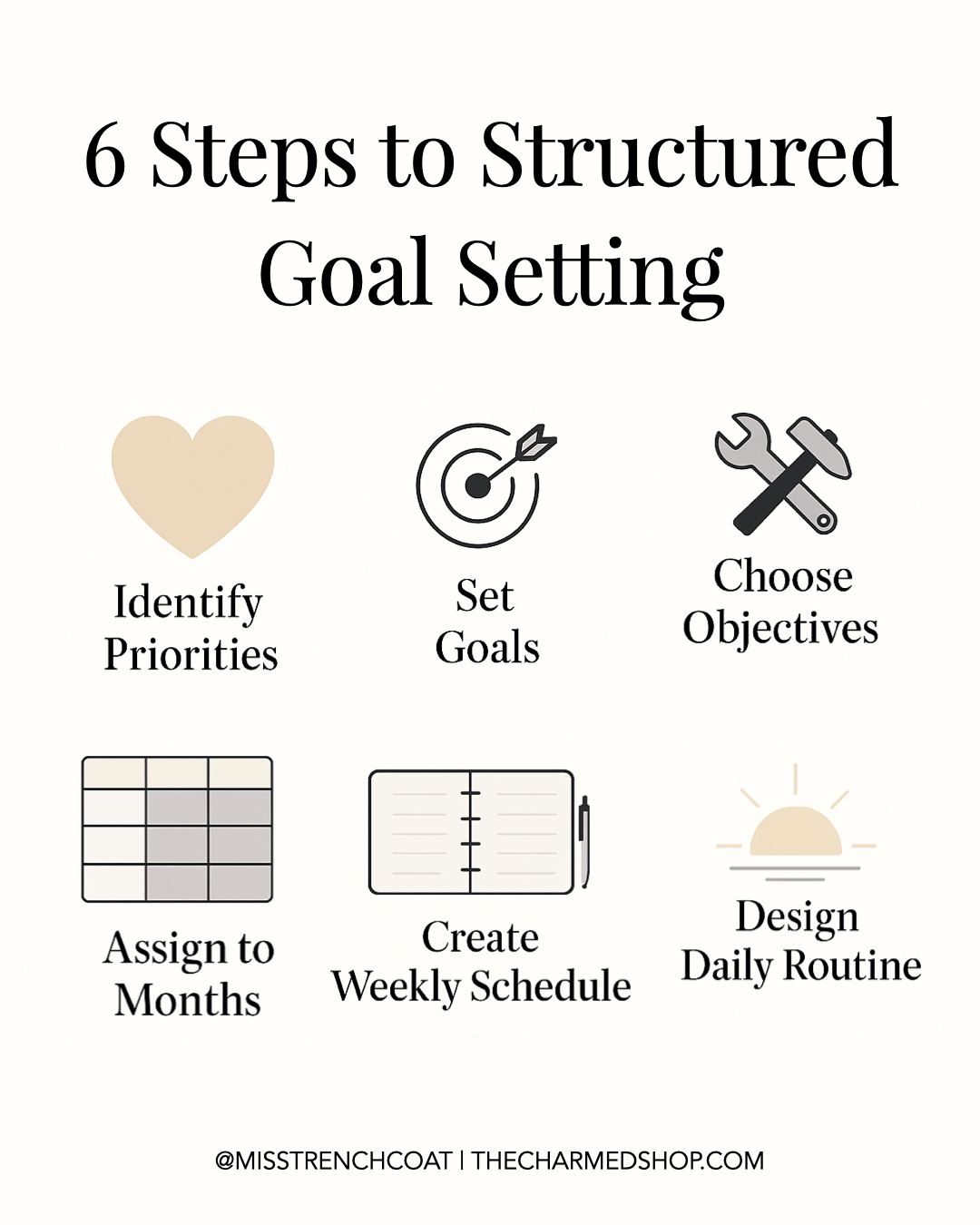
This six-step process takes you from scattered thoughts to a structured roadmap you can actually follow through on.
Step 1: Identify Your 1–5 Priorities
Clarity begins with knowing what matters most. Instead of vague categories like health or career, get specific. Think about the actual people, places, or institutions that deserve your energy right now. Examples:
Family
Business
Home
Personal development
Finances
👉 Ask yourself: “If I only made progress in a few areas over the next 90 days, what would they be?”
Step 2: Set 1–3 Goals for Each Priority
Once you know your priorities, define what success will look like in each by the end of the year. Keep these goals specific and realistic for the short timeline of Q4.
Example: For Business, your goal might be “Complete my website redesign.”
Example: For Health, your goal might be “Walk 5,000 steps a day.”
👉 The key is to set no more than 1–3 goals per priority so you don’t stretch yourself too thin.
Step 3: Brainstorm Objectives (The How)
Goals are great, but without a plan, they remain wishes. This step is about breaking each goal down into actionable objectives:
Projects → multi-step outcomes with a clear finish line (ex: “Plan holiday content calendar”).
Systems → repeatable processes that support progress (ex: “Batch cook lunches every Sunday”).
Habits → single actions you repeat consistently (ex: “Read 10 pages before bed”).
👉 Ask: “What projects, systems, or habits will move this goal forward?”
Step 4: Assign 3 Objectives Per Month (October, November, December)
Now it’s time to make your plan realistic by spreading objectives across Q4. Choose three per month, max. This forces you to focus and prevents overwhelm.
October: Start strong by launching a system or habit.
November: Push forward with a big project.
December: Wrap up and review progress.
👉 Think of this as your “90-day game plan” broken into monthly chapters.
Step 5: Create a Default Weekly Schedule
Clarity also comes from knowing when things will get done. A default weekly schedule is your foundation—it makes sure you always have time blocked for your objectives.
Protect time for both work and rest so your goals don’t compete with your energy.
👉 When your week has structure, you no longer wonder where the time will come from—you’ve already made space for progress.
Step 6: Design Your Ideal Daily Routine
Finally, anchor your habits into daily life. What does a day look like when it fully supports your priorities?
Example: Morning journaling, daily Top 3, evening reflection.
Include small, consistent actions that compound into big results by the end of Q4.
👉 Your routines are the glue that keeps your goals from slipping through the cracks.
✨ When you follow this six-step system, you stop relying on motivation and start relying on structure. Your goals aren’t just intentions anymore—they’re mapped into your months, weeks, and days. That’s where clarity comes from.
Why This System Works
There’s a reason so many people set goals in January and feel lost by September—it’s not because they aren’t motivated or disciplined enough. It’s because their goals were never given a clear structure.
When you build structure around your goals, three powerful things happen:
1. You Reduce Overwhelm
Instead of staring at a vague, endless list of “things I should do,” you’ve narrowed your focus to just a few meaningful priorities. You know where your energy belongs—and where it doesn’t.
2. You Gain Focus
By breaking goals into objectives, and assigning those objectives to specific months, weeks, and days, you always know exactly what to work on next. No more decision fatigue. No more spinning your wheels.
3. You Create Consistency
Structure turns one-time intentions into repeatable actions. With your weekly schedule and daily routines in place, progress stops being random—it becomes inevitable.
4. You Protect Your Energy
Because this system includes white space, rest, and realistic pacing, it supports you instead of draining you. Structure creates sustainability, and sustainability creates long-term success.
Clarity isn’t something you stumble into—it’s the natural outcome of building the right framework. When you know your priorities, have a clear roadmap, and protect the time to execute it, you no longer waste energy on wondering if you’re doing enough. You already know you’re on the right path.
That’s why this system works: it transforms the chaos of “too many goals, not enough time” into a clear plan that will carry you through the end of the year with confidence and calm.
How to Put This Into Action for Q4
Right now, you’re standing at the threshold of the final 90 days of the year. It can feel daunting—like there’s not enough time left to make meaningful progress. But here’s the truth: there is plenty of time to create momentum, as long as you have a structure guiding you.
Start small. This week, choose just 1–2 priorities and walk them through the six steps of the Goal Setting System:
Define your priority.
Set 1–3 clear goals.
Break them down into objectives.
Assign those objectives to October, November, and December.
Block time in your week.
Anchor habits into your daily routine.
Even if you stop there, you’ll feel an immediate shift—from chaos to clarity, from overwhelm to direction.
But imagine what would happen if you didn’t have to do this alone. Imagine sitting down with me to walk through the system together, step by step, so you leave with a Q4 plan you can trust.
That’s exactly what I’ll be teaching inside the Q4 Crescendo Workshop.
On Saturday, September 13th at 12pm EDT, I’m hosting a free live training where I’ll guide you through structuring your priorities, mapping your goals, and creating a personalized plan to carry you through the rest of the year with confidence.
The final months of the year don’t have to feel like a race you’re barely keeping up with. When you give your goals a clear structure—when you know your priorities, map your objectives, and create space in your weeks and days to bring them to life—you trade chaos for clarity.
Clarity doesn’t come from thinking harder or doing more. It comes from structure. And once you have that structure, every step you take has purpose.
This Q4 can be the season you finish strong, not by chance, but by design.
✨ Don’t wait for clarity to find you—create it. Join me in the Q4 Crescendo Workshop and let’s build your plan together.
There was a time when I thought planning was all about squeezing more productivity into my day. More tasks. More goals. More doing.
But what I’ve learned over the years is this: if your planning isn’t protecting your peace, it’s not actually helping you live well.
A well-planned life isn’t rigid. It’s intentional, responsive, and grounded in self-leadership. It’s about having a structure that supports your priorities and your well-being.
These are the 5 planning habits I practice consistently to keep my plans aligned with my peace — so I can lead my life with clarity, energy, and purpose.
1. Weekly Reflection Before Planning
Key Question:“What worked last week? What didn’t? Where did I feel energized—or drained?”
Before I start writing my plans for the week, I pause and look back. Reflection keeps me from starting from scratch or guessing what matters — I use the real data of my lived experience to guide my next steps.
I’ll ask myself:
Which projects or tasks gave me momentum?
Where did I feel resistance or burnout?
Did I honor my personal priorities alongside my professional ones?
From there, I can lean into what’s working and adjust what’s not — before the week even begins.
Pro tip: Keep a running “energy tracker” in your planner to note patterns in how you feel and perform. These insights are invaluable for creating plans that truly support you.
2. Top 3 Priorities Every Day
Key Question:“If I only got 3 things done today, what would make the biggest impact?”
The Daily Top 3 is my secret weapon against overwhelm.
Instead of staring down a mile-long list, I identify three high-impact tasks that will move me closer to my goals. The rest becomes optional bonus work.
Your Daily Top 3 could be:
Wrapping up a client project
Completing a workout
Prepping meals for the week
Choose them based on urgency and alignment with your bigger objectives — not just what’s loudest in your inbox. When you lead with these, you’ll end the day feeling accomplished instead of depleted.
3. Time Blocking with White Space
Key Question:“When do I need to focus—and when do I need to breathe?”
Time blocking helps me protect my most valuable resource: my energy.
I map my day into chunks dedicated to focused work, creative tasks, and yes — rest. White space is not wasted time; it’s recovery time that allows you to show up sharper for what’s next.
I even block buffer time between meetings or errands. Those extra minutes mean I’m not rushing, flustered, or playing catch-up. It’s small planning decisions like these that keep stress at bay.
4. Monthly Reset Rituals
Key Question:“What do I want to leave behind this month? What do I want to make space for?”
At the end of each month, I set aside an hour for a reset. I light a candle, put on some music, and review my goals and planner pages.
Here’s what I do:
Clear out any tasks or projects that no longer serve me
Migrate or schedule important tasks forward
Refresh my monthly spreads with new priorities and dates
Identify one or two focus areas for the upcoming month
This ritual is both practical and grounding. It’s a way of closing one chapter before starting the next with clarity and intention.
5. Permission to Pause and Adjust
Key Question:“What can I let go of today to protect my energy and stay aligned?”
The final habit is less about what I write in my planner and more about how I use it.
I remind myself daily: My plan is a guide, not a contract. If life shifts, I’m allowed to adjust.
Sometimes that means moving a task to tomorrow, delegating it to someone else, or deleting it altogether. Other days, it means dropping my to-do list entirely and giving myself rest without guilt.
I’ll often write a simple “I release…” statement in my planner to make the letting go intentional. Protecting your peace is as much about what you don’t do as what you do.
Final Thoughts
These five habits are small shifts, but they’ve completely transformed the way I plan and live. They help me protect my energy, honor my priorities, and approach each day with purpose instead of pressure.
If you’re ready to start planning this way, the Charmed Life Master Planner was designed to be your ultimate second brain — helping you capture your thoughts, organize your priorities, and build the well-planned, peaceful life you’ve been craving. ✨ Enjoy 25% off your purchase with code MasterPlan2026.
And if you want clarity on the next steps to becoming your most well planned and productive self, download the Well Planned & Productive Woman Reset Workbook. It’s the perfect companion to start integrating these habits into your daily life.
Your peace is worth protecting — and your planner can help you do it.
Your planner isn’t just a notebook — it’s your second brain. It’s the safe, structured space where all the moving pieces of your life can live without weighing you down.
Because here’s the truth: you were never meant to keep it all in your head. The ideas, the to-dos, the appointments, the dreams — it’s too much cognitive weight for one brain to carry. That’s why we plan. To release the mental clutter, create structure for our energy, and build momentum without burnout.
Each morning, before the world starts making requests of my time and attention, I sit down with my planner and anchor into my day. It’s a simple ritual that takes just a few minutes, but it sets the tone for everything that follows.
If you want to feel calmer, clearer, and more in control of your time, here are the five things every Well Planned & Productive Woman writes in her planner each morning.
1. Daily Top 3
The Well Planned & Productive Woman knows that not all tasks are created equal. Your Daily Top 3 are the three most important tasks you must accomplish today in order to stay aligned with your goals and keep momentum moving forward.
These aren’t just random to-dos pulled from a long list — they’re chosen with intention. I use the urgency/importance filter to decide: Will this move the needle? Is there a consequence if it’s not done today? Is it directly tied to one of my bigger objectives?
Your Daily Top 3 might look like:
Finalizing a client proposal
Recording a podcast episode
Booking a long-overdue dentist appointment
When you lead with these priorities, everything else on your list becomes bonus progress, not a source of guilt or overwhelm.
2. Any Appointments or Time-Based Commitments
Once I’ve locked in my Daily Top 3, I turn my attention to the non-negotiables on my schedule — the appointments, calls, and events that are tied to a specific time.
These are the anchor points of my day. They tell me where my energy needs to be and when, and they help me realistically plan what’s possible in the spaces between. Because let’s be honest — we’ve all had those days where our to-do list was longer than our actual available hours.
By putting my time-based commitments front and center, I can see immediately where I have focused work windows, where I might need to shift priorities, and where I should build in white space for travel, preparation, or recovery.
Pro tip: If you have multiple small appointments, try batching errands or phone calls around them. This keeps your energy contained instead of scattered, and it protects those bigger blocks of uninterrupted time that are so valuable for deep, focused work.
3. A Personal Intention or Mindset Anchor
This is where I remind myself who I am becoming and what I’m working toward.
Each morning, I write a short statement that connects me directly to my bigger goals — not just for the day, but for my life and business. It might be a concrete objective I’m focused on, like:
I am creating $10,000 in sales this month with ease and joy.
I am showing up consistently for my health with nourishing food and daily movement.
Or it might be an affirmation that shifts me into the version of me who has already achieved those goals:
I am a confident, well-resourced CEO who makes decisions with clarity.
My dream clients find me easily and love to work with me.
This small act isn’t just motivational — it’s mental reprogramming. By writing and re-reading these intentions daily, you train your mind to believe they are possible (and inevitable), which shapes the actions you take.
I place my intention at the top of my planner page so I see it all day long. It becomes my quiet reminder to lead my decisions from the future I’m creating, not the limitations I’m leaving behind.
4. A Quick Brain Dump to Declutter Your Thoughts
Before I dive into my work, I give my mind a clean slate by getting everything that’s floating around in my head down on paper.
This isn’t my full to-do list — it’s a capture session for anything that’s surfaced since I last planned. It might be a small errand, a random idea for my business, a reminder to follow up with someone, or even a household task I’ve been mentally carrying.
From there, I quickly triage each item:
Do it today — if it’s urgent or connected to my Daily Top 3.
Schedule it — for later in the week or month.
Delegate it — to someone else who can handle it.
Delete it — if it’s not important or relevant anymore.
I use the Brain Dump inserts from the Charmed Life Master Planner for this because it keeps everything in one place and makes sorting easy. Once I’ve captured it all, I can see clearly what actually matters today and what can wait — which means I’m not carrying the stress of remembering it all in my head.
5. One Thing I’m Letting Go of to Protect My Peace
This is my favorite part of my morning planning ritual — identifying something I’m consciously not carrying with me into the day.
It could be a task I’ve been pressuring myself to finish that truly isn’t a priority right now. It might be a worry I can’t control, a piece of perfectionism that’s slowing me down, or even someone else’s expectation that doesn’t align with my goals.
By naming it, I give myself permission to release it. I write it right in my planner so it’s a visible reminder: this is not mine to hold today.
Letting go isn’t about avoidance — it’s about protecting my energy for the things that truly matter. When I do this daily, I find I end the week feeling more grounded, less scattered, and far more satisfied with the progress I’ve made.
Your morning planning ritual doesn’t have to be long or complicated — just intentional. By taking a few minutes to map out your Daily Top 3, note your commitments, anchor into your goals, clear the mental clutter, and release what doesn’t serve you, you’ll set yourself up to lead your day with clarity, focus, and peace.
And if you’re ready to take this practice to the next level, the Charmed Life Master Planner is the ultimate functional planner designed to be your second brain. It’s built to support you in becoming the Well Planned & Productive Woman you’ve always wanted to be — with tools for capturing, organizing, and allocating your life with ease. ✨ Enjoy 25% off your purchase with code MasterPlan2026.
If you’re just getting started on your journey and want clarity on exactly what to do next, download the Well Planned & Productive Woman Reset Workbook. It will walk you through the first steps to creating structure, simplifying your routines, and building the habits that will transform your life.
Your dream life isn’t built by chance — it’s built by design. Let’s make it happen.