A behind-the-scenes look at how I manage life, content, and business tasks without burning out
Running a business is a lot.
There are goals to set, content to create, clients to serve, offers to manage, and about a thousand decisions to make every week. Add in managing your home, your relationships, and your energy, and it’s no wonder so many creative entrepreneurs end up feeling overwhelmed.
After 12 years in business, I can tell you this with confidence:
✨ You don’t need more time. You need better systems.
In this post, I want to give you a behind-the-scenes look at the exact systems and tools I use to manage my life and business without burning out. These are the rhythms that keep me focused, the planners that keep me grounded, and the automations that multiply my energy.
If you’ve been struggling to stay consistent with your content, goals, or execution, this post will show you how to build the systems that support your vision.
Let’s dive in.
Why Systems Are the Secret to Consistency
Consistency isn’t about willpower. It’s about structure.
If you don’t have a system for planning your tasks, tracking your goals, and executing your ideas, you’ll always feel behind. You’ll always be reacting instead of leading.
And the truth is: most people don’t fail because they lack ambition—they fail because they lack structure.
Structure creates freedom. Systems create flow.
The good news? You can create simple systems that take the pressure off and help you show up consistently, even when life gets messy.
Here are the core systems I use to run my business.
System 1: My Planning Stack
This is where everything begins: with my planners.
I use two digital planners every single day:
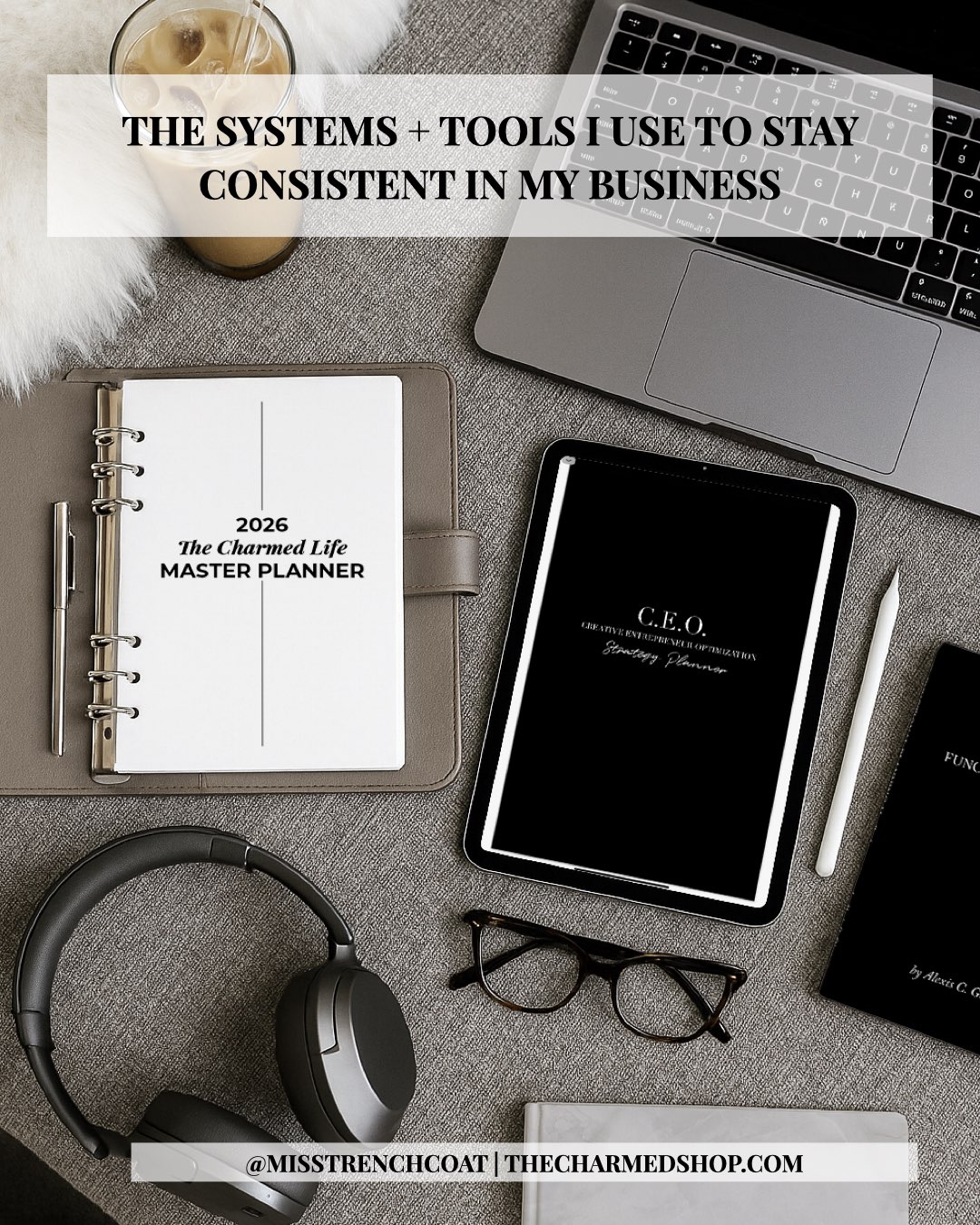
🗓 The Charmed Life Master Planner This is my main life + time management hub. It holds:
My yearly, quarterly, monthly, weekly & daily planning routines
My master task lists, calendars, routines, and habits
My content plans and household systems
📘 The CEO Strategy Planner This is my business planning brain. It holds:
My business goals and revenue plans
Project outlines + task breakdowns
Launch plans, marketing strategies, and performance tracking
The key is integration: tasks from the CEO Strategy Planner always get scheduled into the Master Planner. That’s how I stay consistent and make sure everything gets done.
System 2: Functional Weekly Routines
Once I have my plan, I rely on simple weekly rhythms to help me follow through:
🧠 Weekly CEO Planning Session Every Sunday or Monday, I review my goals, assess last week, and make my plan for the week ahead. I block out time in my calendar and use my Top 3 method to stay focused.
📆 Themed Work Days To stay productive, I group my work into themed days:
Monday: Admin & Operations
Tuesday: Content Creation
Wednesday: Marketing & Visibility
Thursday: Product or Offer Development
Friday: CEO Visioning, Strategy, and Overflow
This helps me batch tasks, reduce decision fatigue, and stay in alignment with my priorities.
System 3: Content Planning Framework
My content doesn’t happen by accident. I use a structured monthly and weekly content calendar to guide what I publish, when, and where.
Each month, I:
Choose a focus or theme tied to my offers
Plan blog posts, email newsletters, and Instagram content
Align my content to introduce or lead into specific offers
I use a content planning template inside my CEO Strategy Planner to keep everything organized, and I repurpose core messages across platforms to work smarter, not harder.
Consistency in content is what builds trust. And trust is what drives sales.
System 4: Automation & Templates
To reduce decision fatigue and free up energy, I use automations and templates for recurring business tasks.
Examples:
Email welcome sequences + nurture funnels
Evergreen sales funnels tied to opt-ins
Social media templates + caption formulas
Client onboarding emails + workflows
These systems work for me while I focus on showing up, serving, and selling.
Inside IN BUSINESS, I share these behind-the-scenes templates and tools so you can copy what works and customize it for your business.
System 5: Reflection & Realignment
The final piece of my consistency system is the part most people skip: reflection.
Each month and quarter, I review:
What worked
What didn’t
What I want to do differently moving forward
This process helps me refine my systems, spot misalignments, and recommit to my vision.
There is no perfect plan. Only a commitment to keep coming back to the work.
Final Thoughts: Build Systems That Support You
You don’t need to be perfect. You don’t need to do it all.
You just need to build systems that support the life and business you actually want.
✨ The right systems give you structure, clarity, and breathing room. ✨ The right tools keep you focused and on track. ✨ The right mindset reminds you that progress happens in cycles.
If you’re ready to create your own systems for consistency, here’s where to start:
Why goal setting isn’t enough—and how to actually follow through.
If you’ve ever found yourself setting ambitious goals for your business and then losing momentum within weeks, you’re not alone.
You’re not broken. You’re not unmotivated. You’re just missing one key ingredient:
Alignment.
Alignment is what turns goals into action. It’s the bridge between the vision you set and the execution that creates results.
In this post, I want to share the real secret to taking consistent action in your business, based on over a decade of running my own business full time. We’ll talk about what alignment looks like, why traditional goal setting often leads to burnout, and how to build a structure that supports sustainable progress.
If you’ve been:
Overplanning but not taking action
Setting goals but falling off track quickly
Or feeling overwhelmed by how to manage your time and energy as a business owner…
This is for you.
Why Traditional Goal Setting Doesn’t Work
Let’s start here: Goal setting isn’t the problem. The way we approach it is.
Most entrepreneurs are taught to dream big and set clear goals—and that’s great. But then they try to tackle everything at once, with no realistic plan for follow-through.
You get excited, make a long to-do list, and try to hustle your way to the finish line.
But without:
A system to break things down
A routine to follow
And a mindset that supports consistency…
…you burn out or lose focus.
This is exactly why I created my IN BUSINESS program—to help women entrepreneurs stop the cycle of starting and stopping, and finally build the rhythm that helps them move forward month after month.
What It Means to Be in Alignment
Alignment in business means your goals, your plans, your schedule, and your energy are working together.
When you’re in alignment:
You know what to focus on each month
Your tasks feel purposeful, not scattered
You feel motivated because your actions are connected to your vision
When you’re not in alignment:
You’re constantly overwhelmed by your to-do list
You procrastinate or avoid the work
You set the same goals every year but never hit them
Alignment doesn’t happen by accident. It’s a system you build.
Here’s how I build that alignment inside my business year after year.
1. Start With a Braindump
Everything starts with clarity. And clarity begins with a braindump.
Before I plan anything, I do a full mental download using the CEO Braindump Triggers List. I use prompts to get all the tasks, ideas, to-dos, and mental clutter out of my head and onto the page.
Once I’ve cleared my mind, I sort my list and look for themes:
What projects are high priority?
What tasks actually move the needle?
What can I delegate, delay, or delete?
From there, I choose 1–3 core priorities to focus on for the month or quarter.
This is key. If everything is important, nothing is.
You don’t need to work on everything at once. You need to move the right things forward.
Inside IN BUSINESS, I walk members through my system for choosing aligned business projects based on their goals, energy, and season of life. This is where real momentum begins.
3. Create Structure That Supports You
Your goals need a home. That means planning routines, systems, and tools that hold your priorities and make space for execution.
My tools of choice:
Charmed Life Master Planner for scheduling and time management
CEO Strategy Planner for organizing my business plans and priorities
Each week, I:
Review my business goals
Set weekly priorities
Block time for action
Use my Top 3 system daily to move forward consistently
This isn’t about working harder. It’s about creating a rhythm that you can show up for even on imperfect days.
4. Anchor Back Into Your Vision
Whenever I feel off-track, I come back to my vision. I revisit my goals. I journal. I check in with how I want to feel.
Business isn’t just strategy. It’s energy. If something feels off, it probably is.
The solution? Reconnect with your why. Then recommit.
Inside IN BUSINESS, we build this reflection into the system. We use mindset tools, prompts, and monthly check-ins to help you come back into alignment and keep moving forward.
Action Follows Alignment
The secret to consistent action isn’t more motivation or more hours in the day. It’s alignment.
When you:
Clear your mental clutter
Choose aligned goals
Build supportive structure
And reconnect with your vision regularly…
You don’t just make progress. You become the kind of person who always follows through.
If that’s who you want to be in your business this year, I invite you to:
A behind-the-scenes breakdown of the functional planning system that helps me manage a multi-offer business and a well-balanced life year after year.
Being productive and organized is something that takes consistency. Like anything else you may want to find success at in life, you have to put systems in place and keep those systems up and running. Being a productive and organized person isn’t something that you set up once and then you’re done forever.
However, the systems you use can be decided on once, and then all you have to do is show up to maintain them. That’s what I’ve created for myself—a full-spectrum functional planning system that supports my business and my life.
Today I’m walking you through the planners and tools I use and the five core routines—yearly, quarterly, monthly, weekly, and daily—that make it all work.
If you’re someone who wants to:
Run your life and business with more ease and intention
Stay consistent and organized with your tasks and goals
Reduce decision fatigue and planning overwhelm
…this post will help you lay the foundation for your most productive and peaceful year yet.
Part 1: Yearly Planning — Setting the Vision
The purpose of my yearly planning routine is to set the vision and direction for the year. You can’t create the life or business you want unless you know what that looks like—and create a plan to get there.
Each December, I:
Set my goals for the new year
Break larger goals into milestones
Define objectives for how I’ll achieve each milestone
Assign major projects to quarters or months
Populate my planner with known events and timelines
This high-level planning ensures that my schedule reflects my priorities. It helps me visualize the big picture while grounding me in what’s most important.
My Tools:
You Got Goals Workshop + Planner: helps me clarify and break down annual goals
CEO Retreat Workshop + Workbook: outlines my business goals and sets strategic monthly focuses
2026 Charmed Life Master Planner (Vertical Digital): holds my schedule, routines, and life management
CEO Strategy Planner (Digital): organizes my business objectives, launch timelines, and offers
I view my CEO Strategy Planner as a supplementary tool. It gives me space to think deeply about business strategy, but the Charmed Life Master Planner is the hub for execution. Any business tasks or deadlines I define in the CEO planner ultimately get scheduled in my Master Planner.
This two-planner system creates a balance of big-picture thinking and daily focus.
Part 2: Quarterly Planning — Creating the 90-Day Focus
The purpose of my quarterly planning routine is to check in on my goals and break them down into manageable, actionable segments.
Too often people try to plan their whole year in detail from the start, but the truth is—you learn and adjust as you go. That’s why I plan my year broadly first, and then plan strategically one quarter at a time.
Each quarter (usually at the end of the previous one), I:
Review progress toward goals and milestones
Adjust any timelines or expectations
Define my business focus for the next 90 days
Break down large projects into smaller tasks
Assign tasks to the appropriate months
This quarterly check-in gives me a moment to breathe and re-align. I get to zoom in and ask:
What’s still relevant?
What’s no longer aligned?
What deserves my focus now?
My Tools:
Charmed Life Master Planner
CEO Strategy Planner
For example, if I scheduled a product launch in April during my yearly planning, my Q2 planning session is where I’ll map out the timeline, prepare assets, and distribute tasks into April’s monthly tracker.
Quarterly planning is also when I take stock of my time capacity. If life feels full or energy is low, I adjust accordingly. I’d rather scale back than push forward misaligned.
Part 3: Monthly Planning — Clarifying the Scope
Monthly planning is about setting clear expectations and managing scope.
It’s so common to see people overloaded with long lists of intentions, habits, and to-dos—and by week two of the month, they’re already overwhelmed and off track. That’s why my monthly routine includes intentional limitations to protect my time, energy, and momentum.
Each month, I:
Brain dump all new ideas, tasks, and obligations
Populate my calendar with key dates, events, and deadlines
Revisit any ongoing project plans
Fill out my monthly master task list
Prioritize the top 1–3 projects or habits to focus on
Begin distributing tasks to weeks of the month
In the Charmed Life Master Planner, I’ve designed structure around how many projects, systems, and habits you can reasonably track. This helps me—and my customers—self-edit.
Instead of juggling a dozen goals or routines at once, I choose a few things that matter. This lets me actually build momentum and success.
Everything I decide on in the CEO Strategy Planner, like launches or campaign prep, gets moved into my Master Planner for day-to-day execution.
This process makes my month feel like a strong container for progress—not a chaotic list of unfinished ideas.
Part 4: Weekly Planning — Structuring the Flow
Weekly planning is where the magic happens. This is how I manage my energy and time across the 168 hours we all get in a week.
Each week, I:
Review my priorities for the month
Choose 3–5 main objectives for the week
Slot tasks and projects into daily blocks
Check my calendar for appointments and commitments
Make space for self-care, rest, and personal rituals
Confirm alignment with my partner, team, or collaborators
At the beginning of the year, I set up an Ideal Weekly Schedule inside my Charmed Life Master Planner. This template includes time blocks for household management, business admin, content creation, CEO work, errands, and personal routines.
Each week, I simply layer my current priorities on top of this template. This saves me time and energy and ensures my most important routines get done—even during busy seasons.
Themed workdays also help. I dedicate specific days for:
Admin and batching
Content creation
Coaching or calls
CEO deep work
Having this rhythm in place makes planning and showing up feel simple.
Part 5: Daily Planning — Taking Aligned Action
This is where it all comes together.
Daily planning is about knowing exactly what needs to happen today—and trusting the plan you’ve created.
Each day, I:
Review my weekly priorities and appointments
Assign a Top 3 for the day (the three tasks that move the needle)
Add any bonus or admin tasks if time allows
Reference my Ideal Daily Routine to keep the day structured
Leave white space for flexibility, rest, or unexpected events
Just like I use a weekly template, I also use a Daily Routine Template to hold the structure of my day. It includes:
Morning routine
Work blocks (deep work, meetings, batching)
Meals and breaks
Self-care and movement
Evening wind-down
This daily plan is flexible, but it creates guardrails. I don’t waste energy deciding what to do—I already know. And because my tasks are scoped and scheduled in advance, my daily list is realistic, achievable, and aligned.
If I ever need to map out a more intensive day, I use a Day on One Page spread from my planner. But most days, my Top 3 + Routine holds me steady.
Final Thoughts: Why This System Works
This system has been the key to building and sustaining my business for over a decade. And not just any business—a spacious business, one that supports my life instead of consuming it.
What makes this system powerful isn’t how much I plan. It’s how intentionally each layer supports the next:
My yearly vision gives me a sense of purpose
My quarterly plan keeps me focused
My monthly scope keeps me grounded
My weekly plan gives me flow
My daily plan drives action
This method is both strategic and self-honoring. It lets me stay productive without hustling. I get things done and I have space to rest, recharge, and enjoy life.
Want to Plan This Way Too?
You don’t need to guess or start from scratch. I’ve created tools to help you:
Start the year with clarity and structure using this simple business planning process.
If you’re a business owner or aspiring entrepreneur who feels overwhelmed by all the ideas, tasks, and goals swirling around your mind, you’re not alone. The beginning of the year brings a renewed sense of purpose and ambition—but without the right systems in place, that energy can quickly turn into chaos.
You may have a list of ideas for content you want to create, products you want to launch, or strategies you want to try. But when you sit down to plan or take action, you get stuck. The ideas are there, but they feel jumbled, disconnected, and disorganized.
This post is for you if:
You feel like your brain is constantly “on,” but you’re not making progress.
You have tons of notes, digital files, or half-started plans that don’t connect.
You’re excited about building your business this year but aren’t sure where to start.
Let me introduce you to one of the most foundational productivity and business planning tools I use: the CEO Braindump.
What Is a Business Braindump (and Why You Need One)?
A business braindump is exactly what it sounds like: it’s a process of taking everything in your head related to your business—ideas, tasks, goals, reminders, to-dos—and getting them out onto paper.
This practice gives your thoughts a home outside your mind so you can finally:
See what you’re working with
Organize your ideas
Prioritize what matters
Create plans that make sense
It’s the first step I take each year when planning for my business, and it’s something I return to monthly, weekly, or anytime I feel mentally cluttered.
Without this process, it’s easy to fall into the trap of idea overwhelm where everything feels urgent and nothing gets done.
Signs You Need to Braindump:
You procrastinate because you don’t know what to work on first
You start projects but abandon them midway
You can’t clearly explain your business plan or goals
You’re always “working” but not moving forward
Sound familiar?
It’s time to clear the clutter and get your business ideas organized.
Step 1: Capture Everything
Set aside 30-60 minutes of quiet time and grab a notebook or planner. This is your CEO meeting with yourself.
Start by writing down everything that comes to mind related to your business:
Project ideas
Content you want to create
Marketing strategies
Products or offers you want to launch
Admin or tech tasks you’ve been putting off
Education or resources you want to explore
This isn’t about filtering or judging what comes up—just let it flow. Think of this like a full brain sweep.
If you’re not sure where to begin, I created the CEO Braindump Triggers List, a free download with 50+ prompts to help jog your memory and make sure you capture everything. You can grab it [here].
Step 2: Categorize Your Thoughts
Once you have your big list of ideas, start grouping them into categories. This helps you make sense of the chaos.
Here are some simple categories to use:
Content (blog, YouTube, podcast, social posts)
Products/Offers (what you’re selling or want to sell)
Using colored pens, highlighters, or symbols can help you visually sort your thoughts. The goal here is to turn the raw data into a more organized view of your business.
Step 3: Prioritize Based on Your Goals
Once you’ve organized your list into categories, it’s time to identify what really matters.
Ask yourself:
What is essential to move my business forward right now?
What can wait?
What ideas are exciting but don’t align with my current direction?
Not every idea needs to be pursued immediately—or even at all. This step helps you discern what belongs in your business strategy and what’s just noise.
Tip: Choose 1-3 focus areas for the quarter and let the rest go (for now). This prevents burnout and builds momentum.
Step 4: Create an Actionable Plan
Now that you’ve filtered your list, you can start mapping out your next steps.
For each priority area, ask:
What is the goal?
What needs to happen to achieve it?
What specific tasks will move this forward?
Break larger goals down into manageable tasks. From here, you can assign them to specific weeks or days using a tool like the CEO Strategy Planner, which is what I personally use to manage my business goals and keep myself accountable.
Why This Works
This process may seem simple, but it’s incredibly effective. Here’s why:
It gives your ideas structure. Most people stay stuck because their thoughts are a swirl of inspiration, fear, and to-dos. This process helps you separate and structure them.
It calms your mind. Getting everything out on paper releases mental pressure. You don’t have to carry it all in your head.
It reveals priorities. Once everything is visible, it becomes easier to see what actually matters.
It sets you up for action. Clarity leads to confidence. And confidence leads to consistent action.
Tools I Recommend
If you’re ready to go deeper with your business planning, here are the tools and systems I recommend:
CEO Braindump Triggers List (Free Download): Use this every time you feel mentally cluttered. [Grab it here.]
CEO Strategy Planner: This is my ultimate tool for organizing goals, projects, and tasks in a streamlined system. Perfect for quarterly and monthly planning.
CEO Retreat Workshop: A guided experience where I walk you through the exact business planning process I use each year. Available on demand!
IN BUSINESS Program: If you’ve struggled to take consistent action on your business goals, this course will help you build the mindset and habits to follow through.
You Don’t Need to Do It All. You Just Need to Start.
If you’re still reading this, I know your heart is in the right place. You care about your business, your goals, and your potential. You’re just overwhelmed.
That doesn’t mean you’re unqualified or incapable. It just means you need a better system.
Start with a braindump. Get clear. Organize your thoughts. Choose your focus. Then build a plan.
You don’t have to get it perfect—you just have to get it out of your head.
And I promise, when you do, you’ll feel the shift.
You’ll go from chaos to clarity.
And that’s how you finally move in business.
Ready to clear your mind and organize your business ideas? Download my free CEO Business Braindump Triggers List and get started today.
How to Plan a Holiday Sale That Grows Your Audience and Revenue
With the holiday season quickly approaching, now is the time to get serious about your sales strategy—but don’t panic. If you haven’t mapped out a promotion yet, or feel like you’re behind, you’re not alone.
Between Black Friday and the end of the year, online business owners often experience a major spike in traffic, engagement, and customer interest. It’s one of the most profitable windows of the year—but only if you’re ready for it.
I want to show you how to plan a simple but strategic holiday sale that not only helps you make more money now, but also builds momentum for your business into the new year. This isn’t about stress or complexity. It’s about choosing a thoughtful promotion, organizing your assets, and showing up consistently with a clear message.
To make this even easier, I created a free DIY Holiday Promotion Planning Worksheet to help you map out your strategy and execute it with ease. Whether you want to drive sales, grow your list, or test a new offer, this planner is going to walk you through the process step by step.
Let’s walk through the exact steps I use to create successful, aligned promotions for my business—so you can close out the year with clarity, confidence, and revenue that feels well-earned.
Why Most Holiday Sales Fail (and How to Avoid It)
Every year, thousands of small business owners rush to throw together last-minute holiday sales—discounts get slapped on products, haphazard graphics are posted to Instagram, and inboxes are flooded with vague promo emails. And then… crickets.
The truth is, most holiday sales underperform because they’re rushed, reactive, and lack strategic focus. When your promotion is just “another sale” without a clear message or aligned intention, it gets lost in the noise of the season.
Here’s what I see over and over again:
Waiting too long to start planning → leads to unnecessary stress
Choosing the wrong offer → one that doesn’t align with your audience or goals
Lack of visibility → no real plan to drive traffic and engagement
But here’s the good news: you don’t need a massive audience, complex funnel, or deep discount to make your holiday promo work. What you do need is a simple plan that:
Targets the right product or service
Attracts and nurtures your ideal customer
Encourages them to take action—before the holiday rush hits full swing
That’s exactly what we’re going to build together in the next three steps.
Step 1: Design a Promo That’s Aligned + Irresistible
The first and most important step in your holiday sales plan is deciding what exactly you’re going to promote—and why. Your offer needs to do more than just look good on a graphic. It should:
Support your business goals (sales, leads, list growth)
Make sense for your audience right now
Feel exciting and time-sensitive enough to take action
Types of Holiday Promotions to Consider:
% Discount or Dollar-Off Sale: A classic and easy win—ideal for best-sellers or evergreen products.
Limited-Time Bundles: Group together complementary products/services for a seasonal package.
Free Gift with Purchase: A high-value bonus that feels generous but protects your margins.
Lead-Generating Freebie: Perfect if your goal is audience growth and list-building.
Giveaway or Contest: Create buzz, drive engagement, and collect emails at the same time.
Early Access or VIP-Only Offers: Reward your email list or loyal followers with exclusive deals.
Charmed Tip: If you’re not comfortable discounting, use perceived value instead: offer an exclusive bonus, a holiday-themed bundle, or a limited-time incentive.
Once you’ve chosen your offer, set a clear timeline. A 3–5 day promotion window is ideal, especially around high-traffic days like Black Friday through Cyber Monday. This gives you enough time to build anticipation, promote actively, and close the cart with intention.
Keep in mind: Your holiday promotion isn’t just about the short-term sale—it can also introduce new people to your world, bring dormant leads back to life, and give you insight into what kinds of offers convert best for your audience.
Step 2: Create Magnetic Promo Imagery
Once you’ve defined the what and when of your promotion, it’s time to make it look irresistible. In the world of online business, your visuals do the heavy lifting of capturing attention, conveying value, and creating the emotional desire to buy.
But don’t worry—you don’t need to be a professional photographer or designer to make compelling promo content. What you do need is a small set of high-impact visual assets that can be repurposed across all your platforms.
Promo Assets to Plan For:
Primary Promotional Graphic – A clean, branded image to announce your sale
Product or Bundle Mockups – Showcase what’s included in your offer
Styled Product Photos – Lifestyle visuals that connect emotionally
Countdown or Urgency Graphic – Remind people how long they have to shop
Email Header or Banner – A graphic that helps your emails look professional and cohesive
Instagram Story Slides – Promo teasers, FAQs, or testimonials
Charmed Tip: One solid photo can be reused across Instagram, your blog, emails, and even ads. Simplicity is powerful.
Tools & Resources:
Your smartphone + natural light = perfectly good photography
Canva templates for promotional banners and social posts
Lightly edited lifestyle stock photos can work in a pinch
For deeper help, check out my Charmed Digital Styling Course, where I teach you how to create and edit beautiful product images and promos—even if you’ve never used a camera or Photoshop before.
Most importantly, don’t let perfectionism delay your promo. Done is better than perfect, and the most profitable promo is the one that actually gets published.
Step 3: Promote with Purpose
Now that you have your offer and visuals ready, it’s time to get the word out—and this is where many small business owners fall short. You can’t rely on a single Instagram post or email to do all the work. Instead, think of your promotion as a short campaign that builds awareness and drives action over several days.
Your Promo Visibility Plan Should Include:
Pre-Promo Teasers: Start talking about your offer 2–4 days before it goes live. Share sneak peeks, behind-the-scenes prep, or holiday-themed hints.
Email Campaign: Plan at least 3 emails:
Sneak Peek/Coming Soon
Launch Announcement
Last Call Reminder
Instagram & Stories: Use a mix of static posts, Reels, and Stories to build excitement and urgency.
Pinned Blog Post: Make sure your blog has a post (like this one!) that supports your promo with more context and value.
Collaborations or Affiliates: If you have brand partners or business besties, now’s the time to ask for cross-promotion support.
Charmed Tip: Don’t be afraid to repeat yourself. People need multiple exposures to your message before they take action—and holiday inboxes and feeds are busy!
This isn’t about spamming or shouting—it’s about showing up consistently to remind your audience of the value you’re offering, and making it clear how they can get it before time runs out.
If you’ve never promoted a sale this way before, I promise it feels more natural (and gets far better results) than just dropping a code and hoping for the best.
Bonus: Turn Your Holiday Promo Into a Long-Term Funnel
Here’s something most business owners overlook—your holiday promotion isn’t just a one-off event. When done right, it can become the entry point into a long-term, sustainable marketing funnel that keeps bringing in leads and sales long after the holidays are over.
Think about it:
Your free worksheet opt-in builds your email list.
Your emails warm up new leads and introduce them to your offers.
Your promotion reveals what your audience is most interested in buying.
And your content continues to nurture and engage your community.
This is exactly how I teach my content and social sales funnel strategy inside my course, #INSTAINCOME. Instead of relying on complicated tech or expensive ads, my system helps you create a simple, organic funnel that turns interest into income—on autopilot.
So while you’re setting up this holiday promo, think of it as more than just a seasonal sale. It can be the foundation of a sales system that supports your business every day.
Start Simple, Start Now
You don’t need to be “ready.” You just need a plan.
The holidays are a golden opportunity to serve your audience, show off your offers, and generate meaningful income for your business. Whether you’re just starting out or already in growth mode, a well-planned holiday promotion can do more than make sales—it can help you build relationships, boost your confidence, and set the stage for success in the new year.
So don’t let perfection or procrastination hold you back.
Download the free Holiday Promotion Planning Worksheet I created to help you get organized, stay focused, and execute your most intentional—and profitable—holiday campaign yet.
And if you want to take your marketing strategy to the next level by building a sales system that runs year-round, I’d love to support you inside #INSTAINCOME. It’s where I teach my exact funnel method—designed for creative, heart-centered business owners who want to sell with simplicity and confidence.
You’ve got this. Start today, and make this season your most successful one yet.
February, with its romantic ambiance and Valentine’s Day festivities, provides a unique opportunity for businesses to engage and connect with their audience. Crafting content that resonates with the season can not only boost engagement but also foster a deeper connection with your customers. Here are some popular content ideas tailored to help you make the most of February and the Valentine’s Day season.
1. Share the Love: Customer Appreciation
Content Idea: Express gratitude to your customers with a heartfelt thank-you post. Consider featuring customer testimonials, success stories, or creating a customer appreciation video.
Caption: “Our business is sweetened by your support! Thank you for being the heart of our success. 💕 #CustomerAppreciation #Gratitude”
2. Valentine’s Day Specials and Promotions
Content Idea: Highlight special offers, discounts, or exclusive products/services for Valentine’s Day. Create eye-catching visuals and share the details across your social media platforms.
Caption: “Love is in the air, and so are our Valentine’s Day specials! Treat yourself or your loved ones to something special. ❤️ #ValentinesDayDeals #SpreadTheLove”
3. Behind-the-Scenes Romance
Content Idea: Give your audience a peek behind the scenes of your business, showcasing the people and processes that make everything possible. Share stories that resonate with the theme of love and dedication.
Caption: “Our team is the heart of our operation! Here’s a glimpse behind the scenes of the love and hard work that goes into making your favorite products/services. 💖 #TeamLove #BTS”
4. DIY Valentine’s Day Ideas
Content Idea: Offer your audience do-it-yourself ideas related to your products or services. Whether it’s crafting, cooking, or decorating, provide easy-to-follow guides that align with the Valentine’s Day theme.
Caption: “Get creative this Valentine’s Day with our simple DIY ideas! Share your creations with us using #DIYLove. 💝 #ValentinesCrafts #DIYInspiration”
5. Love-Infused Product/Service Spotlights
Content Idea: Showcase specific products or services that align with the Valentine’s Day theme. Highlight their features, benefits, and how they can add value to your customers’ celebrations.
Caption: “Introducing our Valentine’s Day Collection! From romantic essentials to thoughtful gifts, find the perfect way to express your love. 💘 #ValentinesSpecials #ProductSpotlight”
6. Valentine’s Day Giveaways
Content Idea: Run a Valentine’s Day-themed giveaway or contest. Encourage audience participation by asking them to share love stories, photos, or tag someone special for a chance to win.
Caption: “Spread love and win! Participate in our Valentine’s Day giveaway for a chance to win [prize]. Share your love story below or tag someone special to enter! 🎁💕 #ValentinesGiveaway #SpreadTheLove”
29 Social Media Prompts to Spark Love for Your Brand in February
February is not just about chocolates and roses; it’s a fantastic opportunity for businesses to infuse love into their social media presence. To help you engage with your audience and spread the love for your brand, here are 29 creative prompts for your social media posts throughout the Valentine’s season.
1. #SelfLoveSunday
Share a self-care tip or highlight how your product/service promotes self-love.
2. Throwback Love
Share a memorable moment from the past that holds a special place in your business journey.
3. Valentine’s Day Countdown
Start a countdown to Valentine’s Day with daily posts featuring different aspects of your brand.
4. Meet the Team Monday
Introduce your team members and share what they love most about working for your business.
5. Love-Infused Product Showcase
Spotlight products or services that make the perfect Valentine’s Day gift.
6. Customer Love Stories
Feature customer testimonials or stories that showcase their love for your brand.
7. Valentine’s Day Wishlist
Share a curated list of your favorite products/services for the season.
8. Behind-the-Scenes Love
Give followers a sneak peek behind the scenes, showing the love and effort that goes into your business.
9. #TransformationTuesday
Share a business transformation or success story that inspires love and growth.
10. Love Quotes Inspiration
Share uplifting and love-themed quotes related to your business values.
11. Valentine’s Day Poll
Engage your audience with a poll asking about their Valentine’s Day plans or preferences.
12. Showcase Love for Local Businesses
Collaborate with local businesses and share posts that promote mutual support.
13. Valentine’s Day DIY Tips
Provide DIY tips related to your products or services that followers can try for Valentine’s Day.
14. Spread the Love Giveaway
Host a giveaway and encourage followers to share what they love most about your brand.
15. Fan Feature Friday
Feature user-generated content, showcasing how your products are loved by your audience.
16. Share the Love Playlist
Create a Valentine’s Day playlist that aligns with your brand and share it with your followers.
17. Valentine’s Day Memories
Share a memorable moment from a past Valentine’s Day celebration at your business.
18. Love Your Community
Highlight community involvement or charitable efforts your business supports.
19. Valentine’s Day Discounts
Announce exclusive discounts or promotions for the Valentine’s season.
20. Ask for Recommendations
Seek recommendations for favorite love-themed books, movies, or activities from your audience.
21. Love-Inspired Blog Post
Share a blog post or article that aligns with the Valentine’s season.
22. Valentine’s Day Trivia
Engage your audience with fun Valentine’s Day trivia related to your business.
23. Love Language Quiz
Encourage followers to discover their love language and how your brand caters to it.
24. Valentine’s Day Decorations
Showcase how your business is decorated or themed for the season.
25. Valentine’s Day Recipe
Share a love-themed recipe that your audience can try.
26. Love for Your Industry
Share your passion for your industry and why you love being a part of it.
27. Valentine’s Day Challenges
Create challenges related to your products or services and encourage followers to participate.
28. Heartfelt Thank You
Express gratitude to your followers for their continuous support.
29. Future of Love
Share exciting plans and developments for your brand in the upcoming months.
Remember to tailor these content ideas to your brand’s personality and values. Personalization and authenticity are key to creating meaningful connections with your audience during the romantic vibes of February.
Elevate Your Business with the Charmed Life Master Mind!
Ready to take your content, marketing, and business strategy to new heights this season? Join the Charmed Life Master Mind—a community of ambitious women and female entrepreneurs committed to growth and success.
In the Charmed Life Master Mind, you’ll unlock exclusive insights, strategies, and a supportive network to help you flourish in your entrepreneurial journey. Elevate your brand, enhance your content, and conquer your business goals with the collective wisdom of like-minded women.
Don’t miss out on this opportunity to transform your business into a thriving, charmed venture.
11 Questions to Ask Yourself before You Create a Business Plan for 2024
Hey there, ambitious and empowered women! Are you ready to conquer 2024 with your entrepreneurial spirit? Before you dive headfirst into the year, let’s take a moment to reflect and plan. Creating a business plan is the cornerstone of success, providing direction and purpose for your journey. In this blog post, we’ll explore 11 crucial questions that will guide you in shaping a strategic roadmap for your business. So, grab your favorite notebook and let’s embark on this empowering journey together!
1. What is your business name and tagline?
Your business name and tagline are the first impressions you make on the world. They should encapsulate the essence of your brand and resonate with your target audience. Take a moment to evaluate if your business name and tagline effectively convey your vision and values.
2. What are your business values?
Values are the compass that guides your decisions and actions. Clearly defined values help you build a strong and authentic brand. Reflect on the values that matter most to you and how they align with your business. Integrating your values into your business practices creates a genuine connection with your audience.
3. What is your business Manifesto
Crafting a manifesto allows you to articulate your mission and purpose. It’s a powerful tool that communicates your brand’s identity and motivates both you and your customers. Share your passion and vision through a compelling manifesto that inspires others to join your journey.
4. What does your business offer or sell?
Define your product or service and understand its unique value proposition. How does it solve a problem for your customers? Knowing what sets your offerings apart will help you stand out in the crowded market and attract the right audience.
5. Who are your customers?
Understanding your target audience is crucial. Identify the demographic, psychographic, and behavioral aspects of your ideal customers. This knowledge will enable you to tailor your marketing strategies to effectively reach and resonate with your audience.
6. What outcomes do you produce for your customers?
Shift your focus from features to outcomes. What transformations or solutions do your products or services provide? Clearly defining the benefits your customers receive will enhance your marketing messages and foster customer loyalty.
7. How do you market to your customers?
Explore various marketing channels that align with your audience’s preferences. Social media, content marketing, and influencer collaborations are just a few options. Tailor your marketing approach to your ideal customers, ensuring your messages resonate and create meaningful connections.
8. Where do you see your business in the next year?
Paint a vivid picture of where you want your business to be in the short term. Set realistic and measurable goals that align with your broader vision. This will help you stay focused and motivated throughout the year.
9. Where do you see your business in the next three years?
Look beyond the immediate horizon and envision the growth and evolution of your business. What milestones do you aim to achieve in the next three years? This forward-thinking approach will guide your long-term strategy.
10. Where do you see your business in the next 5 years?
Dream big! Consider the major milestones and achievements you want to reach in the next five years. This perspective will shape your strategic decisions and provide a roadmap for sustained success.
11. Where do you see your business in the next 10 years?
As you look a decade ahead, envision the legacy you want to leave with your business. What impact do you hope to have on your community or industry? This long-term perspective will fuel your determination and passion.
Congratulations! You’ve just laid the foundation for an incredible year and beyond. Now, to make this planning process even smoother, we’re excited to introduce the CEO Strategy Planner—your ultimate business planning companion on your entrepreneurial journey.
Our planner includes over 60 elegantly designed inserts to help you map, plan, and organize every aspect of your business. Whether you prefer a print-at-home version or a digital interactive PDF, the CEO Strategy Planner is tailored to fit your planning style.
Don’t let overwhelm hold you back—take charge of your dreams with the CEO Strategy Planner. Your journey to success starts here!
Here’s to a year of growth, empowerment, and achieving the extraordinary! 🌟
xoxo,
Alexis Giostra @MissTrenchcoat, Founder of Strange & Charmed
P.S. If you’d like my help in answering these questions and creating your 2024 business plans, join me inside the Charmed Life Master Mind. Each month inside the Master Mind we meet for a CEO Power Hour with the other business owners in our group to make our plans for the month ahead and I can help you clarify your business plans live in class or one on one through our private messaging platform!But you have to be a Master Mind member to unlock this level of bonus coaching with me!
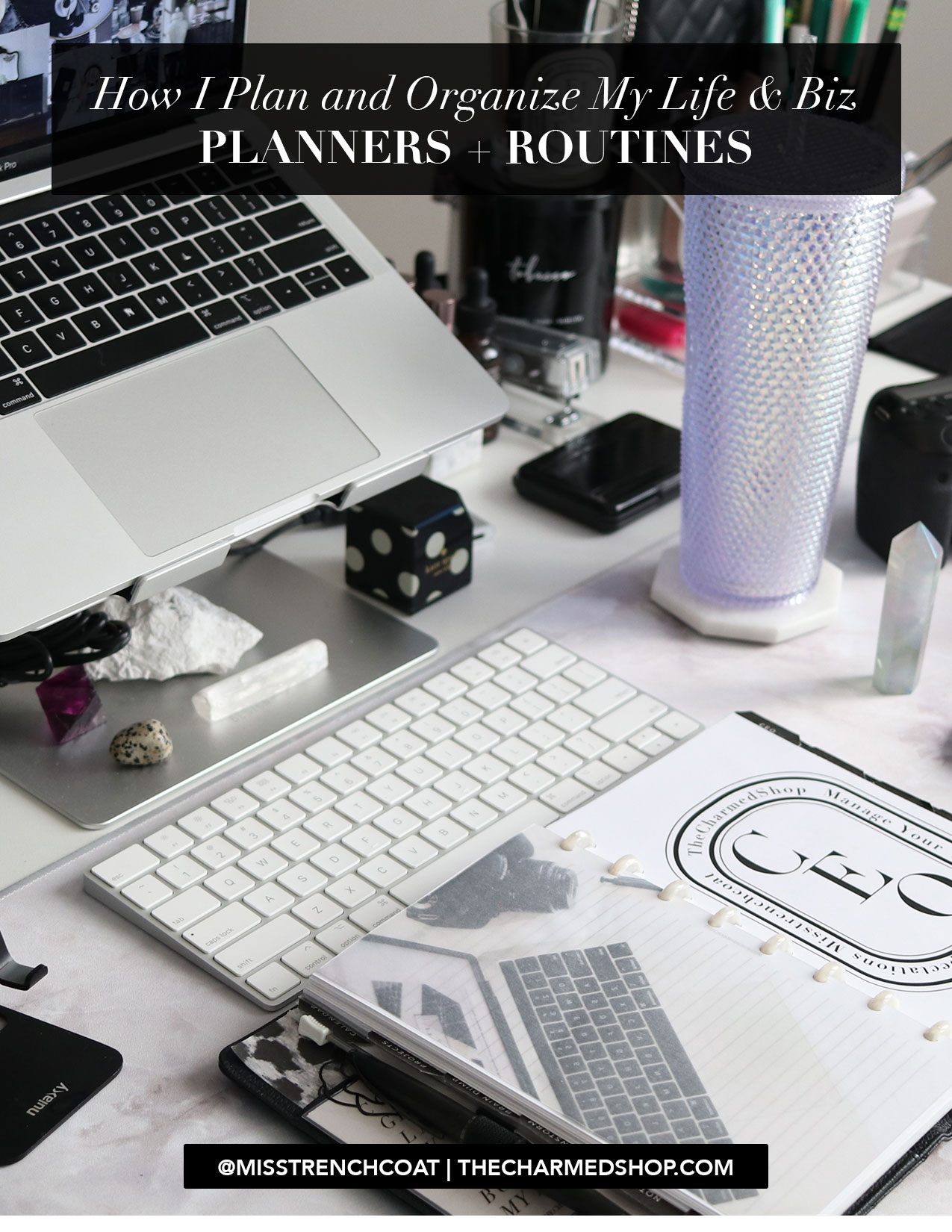
How I Plan and Organize My Life & Business | The Planners and Routines I use Each Year
Being productive and organized is something that takes consistency, like anything else you may want to find success at in life, you have to put systems in place and keep those systems up and running. Being a productive and organized person isn’t something that you set up once and you are done forever. However, the systems you use can be decided on once and then all you have to do is show up to do the regular maintenance routines and it can be as simple as that. So, today I thought it would be helpful if I shared not only the planner and planning tools I’m using to stay productive and organized, but also the functional planning routines and the process I take to plan and organize my life and business on a regular basis.
Part 1: Yearly Plan
The purpose of my yearly planning routine is to set the vision and direction for my year. You can’t create the life you want unless you know what that life is and make a plan to get there and that is the function of my yearly planning routine.
So, on an annual basis, in December, I take the following steps in my Yearly Planning Routine.
I set my goals for the new year
Break larger or longer term goals into milestones
Define objectives for precisely how I will achieve each goal and milestone and assign them to specific quarters and months of my year
Populate my planner with known tasks, events and due dates
The tools I use to complete my Yearly Planning routine are my You Got Goals Workshop and Planner that helps me identify and break down my goals. I also use the CEO Retreat Workshop and Workbook to set my specific business goals and define my business plans for the year in terms of what work I will be focused on each month of the year.
The Master Planner is the where I collect all relevant information for scheduling my time, and managing my tasks functionally.
The CEO Strategy Planner is a tool I use to supplement my main planner that gives me worksheets that help me create, outline and track business related information, but any tasks I define in that planner always get moved to the Master Planner. Yes, it’s a bit of duplication but it helps ensure I get individual tasks accomplished- so while I use the CEO Strategy Planner for working out my business plans and storing some important information, I need to integrate my business plans with the rest of my tasks and schedule in my Master Planner.
This process and these tools become the framework or outline for my plans for the year. Each subsequent step of my planning process is meant to fill out more specific details of plans and to prioritize tasks so my life is balanced and on track.
Part 2: Quarterly Plan
The purpose of my quarterly planning routine is to check my progress towards goals and create a 90 day plan of action to focus on. Many people get overwhelmed by their goals and plans because they try to make a plan to far in advance but in my functional planning system, I create more focused targets for 90 days at a time. 90 days or a quarter of planning at a time is often recognized as being a good amount of time to create more detailed plans for because its enough time to get a lot accomplished and to make adjustments to plans as you begin to take action.
So, on a quarterly basis, I take the following steps in my quarterly planning routine, and yes, this means that I am planning out Q1 not long after I set my goals because I need my 90 day plan in place before the quarter begins.
Check progress towards my goals and milestones (Q2-4)
Adjust plans as necessary to account for progress and obstacles
Generate my quarterly business plan
Populate action plans for objectives in the following quarter
Allocate tasks from project plans to monthly trackers and monthly master task lists
For my quarterly planning routine, I use my Charmed Life Master Planner and my CEO Strategy Planner to fill in the action plans and specific details of plans that I simply assigned to specific quarters or months of the year during my Yearly Planning Routine.
For example: During my Yearly Planning Routine, I may have decided I wanted to put together a launch for a product in a specific month, let’s say January. So, during my Q1 planning session, I would now take the time to create the plan for that launch and once I have the plan made, the tasks would be distributed to the monthly trackers inside the Charmed Life Master Planner for the month they belong to.
So, during our yearly planning we are deciding on things we want to do, and then during the Quarterly Planning session, we actually make the action plans and start assigning the tasks to the right months.
Part 3: Monthly Plan
The purpose of my monthly planning routine is to set reasonable expectations for accomplishing my objectives and tasks each month. Often times, people will overload their monthly to do list with things and then fail to get much of it accomplished because you put too much on your plate at one time. So, this monthly routine is meant to capture all the tasks that belong to the month but also to ensure their is enough time to get it all done.
So, on a monthly basis, I take the following steps in my monthly planning routine.
Brain dump to capture any additional new tasks that belong to my plans for the month
Populate my monthly calendar with important dates
Check the progress of project plans
Fill in my master monthly tasks list and make sure my monthly tracker is fully populated
Start assigning important projects and work to the specific weeks across the month
Something that has always set my functional planning process apart from other planning processes is that I use the month as the basic unit for task management. So, instead of having a long to do list with tasks that apply to various months of the year- I prefer a master monthly task list so as you are working day in and day out, you have a more reasonable to do list to work off of. Projects. systems and habits are also tracked on a monthly basis in my system and limited because when people make their plans for the month, I find they often overplan. They say they want to complete a whole list of projects, they want to start a whole list of new habits, they want to integrate all these new systems at once, but it’s too much and they fail. So, my Charmed Life Master Planner puts limits on how much you can plan for each month in order to help you self-edit and limit the plans you make each month. Because if you get overwhelmed, you will most likely fail to get everything done, and I’d prefer for you to at least get a reasonable amount of things done.
So, for my monthly routine, of course I use my Charmed Life Master Planner, and I will manage work for my business inside the CEO Strategy Planner, but again, any specific tasks are always moved into my master planner for actual scheduling to ensure the task gets done.
Part 4: Weekly Plan
The purpose of my weekly planning routine is to outline a schedule for accomplishing tasks and meeting expectations across the week. I love using the week as my basic unit for time management, similar to the way that I prefer to use the month as the basic unit for task management. We all get 24 hours in a day, but for most of us, 24 hours is just not enough time to plan to get the bulk of our tasks accomplished. Instead, by zooming out from the day to the week, we suddenly have 168 hours to use instead and a place in our week we can schedule in for nearly every priority and habit we want to complete.
So, on a weekly basis, I take the following steps in my weekly planning routine.
Get clear on the weeks objectives/priorities
Assign tasks, events and due dates across the week
Make a weekly to-do list
Ensure I have planned for self-care and other essential habits
Optional but impactful: Check with the important people in your life who have the ability to affect your plans and ensure you are on the same page with expectations.
When it comes to creating my weekly plan, this usually isn’t something I am doing from scratch each week. As part of my Charmed Life Master Planner, I keep my ideal weekly schedule laid out that becomes the template for me to organize my week by. My ideal weekly schedule is a default schedule I create at the start of the year that includes time blocks for priority tasks and habits. On it you will find time blocked off for meal planning, grocery shopping, meal prepping, cleaning, self-care, laundry, and other recurring activities in my week. The ideal weekly schedule also includes the plan for my themed workdays, which are time blocks I use to manage work for my business. So, using this default template, I already have a consistent plan for my week, and so on a weekly basis I just need to fill in specific projects, tasks and appointments that vary.
Part 5: Daily Plan
The purpose of my daily planning routine is to create a prioritized schedule and plan for tasks to accomplish each day. Once we get to the daily planning portion of this process, my tasks have been organized so I know what actions I need to take, my time has been allocated so can feel confident showing up each day knowing that the things on my to do list today are all I need to accomplish to move my plan forward, and so all that’s left for me to do is show up, trust the plan and take action.
So, on a daily basis, I take the following steps in my daily planning routine.
Review my ideal daily schedule plus any scheduled items for the day and my weekly to do list
Assign my top 3 daily tasks
Identify other tasks to worn on to fill my time for the day
Ensure I have white space in my schedule in case new urgent items or interruptions cause delays
When it comes to creating my daily plan, just as my weekly plan is not something built from scratch, neither is my daily routine. In my Charmed Life Master Planner I have an insert for my Ideal Daily Routine- which is the schedule break down for my time each day that includes time blocks for my morning routine, daily work blocks, meals, self-care and other daily non-negotiable tasks. So, that forms the outline for my day that remains consistent day over day, and then all I need to do is fill in my specific top 3 daily tasks for the day and populate a plan for my work blocks. Everything else in my day is part of a system, part of a routine that I show up for consistently and it makes managing my days so much easier because my routine becomes second nature for me. So, I will plan my days usually within my week on two pages agenda in my master planner, since I am using the digital master planner this year, it also has day on a page inserts as well, so if I need to map out a more detailed day, I have the space to do so, but usually working off my daily top 3, my ideal daily routine and my weekly to do list is all I need to stay on top of my tasks.
I will of course use my CEO Strategy Planner for reference if needed, but I don’t plan my day from my business planner, I plan it from my Master Planner.
WATCH: How I Plan and Organize My Life and Business in 2024
So, that is my complete functional planning routine that I perform on a yearly, quarterly, monthly, weekly and daily basis. I realize it may seem like a lot, but this is a complete functional planning system from start to finish, and over time as I’ve used this routine, it’s made planning and getting things done so much easier for me because things are almost formulaic for me. As long as I show up and do these planning routines, I know I’m set to take action fully knowing and trusting that what is on my to do list for a day truly is exactly what I need to do to build the life I want and create all the wonderful things I want to see in the world as part of my business.
Obviously, you know, I do a lot as a solo business owner who creates regular content across multiple platforms, who has multiple different offers and products that I market throughout the year and who hosts live classes and coaching multiple times per month, and this system is what helps me get it all done without working myself to the bone. You know I’m not afraid to hustle when I need to, but thanks to this system, my days are usually very relaxed, I miss very few tasks or obligations in the year, and I make the time for so many lovely things in my life from personal self-care to spending time with friends and family and my own interests and hobbies offline.
So, if the way I manage my life sounds good to you, if you would also like to live your life more intentionally and more balanced, I welcome you to pick up some of my tools, my planners, my Goal Setting classes or even enroll in my Charmed Life Master Mind and spend a year inside my world getting classes, coaching and ready made resources to help you live your version of a Charmed Life as well.
Everything has been linked within this post, and if you have any questions, leave me a comment or feel free to email me, and I’d love to help you discover my products and decide how best you can work with me moving forward into this new year so you can experience a new level of productivity, success and enjoyment from you life!
xoxo,
Alexis Giostra @MissTrenchcoat, Founder of Strange & Charmed
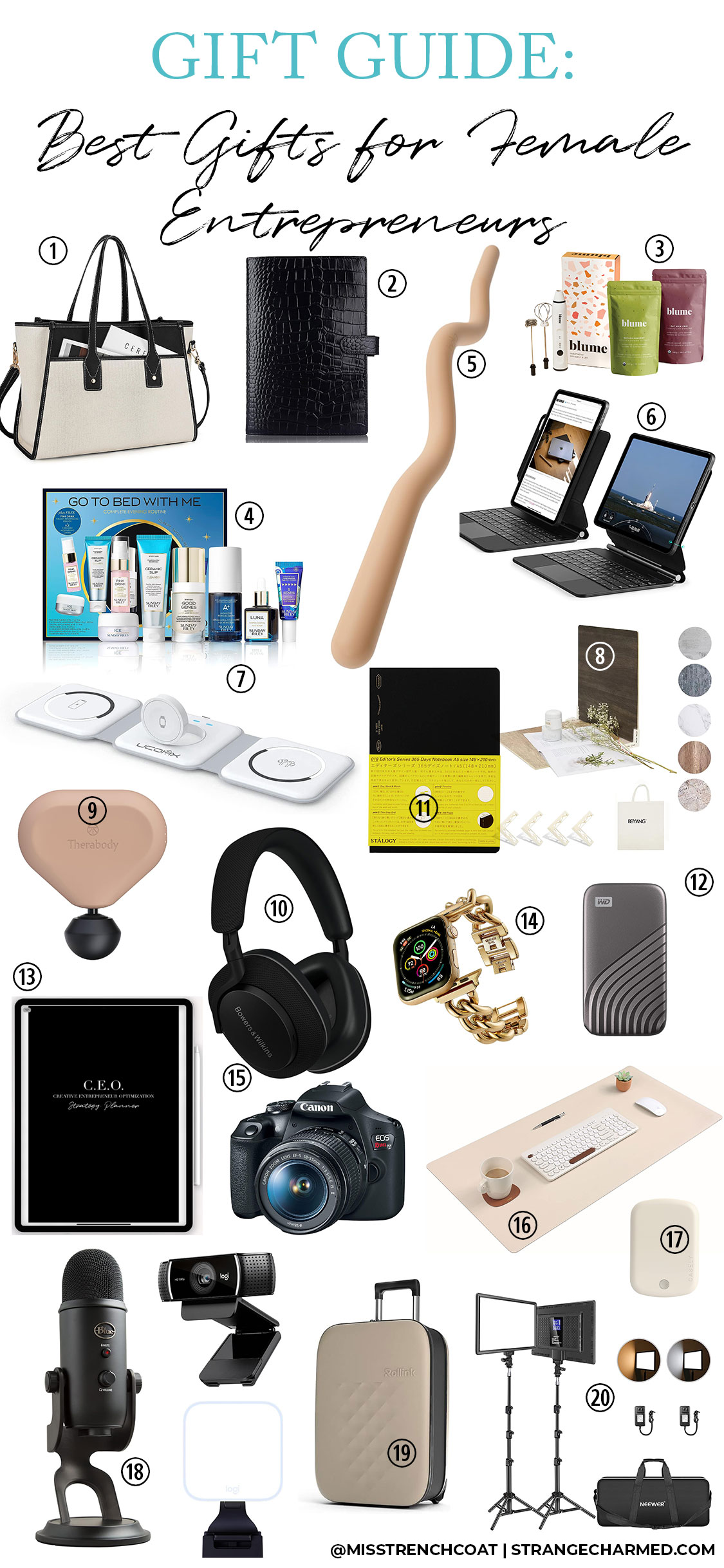
‘Tis the season to celebrate the female entrepreneurs who inspire us with their passion and dedication. Show your appreciation with these thoughtful and practical gifts:
1. Canvas Laptop Bag: A stylish and functional bag for her on-the-go workdays.
Make her holiday season brighter with these carefully curated gifts tailored to her entrepreneurial spirit.
Happy gifting!
Founder, Strange & Charmed 🌟
P.S. If you’re looking for more support in living your best, most organized and successful life, consider joining my inner circle private group coaching community called The Charmed Life Master Mind. Each month we meet for live classes, Q+As and monthly planning sessions, plus you have access to an on-demand resource library with dozens of classes, workbooks, planner inserts and other tools to help you craft the life you want to live. Click here to learn more and enroll today for instant access to all my best content and tools!
I appreciate you all more than you know! For the last 9+ years you have helped me make the life of my dreams a reality and I love helping you do the same!
My Annual Holiday Sale has officially begun, don’t miss out on 30% Off in The Charmed Shop!