
Why Overwhelm Isn’t Failure
We’ve all had those days where the to-do list feels endless. You wake up with the best of intentions, but almost immediately, life feels like it’s happening faster than you can keep up. Emails flood your inbox, someone needs you at home, deadlines loom, and even the simple act of deciding what to do next feels impossible.
The first instinct many women have in moments like this is to assume they’re failing. That if they were more disciplined, more organized, or just “better” at balancing it all, the overwhelm wouldn’t be there. But that isn’t true.
Here’s what I want you to know: overwhelm isn’t failure — it’s feedback.
When you feel overwhelmed, it’s not a sign that you’re weak, behind, or incapable. It’s a signal. A message from your mind and body telling you something is out of alignment. Maybe you’re carrying too much, focusing on the wrong things, or pushing through when you really need to pause.
The problem isn’t the overwhelm itself. The problem is how we interpret it. When we shame ourselves for feeling overwhelmed, we spiral deeper into stress. But when we learn to reframe overwhelm, we can use it as a tool for clarity.
In this post, I’ll show you how to do exactly that. You’ll learn five powerful mindset shifts that transform overwhelm from a roadblock into a roadmap — helping you reset, realign, and find clarity when you need it most.
Overwhelm as a Signal, Not a Stop Sign
Think of overwhelm as a dashboard light in your car. When it turns on, it’s not telling you that you’ve failed at driving. It’s simply alerting you that something needs attention.
The same is true in life. Overwhelm is your signal that your current pace, plan, or perspective isn’t sustainable. Instead of pushing harder or trying to “outrun” it, the key is to pause and listen.
That pause is where mindset shifts become powerful. By reframing the thoughts that fuel overwhelm, you take back control of the narrative. Instead of telling yourself a story about why you’re not enough, you start asking: What’s this feedback trying to teach me?
Here are five mindset shifts that will help you do just that.
1. “I don’t have time.” → “I need a system for my time.”
This is one of the most common thoughts fueling overwhelm. You glance at your calendar, see back-to-back tasks, and immediately feel like there’s simply no way to fit it all in. The problem? Believing that time is the enemy.
The truth is, time is neutral. Everyone gets 24 hours in a day. What creates overwhelm isn’t the amount of time we have — it’s the way we’re using it.
When you say “I don’t have time,” what you’re really noticing is the absence of a system. Without structure, every task feels urgent, and everything competes for your attention at once.
The reframe: “I need a system for my time.”
Instead of trying to squeeze more into your day, create a framework that shows you where your time is going and how to protect it for what matters. This might mean:
- Using time blocking to assign your top priorities to actual calendar space.
- Choosing a daily Top 3 so you focus only on the tasks that move the needle.
- Building white space into your schedule so you can reset instead of run on fumes.
Once you give your time structure, clarity emerges. You stop saying, “I don’t have time” and start saying, “Here’s how I’m choosing to spend my time.”
2. “I have too much on my plate.” → “Not everything deserves a place on my plate.”
Overwhelm often shows up as a sense that you’re juggling too many responsibilities. But here’s the truth: your plate isn’t the problem — it’s what you’ve chosen to put on it.
Many of us feel pressured to say yes to everything: work projects, family commitments, social obligations, household tasks, and endless small “shoulds.” But when everything gets treated as equally important, your energy scatters, and nothing gets the attention it truly deserves.
The reframe: “Not everything deserves a place on my plate.”
This mindset shift reminds you that you are the gatekeeper of your time and energy. You have the power to choose what stays and what goes.
Practical ways to apply this:
- Do a weekly brain dump of everything on your mind.
- Circle the 3–5 items that matter most for this season of your life.
- Cross off, delegate, or defer the rest.
When you release what doesn’t belong, overwhelm dissolves, and alignment takes its place. You start focusing on what actually matters instead of drowning in what doesn’t.
3. “I should be further ahead.” → “I am exactly where I need to be.”
This mindset trap is one of the most painful. When you believe you’re behind, you create a spiral of shame that makes progress feel impossible. You measure yourself against others or against unrealistic expectations, and you conclude that you’re failing.
But here’s the truth: progress is never linear. Every season of your life has its own pace, its own lessons, and its own priorities. Being “behind” is an illusion.
The reframe: “I am exactly where I need to be.”
When you shift into this belief, overwhelm becomes an invitation to realign, not a judgment of your worth. Instead of beating yourself up for what you haven’t done, you get curious about what you need now.
Try reflecting with prompts like:
- What progress have I already made this year that I haven’t celebrated?
- What lesson is this season teaching me?
- What one thing would feel good to move forward this week?
With this reframe, you stop chasing an invisible finish line and start honoring your actual path. That’s where alignment lives.
4. “I have to do everything.” → “I only need to do the things that matter.”
One of the sneakiest ways overwhelm creeps in is through the belief that you must handle everything yourself. Whether it’s work tasks, family responsibilities, or personal goals, the pressure to “do it all” leaves you drained and unfocused.
But here’s the truth: not everything matters.
The reframe: “I only need to do the things that matter.”
Productivity isn’t about cramming your day with more tasks. It’s about identifying the few actions that truly create impact and letting the rest go.
One of my favorite tools for this is the Daily Top 3. Each morning, I ask myself:
- What three tasks will move me closer to my biggest goals today?
- Which tasks would bring me a sense of calm and completion if they were done?
- Which tasks have real consequences if I delay them?
By choosing just three, I give myself clarity and focus. And at the end of the day, even if nothing else got done, I can feel aligned and accomplished.
5. “I can’t stop now.” → “Pausing will give me the clarity to move forward faster.”
This mindset is one of the most dangerous. When you believe you can’t stop, you push yourself past your limits. You ignore your body, skip rest, and run headfirst into burnout.
But rest isn’t laziness — it’s a productivity tool.
The reframe: “Pausing will give me the clarity to move forward faster.”
Sometimes the most aligned thing you can do is step away. That pause gives your brain space to reset, your body space to recharge, and your heart space to realign with what matters.
Ways to practice this pause:
- A 5-minute breathing break at your desk.
- A journaling session to sort your thoughts.
- Gratitude practice to shift your perspective.
- Listening to a mindset rampage audio to reset your energy.
When you choose to pause, you don’t lose time — you gain clarity. And clarity saves more time than hustling ever could.
How Mindset Work Stops the Spiral
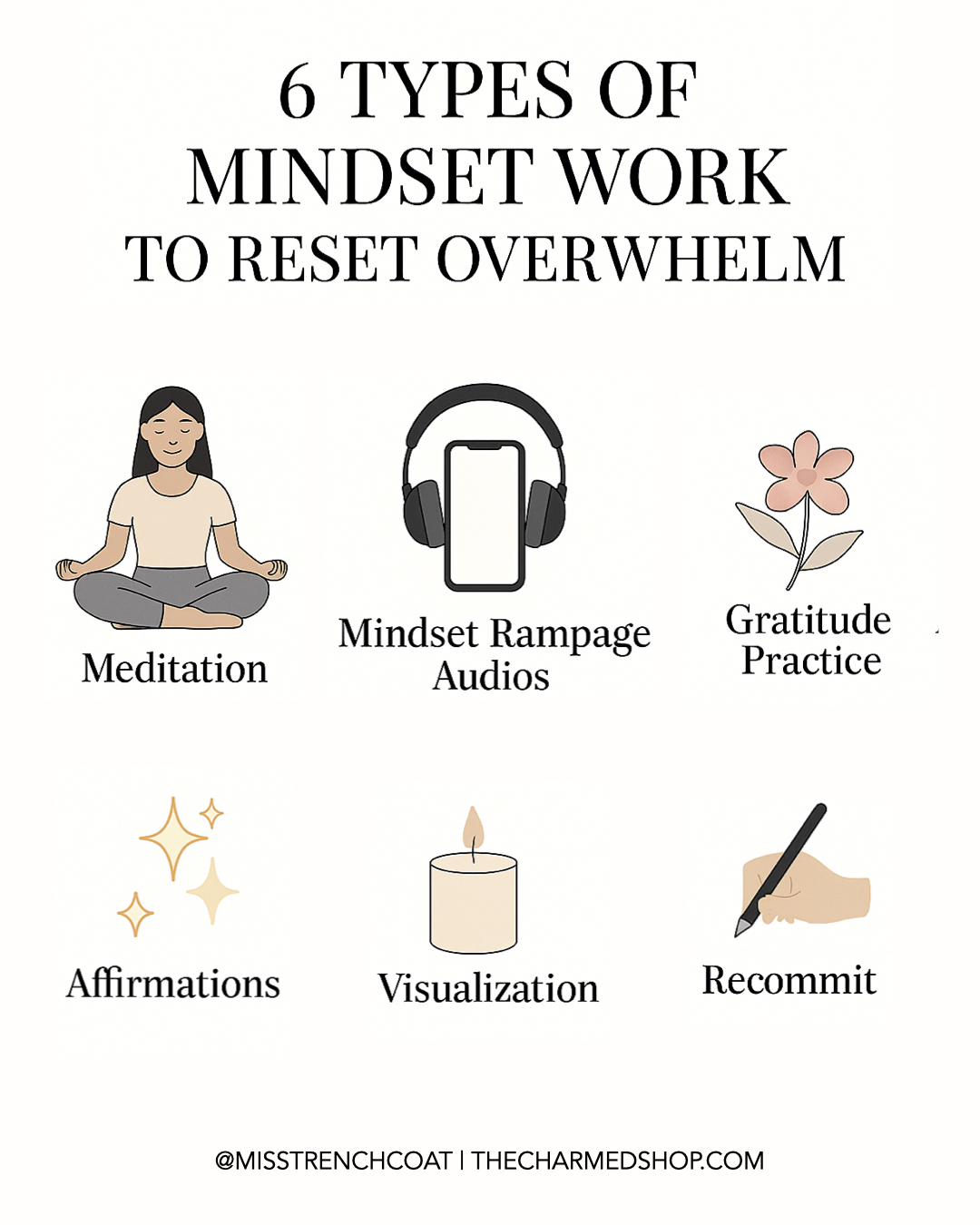
When overwhelm strikes, mindset work is your anchor. It interrupts the spiral of stress and self-doubt and brings you back into alignment with your values and goals.
Think of it as building a toolkit of clarity practices you can reach for anytime you feel overwhelmed:
- Meditation quiets the noise and grounds you in the present.
- Journaling helps you release mental clutter and see your thoughts more clearly.
- Mindset rampage audios flood your mind with empowering beliefs.
- Gratitude rewires your perspective from lack to abundance.
- Affirmations create new thought patterns that support your goals.
- Visualization reminds you of the bigger picture you’re working toward.
By weaving these practices into your daily or weekly routine, you build resilience. Instead of spiraling deeper into overwhelm, you create pathways back to clarity and alignment every single time.
From Overwhelm to Alignment
Overwhelm isn’t a verdict on your worth. It’s simply feedback — a signal that something in your plan, pace, or perspective needs attention.
When you shift your mindset, you stop treating overwhelm as failure and start using it as a tool for alignment. By reframing your thoughts, you gain clarity, focus, and the ability to move forward with purpose.
✨ Remember:
- You don’t need more hustle.
- You don’t need more pressure.
- You need structure, support, and mindset shifts that bring you back to alignment.
And if you’re ready to put these mindset shifts into practice and build a clear, structured plan for the final quarter of the year, I’d love for you to join me in the Q4 Crescendo Workshop.
On Saturday, September 13th at 12pm EDT, I’ll guide you step-by-step through creating your Q4 plan — identifying your priorities, setting aligned goals, and building the systems that will carry you into the new year with clarity and confidence.
👉 [Sign up for the free Q4 Crescendo Workshop here]
Don’t wait for clarity to magically appear. Create it.
xoxo,