
Goal Getter

In My Soft Life Era: Turning 40 and Starting My New Year on March 20th

In March, I turn 40.

And instead of setting bigger goals, pushing harder, or trying to optimize every corner of my life… I’m doing something different.

I’m allowing myself to do less.

Intentionally. Strategically. Without guilt.

If you’ve been around Strange & Charmed for any amount of time, you know I believe in structure. I believe in aligned action. I believe in functional planning and building systems that support your dream life.

But here’s what I’ve learned after more than a decade of building businesses, achieving goals, and becoming the woman I once imagined:

Productivity isn’t about constant acceleration.

Sometimes, the most powerful move is to soften.

And I have a feeling… you might be feeling this shift too.

Entering My Soft Life Era (At 40)

For me, this “soft life era” isn’t about abandoning ambition.

It’s about refining it.

It’s about:

  • Doing less — but doing what matters most
  • Letting go of rigid timelines
  • Releasing specific outcomes
  • Enjoying my life while I build it

I’m not holding onto things so tightly anymore.

I still have goals. I still have vision. I still have standards.

But I’m not gripping them with white knuckles.

I’m letting things unfold.

And that shift alone has changed the way I wake up each day.

Instead of asking:

“How can I get more done?”

I’ve been asking:

“How can I enjoy this?”

That’s a very different energy.

And for women like us — the high-achieving, capable, responsible ones — that question can feel almost radical.

The Gentle January Experiment

To kick off 2026, inside The Charmed Life Master Mind, I hosted something called the Gentle January Challenge.

The entire theme was anti-hustle.

We focused on:

  • Let it be easy
  • Guilt-free rest
  • You can go slow and still achieve it all
  • Overwhelm is not a requirement for success

Because every year, January arrives with this unspoken pressure.

New year.
New goals.
New habits.
New body.
New business plan.
New everything.

And yet… for those of us in the Northern Hemisphere, what is the season actually doing?

It’s cold.
It’s dark.
The trees are bare.
The earth is resting.

Nature is not launching.

Nature is conserving.

And yet we expect ourselves to operate at full throttle.

This year, I questioned that.

What if January wasn’t for building?

What if it was for living off your reserves?

What if it was for reflection, restoration, and small, gentle movements forward?

Inside the Master Mind, we practiced:

  • Simplifying routines
  • Prioritizing sleep
  • Setting fewer goals
  • Celebrating small wins
  • Reducing inputs (less comparison, less noise)

And something beautiful happened.

Instead of burning out by February…

The women felt steadier.

Calmer.

Clearer.

And that’s when I realized this shift isn’t just personal.

It’s seasonal.

Why I’m Treating March 20th as My New Year

This year, I’ve decided that my real “new year” begins on March 20th — the start of Aries season and the astrological new year.

The first day of spring.

The shift from dormancy to bloom.

The moment when light returns.

This is when nature begins to move.

This is when seeds sprout.

This is when momentum feels natural — not forced.

And regardless of what Punxsutawney Phil says… spring always comes.

I’ve spent years teaching quarterly planning, yearly planning, functional systems.

And I still believe in them.

But I also believe in alignment.

And March feels aligned.

It feels like the true energetic reset.

Not because it’s trendy.

But because it makes sense.

A Soft Life Isn’t a Lazy Life

Let’s be clear.

Soft doesn’t mean passive.
Soft doesn’t mean unmotivated.
Soft doesn’t mean small.

Soft means:

  • Intentional
  • Self-aware
  • Regulated
  • Aligned

It means understanding that you have 168 hours in a week — and you don’t need to fill all of them.

It means recognizing that you can:

  • Delegate
  • Defer
  • Delete

It means asking:

  • What are my real objectives this season?
  • What actually matters?
  • What can wait?

Functional planning has always been about making space for what matters most.

Now I’m using it to make space for joy.

Integrating Play Back Into My Life

This is the part that might surprise you.

Lately, I’ve been playing more video games.

I bought a few Labubu dolls and dressed them up.

I’m getting into Tamagotchi and digital pets again… like I’m 14 not 40!

I’ve been enjoying my streaming services.
Wearing the makeup I already own.
Using the planners and notebooks I already have.
Cooking at home.
Re-reading books from my (digital) shelves.

Simple pleasures.

No productivity goal attached.

No monetization strategy.
No content angle.
No outcome.

Just enjoyment.

And do you know what I’ve realized?

So much of adult burnout comes from eliminating play.

We turn everything into optimization.

Even rest becomes strategic.
Even hobbies become side hustles.
Even fun becomes content.

And I don’t want to live like that.

At 40, I want delight.

The Trap of Buying Happiness

Another subtle shift I’ve been noticing…

When we feel disconnected or overwhelmed, we often buy something.

New planner.
New wardrobe.
New skincare.
New program.
New aesthetic.

But what if happiness isn’t in the new?

What if it’s in using what you already have?

This season, I’ve been asking myself:

  • What do I already own that could bring me joy?
  • What hobbies did I abandon?
  • What creative impulses have I ignored?

Instead of accumulating more…

I’m interacting more deeply with what’s already here.

That alone has created more abundance in my life than any purchase ever has.

The Productivity Lie Women Have Been Sold

There’s something I talk about often:

Women don’t have a productivity problem.

They have an over-responsibility problem.

You are likely already productive.

You are already doing too much.

You are already holding everyone else together.

And then January comes and tells you:

“Do more.”

But maybe the shift this year is:

“Do less, but better.”

“Do less, but with intention.”

“Do less, but in alignment with your energy.”

Soft productivity.
Seasonal productivity.
Functional productivity.

That’s the future.

Working With the Season Instead of Against It

Here’s what I’m embracing in this seasonal model:

Winter

  • Reflect
  • Restore
  • Plan lightly
  • Conserve energy
  • Build internal clarity

Spring

  • Initiate
  • Launch
  • Experiment
  • Take bold action
  • Build momentum

Summer

  • Sustain
  • Expand
  • Optimize

Fall

  • Refine
  • Evaluate
  • Simplify

This is still strategic.

This is still structured.

But it honors your nervous system.

And that’s the difference.

Letting Go of Specific Outcomes

One of the most profound shifts for me lately has been releasing tight control over specific outcomes.

I still set objectives.
I still define action plans.
I still allocate my Top 3.

But I’m not attaching my worth to results.

If something takes longer?
Fine.

If something evolves?
Even better.

If something doesn’t happen?
Maybe it wasn’t meant for this season.

There is power in looseness.

There is confidence in flexibility.

And at 40, I trust myself enough to adapt.

The Season of Life I’m In

Every woman moves through seasons.

Career building.
Motherhood.
Reinvention.
Healing.
Expansion.
Simplification.

Right now, I feel like I’m in a refinement season.

I’ve built.
I’ve proven.
I’ve achieved.

Now I’m curating.

Choosing.
Softening.
Enjoying.

And when I look at the messages I receive, I see so many of you in a similar transition.

Less hustle.
More intention.
Less noise.
More clarity.
Less proving.
More living.

Is that you too?

Your Invitation

I want to hear from you.

Are you changing your relationship with productivity this year?

Are you redefining ambition?

Are you craving softness without sacrificing success?

And will you join me in celebrating the seasonal new year on March 20th — the start of Aries season — as our true reset?

Imagine beginning your year when the world is blooming.

Imagine setting goals when light is returning.

Imagine building momentum when energy feels natural.

It doesn’t mean you ignore January.

It just means you don’t force it.

What This Means Practically

Here’s how I’m approaching the next few weeks:

  • Light planning until March 20th
  • Gentle routines
  • Focus on rest and play
  • Clarifying vision for the next 90 days
  • Releasing anything that feels forced

Then on March 20th:

  • Quarterly reset
  • Clear objectives
  • Fresh momentum
  • Strategic aligned action

Structured.
Intentional.
Charmed.

That’s the balance.

You Can Do It All — Just Not All at Once

This has always been true.

You can build the business.
Have the relationship.
Prioritize your health.
Enjoy your home.
Read the books.
Play the games.
Wear the lipstick.
Take the nap.

Just not all in the same season.

The Well Planned & Productive Woman knows when to push.

But she also knows when to soften.

And maybe turning 40 has simply made that truth louder for me.

A Final Thought

If you’ve been feeling:

  • Tired of hustle culture
  • Resistant to rigid timelines
  • Drawn toward slower mornings
  • Interested in hobbies again
  • Less attached to proving yourself

You’re not falling behind.

You’re evolving.

And maybe this March 20th can be your permission slip.

To begin again.
To bloom slowly.
To plan strategically.
To live softly.

Because productivity was never meant to steal your joy.

It was meant to protect it.

So tell me…

What season are you in?

And will you celebrate the new year with me this spring?

xoxo,

Your Guide to a Gentle January and an Intentional New Year

January arrives with pressure.

New goals. Fresh starts. Big dreams. The unspoken rule seems to be: start strong, go big, do more.

But what if you didn’t need to hustle to make progress?
What if the most productive thing you could do right now… was pause?

Welcome to Gentle January.

This is your invitation to start 2026 differently. With more ease, more clarity, and more control over how your year unfolds.

Because you don’t need more to do.
You need space to think. Structure that supports you. And systems that actually help you make progress on what matters.


What is Gentle January?

Inside the Charmed Life Master Mind, we’re kicking off the year with a 31-day challenge designed to ease you into aligned productivity.

Each day in January, members receive a short but powerful journaling or planning prompt. These are designed to help you:

  • Reflect on where you are and where you want to go
  • Reset your routines and planning practices
  • Reconnect with your goals and values
  • Release the overwhelm and embrace intention

This isn’t about pushing yourself harder. It’s about softening into the structure that supports the woman you want to become.

Here’s a peek at a few of the prompts:

  • “What’s one word or theme you want to embody this year?”
  • “Sketch out your ideal week—with white space included.”
  • “Do an energy audit: When do you feel most focused in a day?”
  • “Reflect: What are you ready to release from last year?”
  • “Write a thank-you note to yourself for showing up with intention.”

You can begin anytime in January. All prompts and support are available inside the Master Mind.

[Join the Charmed Life Master Mind Now]


2026 is a Number 1 Year in Numerology — What That Means for You

In numerology, each year has a number associated with its energy. 2 + 0 + 2 + 6 = 10, which simplifies to 1.

2026 is a Number 1 Year: a year of beginnings, leadership, and fresh energy.

It’s a time to:

  • Start something new
  • Lead yourself with confidence
  • Get clear on who you are becoming

This energetic reset is powerful—but only if you meet it with intention.

A fresh start doesn’t require a full calendar or endless goals.
It requires clarity.
It requires a plan.
It requires prioritizing the few things that truly matter.

Use this moment to ask:

  • What am I ready to leave behind?
  • What identity am I stepping into?
  • What would it look like to build a year aligned with my values?

This is where the real magic of Gentle January begins. You aren’t just starting a new year. You’re setting the tone for an entirely new chapter.


What an Intentional Year Looks Like

An intentional year isn’t packed. It’s purposeful.

It’s less about doing more and more about doing what matters most.

To create that kind of year, you need:

  • Clarity on your priorities
  • A plan to support your goals
  • The discipline to follow through with ease

That’s where functional planning comes in.

Functional planning is the system we use inside the Charmed Life Master Mind and in all of our planners. It’s a three-phase method:

  1. Capture – Get everything out of your head and onto paper
  2. Organize – Turn tasks into action steps under clear objectives
  3. Allocate – Strategically plan what happens when so you stay on track

This isn’t about being rigid or over-planning your life.
It’s about building flexible structure that supports flow.

You know what to focus on. You know what can wait. And you finally feel like you’re in the driver’s seat of your day.


Tools to Support Your Gentle & Aligned Year

Want to make 2026 your most intentional year yet?
Start with the right tools.

🗓️ The 2026 Charmed Life Master Planner
Our best-selling planner system that helps you integrate planning with personal growth. Use it to set goals, create routines, and manage your time with elegance.

💼 The CEO Strategy Planner
Designed for entrepreneurs and creative business owners who want to run their business with intention. Map out your offers, marketing plans, and revenue goals.

💸 Use code FRESHSTART2026 to get 25% off all planning and goal-setting tools in the shop:
👉 thecharmedshop.com

Don’t just set goals this year—plan for the life you want.


The Charmed Life Master Mind: Your One-Stop Shop for Support in 2026

If you’re craving more accountability, structure, and aligned community this year, the Charmed Life Master Mind is where it all comes together.

Here’s what we’re doing this January:

🎓 Master Class: You Are the Masterpiece – Quarter 1 Planning
Saturday, January 10th
Create a focused, aligned plan for Q1 that supports your energy and goals.

🎉 Office Hours: 2026 Vision Board Party
Tuesday, January 20th
A cozy, creative session to dream, design, and visualize the life you’re building.

📆 Power Hour: Monthly Planning Session
Saturday, January 31st
Get your February plan in place with the support of our community.

📚 Book of the Month: The One Thing by Gary Keller
We’ll read and discuss this productivity classic together—because narrowing your focus is the most powerful move you can make in a number 1 year.

Plus: You’ll get access to the full Gentle January challenge, planning templates, coaching support, and a community of women who are done with hustle and ready for harmony.

Join us now and make 2026 the year you lead your life with clarity, intention, and ease.
👉 [Join the Master Mind Here]


Your Gentle Reset Starts Now

Take a breath.
Take a beat.

You don’t have to rush.
You just have to begin.

This is your year to build something beautiful. Not by doing more than ever before—but by doing what matters most.

So whether you’re:

  • Just starting to think about your goals
  • Feeling behind already
  • Or craving a different way to approach your life and time…

Know this: Gentle is still powerful.

And you get to choose a new way forward.

Join the Master Mind. Grab your planners. And let’s make 2026 the year of your most intentional and aligned self.

With grace, structure, and your dreams at the center.

xoxo,

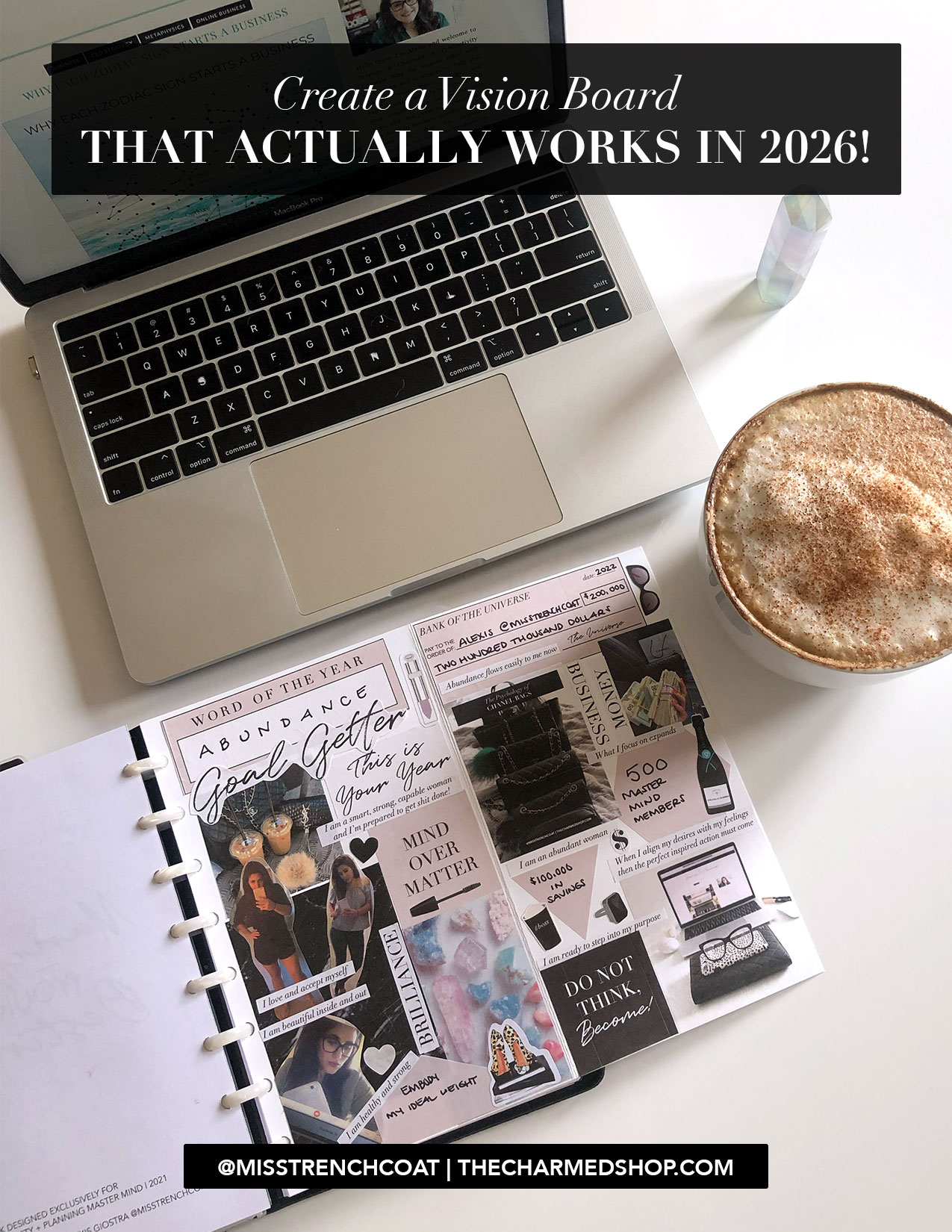
Create a Vision Board That Actually Works in 2026

You’ve probably created a vision board before—beautiful, full of dreams, and full of hope. But then… quietly it ends up folded in a drawer, forgotten by February. That’s not your fault. The problem isn’t your desire—it’s often the method. A vision board should be more than pretty pictures—it should be a functional tool that keeps your goals alive all year. In this post, I’ll walk you through how to craft a vision board that aligns with your goals, supports your systems, and actually works in 2026.

Why Most Vision Boards Don’t Work

Many boards fail because they’re:

  • purely aesthetic with no action tie‑in
  • disconnected from the actual goals and planning system
  • created and then never referenced again
    When your board is not anchored to your reality, it becomes decoration instead of direction. Vision boards can and do work—but only when they’re designed with intention and integrated into your systems. 

Step 1. Connect to Your Vision for 2026

Before you start gluing or designing, spend time with your feelings. Ask: “What do I want my life to feel like in 2026?”Reflect across key areas:

  • Yourself
  • Your home
  • Relationships
  • Career or business
  • Finances
  • Health + wellness
    Choose your primary life priorities and let those feelings guide your board. A vision board grounded in your why becomes an energetic anchor for your goals.

Step 2. Set Goals First, Then Build the Board

Your vision board isn’t the goal-setting step—it’s the after‑step that supports goals mapped into action. Set your aligned goals first (see last week’s post) and then choose visuals and words that represent them. This way your board reflects what already matters, rather than what’s trendy. 

Step 3. Choose Your Format: Digital or Physical

Decide what you’ll use based on your life and planner system:

  • Physical board: poster, cork board, notebook insert
  • Digital board: Canva, Pinterest, tablet wallpaper
    Choose what you’ll see and use—because use is what gives power, not perfection.

Step 4. Curate With Strategy, Not Just Aesthetics

Go deeper than images. Choose visuals that evoke the feelings you want. Include meaningful words or affirmations. Keep a cohesive palette and layout. Some tips:

  • Use a photo of you or a strong symbol of the year you’re building
  • Add your Word of the Year or Core Desired Feelings
  • Avoid clutter—each element should serve a purpose
    Research shows vision boards enhance clarity and self‑efficacy when used deliberately.

Step 5. Display It Where You’ll See It

A vision board only works if you refer to it. Place it where you’ll see it daily:

  • In your planner dashboard
  • On your phone or tablet lock screen
  • On your desk or wall
    Only when the vision becomes part of your visible environment does it shift from dream to reminder.

Step 6. Use It as a Decision‑Making Filter

Use your board actively. When planning tasks, projects, or making decisions ask:

“Does this align with my board?”
Make it part of your weekly review and planning rhythm. This transforms the board from static art into a tool that guides your actions.

Join Our Vision Board Party This January

Every January inside the Charmed Life Master Mind we host a cozy Vision Board Party—an aligned, soulful workshop where we create together. We provide printable resources, design prompts, and live facilitation to help you build a board that inspires and supports your year. Whether you join there or begin now on your own, you’re ready.

Vision Board FAQ

  • Do I need more than one board? No—but you can create mini boards for specific goals.
  • Should I include “material” goals? Yes—if they align with your deeper vision.
  • What if my vision changes mid‑year? Update it. Vision boards can evolve as you do.
  • Do I need to look at it every day? Yes—frequent engagement intensifies its impact.

You don’t need to be crafty, artistic, or perfect to create a meaningful vision board—you just need alignment, clarity, and visibility. A vision board that actually works is one that reflects your goals, fuels your mindset, and supports your planning system.


If you’re ready to make your 2026 vision board with us, join the Charmed Life Master Mind for access to the Vision Board Party, templates, and community support.


✨ Let’s build a year that’s well‑planned and beautifully aligned.

xoxo,

How to Set Goals for 2026 You’ll Actually Follow Through On

So many women step into a new year with high hopes… only to feel defeated by February. I’ve seen it again and again: bold goals, massive motivation, and then the spark fades. The missing piece? A goal‑setting method that fits your real life, not a checklist you abandon.

In this post, we’ll walk through how to create goals that feel exciting, realistic, and actionable—so you don’t just set goals, you live them.

Why Most Goals Fail (and How to Avoid It)

Many goals collapse under their own weight because:

  • They’re too vague (“Grow my business” without clarity)
  • They aren’t connected to daily routines or reality
  • They stem from “shoulds” instead of what you truly desire

    The right goal isn’t just inspiring—it’s aligned, structured, and supported by a system you’ll stick with.

Step 1. Get Clear on What You Actually Want

Before writing goals, ask yourself: “What do I want my life to feel like in 2026?”
Reflect across these life categories:

  • Personal growth
  • Health + wellness
  • Business or career
  • Finances
  • Creativity or learning
  • Relationships + community
  • Lifestyle or environment

Then, from this vision you’ve created, identify 1-5 specific Priorities you’ll want to focus on. Priorities are specific people, relationships, institutions or establishments that you can actually point to and see your outcomes. We set goals against priorities not vague categories so that you have a strong “why” tied into your goals.

Step 2. Choose Intentional, Aligned Goals

Under each Priority, write 1‑3 goals that pass your “alignment test”:

  • Does this reflect my values?
  • Does it support the vision I want to live?
  • Does the goal energize me or drain me?

    This makes your goals both inspiring and doable.

Step 3. Break Goals into Milestones

Reverse‑engineer your goals: start from the end and map backwards into quarters.
For example, if you have a goal to start a business:

  • Q1: Research & outline
  • Q2: Build & test
  • Q3: Launch
  • Q4: Review & scale

    This creates a roadmap and prevents overwhelm to keep momentum alive.

Step 4. Anchor Goals into Your Planner System

Goals live beyond ideation—they need a plan. Break each goal down into specific objectives, which are the how to achieve it. Make sure to identify the objective type for each to understand how to manage and track the task in your planner.

  • Project‑based objective: use a project planning sheet to break down the steps in logical order and give it deadlines.
  • System-based objective: list out the specific steps and process for the system and assign it a frequency to track it on either a daily, weekly, monthly or other basis.
  • Habit‑based objective: define the specific habit, where it belongs in your daily routine and track it on a habit tracker for the month.

    If you’re using the Master Planner System, you’ll find this built in and designed to support your journey.

Step 5. Build in Accountability & Review Rituals

No goal sticks without check‑ins.
Schedule monthly reviews:

  • What progress did I make?
  • What new obstacles showed up?
  • What is the next small step I can take?

    Add accountability: a mastermind, partner, or community (like ours) can be the difference between “maybe” and “yes.”

Common Goal‑Setting Pitfalls to Avoid

  • Choosing too many goals → dilutes focus
  • Setting goals from pressure or comparison
  • Hiding your goals (out of sight = out of mind)
  • Skipping scheduled reviews
  • Mistaking ambition for alignment

    Your goals should feel like an invitation, not a burden.

My 2026 Goal Planning & Mapping Process

If you would like to learn more about how I set my goals and plan my year, including the specific planning tools I use, I have a dedicated post on the topic that I recommend you read next. This article was written a few years ago but the process I use is still the same. Just the tools have been updated to the current year.

Read Next: How I Plan and Organize My Life & Business | The Planners and Routines I use Each Year

Action Steps: Set Your 2026 Goals with Confidence

  1. Reflect on what you want your life to feel like
  2. Choose 3‑5 life priorities to focus on
  3. Write 1‑3 aligned goals per priority
  4. Break them into quarterly milestones
  5. Plug objective plans into your planner and design your check‑in rituals
  6. Choose whether you’ll join a community or accountability partner to keep you moving

Setting goals that you’ll actually follow through on isn’t about willpower—it’s about building a system that supports your success. You have permission to dream big and keep it simple.

If you’re ready to get serious about your 2026 goals, I’m so excited to invite you to the 2026 YOU GOT GOALS Planner & Workshop Series—available to purchase a la carte in the shop, or included as part of your membership inside the Charmed Life Master Mind.

Whether you join for the tools, the training, or the community—or all three—this is the year you move forward with clarity and confidence.

Here’s to well‑planned goals that become done goals.

xoxo,

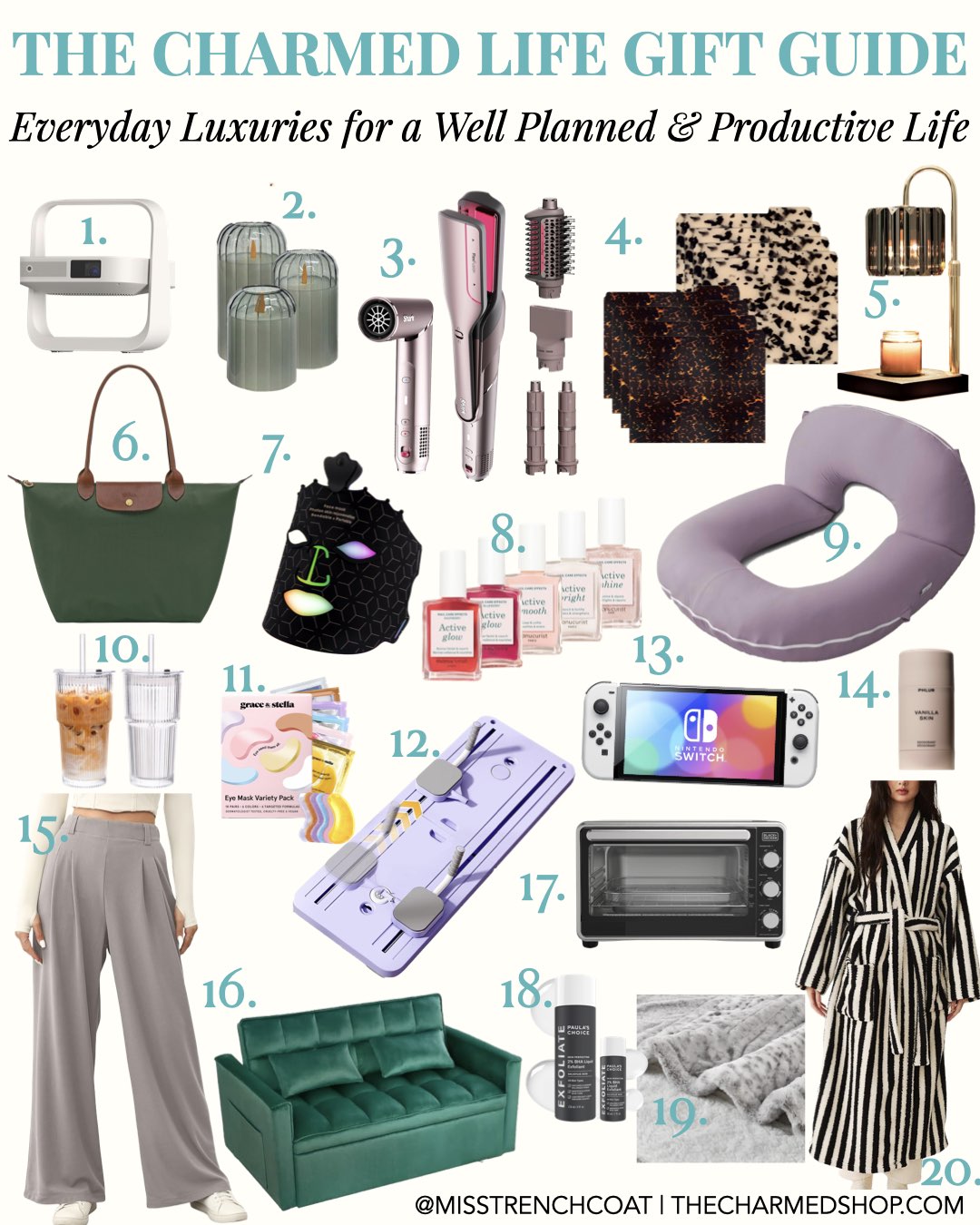
The Charmed Life Gift Guide: Everyday Luxuries for a Well Planned & Productive Life

If you’ve been following me for any length of time, you know how much I love to find small ways to elevate everyday life. That’s why every year, I share a curated list of items that have added a touch of charm and intentionality to my routines. These are products I’ve used and loved—or that are on my wishlist—and I think they’d make amazing gifts for someone else or little luxuries for yourself.

This year’s gift guide is packed with beautiful and functional items that help you live your most productive and well-planned life.

Gift Guide

1. XGIMI Elfin Flip Portable Projector
Fun fact about me: I do not like TVs—I think they’re large, heavy, ugly, and not portable. I prefer watching media on my phone, tablet, or laptop. But I also love a big screen experience. Thankfully, Mr. Trenchcoat gifted me this projector for my new office space, and I’m in love. Just aim it at a wall, and you’re good to go.

2. Rechargeable Flameless Candle
I love candle ambience without the fire hazard. These flameless candles are cute, portable, and can even be used while plugged in—super convenient.

3. Shark FlexFusion Hair Straightener and Dryer
This replaced my old Shark FlexStyle. I love the new styling tools that include heated plates. It’s my go-to all-in-one hair tool.

4. Tortoiseshell File Folders
A stylish upgrade to your home office setup. These file folders are not only functional but also beautiful.

5. Candle Warmer Lamp
I’ve wanted one of these for a while. It’s a cute decor piece that lets you enjoy the benefits of a candle without lighting it.

6. Longchamp Le Pliage Original Large Nylon Tote Bag
I’ve used a non-branded nylon tote for years, and when it wore out, I decided to go for the real thing. Great for travel and perfect for carrying my dog’s essentials too!

7. 7 Color Red Light Therapy Mask
I’ve used this for months and love it. Light therapy doesn’t need to be expensive to be effective.

8. Manicurist Active Range Nail Polish
This range has been my go-to since summer. It gives the perfect clean-girl manicure look.

9. Cozy Reading Pillow
Perfect for reading, gaming, or napping. It adds that extra cozy touch to any chair or couch.

10. Ribbed Glass Tumblers with Lids and Straws
These are beautiful and durable. I never understood the hype until I got a set myself.

11. Under Eye Masks
They instantly elevate your skincare routine and make you feel like you’re at a spa.

12. Pilates Board
A cute, compact piece of home workout equipment. Easy to store and fun to use with YouTube workouts.

13. Nintendo Switch OLED Model
I’ve used the Lite version for years but finally upgraded. It’s my favorite tool for cozy hobbies and mental relaxation.

14. PHLUR Vanilla Skin Natural Deodorant
The best natural deodorant I’ve found. It smells amazing and helps with ingrown hairs.

15. Wide Leg Waffle Knit Pants
Dupe for the Halara pants and a great alternative to leggings for a comfy daily uniform.

16. 3-in-1 Sofa Bed
Affordable, functional, and great for small spaces. I use it as a daybed in my office.

17. Air Fryer Toaster Oven
Replaced my old air fryer with this, and I’m obsessed. It does so much more than I expected.

18. Paula’s Choice Skin Perfecting Liquid Exfoliant
The MVP of my skincare routine. Brightens, clears, and keeps my skin looking youthful.

19. Heated Faux Fur Blanket
Perfect for colder months. Stylish and cozy.

20. Stripped Fluffy Bathrobe
A dupe for the Brooklinen robe but in black stripes. Great year-round, but especially for fall and winter.

🎁 It’s That Time of Year Again…

My Annual Holiday Sale in The Charmed Shop is Here!

From now through Tuesday, December 2nd at 11:59 PM, enjoy 30% off everything in my shop at TheCharmedShop.com with code GIVETHANKS30—with the exception of the Charmed Life Master Mind, which is already available at a special annual membership price of just $333.

This is your moment to stock up on the tools and systems that will help you finish the year strong—and step confidently into 2026 with a plan.

Here’s what I recommend:

🗓 The 2026 Charmed Life Master Planner
The all-in-one planning system designed to help you manage your time, tasks, and goals with clarity and ease. Available in both print-on-demand and digital PDF formats.

💼 The CEO Strategy Planner
The ultimate business supplement to the Master Planner with over 60 inserts to organize your marketing, finances, content, and operations. Perfect for solopreneurs and side hustlers alike.

🎯 You Got Goals: 2026 Goal Planner & Workshop Series
Set goals that actually matter and create a year-long action plan to follow through. This is my signature goal-setting system—and it’s a game changer.

🏆 The 2026 CEO Retreat
An immersive annual business planning experience to help you clarify your vision and map out your strategic plan for the new year.

📚 Business Courses: Empire Building & InstaIncome
Build your brand, grow your audience, and start generating income with courses designed to give you everything you need to succeed online.

🌟 Want it all?
Join the Charmed Life Master Mind—our signature coaching and accountability community. You’ll receive:

  • The full Charmed Life Master Planner system
  • All goal-setting and productivity workshops
  • Monthly coaching + a private community
  • Instant access to a library of trainings and classes

Whether you’re organizing your life, planning your business, or building habits for long-term success—this is your chance to get everything you need for your Charmed Life at the best price of the year.

🛍️ Use code GIVETHANKS30 at checkout now through December 2nd at TheCharmedShop.com

Have any additional questions about the sale or which products might be best suited for your needs? I am always available to help support and guide you. CLICK HERE to email me so I may assist you.

xoxo,

7 Rules Successful Women Follow When Planning Their Goals

As we approach a new year, many of us are inspired to set ambitious goals and resolutions for 2026. The idea of a fresh start is exciting, but the truth is, achieving those goals isn’t about luck or sheer willpower—it’s about planning the right way.

Here’s the difference: successful women don’t just set goals—they follow a proven process that keeps them focused, motivated, and on track. They know that having clear intentions, effective systems, and the right support makes all the difference.

In this post, I’ll share the 7 rules successful women follow when planning their goals. These aren’t just tips—they’re the principles that separate dreamers from achievers. Whether you’re pursuing personal growth, career milestones, or business success, these rules will help you create a plan that works and turn your aspirations into reality.

If you’re ready to make 2026 your most productive and fulfilling year yet, stay with me and discover how you can adopt the strategies, systems, and accountability that successful women rely on to achieve their dreams.

Rule 1. They Set SMART Goals With Clear Expectations

Successful women make their goals specific, measurable, actionable, realistic, and time-bound (SMART). They know that clarity is power, and they avoid vague ambitions by clearly defining what success looks like and how to achieve it.  

Imagine you’re planning a dinner party. You know the goal is to host a fabulous evening, but if you don’t have clear expectations, things can quickly spiral into chaos. Instead of just saying, “I’m going to have a dinner party,” you need to define every detail to ensure it’s a success.

First, you set a specific menu: “I will make lasagna, salad, and a homemade dessert” instead of just saying, “I’ll make food.” You know exactly what you need to buy and prepare.

Next, you make it measurable: “I’ll prepare the lasagna by 3 PM, and my guests will arrive at 6 PM.” You can track your progress to make sure you’re on schedule.

You also ensure the plan is actionable by breaking it down further: “I’ll chop vegetables at 2 PM,” “Preheat the oven at 4 PM,” and so on. Each task is manageable and doesn’t leave you scrambling.

Then, you check that the goal is realistic: If you’re only working with an hour to prepare, you’ll adjust your menu or your timeline to make sure it’s achievable. Maybe you decide to make a simpler dessert or ask a friend to bring wine.

Finally, you set a time-bound deadline: “Dinner will be served at 6 PM,” so you know exactly when everything needs to be ready.

By following a clear, step-by-step plan, you won’t waste time figuring out what to do next. Your dinner party is well-organized, and the evening goes smoothly. The same applies to your goals—setting SMART goals gives you a clear direction, measurable milestones, and a realistic timeline to ensure you’re not just hoping for success but actively creating it.

When you use the SMART framework for your goals, you’re setting yourself up for success, just like you would plan a dinner party with purpose and precision. Each action you take is aligned with your goal, and by sticking to the plan, you increase your chances of a successful outcome.

Rule #2. They Create a Strategic Plan for the Year Ahead

They don’t wing it or piecemeal their efforts. Instead, they map out a year-long plan that includes the habits, systems, routines, or projects they need to act on, ensuring every step builds momentum and keeps them on track. 

Imagine your goal-setting process like going to the grocery store. You know your destination — to get food (your goal) — but if you don’t have a list prepared in advance, things quickly become chaotic. You end up walking around the store aimlessly, forgetting key items, buying duplicates of things you already have at home, and making impulse purchases you didn’t need. Plus, you waste time backtracking to the aisles you missed, all while feeling frustrated and overwhelmed.

Now, picture having a grocery list that’s organized by the layout of the store. With your list, you know exactly what you need and where to find it. You move through the aisles in a logical sequence, picking up everything you need without doubling back or wasting time. You get in and out efficiently, making the process smoother and faster, and you leave the store feeling confident that you’ve got everything you came for.

This is how goal-setting works when you have a strategic plan in place. Instead of wandering through the year, trying to figure out what to do next or wasting time on unimportant tasks, you’ve already broken down your big goal into clear milestones and objectives. By planning your actions ahead of time and laying them out across the months, you create a logical, step-by-step roadmap for success. This ensures you stay on track, build momentum, and avoid the frustration of wasted time or missed opportunities.

Rule #3. They Prioritize Time for What Matters

Successful women don’t let their goals get buried under the weight of their busy lives. They create time for their priorities by implementing systems like an Ideal Daily Routine and a Default Weekly Schedule, ensuring their goals always have a place in their day.  

Think of your time like a suitcase you’re packing for a trip. You know you have limited space, so you can’t fit everything in. If you just start tossing things in randomly—like clothes, toiletries, and random items—you’ll end up with a stuffed, disorganized suitcase. You’ll struggle to find what you need, and even worse, you may forget essential things that matter, like your phone charger or favorite sweater.

Now, imagine you lay out everything you want to pack ahead of time and prioritize what’s most important. You start with the essentials—the items you absolutely can’t leave behind, like your clothes, toiletries, and any important documents. Then you use the remaining space for the things that matter but aren’t as critical. By organizing and prioritizing your packing, you’re able to fit everything in neatly and efficiently, without wasting time or overloading your bag.

This is what prioritizing time for what matters looks like in your life. Instead of cramming in tasks and allowing daily distractions to take over, you consciously decide what’s most important and make room for those activities first. Once you’ve packed the most essential goals and tasks into your schedule, everything else—like errands or spontaneous activities—can fit around it.

When you use systems to prioritize your time, you stop feeling like you’re running out of space or constantly struggling to “fit everything in.” You’ll feel more in control, more organized, and more confident that you’re investing your time in what really matters, helping you make steady progress toward your goals without overwhelm.

Rule #4. They Anchor Goals in a Deeply Personal Why

They don’t pursue goals out of societal pressure or to chase someone else’s dream. Instead, they reflect on their true desires and align their goals with a purpose that deeply motivates them to act.  

Think of your goal like planting a tree. The tree itself—whether it’s to grow your business, improve your health, or reach any other goal—is important, but the roots are what truly sustain it. If the roots are shallow or weak, the tree might grow tall at first, but it won’t have the strength to weather storms, survive a drought, or stand the test of time. It could easily topple or wither when things get tough.

Now, imagine if the roots of your tree are deeply connected to something meaningful—your values, your passions, or a larger purpose. For example, maybe you plant the tree in honor of your family’s legacy, for the future generations to enjoy the shade, or because it aligns with your love for nature and preserving the earth. 

The deeper those roots are, the stronger the tree becomes, able to withstand any storms or dry spells. You’re more likely to nurture it, care for it, and keep it thriving because you’ve connected it to something that truly matters to you.

This is how your goals work when they are anchored in a deeply personal “why.” Just like a tree with strong, meaningful roots, your goals need to be grounded in something that fuels you emotionally and ties into your core beliefs. When the journey gets tough—and it will—your “why” is what keeps you going. It’s the reason you’ll persevere and stay committed, even when challenges arise, because that deeper connection gives you the energy and focus to keep growing, no matter what.

Rule #5. They Cultivate a Winning Mindset

Successful women don’t let past failures or self-doubt hold them back. They actively work on building belief in their abilities, reprogramming limiting beliefs, and approaching challenges with resilience and optimism.  

Think of your mindset like your wardrobe. When you were younger, or maybe in a different phase of your life, you likely wore clothes that fit who you were at the time—both in style and size. Perhaps you had a wardrobe full of trendy outfits, but now, looking back, those clothes no longer suit your current life or the person you’ve become. They might not fit the way they once did, or they simply don’t reflect the version of yourself that you are today. Holding onto those old clothes can make you feel uncomfortable, out of place, and disconnected from who you are now.

Now, imagine that your new mindset is like investing in a fresh, updated wardrobe. You’ve grown, and your style has evolved. You’ve stepped into a new version of yourself—whether it’s as a career woman, a mother, or a person with bigger goals—and your mindset needs to reflect that. A new mindset is like choosing clothing that fits your current body and your future aspirations. It’s about shedding the outdated beliefs that no longer serve you and embracing beliefs that empower you to step into your best self.

Just like picking out a new wardrobe that makes you feel confident and ready for anything, adopting a new mindset gives you the tools to face challenges with strength and grace. The old clothes—those old doubts, fears, and limiting beliefs—are no longer needed. By making room for this new mindset, you create space for growth and transformation. You’re ready for the next chapter, and just like a wardrobe update, your new mindset will help you feel more aligned, confident, and empowered to take on whatever comes next.

So, it’s time to donate that outdated wardrobe of self-doubt and old limiting beliefs, and treat yourself to a mindset makeover that helps you look and feel your best as you achieve your goals.

Rule #6. They Feel Successful Before It Happens

They know transformation starts from within. Successful women embody the habits and mindset of the person they want to become, taking actions that align with their goals, which naturally leads to their desired outcomes.  

Imagine you’re deciding what to make for dinner. You have a variety of ingredients in your kitchen—pasta, chicken, vegetables, rice—but the question is, what are you in the mood for? You don’t just start cooking randomly with what’s available. Instead, you think about what you truly want to eat, what will satisfy your cravings, and then choose the dish that matches that desire.

This is similar to achieving your goals. You have all the ingredients—skills, resources, time—but you need to decide how you want to feel first. Do you want to feel confident, accomplished, or empowered? 

Once you recognize the feeling you’re craving, it helps you choose the right goal to pursue and the actions to take. Just like deciding on a meal, the feeling comes first, and from there, the goal becomes clear. When you know what you’re truly in the mood for, the steps to create it—like choosing the right recipe—fall into place naturally.

Rule #7. They Leverage Accountability for Consistency

They recognize the power of external accountability to stay on track. Whether through trusted confidants or communities of like-minded individuals, successful women use accountability to maintain focus and progress toward their goals.  

Think of accountability like having a workout buddy at the gym. On your own, it’s easy to hit the snooze button, skip a session, or tell yourself you’ll work out tomorrow. But when you have someone waiting for you, or a coach keeping track of your progress, you’re much more likely to show up, put in the work, and keep going even on days you feel tired or unmotivated.

Just like a workout buddy helps you stay consistent, accountability partners or systems push you to stick to your goals. When you know someone is checking in on you, or when you have clear milestones and deadlines in place, you’re less likely to procrastinate or drop the ball. It helps you keep the momentum going, break tasks into manageable pieces, and ensure you’re consistently progressing toward success.

Accountability is the force that keeps you going, even when motivation fades, just like how a workout buddy helps you push through that last set, even when you’re tempted to quit.

Achieve Your Goals in 2026 by Planning Like a Successful Woman

If you’re struggling to achieve your goals year after year, it’s time to do something different. They say the definition of insanity is doing the same thing over and over again, expecting different results — and that’s exactly what many of us do. We stick to the same process that didn’t work for us in the past, blaming external circumstances for why we didn’t hit our goals, when in reality, we’re relying on a broken system that we expect to magically work for us this time.

Successful women know that achieving their goals requires more than just wishful thinking. They approach goal-setting and planning differently — with clarity, strategy, and consistency. They don’t wait for the “perfect time” to take action. They have the systems, mindsets, and accountability to stay on track and overcome challenges.

If you’re ready to stop repeating the same cycle and want to learn from women who have mastered their goals, 2026 can be your year. By joining the Charmed Life Master Mind, you’ll be part of a community that supports your growth, provides you with proven systems, and helps you develop the mindset of a successful woman.

Now is the perfect time to make 2026 your year of productivity, success, and goal achievement. Inside the Master Mind, you’ll gain access to the YOU GOT GOALS goal-setting workshops and planner, the CEO Retreat annual business planning workshops, dozens of productivity, time management and mindset classes, and a supportive accountability community to keep you on track.

This is everything you need to create a strategic, actionable plan for your year, build the mindset of a successful woman, and make your biggest goals happen. Don’t wait for the perfect moment — the time is now. Let’s make 2026 your most successful year yet.

Join the Charmed Life Master Mind today and take advantage of the lowest price of the year for the annual membership subscription. Get the tools, resources, and support you need to achieve your goals and live your best life. 

xoxo,

The Palm Reader’s Guide to Manifesting Your Goals with Rings

What if your next breakthrough wasn’t written on your to-do list… but etched into the lines of your hand?

In this final installment of The Oracle of Productivity, we’re diving into a mystical, wearable ritual that turns everyday jewelry into a tool for manifestation. ✨

Rings have long symbolized commitment, connection, and power. But what if they could do more than accessorize your outfit—what if they could help you focus your energy, amplify your intentions, and manifest your goals?

In the metaphysical world, each finger represents a different planetary energy. Each metal holds a frequency. And each crystal carries a message. When you combine all three intentionally—finger, metal, and stone—you don’t just wear a ring… you wear a ritual.

This post is your palm reader’s guide to using rings for focused manifestation. Whether you’re calling in discipline, creativity, clarity, or abundance, your hands can help you hold that energy—literally.

Let’s explore how to choose the right ring for your intention, infuse it with magic, and integrate it into your planning routine for a powerful new way to stay aligned.

💫 Why Rings Are Powerful Manifestation Tools

We often think of rings as sentimental or symbolic—tokens of love, success, or personal style. But in manifestation, symbolism is everything. What you see repeatedly becomes what you believe, and what you believe becomes what you create.

Rings sit at the perfect intersection of energy and action:

You see them constantly.

You wear them as you work.

You feel them as you move.

This makes them ideal anchors for your intentions. Each time you glance at your hand, adjust your jewelry, or feel your ring press against your pen—you’re reconnecting with your focus.

That’s the magic of wearable ritual.

Unlike affirmations you might forget or journal entries you don’t revisit, a ring stays with you. It turns your body into an altar and your hands into a spell. It’s a simple way to stay energetically aligned to your goals—without needing to carve out extra time for it.

With the right combination of finger (astrological meaning), metal (energetic property), and crystal (goal alignment), a ring becomes more than an accessory. It becomes a portal for your purpose.

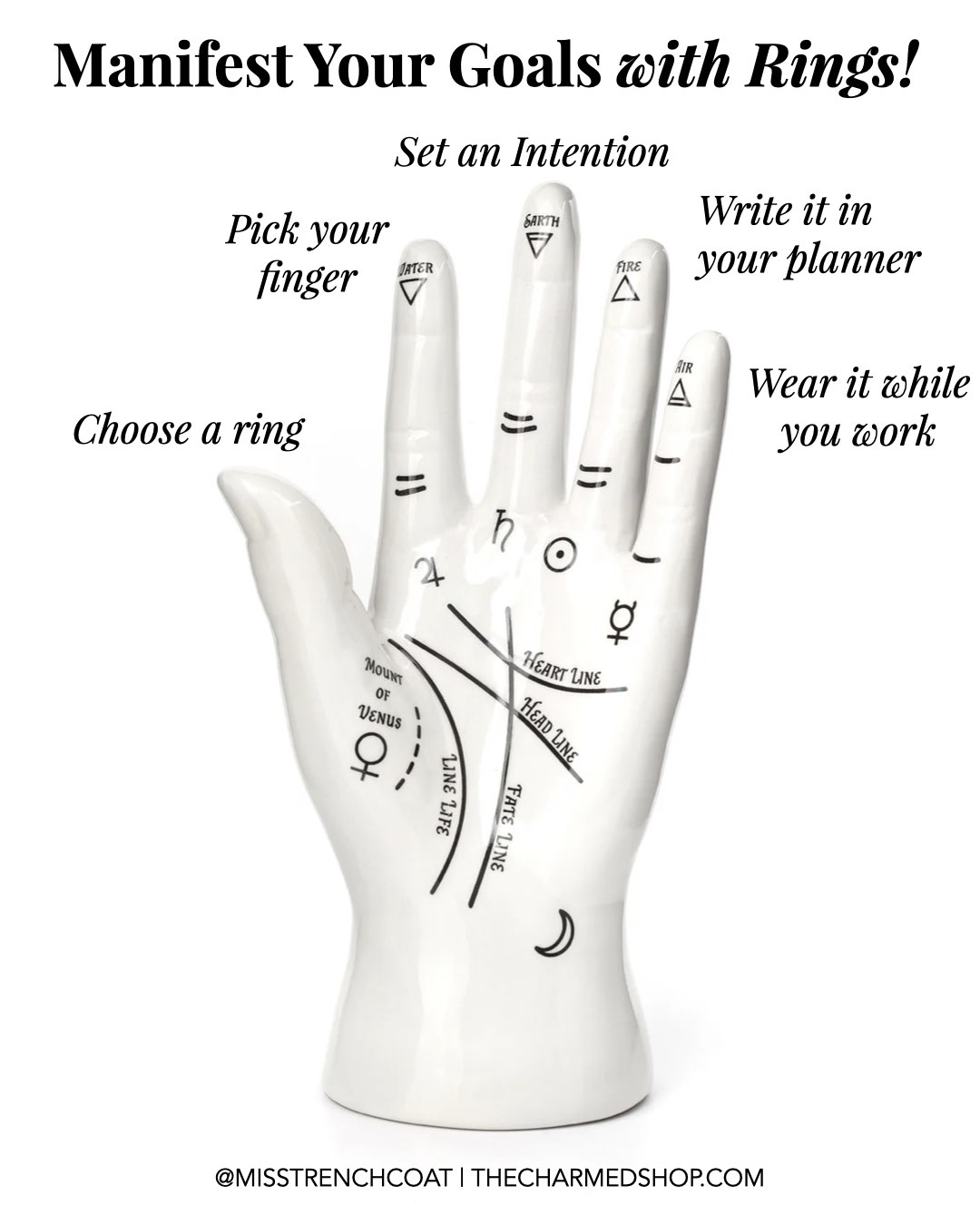
✋ What Each Finger Means in Palmistry + Astrology

Your fingers aren’t just functional—they’re energetic channels. In both palmistry and astrology, each finger corresponds to a planet and holds symbolic meaning tied to your focus, mindset, and strengths.

When you wear a ring on a specific finger, you activate that energy and keep it in your awareness throughout the day. Here’s what each finger represents—and the types of goals best supported by it:

👍 Thumb – Ruled by Mars

Themes: Willpower, action, independence

Manifestation Power: Confidence, motivation, bold moves

Use for:

  • Starting a new venture
  • Breaking through procrastination
  • Standing in your power

💍 Wear here to commit to courageous action.

☝️ Index Finger – Ruled by Jupiter

Themes: Leadership, expansion, ambition

Manifestation Power: Growth, vision, personal success

Use for:

  • Career advancement
  • Big-picture goal setting
  • Manifesting confidence or visibility

💍 Wear here to direct energy toward expansion and momentum.

🖖 Middle Finger – Ruled by Saturn

Themes: Discipline, structure, responsibility

Manifestation Power: Boundaries, focus, long-term commitment

Use for:

  • Time management goals
  • Building strong systems
  • Committing to daily routines

💍 Wear here to anchor yourself in structure and stay the course.

💍 Ring Finger – Ruled by the Sun

Themes: Creativity, purpose, love, identity

Manifestation Power: Passion, visibility, joy

Use for:

  • Artistic or creative goals
  • Self-expression
  • Manifesting love or alignment

💍 Wear here to shine your light and show up for what truly matters to you.

💠 Pinky Finger – Ruled by Mercury

Themes: Communication, intellect, business

Manifestation Power: Clarity, connection, clever strategy

Use for:

  • Writing, speaking, or marketing goals
  • Launching offers or business projects
  • Improving relationships or negotiation skills

💍 Wear here to support clear communication and aligned decisions.

Each finger holds a unique energetic influence. When you align your ring placement with your intention, you’re not just “wearing jewelry”—you’re activating your focus with every gesture.

💍 Choosing Your Ring with Intention

Once you’ve chosen the finger that aligns with your current goal or desired energy, it’s time to select a ring that supports that intention on a deeper level. This is where metals and stones come into play.

By selecting specific materials, you’re tuning into different energetic frequencies—each one reinforcing your focus through touch, color, and symbolic association.

🪙 A. The Energetic Meaning of Metals

Each metal carries its own vibration and spiritual quality. Choose one based on the tone you want to set for your manifestation.

Gold → Solar energy, abundance, confidence, masculine power

Best for: wealth goals, visibility, leadership

Silver → Lunar energy, intuition, feminine wisdom, emotional balance

Best for: inner work, spiritual growth, emotional clarity

Copper → Conductor of energy, balance, creativity, fertility

Best for: manifesting new ideas or partnerships

Iron/Steel → Protection, strength, grounding

Best for: boundaries, resilience, focus

💎 B. Crystals + Gemstones for Manifestation Goals

Adding a gemstone to your ring amplifies the intention you’re setting. Here are some classic metaphysical pairings:

Citrine → Prosperity, self-confidence, business success

Carnelian → Courage, creativity, energy for new projects

Moonstone → Intuition, divine feminine, emotional balance

Amethyst → Calm, mental clarity, spiritual protection

Rose Quartz → Self-love, compassion, attracting harmony

Black Tourmaline → Grounding, protection, clearing negative energy

Lapis Lazuli → Wisdom, communication, truth-telling

Green Aventurine → Luck, opportunity, optimism

💡 Tip: Choose a gemstone that feels aligned—not just based on description. Trust your intuitive draw to a specific color, texture, or energy.

By combining the symbolism of the finger, metal, and stone, your ring becomes a powerful trifecta of focus. It’s a beautiful way to channel your energy with intention every day.

🔮 How to Create a Ring Ritual

To turn your ring into a true manifestation tool, treat it like a sacred object—not just a piece of jewelry. With a simple ritual, you can infuse your ring with energy, clarity, and purpose.

Here’s how to create a ring ritual to support your goals:

Step 1: Clarify Your Intention

  • What are you calling in?
  • Is it discipline, creativity, love, focus, visibility?
  • Be specific—write your intention in your Charmed Life Master Planner, ideally in the Objective Plan with Notes or Brainstorm insert.

Step 2: Choose Your Ring

  • Use the finger chart to pick the appropriate placement
  • Choose a metal and/or gemstone that amplifies your goal
  • You can use an existing ring or purchase one intentionally

Step 3: Cleanse the Ring

Remove any residual energy before you program it.

Options:

  • Smoke (sage, palo santo)
  • Moonlight (especially during full moon)
  • Salt bowl or selenite dish
  • Intentional breath work (hold it and exhale to clear)

Step 4: Infuse with Intention

Hold the ring in both hands. Visualize the goal you wrote down. Speak the intention aloud or silently:

“I wear this ring as a symbol of my focus on [insert goal]. May it remind me daily to align with this vision.”

Bonus: Write your intention again in the Notes section of your planner to anchor it on paper.

Step 5: Wear it Daily During Aligned Action

Put the ring on when you’re doing work related to that goal—whether it’s writing content, having a business call, or doing deep planning.

Let the ring serve as a physical anchor to your energetic commitment.

Step 6: Revisit + Recharge

  • Cleanse and re-infuse monthly or during moon phases
  • Adjust your ring and intention as your goals evolve
  • Use your planner to track progress (Objective Tracker, Monthly Review)

Ritual doesn’t have to be complicated—it just has to be consistent. This one small gesture, done with meaning, can keep your mindset aligned every time you reach for your pen or open your planner.

🗓️ How to Incorporate Ring Magic into Your Planning Practice

Your planner is where your vision becomes a strategy. When paired with the energetic intention of a ring, your planning ritual becomes even more powerful. Here’s how to bring ring magic into your Charmed Life Master Planner system:

💍 Match Your Ring to Your Planning Focus

Before each planning session (daily, weekly, or monthly), choose a ring based on the type of work you’re doing:

Thumb (Mars): Bold planning, decision-making, starting fresh

Middle Finger (Saturn): Structuring your time, reviewing systems

Ring Finger (Sun): Brainstorming creative content, visualizing your dream life

Pinky (Mercury): Writing emails, social media content, or journaling

🧠 Use Planner Inserts to Anchor Your Intentions

Pair your ring ritual with these powerful inserts from the Charmed Life Master Planner:

Objective Plan with Notes → Detail the goal your ring represents

Brain Dump → Clear space to make room for aligned action

Ideal Weekly Schedule → Block time for the goal you’re manifesting

Monthly Objective Tracker → Track habits and micro-goals connected to your ring

Monthly Review → Reflect on your energetic alignment + progress

🔄 Create a Ring Routine for Planning Rituals

Incorporate ring magic into your existing planning structure:

Weekly Reset: Cleanse and re-intend your ring as you plan the week

Monthly Goal Setting: Choose a new ring or intention for the new month

Quarterly Planning: Use the Yearly Objective Matrix to align rings with quarterly focus areas

✨ Your ring becomes your cue, your charm, your compass. It keeps your goal close—literally at your fingertips.

When you combine wearable intention with structured planning, your energy and actions work in harmony.

🌟 Conclusion: Manifestation at Your Fingertips

You don’t need more hustle—you need more alignment.

And sometimes, alignment is as simple as a small, sacred reminder on your hand.

By understanding the energetic power of each finger, the symbolism of metals, and the magic of stones, you can turn your rings into intentional tools for focus, flow, and manifestation. Whether you’re calling in structure, visibility, or creative inspiration, your hands can help you hold that vision—literally.

💍 Let your jewelry become a ritual.

🖋️ Let your planner become the plan.

✨ Let your energy support your productivity.

Ready to bring your vision to life with structure, magic, and ease?

👉 Grab the Charmed Life Master Planner now and start mapping your manifestations onto paper:

[Get Your Copy Here]

Because your next breakthrough might just begin at your fingertips.

xoxo,

7 Rules for Protecting Your Energy in Q4 (and the Productivity Strategies That Make It Possible)

If you’ve ever reached the end of a quarter completely drained, you’re not alone. Most of us were taught to treat productivity like a sprint: push harder, go faster, hustle until you drop. But the truth is, your energy—not your time—is the real VIP resource when it comes to achieving goals.

Time is fixed. Energy is flexible. And when you learn to manage and protect your energy, you unlock the ability to stay consistent, make better decisions, and actually enjoy the process of pursuing your goals.

As we head into Q4—the busiest season of the year—it’s more important than ever to set rules around how you use and protect your energy. Here are 7 rules that will help you conserve your most valuable resource, paired with practical productivity strategies that actually work.


Rule 1: Go Slow to Go Far

Strategy: Theme Your Workdays (Default Weekly Schedule)

The culture of hustle tells us to go all-in, move faster, and get it all done yesterday. But real progress is built through rhythm, not sprints. Going slow doesn’t mean moving lazily—it means moving intentionally.

One of the best ways to apply this rule is to theme your workdays using a default weekly schedule. Instead of reacting to whatever comes your way, you assign each day a primary focus.

Examples of a themed week in Q4 might look like this:

  • Monday: Planning & administration
  • Tuesday: Deep work / big projects
  • Wednesday: Meetings & collaboration
  • Thursday: Content creation
  • Friday: Wrap-up & holiday/family prep

When you stick to a rhythm like this, you reduce decision fatigue, protect your focus, and ensure your energy is always aligned with meaningful progress.

Remember: You don’t need to sprint to the finish line. You just need a pace you can sustain.


Rule 2: Rest Before You’re Tired

Strategy: Take Strategic Breaks (Pomodoro & Micro-Breaks)

Most people rest only after they’ve hit a wall—but by then, recovery takes far longer. Protecting your energy means resting before you need to.

Use simple strategies like:

  • Pomodoro Technique: Work for 50 minutes, then rest for 10.
  • Micro-breaks: Stand up, stretch, or walk for 2–3 minutes every hour.
  • Daily pauses: Midday reset rituals (like a walk, journaling, or a short meditation).

These small, intentional breaks keep your energy consistent throughout the day. Think of it like fueling a car: you don’t wait until the tank is empty to fill up—you top off before you’re stranded.


Rule 3: Use Your Best Energy on Your Best Work

Strategy: Energy-Based Time Blocking

Not all hours of the day are equal. Some hours you’re sharp and focused; others, you’re sluggish and distracted. The key to energy management is to match your best energy to your most important priorities.

  • Schedule deep, creative, or strategic work during your natural peak hours (morning for many people, late evening for others).
  • Save routine or administrative tasks for lower-energy times.
  • Block your calendar around these rhythms so you’re not wasting prime energy on mundane tasks like emails or errands.

When you direct your best energy toward your highest-value work, you get better results in less time—without needing to push harder.


Rule 4: Guard Your Inner Dialogue

Strategy: Journaling & Affirmations

The way you speak to yourself can either energize you or drain you. Negative self-talk is one of the biggest energy leaks, quietly killing your motivation and confidence.

To protect your energy:

  • Start the day with affirmations. Simple reminders like “I honor my energy today” or “I don’t rush—I move with purpose” set the tone.
  • Journal your thoughts. Write down worries, doubts, or frustrations to release them from your mind instead of carrying them all day.
  • Reframe setbacks. Instead of “I failed,” shift to “I learned.”

Guarding your inner dialogue ensures that your energy isn’t wasted fighting battles with yourself.


Rule 5: Limit Inputs to Protect Output

Strategy: Create Before You Consume

In Q4, the flood of information—emails, news, social media—can feel endless. But every time you consume, you spend energy processing. The more input you allow in, the less energy you have left for output.

Flip the script:

  • Create before you consume. Work on your projects, writing, or goals before scrolling your phone or checking email.
  • Designate “consumption windows.” Check social media or email at specific times instead of all day.
  • Unsubscribe and unfollow. Limit the content you allow into your mental space.

When you manage your inputs, you preserve your focus and keep your energy directed toward what matters most.


Rule 6: Batch & Simplify to Conserve Focus

Strategy: Task Batching & Context Management

Switching between tasks drains mental energy—even more than you realize. Research shows it takes up to 20 minutes to regain focus after a distraction. That means constant context-switching is one of the biggest drains on your productivity.

Instead, batch similar tasks together:

  • Handle all emails in one or two blocks daily.
  • Group errands or phone calls.
  • Dedicate a specific day for content creation or client work.

By batching, you reduce mental switching, conserve focus, and protect your energy for deeper work.


Rule 7: Build Rest Into Your Routine

Strategy: Scheduled Rest Rituals

Rest isn’t a reward you earn when everything is finished. It’s a non-negotiable part of sustainable productivity.

In Q4, when schedules get busier, protecting your energy requires scheduling rest on purpose. Examples include:

  • Weekly yoga class or workout.
  • Friday evening bath with candles.
  • Sunday afternoon rest block with no commitments.

When you proactively schedule rest, you protect your energy reserves and avoid the crash-and-burn cycle.


Bonus Rule: Protect Your Boundaries

Strategy: Say No to Protect Your Yes

One of the fastest ways to drain your energy is by giving it away to everyone else. Protecting your energy requires setting boundaries around your time, access, and attention.

Ask yourself:

  • Does this request align with my goals?
  • Is this the best use of my energy right now?
  • What am I saying “no” to if I say “yes” to this?

When you protect your boundaries, you keep your energy aligned with your true priorities—not someone else’s agenda.


Bringing It All Together

Energy management isn’t about squeezing more productivity out of yourself—it’s about protecting your capacity to show up consistently, sustainably, and joyfully.

Here’s a recap of the 7+1 Rules for Protecting Your Energy in Q4:

  1. Go slow to go far → Theme your workdays.
  2. Rest before you’re tired → Strategic breaks.
  3. Use your best energy on your best work → Energy-based time blocking.
  4. Guard your inner dialogue → Journaling & affirmations.
  5. Limit inputs to protect output → Create before consume.
  6. Batch & simplify → Task batching.
  7. Build rest into your routine → Scheduled rituals.
  8. Bonus: Protect your boundaries → Say no to protect your yes.

When you apply these rules, you stop running on empty and start moving through your days with clarity and strength. In Q4 especially, protecting your energy is the difference between burning out and actually crossing the finish line with your goals intact.


Protecting your energy isn’t selfish—it’s strategic. Your energy is the foundation of your progress, and when you treat it like the VIP resource it is, you’ll notice not only that you get more done, but that you feel better while doing it.

Inside the Charmed Life Master Mind, we take these strategies even deeper, helping you build personalized routines, planning systems, and mindset shifts that keep you consistent all year long. If you’re ready to protect your energy and finish this year strong, everything you need is waiting for you inside.

✨ Save this post for later—and commit to protecting your energy like the VIP it is.

xoxo,

Intentional Action Beats Hustle: How to Plan a Meaningful Q4

Why Hustle Steals Joy From the Season

If there’s one word most women use to describe the last quarter of the year, it’s busy.

The final stretch of the year always seems to come with a whirlwind of expectations—work deadlines to hit before year-end, family traditions to uphold, travel to coordinate, and social invitations to juggle. Add in the pressure of wrapping up personal goals before December 31st, and suddenly Q4 feels less like a season of joy and more like a marathon of obligations.

We’ve been conditioned to believe that the only way to “make the most” of the season is to hustle harder, do more, and check off every seasonal bucket list item. But hustle steals the very joy it promises. Instead of feeling fulfilled, you’re left burnt out, scattered, and wondering where the season went.

Here’s the truth: you don’t need to do everything to have a meaningful Q4. You only need to do the right things—the commitments, activities, and rituals that align with your values and priorities. That’s where intentional action comes in.

Intentional planning isn’t about cramming more into your days. It’s about creating clarity, choosing deliberately, and making space for the experiences that matter most. In fact, the most joyful seasons come not from doing everything, but from intentionally choosing less—and savoring it more.

In this post, I’ll show you how to trade the hustle for intention by focusing on three key elements of seasonal planning: Expected Events, Seasonal Activities, and Memory Making. Together, they’ll help you craft a Q4 that feels abundant, not exhausting.


Key #1: Expected Events — Anchor Your Calendar With Fixed Commitments

The first step to planning a meaningful Q4 is to get clear on what’s already happening.

Expected events are your non-negotiables—the deadlines, obligations, and commitments that are going to take up space in your calendar whether you acknowledge them or not. Ignoring them doesn’t make them go away; it just makes everything else harder to plan.

Think of expected events as the anchor points for your season. When you identify them upfront, you create a realistic picture of the time and energy you actually have available. Without this step, it’s easy to fall into the trap of overcommitting and wondering later why you feel so overwhelmed.

Examples of expected events:

  • End-of-quarter work projects and reporting deadlines
  • Thanksgiving dinner or other family gatherings
  • Kids’ school concerts, sports, or recitals
  • Annual conferences or seasonal events at work
  • Pre-planned travel for the holidays

How to anchor your Q4 with expected events:

  1. Open your planner or digital calendar. Block out October through December.
  2. List every known commitment. Include work, family, and personal categories. Don’t forget travel days—they take more energy than you think.
  3. Color code or categorize. Assign each commitment a label (Work, Family, Travel) to visualize balance.
  4. Step back and review. Where are the heavy weeks? Where are the lighter weeks?

This step alone can reduce anxiety. Suddenly, you’re no longer reacting to what pops up—you’re acknowledging what’s already there.

Reframe: Instead of seeing expected events as obstacles, view them as guideposts. They’re not stealing your freedom; they’re giving you clarity. Once you’ve acknowledged them, you can plan the rest of your season with intention.


Key #2: Seasonal Activities — Choose What Lights You Up

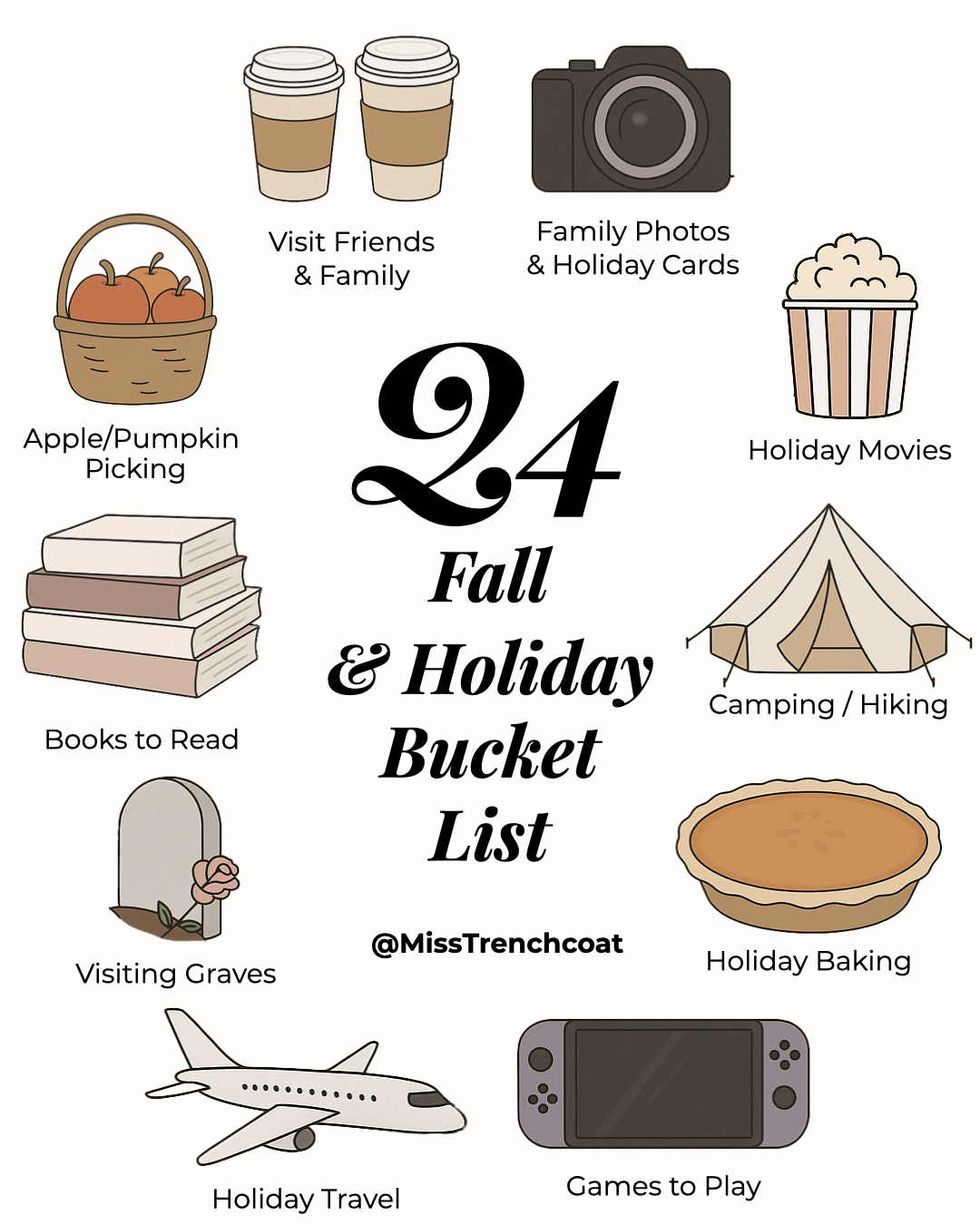
Once you’ve identified the structure of your season, it’s time to decide what joy-filled activities you want to sprinkle in. These are your seasonal activities—the experiences that make Q4 feel magical and memorable.

Here’s the catch: you don’t need to do all of them. The fastest way to drain the magic out of the season is by treating it like a checklist. The goal isn’t quantity—it’s depth.

Examples of seasonal activities:

Fall:

  • 🍂 Visiting a pumpkin patch
  • Apple picking with friends
  • Baking pumpkin bread or pies
  • Decorating the house with autumn touches

Winter/Holidays:

  • 🎄 Strolling through a holiday market
  • Decorating the tree
  • Baking cookies as a tradition
  • Hosting or attending holiday gatherings

New Year:

  • Journaling your reflections from the past year
  • Setting intentions and goals for the year ahead
  • A cozy at-home celebration to mark the transition

How to choose seasonal activities intentionally:

  1. Make a seasonal wish list. Write down everything that comes to mind that you’d like to do in Q4.
  2. Circle 2–3 favorites. Ask yourself: Which ones truly light me up? Which ones would I be sad to miss?
  3. Schedule them early. Don’t wait until December 23rd to decide if you want to visit that market—it won’t happen. Put it in the calendar now.
  4. Release the rest. A season well-lived is not about maximizing—it’s about savoring.

Reframe: Seasonal activities don’t need to be elaborate to matter. Sometimes the simplest traditions—like lighting a candle every evening in December or baking bread on Sundays—are the ones that create the most lasting joy.


Key #3: Memory Making — Schedule Downtime & Rituals

Here’s where many women go wrong: they fill their calendars with obligations and activities but forget to create space.

Downtime isn’t wasted time. It’s where meaning lives. It’s in the quiet evenings, the simple rituals, and the pauses that we create our most cherished memories.

This is what I call memory making—the intentional practice of slowing down to soak in the season. These aren’t the big events or bucket-list activities. They’re the little moments you’ll remember long after the year has passed.

Examples of memory rituals:

  • Evening walks to enjoy the crisp fall air
  • Cozy reading nights with tea and candles
  • Watching holiday movies together every Friday in December
  • Journaling about your reflections before the New Year
  • Making soup and bread on Sundays as a seasonal rhythm

How to create memory making in Q4:

  1. Block downtime into your calendar. Literally schedule blank space. Write “Family Night” or “Cozy Reading.” If you don’t, it will get filled.
  2. Establish simple rituals. Pick one thing you can repeat weekly (movie night, journaling, baking) to create rhythm.
  3. Protect this time. Treat it like any other non-negotiable. Just because it’s restful doesn’t make it optional.

Reframe: Busyness doesn’t create memories—presence does. Productivity isn’t about squeezing in more; it’s about protecting space for what matters most.


Hustle vs. Intention

At the heart of it, the difference between hustle and intention is simple:

  • Hustle says: Everything matters, so you must do it all.
  • Intention says: Only the right things matter, so you can focus deeply and joyfully.

When you hustle, you end the season exhausted and disconnected. When you plan with intention, you end it with clarity, peace, and memories that actually mean something.

So as you step into Q4, I encourage you to pause and ask yourself:

  • What’s already happening that I need to anchor into my calendar?
  • Which seasonal activities would bring me the most joy?
  • How can I schedule downtime and rituals that make the season memorable?

That’s it. That’s the plan. Everything else? You can let it go.

Because this season isn’t about proving you can do it all. It’s about living meaningfully.

And intentional action will always beat hustle—every time.


✨ Want support creating your intentional Q4 plan? Join me for the Q4 Crescendo Workshop where I’ll walk you through the exact mindset, goal-setting, and master planning process to end your year strong and aligned.

👉 [Watch the Workshop Now]

xoxo,

The Mindset Shifts That Turn Overwhelm Into Alignment

Why Overwhelm Isn’t Failure

We’ve all had those days where the to-do list feels endless. You wake up with the best of intentions, but almost immediately, life feels like it’s happening faster than you can keep up. Emails flood your inbox, someone needs you at home, deadlines loom, and even the simple act of deciding what to do next feels impossible.

The first instinct many women have in moments like this is to assume they’re failing. That if they were more disciplined, more organized, or just “better” at balancing it all, the overwhelm wouldn’t be there. But that isn’t true.

Here’s what I want you to know: overwhelm isn’t failure — it’s feedback.

When you feel overwhelmed, it’s not a sign that you’re weak, behind, or incapable. It’s a signal. A message from your mind and body telling you something is out of alignment. Maybe you’re carrying too much, focusing on the wrong things, or pushing through when you really need to pause.

The problem isn’t the overwhelm itself. The problem is how we interpret it. When we shame ourselves for feeling overwhelmed, we spiral deeper into stress. But when we learn to reframe overwhelm, we can use it as a tool for clarity.

In this post, I’ll show you how to do exactly that. You’ll learn five powerful mindset shifts that transform overwhelm from a roadblock into a roadmap — helping you reset, realign, and find clarity when you need it most.


Overwhelm as a Signal, Not a Stop Sign

Think of overwhelm as a dashboard light in your car. When it turns on, it’s not telling you that you’ve failed at driving. It’s simply alerting you that something needs attention.

The same is true in life. Overwhelm is your signal that your current pace, plan, or perspective isn’t sustainable. Instead of pushing harder or trying to “outrun” it, the key is to pause and listen.

That pause is where mindset shifts become powerful. By reframing the thoughts that fuel overwhelm, you take back control of the narrative. Instead of telling yourself a story about why you’re not enough, you start asking: What’s this feedback trying to teach me?

Here are five mindset shifts that will help you do just that.


1. “I don’t have time.” → “I need a system for my time.”

This is one of the most common thoughts fueling overwhelm. You glance at your calendar, see back-to-back tasks, and immediately feel like there’s simply no way to fit it all in. The problem? Believing that time is the enemy.

The truth is, time is neutral. Everyone gets 24 hours in a day. What creates overwhelm isn’t the amount of time we have — it’s the way we’re using it.

When you say “I don’t have time,” what you’re really noticing is the absence of a system. Without structure, every task feels urgent, and everything competes for your attention at once.

The reframe: “I need a system for my time.”

Instead of trying to squeeze more into your day, create a framework that shows you where your time is going and how to protect it for what matters. This might mean:

  • Using time blocking to assign your top priorities to actual calendar space.
  • Choosing a daily Top 3 so you focus only on the tasks that move the needle.
  • Building white space into your schedule so you can reset instead of run on fumes.

Once you give your time structure, clarity emerges. You stop saying, “I don’t have time” and start saying, “Here’s how I’m choosing to spend my time.”


2. “I have too much on my plate.” → “Not everything deserves a place on my plate.”

Overwhelm often shows up as a sense that you’re juggling too many responsibilities. But here’s the truth: your plate isn’t the problem — it’s what you’ve chosen to put on it.

Many of us feel pressured to say yes to everything: work projects, family commitments, social obligations, household tasks, and endless small “shoulds.” But when everything gets treated as equally important, your energy scatters, and nothing gets the attention it truly deserves.

The reframe: “Not everything deserves a place on my plate.”

This mindset shift reminds you that you are the gatekeeper of your time and energy. You have the power to choose what stays and what goes.

Practical ways to apply this:

  • Do a weekly brain dump of everything on your mind.
  • Circle the 3–5 items that matter most for this season of your life.
  • Cross off, delegate, or defer the rest.

When you release what doesn’t belong, overwhelm dissolves, and alignment takes its place. You start focusing on what actually matters instead of drowning in what doesn’t.


3. “I should be further ahead.” → “I am exactly where I need to be.”

This mindset trap is one of the most painful. When you believe you’re behind, you create a spiral of shame that makes progress feel impossible. You measure yourself against others or against unrealistic expectations, and you conclude that you’re failing.

But here’s the truth: progress is never linear. Every season of your life has its own pace, its own lessons, and its own priorities. Being “behind” is an illusion.

The reframe: “I am exactly where I need to be.”

When you shift into this belief, overwhelm becomes an invitation to realign, not a judgment of your worth. Instead of beating yourself up for what you haven’t done, you get curious about what you need now.

Try reflecting with prompts like:

  • What progress have I already made this year that I haven’t celebrated?
  • What lesson is this season teaching me?
  • What one thing would feel good to move forward this week?

With this reframe, you stop chasing an invisible finish line and start honoring your actual path. That’s where alignment lives.


4. “I have to do everything.” → “I only need to do the things that matter.”

One of the sneakiest ways overwhelm creeps in is through the belief that you must handle everything yourself. Whether it’s work tasks, family responsibilities, or personal goals, the pressure to “do it all” leaves you drained and unfocused.

But here’s the truth: not everything matters.

The reframe: “I only need to do the things that matter.”

Productivity isn’t about cramming your day with more tasks. It’s about identifying the few actions that truly create impact and letting the rest go.

One of my favorite tools for this is the Daily Top 3. Each morning, I ask myself:

  • What three tasks will move me closer to my biggest goals today?
  • Which tasks would bring me a sense of calm and completion if they were done?
  • Which tasks have real consequences if I delay them?

By choosing just three, I give myself clarity and focus. And at the end of the day, even if nothing else got done, I can feel aligned and accomplished.


5. “I can’t stop now.” → “Pausing will give me the clarity to move forward faster.”

This mindset is one of the most dangerous. When you believe you can’t stop, you push yourself past your limits. You ignore your body, skip rest, and run headfirst into burnout.

But rest isn’t laziness — it’s a productivity tool.

The reframe: “Pausing will give me the clarity to move forward faster.”

Sometimes the most aligned thing you can do is step away. That pause gives your brain space to reset, your body space to recharge, and your heart space to realign with what matters.

Ways to practice this pause:

  • A 5-minute breathing break at your desk.
  • A journaling session to sort your thoughts.
  • Gratitude practice to shift your perspective.
  • Listening to a mindset rampage audio to reset your energy.

When you choose to pause, you don’t lose time — you gain clarity. And clarity saves more time than hustling ever could.


How Mindset Work Stops the Spiral

When overwhelm strikes, mindset work is your anchor. It interrupts the spiral of stress and self-doubt and brings you back into alignment with your values and goals.

Think of it as building a toolkit of clarity practices you can reach for anytime you feel overwhelmed:

  • Meditation quiets the noise and grounds you in the present.
  • Journaling helps you release mental clutter and see your thoughts more clearly.
  • Mindset rampage audios flood your mind with empowering beliefs.
  • Gratitude rewires your perspective from lack to abundance.
  • Affirmations create new thought patterns that support your goals.
  • Visualization reminds you of the bigger picture you’re working toward.

By weaving these practices into your daily or weekly routine, you build resilience. Instead of spiraling deeper into overwhelm, you create pathways back to clarity and alignment every single time.


From Overwhelm to Alignment

Overwhelm isn’t a verdict on your worth. It’s simply feedback — a signal that something in your plan, pace, or perspective needs attention.

When you shift your mindset, you stop treating overwhelm as failure and start using it as a tool for alignment. By reframing your thoughts, you gain clarity, focus, and the ability to move forward with purpose.

✨ Remember:

  • You don’t need more hustle.
  • You don’t need more pressure.
  • You need structure, support, and mindset shifts that bring you back to alignment.

And if you’re ready to put these mindset shifts into practice and build a clear, structured plan for the final quarter of the year, I’d love for you to join me in the Q4 Crescendo Workshop.

On Saturday, September 13th at 12pm EDT, I’ll guide you step-by-step through creating your Q4 plan — identifying your priorities, setting aligned goals, and building the systems that will carry you into the new year with clarity and confidence.

👉 [Sign up for the free Q4 Crescendo Workshop here]

Don’t wait for clarity to magically appear. Create it.

xoxo,