Each day of the week holds a different kind of energy—and when you understand the vibe, you can plan your time more intentionally.
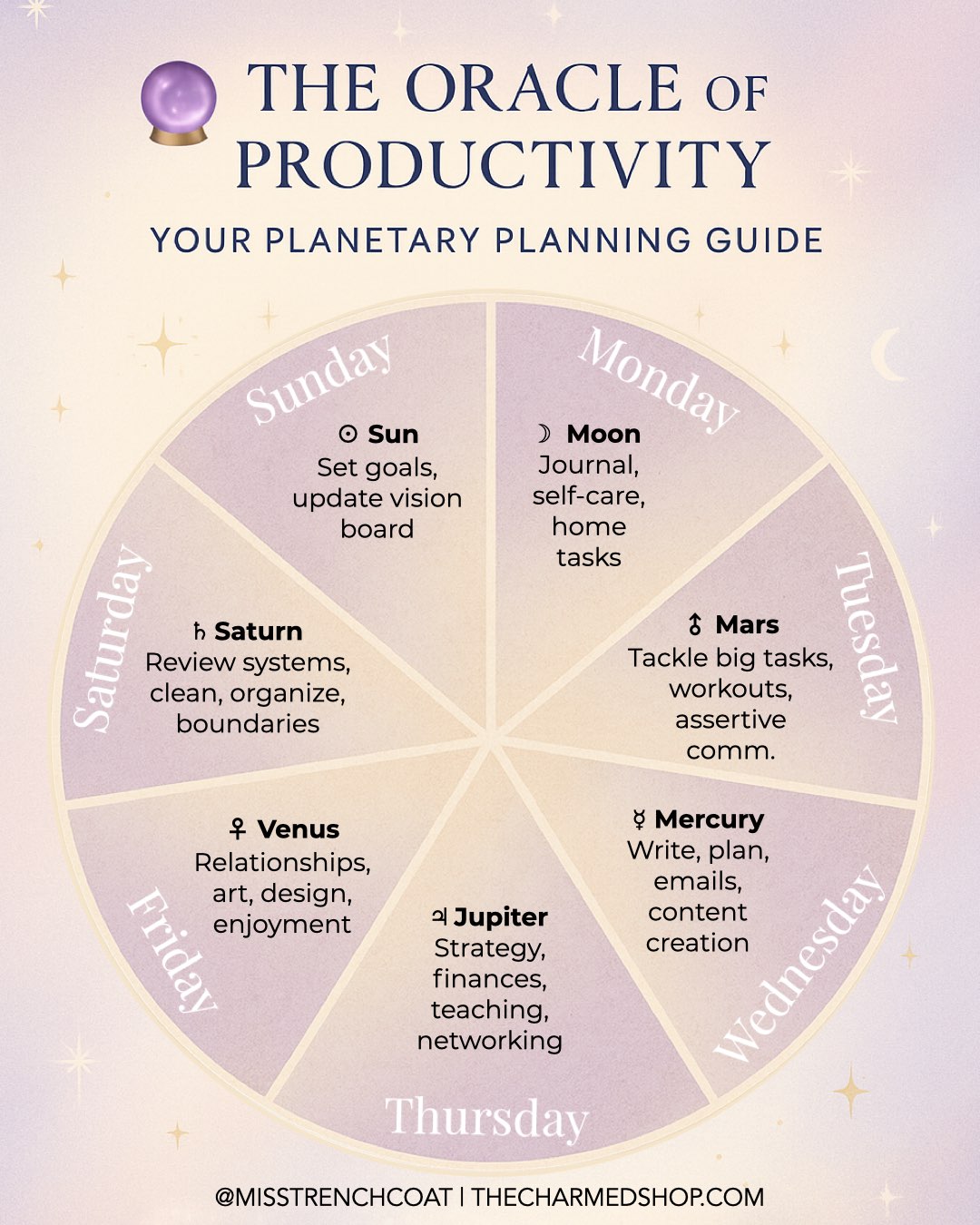
Welcome to the magical practice of planetary planning—a soft, soulful approach to scheduling based on classical astrology. Each day is traditionally ruled by a planet that governs certain moods, actions, and outcomes. And while you don’t need to be fluent in astrology to use this, you can tap into the flow of each day to bring a little more alignment (and ease) to your productivity.
This post will guide you through all 7 days of the week with their corresponding planetary rulers, energetic themes, ideal tasks, and recommended planner inserts from the Charmed Life Master Planner System.
Let’s explore the cosmic calendar…
🌞 Sunday — Ruled by the Sun
Energy: Vitality, self-expression, visibility, creativity Ideal Activities: Set weekly goals, update your vision board, spend time outdoors, reconnect with your personal mission Planner Insert:Yearly Goals or Vision Board Bonus Magic: Wear gold, work with citrine or tiger’s eye
🌙 Monday — Ruled by the Moon
Energy: Emotions, intuition, nurturing, home life Ideal Activities: Journaling, home organization, reflection, intuitive planning Planner Insert:Monthly Review or Brain Dump Bonus Magic: Wear silver or white, work with moonstone or selenite
🔥 Tuesday — Ruled by Mars
Energy: Drive, courage, productivity, assertiveness Ideal Activities: Tackle hard tasks, make decisions, push forward on goals, strength training Planner Insert:Objective Tracker or Week on One Page Bonus Magic: Wear red, work with garnet or red jasper
🧠 Wednesday — Ruled by Mercury
Energy: Communication, clarity, mental focus, planning Ideal Activities: Admin work, meetings, writing, marketing, research Planner Insert:Week on Two Pages Horizontal or Brainstorm Bonus Magic: Wear yellow, work with clear quartz or citrine
💸 Thursday — Ruled by Jupiter
Energy: Growth, wisdom, abundance, optimism Ideal Activities: Strategic planning, education, financial review, visionary work Planner Insert:Yearly Objective Matrix or Productivity Strategy Reference Bonus Magic: Wear blue or purple, work with amethyst or lapis lazuli
💕 Friday — Ruled by Venus
Energy: Beauty, pleasure, connection, creativity Ideal Activities: Self-care, content creation, relationships, beauty rituals, creative projects Planner Insert:Ideal Daily Routine or Monthly Calendar Bonus Magic: Wear pink or green, work with rose quartz or emerald
🪨 Saturday — Ruled by Saturn
Energy: Structure, discipline, boundaries, responsibility Ideal Activities: Review long-term goals, clean and organize, complete unfinished tasks, build structure for next week Planner Insert:Monthly Objective Tracker or Day on One Page Bonus Magic: Wear black or navy, work with hematite or black tourmaline
✨ Final Thoughts
Astrology gives us an intuitive framework for flow. When you understand the energetic story each day is telling, you can plan your time more intentionally—and align your efforts with the universe.
You don’t have to change your entire system. Just start small. Assign one type of task to one day that feels aligned and notice how much smoother your week begins to feel.
And if you’re ready to bring more magic into your planning…
🪐 The Charmed Life Master Planner System was designed to work with your energy, not against it. With flexible inserts and strategic tools, you can create your own cosmic productivity ritual—one week at a time.
Every year, as Q4 rolls around, many women feel the same pressure: “I have to finish the year strong. I need to hustle harder. I need to do it all.”
The problem? That mindset leads straight into the burnout cycle. We sprint at the end of the year, trying to push every goal across the finish line, and end up exhausted by December. The irony is that sprinting in Q4 rarely works. Instead of creating lasting progress, it leaves us depleted—unable to fully enjoy the holiday season and starting the new year already behind.
Here’s the truth: progress isn’t built in sprints—it’s built in routines.
Your daily and weekly rhythms are what carry you steadily toward your goals. They help you stay grounded even when the calendar gets crowded. They give you a sense of control, even when life feels chaotic. And they allow you to build momentum day by day, week by week.
That’s exactly what we’ll be focusing on in the Q4 Crescendo Workshop—a free live class where I’ll show you how to set up your quarter with the right mindset, simplified goals, and a clear master plan. Think of it as creating a steady rhythm, instead of a frantic race.
But before we get there, let’s talk about how to use routines and schedules to make Q4 meaningful and productive without the hustle.
The Power of Daily Routines
Daily routines are the anchors of your life. They don’t need to be elaborate or rigid—in fact, the best routines are flexible frameworks that help you stay consistent with the things that matter most.
In Q4, daily routines become even more important because of the season’s natural busyness. When your days feel full, returning to a simple structure keeps you steady.
Morning Routine: Starting Grounded
A good morning routine sets the tone for the rest of the day. Instead of diving straight into emails or to-do lists, begin with rituals that anchor you.
Examples:
Mindset work: Journaling, affirmations, or meditation to align your thoughts for the day.
Movement: Gentle stretching, yoga, or a quick walk to energize your body.
Planning: Reviewing your Daily Top 3 so you know your priorities.
In Q4, mornings might mean sipping coffee by the window with a cozy blanket before you open your planner, or using a gratitude journal to help you stay present in the holiday season.
Workday Routine: Focused Productivity
Without boundaries, the workday can become a blur. Anchoring your day with blocks of focus ensures you get meaningful work done without overextending yourself.
Examples:
Morning deep work block: Two hours for your most important projects.
Midday reset: A real lunch break (yes, step away from your desk).
Afternoon calls/meetings: Batch them so they don’t interrupt your flow.
In Q4, layer in seasonal responsibilities—perhaps Friday afternoons become your “holiday prep block” where you shop online, wrap gifts, or write holiday cards.
Evening Routine: Winding Down with Intention
How you end the day matters as much as how you start it. Evening routines help your body and mind switch from “doing” to “resting.”
Examples:
Connection: Dinner with family or phone calls with friends.
Memory-making: Holiday movie nights, cozy reading, or baking with loved ones.
Sleep ritual: A warm shower, skincare routine, or light stretching before bed.
Even in the busiest Q4 weeks, a simple evening ritual ensures you recharge and end the day with peace.
The Self-Mastery 7 Daily Success Habits
Beyond routines, I encourage my community to weave in seven essential habits every single day. These aren’t about rigid productivity—they’re about becoming the woman who thrives because her foundation is strong.
Mindset Work – Guard your thoughts. Journal, visualize, or use affirmations.
Planning – Check in with your planner. Align actions to goals.
Cooking – Nourish yourself. Q4 can be hectic—meal prep saves time and health.
Learning – Read, listen to a podcast, or study something new. Growth matters.
Connection – Don’t neglect relationships. Text a friend, sit down for dinner.
Movement – Keep your body moving, whether it’s exercise or a walk through crunchy leaves.
Sleep – Protect your rest like it’s non-negotiable (because it is).
When these habits are built into your routines, Q4 feels less like a hustle and more like a season of alignment.
Weekly Schedules That Sustain Progress
While daily routines keep you grounded, weekly schedules give structure to your progress. They allow you to batch your work, balance your energy, and keep your goals on track.
Here’s how to create a weekly rhythm that works in Q4:
1. Theme Your Workdays
Instead of reacting to tasks, assign each day a “default focus.”
Examples:
Monday: Planning & administration
Tuesday: Deep work / big projects
Wednesday: Meetings & collaboration
Thursday: Content creation
Friday: Wrap-up & holiday/family prep
This approach reduces decision fatigue and ensures you’re always making progress in the areas that matter most.
2. Meal Planning & Prep
Food is one of the first things to fall apart in a busy season. Protect your health (and time) by setting aside one block per week to plan meals, grocery shop, and prep essentials.
This simple ritual ensures you’re fueling yourself well, even when schedules get hectic.
3. Protected Time Blocks for Goals
Big goals won’t move forward unless you schedule time for them. Decide what matters most this quarter and give it space on your calendar every week.
Examples:
Tuesday mornings for writing your book.
Wednesday afternoons for client outreach.
Friday mornings for creative projects.
Even two focused hours per week add up to massive progress over a quarter.
4. Self-Care as a Scheduled Non-Negotiable
Don’t treat self-care as “if I have time.” Block it into your schedule.
Examples:
A weekly yoga class.
Friday evening baths with candles.
Sunday afternoons reserved for rest.
When you protect these times, your energy stays high—and your progress becomes sustainable.
The Q4 Twist
Here’s where it all comes together: layering seasonal tasks into your routines and weekly schedule.
Instead of seeing Q4 as “extra work,” integrate the things you want to experience into your existing structure.
Examples:
Daily routines: Swap your morning scroll for a 15-minute gratitude journal by the Christmas tree.
Weekly schedule: Dedicate Friday afternoons to holiday prep—wrapping gifts, writing cards, or baking.
Memory-making blocks: Create weekly family traditions, like Sunday night holiday movies or Saturday morning fall hikes.
This way, you don’t burn out trying to “fit it all in.” Instead, you’re intentionally shaping your routines so the season feels rich, joyful, and realistic.
Your Q4 Crescendo
Progress doesn’t come from a frantic sprint—it comes from daily routines and weekly rhythms that build consistency.
When you lean on your morning rituals, your themed workdays, and your Self-Mastery 7 habits, you create a strong foundation. When you protect your time and integrate seasonal joy into your schedule, you move through Q4 with both productivity and presence.
Because in the end, it’s not about what you do once—it’s about what you do every day and every week.
✨ Want help setting this up for yourself? Join me for my Q4 Crescendo Workshop, where I’ll walk you through how to plan your final quarter with clarity, focus, and intention. Together, we’ll create a rhythm that helps you finish strong—without the hustle.
If there’s one word most women use to describe the last quarter of the year, it’s busy.
The final stretch of the year always seems to come with a whirlwind of expectations—work deadlines to hit before year-end, family traditions to uphold, travel to coordinate, and social invitations to juggle. Add in the pressure of wrapping up personal goals before December 31st, and suddenly Q4 feels less like a season of joy and more like a marathon of obligations.
We’ve been conditioned to believe that the only way to “make the most” of the season is to hustle harder, do more, and check off every seasonal bucket list item. But hustle steals the very joy it promises. Instead of feeling fulfilled, you’re left burnt out, scattered, and wondering where the season went.
Here’s the truth: you don’t need to do everything to have a meaningful Q4. You only need to do the right things—the commitments, activities, and rituals that align with your values and priorities. That’s where intentional action comes in.
Intentional planning isn’t about cramming more into your days. It’s about creating clarity, choosing deliberately, and making space for the experiences that matter most. In fact, the most joyful seasons come not from doing everything, but from intentionally choosing less—and savoring it more.
In this post, I’ll show you how to trade the hustle for intention by focusing on three key elements of seasonal planning: Expected Events, Seasonal Activities, and Memory Making. Together, they’ll help you craft a Q4 that feels abundant, not exhausting.
Key #1: Expected Events — Anchor Your Calendar With Fixed Commitments
The first step to planning a meaningful Q4 is to get clear on what’s already happening.
Expected events are your non-negotiables—the deadlines, obligations, and commitments that are going to take up space in your calendar whether you acknowledge them or not. Ignoring them doesn’t make them go away; it just makes everything else harder to plan.
Think of expected events as the anchor points for your season. When you identify them upfront, you create a realistic picture of the time and energy you actually have available. Without this step, it’s easy to fall into the trap of overcommitting and wondering later why you feel so overwhelmed.
Examples of expected events:
End-of-quarter work projects and reporting deadlines
Thanksgiving dinner or other family gatherings
Kids’ school concerts, sports, or recitals
Annual conferences or seasonal events at work
Pre-planned travel for the holidays
How to anchor your Q4 with expected events:
Open your planner or digital calendar. Block out October through December.
List every known commitment. Include work, family, and personal categories. Don’t forget travel days—they take more energy than you think.
Color code or categorize. Assign each commitment a label (Work, Family, Travel) to visualize balance.
Step back and review. Where are the heavy weeks? Where are the lighter weeks?
This step alone can reduce anxiety. Suddenly, you’re no longer reacting to what pops up—you’re acknowledging what’s already there.
Reframe: Instead of seeing expected events as obstacles, view them as guideposts. They’re not stealing your freedom; they’re giving you clarity. Once you’ve acknowledged them, you can plan the rest of your season with intention.
Key #2: Seasonal Activities — Choose What Lights You Up
Once you’ve identified the structure of your season, it’s time to decide what joy-filled activities you want to sprinkle in. These are your seasonal activities—the experiences that make Q4 feel magical and memorable.
Here’s the catch: you don’t need to do all of them. The fastest way to drain the magic out of the season is by treating it like a checklist. The goal isn’t quantity—it’s depth.
Examples of seasonal activities:
Fall:
🍂 Visiting a pumpkin patch
Apple picking with friends
Baking pumpkin bread or pies
Decorating the house with autumn touches
Winter/Holidays:
🎄 Strolling through a holiday market
Decorating the tree
Baking cookies as a tradition
Hosting or attending holiday gatherings
New Year:
Journaling your reflections from the past year
Setting intentions and goals for the year ahead
A cozy at-home celebration to mark the transition
How to choose seasonal activities intentionally:
Make a seasonal wish list. Write down everything that comes to mind that you’d like to do in Q4.
Circle 2–3 favorites. Ask yourself: Which ones truly light me up? Which ones would I be sad to miss?
Schedule them early. Don’t wait until December 23rd to decide if you want to visit that market—it won’t happen. Put it in the calendar now.
Release the rest. A season well-lived is not about maximizing—it’s about savoring.
Reframe: Seasonal activities don’t need to be elaborate to matter. Sometimes the simplest traditions—like lighting a candle every evening in December or baking bread on Sundays—are the ones that create the most lasting joy.
Key #3: Memory Making — Schedule Downtime & Rituals
Here’s where many women go wrong: they fill their calendars with obligations and activities but forget to create space.
Downtime isn’t wasted time. It’s where meaning lives. It’s in the quiet evenings, the simple rituals, and the pauses that we create our most cherished memories.
This is what I call memory making—the intentional practice of slowing down to soak in the season. These aren’t the big events or bucket-list activities. They’re the little moments you’ll remember long after the year has passed.
Examples of memory rituals:
Evening walks to enjoy the crisp fall air
Cozy reading nights with tea and candles
Watching holiday movies together every Friday in December
Journaling about your reflections before the New Year
Making soup and bread on Sundays as a seasonal rhythm
How to create memory making in Q4:
Block downtime into your calendar. Literally schedule blank space. Write “Family Night” or “Cozy Reading.” If you don’t, it will get filled.
Establish simple rituals. Pick one thing you can repeat weekly (movie night, journaling, baking) to create rhythm.
Protect this time. Treat it like any other non-negotiable. Just because it’s restful doesn’t make it optional.
Reframe: Busyness doesn’t create memories—presence does. Productivity isn’t about squeezing in more; it’s about protecting space for what matters most.
Hustle vs. Intention
At the heart of it, the difference between hustle and intention is simple:
Hustle says: Everything matters, so you must do it all.
Intention says: Only the right things matter, so you can focus deeply and joyfully.
When you hustle, you end the season exhausted and disconnected. When you plan with intention, you end it with clarity, peace, and memories that actually mean something.
So as you step into Q4, I encourage you to pause and ask yourself:
What’s already happening that I need to anchor into my calendar?
Which seasonal activities would bring me the most joy?
How can I schedule downtime and rituals that make the season memorable?
That’s it. That’s the plan. Everything else? You can let it go.
Because this season isn’t about proving you can do it all. It’s about living meaningfully.
And intentional action will always beat hustle—every time.
✨ Want support creating your intentional Q4 plan? Join me for the Q4 Crescendo Workshop where I’ll walk you through the exact mindset, goal-setting, and master planning process to end your year strong and aligned.
As the days grow shorter and the air turns crisp, we enter one of the most pivotal moments of the year: the beginning of fall and the final stretch of the calendar. Q4 has a unique energy. On one hand, it’s full of opportunities—the chance to finally make progress on those lingering goals, to wrap up the year with momentum, to feel proud of what you’ve accomplished. On the other hand, it’s often when overwhelm peaks. Work deadlines pile up, family commitments multiply, and the holidays quickly fill our schedules.
It’s in this season that many of us start asking the same questions: Where did the year go? How will I get it all done? Is there even enough time left?
Here’s the truth: clarity doesn’t come from overthinking your goals or trying to push harder. Clarity comes from structure. When you take your priorities out of your head and give them a system, you instantly reduce overwhelm and gain direction.
That’s exactly what we’ll focus on today—how to transform the chaos of your to-do list into a clear, structured plan for the rest of the year. By the end of this post, you’ll know exactly how to identify your true priorities, map them into achievable goals, and create the routines that will carry you confidently through Q4.
Why Clarity Feels Hard to Find in Q4
If you’ve ever reached September and felt like the year slipped away from you, you’re not alone. Q4 is notorious for creating confusion and overwhelm.
The final months of the year bring a perfect storm of competing priorities: end-of-year deadlines at work, holiday commitments with family, personal goals you still want to achieve, and the never-ending stream of daily responsibilities. Suddenly, it feels like everything is important, everything is urgent, and there’s simply not enough time.
This is where many women get stuck. You have the desire to finish the year strong, but your goals feel scattered. You may even catch yourself falling into the trap of overthinking—replaying ideas in your head, debating what deserves your attention, and waiting for clarity to magically appear.
But here’s the hard truth: clarity doesn’t come from thinking harder. It doesn’t arrive in a burst of motivation or a sudden spark of inspiration. Clarity comes from structure.
When you take the chaos of your thoughts, tasks, and desires and organize them into a clear framework, the overwhelm lifts. Instead of juggling vague hopes, you have a structured system that tells you: Here’s what matters. Here’s what you’re focusing on this month, this week, and this day.
That’s why creating structure in Q4 isn’t just helpful—it’s essential. Without it, you’ll drift through the season in reaction mode. With it, you’ll end the year with direction, progress, and a sense of calm confidence.
The Goal Setting System That Brings Clarity
If you want to end the year feeling clear and confident, you can’t just “hope” your goals will come together. You need a structure that translates your big-picture vision into daily, doable actions. That’s exactly what my Goal Setting System is designed to do.
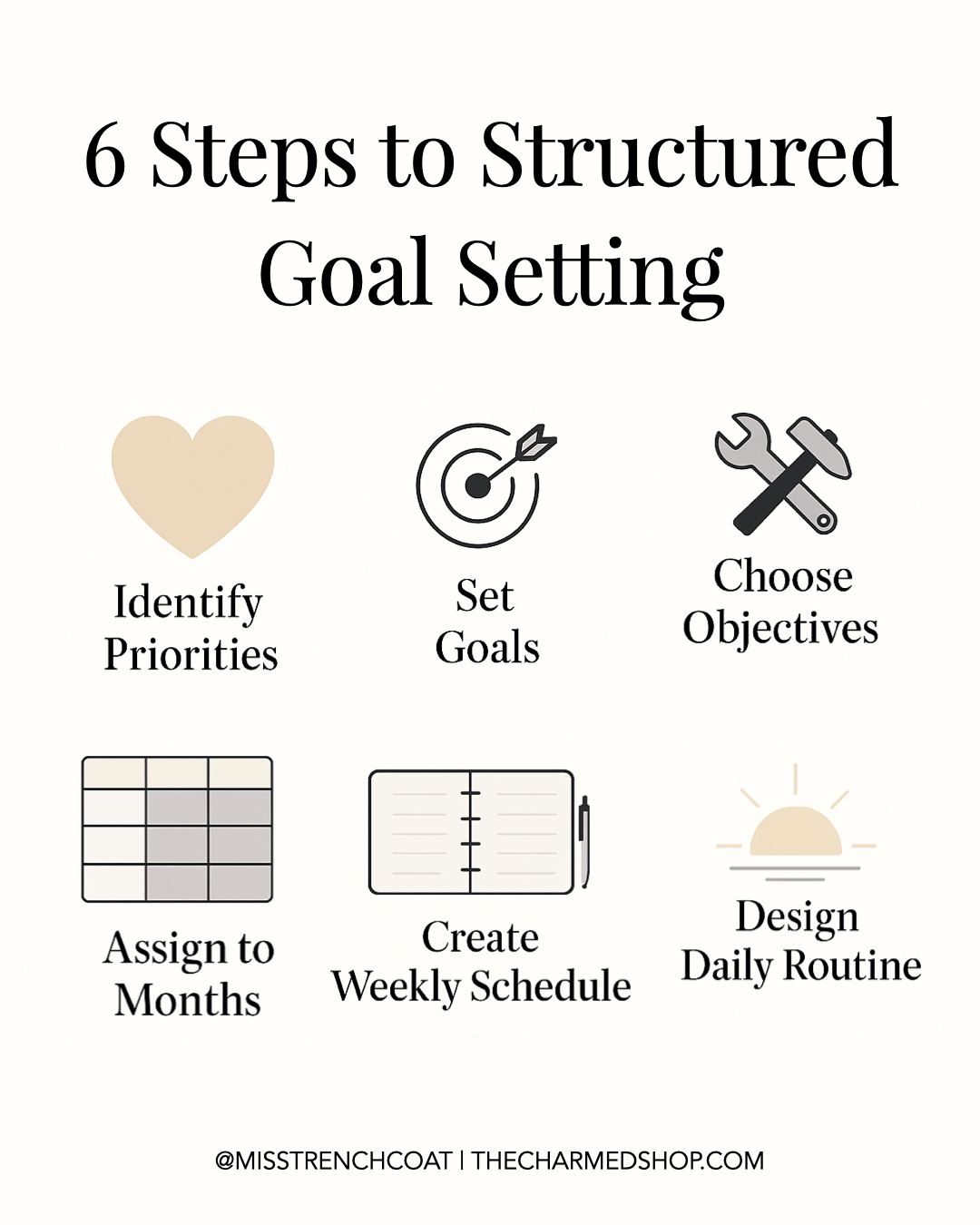
This six-step process takes you from scattered thoughts to a structured roadmap you can actually follow through on.
Step 1: Identify Your 1–5 Priorities
Clarity begins with knowing what matters most. Instead of vague categories like health or career, get specific. Think about the actual people, places, or institutions that deserve your energy right now. Examples:
Family
Business
Home
Personal development
Finances
👉 Ask yourself: “If I only made progress in a few areas over the next 90 days, what would they be?”
Step 2: Set 1–3 Goals for Each Priority
Once you know your priorities, define what success will look like in each by the end of the year. Keep these goals specific and realistic for the short timeline of Q4.
Example: For Business, your goal might be “Complete my website redesign.”
Example: For Health, your goal might be “Walk 5,000 steps a day.”
👉 The key is to set no more than 1–3 goals per priority so you don’t stretch yourself too thin.
Step 3: Brainstorm Objectives (The How)
Goals are great, but without a plan, they remain wishes. This step is about breaking each goal down into actionable objectives:
Projects → multi-step outcomes with a clear finish line (ex: “Plan holiday content calendar”).
Systems → repeatable processes that support progress (ex: “Batch cook lunches every Sunday”).
Habits → single actions you repeat consistently (ex: “Read 10 pages before bed”).
👉 Ask: “What projects, systems, or habits will move this goal forward?”
Step 4: Assign 3 Objectives Per Month (October, November, December)
Now it’s time to make your plan realistic by spreading objectives across Q4. Choose three per month, max. This forces you to focus and prevents overwhelm.
October: Start strong by launching a system or habit.
November: Push forward with a big project.
December: Wrap up and review progress.
👉 Think of this as your “90-day game plan” broken into monthly chapters.
Step 5: Create a Default Weekly Schedule
Clarity also comes from knowing when things will get done. A default weekly schedule is your foundation—it makes sure you always have time blocked for your objectives.
Protect time for both work and rest so your goals don’t compete with your energy.
👉 When your week has structure, you no longer wonder where the time will come from—you’ve already made space for progress.
Step 6: Design Your Ideal Daily Routine
Finally, anchor your habits into daily life. What does a day look like when it fully supports your priorities?
Example: Morning journaling, daily Top 3, evening reflection.
Include small, consistent actions that compound into big results by the end of Q4.
👉 Your routines are the glue that keeps your goals from slipping through the cracks.
✨ When you follow this six-step system, you stop relying on motivation and start relying on structure. Your goals aren’t just intentions anymore—they’re mapped into your months, weeks, and days. That’s where clarity comes from.
Why This System Works
There’s a reason so many people set goals in January and feel lost by September—it’s not because they aren’t motivated or disciplined enough. It’s because their goals were never given a clear structure.
When you build structure around your goals, three powerful things happen:
1. You Reduce Overwhelm
Instead of staring at a vague, endless list of “things I should do,” you’ve narrowed your focus to just a few meaningful priorities. You know where your energy belongs—and where it doesn’t.
2. You Gain Focus
By breaking goals into objectives, and assigning those objectives to specific months, weeks, and days, you always know exactly what to work on next. No more decision fatigue. No more spinning your wheels.
3. You Create Consistency
Structure turns one-time intentions into repeatable actions. With your weekly schedule and daily routines in place, progress stops being random—it becomes inevitable.
4. You Protect Your Energy
Because this system includes white space, rest, and realistic pacing, it supports you instead of draining you. Structure creates sustainability, and sustainability creates long-term success.
Clarity isn’t something you stumble into—it’s the natural outcome of building the right framework. When you know your priorities, have a clear roadmap, and protect the time to execute it, you no longer waste energy on wondering if you’re doing enough. You already know you’re on the right path.
That’s why this system works: it transforms the chaos of “too many goals, not enough time” into a clear plan that will carry you through the end of the year with confidence and calm.
How to Put This Into Action for Q4
Right now, you’re standing at the threshold of the final 90 days of the year. It can feel daunting—like there’s not enough time left to make meaningful progress. But here’s the truth: there is plenty of time to create momentum, as long as you have a structure guiding you.
Start small. This week, choose just 1–2 priorities and walk them through the six steps of the Goal Setting System:
Define your priority.
Set 1–3 clear goals.
Break them down into objectives.
Assign those objectives to October, November, and December.
Block time in your week.
Anchor habits into your daily routine.
Even if you stop there, you’ll feel an immediate shift—from chaos to clarity, from overwhelm to direction.
But imagine what would happen if you didn’t have to do this alone. Imagine sitting down with me to walk through the system together, step by step, so you leave with a Q4 plan you can trust.
That’s exactly what I’ll be teaching inside the Q4 Crescendo Workshop.
On Saturday, September 13th at 12pm EDT, I’m hosting a free live training where I’ll guide you through structuring your priorities, mapping your goals, and creating a personalized plan to carry you through the rest of the year with confidence.
The final months of the year don’t have to feel like a race you’re barely keeping up with. When you give your goals a clear structure—when you know your priorities, map your objectives, and create space in your weeks and days to bring them to life—you trade chaos for clarity.
Clarity doesn’t come from thinking harder or doing more. It comes from structure. And once you have that structure, every step you take has purpose.
This Q4 can be the season you finish strong, not by chance, but by design.
✨ Don’t wait for clarity to find you—create it. Join me in the Q4 Crescendo Workshop and let’s build your plan together.
There was a time when I thought planning was all about squeezing more productivity into my day. More tasks. More goals. More doing.
But what I’ve learned over the years is this: if your planning isn’t protecting your peace, it’s not actually helping you live well.
A well-planned life isn’t rigid. It’s intentional, responsive, and grounded in self-leadership. It’s about having a structure that supports your priorities and your well-being.
These are the 5 planning habits I practice consistently to keep my plans aligned with my peace — so I can lead my life with clarity, energy, and purpose.
1. Weekly Reflection Before Planning
Key Question:“What worked last week? What didn’t? Where did I feel energized—or drained?”
Before I start writing my plans for the week, I pause and look back. Reflection keeps me from starting from scratch or guessing what matters — I use the real data of my lived experience to guide my next steps.
I’ll ask myself:
Which projects or tasks gave me momentum?
Where did I feel resistance or burnout?
Did I honor my personal priorities alongside my professional ones?
From there, I can lean into what’s working and adjust what’s not — before the week even begins.
Pro tip: Keep a running “energy tracker” in your planner to note patterns in how you feel and perform. These insights are invaluable for creating plans that truly support you.
2. Top 3 Priorities Every Day
Key Question:“If I only got 3 things done today, what would make the biggest impact?”
The Daily Top 3 is my secret weapon against overwhelm.
Instead of staring down a mile-long list, I identify three high-impact tasks that will move me closer to my goals. The rest becomes optional bonus work.
Your Daily Top 3 could be:
Wrapping up a client project
Completing a workout
Prepping meals for the week
Choose them based on urgency and alignment with your bigger objectives — not just what’s loudest in your inbox. When you lead with these, you’ll end the day feeling accomplished instead of depleted.
3. Time Blocking with White Space
Key Question:“When do I need to focus—and when do I need to breathe?”
Time blocking helps me protect my most valuable resource: my energy.
I map my day into chunks dedicated to focused work, creative tasks, and yes — rest. White space is not wasted time; it’s recovery time that allows you to show up sharper for what’s next.
I even block buffer time between meetings or errands. Those extra minutes mean I’m not rushing, flustered, or playing catch-up. It’s small planning decisions like these that keep stress at bay.
4. Monthly Reset Rituals
Key Question:“What do I want to leave behind this month? What do I want to make space for?”
At the end of each month, I set aside an hour for a reset. I light a candle, put on some music, and review my goals and planner pages.
Here’s what I do:
Clear out any tasks or projects that no longer serve me
Migrate or schedule important tasks forward
Refresh my monthly spreads with new priorities and dates
Identify one or two focus areas for the upcoming month
This ritual is both practical and grounding. It’s a way of closing one chapter before starting the next with clarity and intention.
5. Permission to Pause and Adjust
Key Question:“What can I let go of today to protect my energy and stay aligned?”
The final habit is less about what I write in my planner and more about how I use it.
I remind myself daily: My plan is a guide, not a contract. If life shifts, I’m allowed to adjust.
Sometimes that means moving a task to tomorrow, delegating it to someone else, or deleting it altogether. Other days, it means dropping my to-do list entirely and giving myself rest without guilt.
I’ll often write a simple “I release…” statement in my planner to make the letting go intentional. Protecting your peace is as much about what you don’t do as what you do.
Final Thoughts
These five habits are small shifts, but they’ve completely transformed the way I plan and live. They help me protect my energy, honor my priorities, and approach each day with purpose instead of pressure.
If you’re ready to start planning this way, the Charmed Life Master Planner was designed to be your ultimate second brain — helping you capture your thoughts, organize your priorities, and build the well-planned, peaceful life you’ve been craving. ✨ Enjoy 25% off your purchase with code MasterPlan2026.
And if you want clarity on the next steps to becoming your most well planned and productive self, download the Well Planned & Productive Woman Reset Workbook. It’s the perfect companion to start integrating these habits into your daily life.
Your peace is worth protecting — and your planner can help you do it.
Your planner isn’t just a notebook — it’s your second brain. It’s the safe, structured space where all the moving pieces of your life can live without weighing you down.
Because here’s the truth: you were never meant to keep it all in your head. The ideas, the to-dos, the appointments, the dreams — it’s too much cognitive weight for one brain to carry. That’s why we plan. To release the mental clutter, create structure for our energy, and build momentum without burnout.
Each morning, before the world starts making requests of my time and attention, I sit down with my planner and anchor into my day. It’s a simple ritual that takes just a few minutes, but it sets the tone for everything that follows.
If you want to feel calmer, clearer, and more in control of your time, here are the five things every Well Planned & Productive Woman writes in her planner each morning.
1. Daily Top 3
The Well Planned & Productive Woman knows that not all tasks are created equal. Your Daily Top 3 are the three most important tasks you must accomplish today in order to stay aligned with your goals and keep momentum moving forward.
These aren’t just random to-dos pulled from a long list — they’re chosen with intention. I use the urgency/importance filter to decide: Will this move the needle? Is there a consequence if it’s not done today? Is it directly tied to one of my bigger objectives?
Your Daily Top 3 might look like:
Finalizing a client proposal
Recording a podcast episode
Booking a long-overdue dentist appointment
When you lead with these priorities, everything else on your list becomes bonus progress, not a source of guilt or overwhelm.
2. Any Appointments or Time-Based Commitments
Once I’ve locked in my Daily Top 3, I turn my attention to the non-negotiables on my schedule — the appointments, calls, and events that are tied to a specific time.
These are the anchor points of my day. They tell me where my energy needs to be and when, and they help me realistically plan what’s possible in the spaces between. Because let’s be honest — we’ve all had those days where our to-do list was longer than our actual available hours.
By putting my time-based commitments front and center, I can see immediately where I have focused work windows, where I might need to shift priorities, and where I should build in white space for travel, preparation, or recovery.
Pro tip: If you have multiple small appointments, try batching errands or phone calls around them. This keeps your energy contained instead of scattered, and it protects those bigger blocks of uninterrupted time that are so valuable for deep, focused work.
3. A Personal Intention or Mindset Anchor
This is where I remind myself who I am becoming and what I’m working toward.
Each morning, I write a short statement that connects me directly to my bigger goals — not just for the day, but for my life and business. It might be a concrete objective I’m focused on, like:
I am creating $10,000 in sales this month with ease and joy.
I am showing up consistently for my health with nourishing food and daily movement.
Or it might be an affirmation that shifts me into the version of me who has already achieved those goals:
I am a confident, well-resourced CEO who makes decisions with clarity.
My dream clients find me easily and love to work with me.
This small act isn’t just motivational — it’s mental reprogramming. By writing and re-reading these intentions daily, you train your mind to believe they are possible (and inevitable), which shapes the actions you take.
I place my intention at the top of my planner page so I see it all day long. It becomes my quiet reminder to lead my decisions from the future I’m creating, not the limitations I’m leaving behind.
4. A Quick Brain Dump to Declutter Your Thoughts
Before I dive into my work, I give my mind a clean slate by getting everything that’s floating around in my head down on paper.
This isn’t my full to-do list — it’s a capture session for anything that’s surfaced since I last planned. It might be a small errand, a random idea for my business, a reminder to follow up with someone, or even a household task I’ve been mentally carrying.
From there, I quickly triage each item:
Do it today — if it’s urgent or connected to my Daily Top 3.
Schedule it — for later in the week or month.
Delegate it — to someone else who can handle it.
Delete it — if it’s not important or relevant anymore.
I use the Brain Dump inserts from the Charmed Life Master Planner for this because it keeps everything in one place and makes sorting easy. Once I’ve captured it all, I can see clearly what actually matters today and what can wait — which means I’m not carrying the stress of remembering it all in my head.
5. One Thing I’m Letting Go of to Protect My Peace
This is my favorite part of my morning planning ritual — identifying something I’m consciously not carrying with me into the day.
It could be a task I’ve been pressuring myself to finish that truly isn’t a priority right now. It might be a worry I can’t control, a piece of perfectionism that’s slowing me down, or even someone else’s expectation that doesn’t align with my goals.
By naming it, I give myself permission to release it. I write it right in my planner so it’s a visible reminder: this is not mine to hold today.
Letting go isn’t about avoidance — it’s about protecting my energy for the things that truly matter. When I do this daily, I find I end the week feeling more grounded, less scattered, and far more satisfied with the progress I’ve made.
Your morning planning ritual doesn’t have to be long or complicated — just intentional. By taking a few minutes to map out your Daily Top 3, note your commitments, anchor into your goals, clear the mental clutter, and release what doesn’t serve you, you’ll set yourself up to lead your day with clarity, focus, and peace.
And if you’re ready to take this practice to the next level, the Charmed Life Master Planner is the ultimate functional planner designed to be your second brain. It’s built to support you in becoming the Well Planned & Productive Woman you’ve always wanted to be — with tools for capturing, organizing, and allocating your life with ease. ✨ Enjoy 25% off your purchase with code MasterPlan2026.
If you’re just getting started on your journey and want clarity on exactly what to do next, download the Well Planned & Productive Woman Reset Workbook. It will walk you through the first steps to creating structure, simplifying your routines, and building the habits that will transform your life.
Your dream life isn’t built by chance — it’s built by design. Let’s make it happen.
There’s a quiet lie that ambitious women have been sold: To have the life you want, you have to do everything—and do it perfectly.
But the truth? You don’t have to do it all. You just need to do what matters most.
Every time you try to tackle your entire to-do list at once, you overwhelm your nervous system, scatter your focus, and drain your energy before the day even begins. You slip into hustle mode, overplan to avoid discomfort, or procrastinate out of perfectionism. It’s not that you’re not capable—it’s that your system is overloaded.
What if, instead of reacting to a mountain of tasks, you could start each day with a sense of calm clarity? What if just three aligned actions were all it took to move your life and goals forward—without burnout?
In this post, I’ll show you the simple strategy I use (and teach inside the Charmed Life Master Planner) to help high-achieving women get the most important things done without sacrificing their peace. Because intentional productivity isn’t about doing more. It’s about knowing what actually matters—and letting the rest wait.
The Problem With Trying to “Do It All”
Let’s be honest: that long, color-coded to-do list isn’t working.
Sure, it looks productive. But when everything feels urgent, nothing gets done well—and often, nothing gets finished at all. You spend your day bouncing between tasks, second-guessing what’s most important, or working endlessly without ever feeling “done.”
Here’s why this happens:
You’re trying to do too much at once, which overwhelms your nervous system and short-circuits your ability to prioritize.
You haven’t clarified your core goals, so you end up spending your best energy on things that don’t really move the needle.
You confuse busyness with productivity, checking off easy wins instead of focusing on the things that create real progress.
This leads to stress, self-judgment, and a cycle of overplanning or avoidance. And even though you’re working hard, you rarely feel accomplished.
But there’s a better way—one that gives you permission to do less, with more impact.
The Daily Top 3: A Simpler Way to Stay Focused and Feel Accomplished
Instead of trying to conquer your entire list each day, imagine waking up and knowing exactly what to focus on. That’s the power of the Daily Top 3—a simple but powerful strategy built into the Charmed Life Master Planner.
Here’s how it works:
📝 Each morning, you define your Top 3 tasks for the day. These aren’t random to-dos or whatever feels most urgent. They are the three most important actions that either:
Move you closer to a meaningful goal or deadline
Prevent unnecessary setbacks or stress
Will leave you feeling proud and accomplished by the end of the day
It’s not about ignoring the rest of your tasks. It’s about creating a clear focal point for your time, energy, and attention. Once your Top 3 are done, everything else is a bonus—not a burden.
The Daily Top 3 lives right on the daily planning page of the Charmed Life Master Planner, making it easy to identify your priorities and structure your schedule around them.
This strategy turns your to-do list from an endless obligation into a purposeful tool. It quiets the noise, lowers anxiety, and helps you make real, measurable progress every single day.
How to Set Your Top 3 (Without Overthinking It)
Choosing your Top 3 each day doesn’t have to be complicated—but it does require intention. The goal is to focus on what will make the most meaningful impact, not just what’s easiest or loudest.
Here are three powerful prompts to guide your decision:
🧠 What must get done today to avoid setbacks? Think about deadlines, responsibilities, or time-sensitive commitments. These are the things that—if ignored—will cause stress or create bottlenecks later.
📆 What moves me closer to an important goal or intention? Choose at least one task that builds long-term momentum. It might not feel urgent, but it’s deeply important to your personal, professional, or creative growth.
💬 What would make me feel successful by the end of the day? Consider the emotional return of your work. Sometimes a task that brings clarity, closure, or relief is just as important as one tied to a deadline.
Once you’ve identified your Top 3, write them clearly in your planner’s daily section. Use the remaining space to list additional tasks or ideas—but don’t allow them to distract you from your focus.
This is how we trade perfectionism for progress—and hustle for intention.
Why This Method Works with Your Nervous System—Not Against It
Most planning systems unintentionally trigger your stress response by overwhelming you with options and impossible expectations. But the Top 3 method is different—it’s designed to work with your nervous system.
Here’s how:
It calms the “fight” response by giving your mind a clear plan instead of pushing you into overwork and micromanagement.
It soothes the “flight” response by eliminating task overload, so you don’t feel the need to escape or avoid your list.
It prevents “freeze” by helping you take decisive action on just three clear tasks, which reduces decision fatigue and inertia.
It avoids “faint” or shutdown by making your day feel achievable. Small wins re-engage your energy.
It counters the “fawn” response by putting your priorities first—before you give your time away to everyone else.
This is nervous system regulation in disguise.
Each time you choose your Top 3, you send a subtle but powerful message to your brain: “I’m safe. I’m supported. I know what to do next.”
Over time, this builds a sense of inner trust. You stop reacting to your day—and start leading it.
What This Looks Like in Real Life: Top 3 Examples for Different Women
This strategy isn’t just for entrepreneurs or planners—it’s for anyone who wants to make progress without burning out. Here are a few examples of how different women might use their Top 3:
👩👧 The Working Mom You’re juggling meetings, school drop-offs, and laundry piles. Today’s Top 3:
Submit final work report by noon
Grocery run for the week
Prep dinner during kid’s homework time
🎯 Why it works: It prioritizes essentials without the pressure to do more than you realistically can.
💻 The Creative Entrepreneur You have a business to run, content to create, and systems to maintain. Today’s Top 3:
Outline blog post for launch campaign
Send client proposal and invoice
Record one short-form video
🎯 Why it works: Keeps momentum on revenue-generating tasks while protecting creative energy.
🎓 The Side Hustler or Student Your time is limited, but your dreams are big. Today’s Top 3:
Write 500 words for your project or paper
Attend virtual class or client call
Schedule your week ahead using your planner
🎯 Why it works: It focuses energy on high-value actions that protect your goals, even in a packed schedule.
Whatever your season, the Top 3 keeps your days focused, intentional, and flexible—so you can get more done without pushing yourself to the edge.
You Can Have It All—But You Don’t Have to Do It All
You don’t need a longer to-do list. You need a better way to focus your energy.
When you stop trying to do it all and start doing what truly matters, your days become calmer, more productive, and more aligned. You feel in control—not because everything is done, but because the right things are.
The Daily Top 3 strategy is a simple ritual that rewires your productivity—and your nervous system—for peace and progress. It’s one of the foundational tools inside the Charmed Life Master Planner, designed to help you work smarter, not harder.
If you’re ready to stop spinning your wheels and start making intentional progress each day, the planner is here to support you.
📝 Use code MASTERPLAN2026 at checkout to save 25% on your Charmed Life Master Planner and start designing a routine that works for you—not against you.
✨ Because you really can have it all. You just don’t have to do it all at once.
When most people think of self-care, they imagine bubble baths and face masks. But true self-care—transformative self-care—starts with nervous system regulation. If you often feel overwhelmed, scattered, or stuck when trying to tackle your to-do list, your sympathetic nervous system may be in overdrive.
The sympathetic nervous system is the part of your body’s stress response system designed to help you survive danger. But in modern life, it’s often misfiring in response to everyday responsibilities. This system triggers one of five trauma responses: Fight, Flight, Freeze, Faint, and Fawn. Each of these reactions can derail your productivity:
Fight makes you over-prepare, micromanage, and feel frustrated when things don’t go perfectly.
Flight leads to avoidance, procrastination, and jumping from one task to another.
Freeze keeps you stuck, unable to start anything because your brain feels foggy or overwhelmed.
Faint (also called shutdown) causes exhaustion, disconnection, or a desire to disappear from your responsibilities.
Fawn turns into people-pleasing, overcommitting, and abandoning your own priorities.
When your nervous system is reacting instead of regulating, even simple tasks can feel like climbing a mountain.
But here’s the good news: a functional planning system can prevent these responses from hijacking your progress.By helping you clarify your goals, structure your schedule, and focus your attention, a good planner works like a nervous system support tool—keeping you calm, clear-headed, and in control.
In this post, we’ll break down how a functional planner and smart systems (like those found in the Charmed Life Master Planner) directly counteract each of the five nervous system reactions—so you can stay centered, take aligned action, and finally get your to-do list from to-do to done.
1. FIGHT: Calm the Need to Push or Control with Structured Objectives
When your nervous system is in fight mode, you’re operating under the belief that more effort equals more results. You might feel irritable, easily triggered, or hyper-focused on controlling every detail of your day. It’s a stress response that masquerades as productivity—but often leads to burnout, perfectionism, and micromanagement.
A functional planning system helps you channel that drive into structure, not chaos.
The Charmed Life Master Planner includes areas for Weekly Objectives on the daily and weekly agenda pages, where you identify your top 1–3 objectives for the week and break them into actionable steps. This step helps you:
Prioritize progress over perfection
Focus your energy on what actually matters
Reduce anxiety by making outcomes feel achievable and planned
Instead of reacting with force, you’re guided by clarity. You’re no longer driven by stress—you’re led by strategy.
Why it works: Creating clear weekly objectives tells your nervous system, “I’ve got a plan.” This quiets the fight response and replaces the urgency to control with a calm, confident roadmap.
2. FLIGHT: Ease the Urge to Run or Avoid with Strategic Allocation
When your nervous system shifts into flight mode, it’s not that you don’t care—it’s that the overwhelm is so intense, your instinct is to escape. This looks like procrastinating, over-researching, constantly rearranging your to-do list, or bouncing between tasks without finishing anything. You feel like you’re running, but you’re not getting anywhere.
A functional planner meets this reaction with structure that grounds and guides you.
In the Charmed Life Master Planner, the Weekly Planning Spread and Daily Top 3 system are designed to combat this exact pattern. Here’s how:
Weekly Planning Spreads allow you to see your entire week at a glance, so you stop reacting and start anticipating.
The Daily Top 3 narrows your focus to just three high-priority tasks, removing the anxiety of a never-ending list.
Instead of “I don’t know where to start,” you begin your day with “I know exactly what to do.”
Why it works: Allocating your tasks to specific days and focusing on a manageable few helps your brain feel safe. Your nervous system sees structure instead of chaos, which calms the urge to run and replaces it with purposeful motion.
3. FREEZE: Thaw Paralysis with Prioritized Capture and Processing
When your nervous system enters freeze mode, everything feels too much. Your thoughts are jumbled, your list is overwhelming, and you’re not sure what even matters anymore—so you do nothing. You might find yourself staring at your planner or scrolling endlessly to avoid making decisions.
This is where functional planning becomes your lifeline.
The Brain Dump system in the Charmed Life Master Planner is designed to gently thaw the freeze response by helping you:
Capture everything swirling in your head—tasks, ideas, worries—into one clean inbox
Label each item by urgency and importance, separating the noise from what truly matters
Cross off or defer what’s not relevant, so your mind isn’t carrying unnecessary mental clutter
This process turns a tangled web of thoughts into an organized, prioritized list of next steps.
Why it works: When your brain sees a clear plan of action, it stops shutting down. The planner acts like a warm hand on your shoulder, reminding you: You don’t have to do everything right now. You just need to take the next right step.
4. FAINT: Rebuild Energy with Gentle Routines and Predictable Structure
The faint response—also known as shutdown—is when your nervous system gets so overwhelmed it simply powers down. You might feel exhausted, detached, hopeless, or unable to care. Even simple tasks feel like too much. This isn’t laziness—it’s a biological response to burnout.
Functional planning offers a gentle structure to restart your system without adding pressure.
The Charmed Life Master Planner includes simple, supportive routines designed to bring you back online at your own pace:
The My Ideal Daily Routine insert organizes those small, repeatable rituals to anchor your day and stabilize your energy.
Even 5 minutes with your planner in the morning can reconnect you to your intentions and give your day a starting point.
Planning even one small action—like prepping clothes or scheduling a walk—helps rebuild confidence and agency.
This isn’t about productivity for productivity’s sake. It’s about restoring the rhythm that helps you feel like you again.
Why it works: Gentle routines tell your nervous system: It’s safe to try again. Over time, these small actions become energy-giving rather than energy-draining—and your motivation naturally returns.
5. FAWN: Break People-Pleasing Patterns with Boundaried Planning
The fawn response is when your nervous system tries to stay safe by keeping everyone else happy. You say yes too often, overextend yourself, and end up abandoning your own goals to meet others’ expectations. Your time gets hijacked, and your to-do list is filled with things that aren’t even yours.
Functional planning gives you permission and structure to protect your energy.
In the Charmed Life Master Planner, two key tools are designed to support you in setting healthy boundaries:
The Ideal Weekly Schedule helps you block time for what matters to you—your goals, rest, routines, and self-care.
The Monthly Habit Trackers give you visual accountability for how often you’re showing up for yourself, not just others.
By pre-planning your time and tracking your habits, you create a schedule that reflects your values—not someone else’s agenda.
Why it works: When your week is already planned and your routines are visible, it becomes easier to say “no” without guilt. Your planner becomes your boundary. Your nervous system feels safe because you’re no longer overexposed—you’re protected by a plan.
From Dysregulated to Deeply Productive
Your productivity isn’t just about tools or time—it’s about how safe and supported your nervous system feels in the process.
When you’re stuck in fight, flight, freeze, faint, or fawn, even the best intentions can stall. But with a functional planning system, you gain more than organization—you gain nervous system regulation. You move through your week with clarity, focus, and a deep sense of calm. You stop reacting and start responding—with aligned action and steady progress.
If you’re ready to get your tasks from to-do to done—without the stress spiral—the Charmed Life Master Planner is here to support you.
🧠 Use code MASTERPLAN2026 at checkout to get 25% off your planner and start building the elegant, energized life you deserve.
Because planning isn’t just about getting things done—it’s about creating a life where you feel safe, seen, and supported every step of the way.
Ever catch yourself thinking, “If I just had more time…”? It’s one of the most common thoughts I hear from ambitious women. You’re juggling a full life, big dreams, and endless to-dos—and it can feel like time is always slipping through your fingers. But here’s the truth: You don’t need more time. You need a better plan.
Feeling overwhelmed doesn’t mean you’re behind. It means your priorities aren’t clear, and your energy is being pulled in too many directions. The good news? There’s nothing wrong with you. You’re not lazy or scattered. You just haven’t been given a system that truly supports the way your mind, energy, and life actually work.
In this post, I’m going to show you exactly how to reset—without adding more to your plate. We’ll walk through a 5-part functional planning method that helps you take aligned action, stay consistent, and create space for what matters most. This is the same system I use to run a business, manage my home, and pursue my goals without burning out.
Let’s shift the way you think about time—because when you have a system that works, your time starts working for you.
What Really Causes Overwhelm
We often think we’re overwhelmed because there’s just too much to do. But the real cause is deeper—and far more solvable. Overwhelm is usually a result of mental clutter, poor prioritization, and lack of structure. Let’s unpack that.
1. Mental Clutter
When your mind is filled with a running list of tasks, ideas, reminders, and worries, it’s nearly impossible to focus. Your brain isn’t meant to be a storage unit. Without a system to capture and organize your thoughts, your mind stays in a loop of stress and reactivity.
2. Poor Prioritization
If everything feels equally important, nothing truly gets the attention it deserves. We get stuck in busywork, checking boxes that don’t move the needle. The result? We feel exhausted, yet still unfulfilled.
3. Lack of Structure
Without a clear structure for your day or week, you end up reacting to what’s urgent instead of acting on what’s important. Your energy gets drained by constant decision-making and context-switching.
Overwhelm doesn’t mean you’re failing—it’s just feedback. It’s your mind and body’s way of saying, “I need more clarity. I need a system that supports me.” And that’s exactly what we’re going to build next.
The 5-Part Planning System That Changes Everything
When you’re clear on your priorities and have a structure that supports your energy, you don’t need more time—you just need a better system. This 5-part planning method is simple, strategic, and designed to help you create consistency without overwhelm.
Let’s walk through each step so you can implement it today.
1. Capture Everything 🧠
The first step is to clear the mental clutter by capturing everything—every task, idea, commitment, or reminder swirling in your head. Think of this as your brain’s offloading process. Until your mind is clear, it’s nearly impossible to focus or make aligned decisions.
Here’s how to do it:
Set a timer for 10–15 minutes.
Grab a notebook, planner, or digital notes app.
Write down everything—work tasks, personal errands, emails to send, ideas you’ve been sitting on, even worries or reminders.
This process gives you a realistic picture of your current bandwidth and relieves your mind from holding onto details it doesn’t need to.
Prompt:What’s been weighing on my mind lately that I haven’t given myself space to fully acknowledge?
💡 Pro tip: Keep a dedicated “inbox” section in your planner to add new thoughts or to-dos throughout the day. That way, you’re not constantly switching focus just to remember something.
2. Clarify Your Top Priorities 🎯
Once you’ve captured everything, the next step is to bring order to the chaos. Not every task on your list is created equal—and treating them that way is a fast track to burnout. To move forward with focus, you need to get clear on your Top 3 Priorities each day.
These are your non-negotiables—the tasks that, if completed, will create real momentum toward your goals.
Here’s how to clarify them:
Review your captured list and ask: Which tasks directly support my current goals or responsibilities?
Identify the 3 most important items for the day. These are tasks that, if left undone, would create a bottleneck or setback.
Everything else can be scheduled, delegated, or deferred.
Use the Urgent vs. Important method as a filter:
Important + Urgent: Do these today.
Important + Not Urgent: Schedule for later in the week.
Not Important + Urgent: Delegate if possible.
Not Important + Not Urgent: Let them go.
Prompt:If I could only accomplish three meaningful things this month, what would they be—and why do they matter?
✨ Mindset shift: If everything is a priority, nothing is. Choosing your Top 3 helps you align with what truly matters—and frees you from guilt around doing it all.
3. Create Structure That Supports You 📆
Now that you’ve cleared your mind and defined your top priorities, it’s time to build the container that supports your focus: structure.
Structure doesn’t mean rigidity. It means giving your energy a clear direction. It means designing your time with intention so you can move through your day with flow, not friction.
Here’s how to create supportive structure:
Use Time Blocking: Set aside blocks of time for different types of work—admin, creative, deep focus, errands, rest.
Create an Ideal Weekly Routine: Map out when you’ll handle recurring responsibilities like content creation, client work, or planning.
Theme Your Days: Give each day a focus to reduce decision fatigue. For example: Monday = Admin, Tuesday = Deep Work, Wednesday = Meetings.
🎯 Goal: Let your calendar reflect your values. If rest, creativity, or deep work matter to you, give them a home in your week.
Prompt:What kind of weekly rhythm would support my energy, creativity, and wellbeing right now?
💡 Pro tip: Start small. Even a single 90-minute block each day for focused work can transform your productivity.
Structure isn’t about squeezing more into your schedule—it’s about protecting your capacity so you can show up fully where it matters most.
4. Organize by Objective, Not Just To-Do’s 🗂️
Once you’ve created structure, it’s time to shift from reactive task lists to intentional action plans. The difference? A to-do list is just a list of tasks. An objective gives those tasks purpose and direction.
Instead of asking, What do I need to get done?, ask: What outcome am I working toward?
Here’s how to organize your work by objective:
Review your captured list and group tasks that relate to the same outcome.
Example: If “launch new product” is the objective, tasks might include writing email copy, updating the sales page, and filming a walkthrough video.
Choose 2–3 major objectives to focus on each week.
Allocate time blocks in your schedule to work on tasks tied to those objectives.
Why this works:
It helps you see the bigger picture and make better decisions about how to use your time.
It reduces mental switching and scattered effort.
It brings a sense of momentum and accomplishment—not just busyness.
Prompt:What outcomes am I working toward this month, and how can I align my tasks with those bigger goals?
🧠 Mindset shift: Productivity isn’t about how many boxes you check—it’s about whether the work you’re doing is actually moving you forward.
5. Leave White Space 🧘♀️
This step is often overlooked—but it’s essential.
White space is the margin in your day that allows you to breathe, reset, and handle the unexpected with grace. It’s not wasted time. It’s restorative time—and it’s a core part of being truly productive.
Here’s how to intentionally leave white space:
Schedule it: Block time between meetings or work sessions as buffer space.
Protect it: Treat it as sacred as your focus blocks or appointments.
Use it wisely: Take a walk, stretch, journal, or simply rest. White space isn’t about doing nothing—it’s about being with yourself without pressure.
The truth is, life rarely goes exactly as planned. White space creates the flexibility and resilience your system needs to keep you grounded, even when things shift.
Prompt:Where in my schedule can I create more margin for rest, joy, or spontaneity—and what might open up for me if I do?
✨ Reminder: You don’t have to earn rest. It’s not a reward for productivity—it’s a requirement for it.
What This System Unlocks for You
When you follow this 5-part planning method—Capture, Clarify, Structure, Organize, and Rest—you’ll feel the shift almost immediately.
✅ Your mind will feel clearer ✅ Your energy will feel more focused ✅ Your goals will feel within reach (not overwhelming)
You’ll finally stop spinning your wheels and start making meaningful progress—without burning out or hustling harder. Because the truth is: You were never behind—you were just missing the system that lets you show up with clarity and intention.
✨ Ready to Build Your Own System?
The Charmed Life Master Planner was designed exactly for this. It’s more than a planner—it’s a strategic tool that walks you through each phase of functional planning so you can take aligned action and make space for what truly matters.
For a limited time, use code MasterPlan2026 to get 25% off your copy.
Want a little digital support too? Don’t miss the Functional Planning Dashboard—your digital HQ for organizing tasks, projects, and goals with elegance and ease.
Head to the shop now and start planning like the Well Planned & Productive Woman you were born to be.
If you’re anything like most of the women in my community, you’re smart, ambitious, and juggling a lot. You’ve got personal goals you want to make progress on, work responsibilities that never seem to end, and a life at home that keeps your heart full—but your hands very, very busy.
You’ve probably tried planners before. Maybe even stacks of them. They were beautiful and full of potential… but none of them ever seemed to work. Not because you failed—but because they were missing something essential: a system.
A system that could hold the complexity of your life. A system that helps you turn your ideas into action. A system that guides you through the real work of getting organized and staying consistent—without burning out.
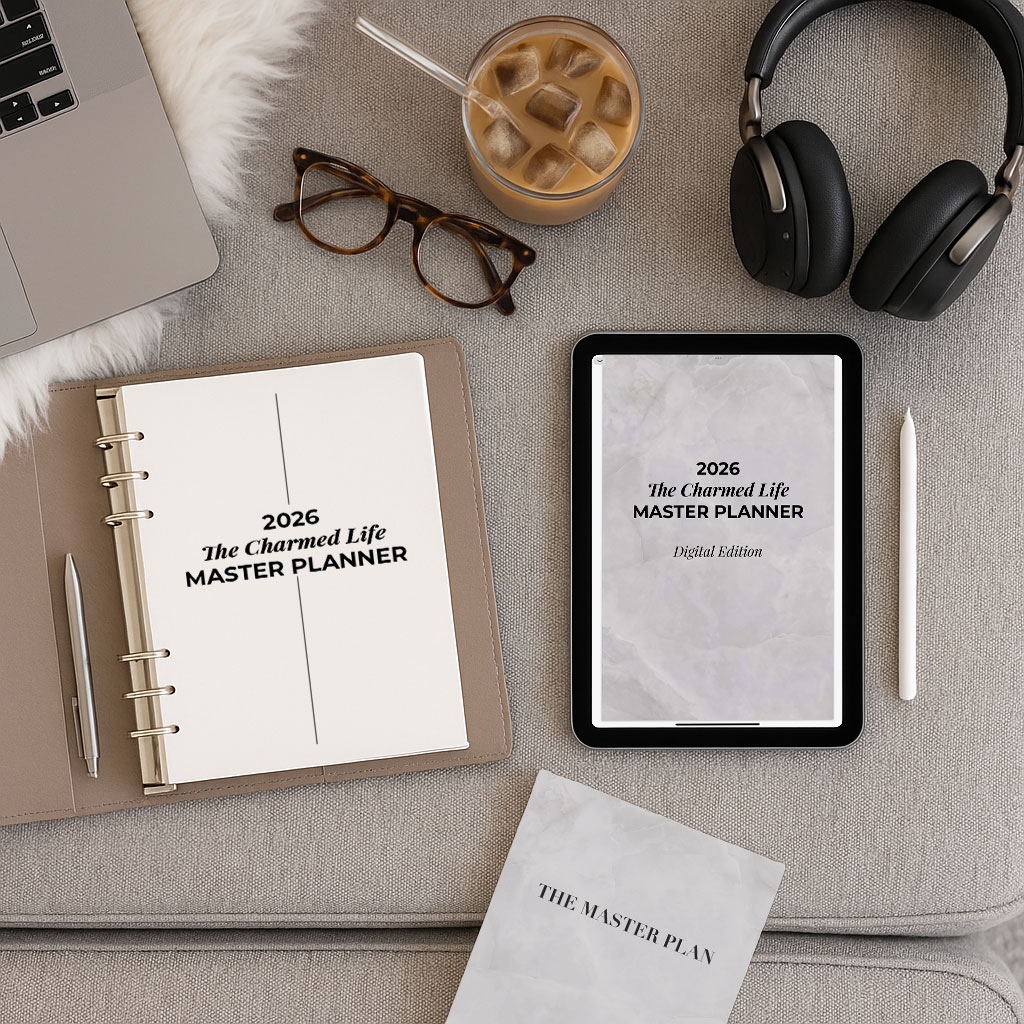
That’s exactly why I created the Charmed Life Master Planner. It’s more than just a planner—it’s a holistic productivity framework built for women like you. Women who want to do more than survive the chaos of everyday life… you want to design it. Live it. Lead it.
This planner gives you the clarity, structure, and flexibility you need to plan your goals, organize your time, and create a life that feels balanced and fulfilling.
If you’re new to functional planning, I’ve created a free companion resource called the Functional Planning Dashboard—it’s a guided tool to help you start building your own planning system step-by-step.
Here are 10 powerful ways you can use the Charmed Life Master Planner to organize your life with confidence and ease…
1. Define the Vision for Your Year
Set Your Priorities and Goals for the Year
Build a Vision Board for Your Goals
Without a clear vision, even your most well-intentioned goals can feel scattered, unfocused, and hard to stick to. That’s why one of the first and most foundational steps to organizing your life is to root your goals in your true priorities—what I call your Uppercase-P Priorities.
These aren’t vague categories like “health” or “career”—they’re the real, tangible people, places, and institutions in your life that matter most to you. And the very first priority? You. Because nothing in your life works if you’re not supported, nourished, and well.
Inside the Charmed Life Master Planner, the Goals Page helps you clearly define up to 5 of your personal priorities for the year. For each one, you’ll outline up to 3 specific goals that you want to bring to life. These goals aren’t random tasks—they’re meaningful outcomes that reflect your deeper desires and direction for the year.
Then, using the Vision Board spread, you’ll bring those goals to life in a visual and emotional way. This is more than a pretty collage—it’s a personal manifesto. Fill it with quotes that motivate you, images that capture your dream lifestyle, symbols of strength, rest, abundance, or whatever you’re calling into your life this year.
Example:
Priority:You
Goal: Run a 5K this year
Vision Board: Include an inspiring quote about strength, photos of running shoes, a scenic trail, and your favorite healthy recipes to keep you focused on how it feels to be energized and well.
When your goals are grounded in what matters most and visually reinforced with intention, you’ll feel connected to them—and far more likely to follow through.
2. Forward Plan Your Year
Track Information Across Your Months
Forward Plan Your Year with the Overview
One of the most overlooked productivity habits is forward planning—looking ahead to understand how your year is likely to unfold, so you can make intentional decisions about what fits where. Because here’s the truth: if you don’t proactively plan your time, something else will fill it for you.
Forward planning is about making space in your year for what matters most—before your calendar gets overwhelmed with everyone else’s priorities.
Inside the Charmed Life Master Planner, two key inserts help you take control of your long-term schedule:
The Yearly Tracker gives you a bird’s-eye view of the entire year. You can use it to block off time for vacations, family events, work deadlines, content launches, or recurring appointments.
The Yearly Overview expands on this by allowing you to track multiple categories of your life—like school schedules, wellness routines, travel, or seasonal cycles (I personally love to track astrological transits here!).
Both spreads are essential for women managing layered responsibilities—whether you’re balancing career projects, family life, or your own creative business.
Example:
Use the Yearly Tracker to highlight summer vacation in July, holiday travel in December, and your product launch window in September.
In the Yearly Overview, create separate sections to track your partner’s travel schedule, your children’s school events, and your self-care commitments.
This kind of planning not only prevents burnout and scheduling conflicts—it gives you the confidence to say yes (or no) to new opportunities because you’ll know what’s realistic and aligned with your vision.
3. Design Your Ideal Day
When your days feel chaotic or disjointed, it’s often because you’re reacting to life instead of designing it. Productivity doesn’t come from doing more—it comes from creating intentional rhythms that support your energy, your goals, and your wellbeing.
That’s why designing your ideal day is such a game changer. It’s not about building the “perfect” routine—it’s about crafting a flexible structure you can return to when life gets busy and your focus starts to slip.
Inside the Charmed Life Master Planner, the My Ideal Day insert is your space to do exactly that. It includes:
A weekday layout with a time-table format—perfect for blocking your workday or planning a high-output day from morning to evening.
A weekend layout with flexible boxes—ideal for less structured days when you want a simpler flow without the pressure of a schedule.
Use this spread to build a daily cadence that reflects your priorities. Start by blocking time for the essentials—work, meals, rest—and then layer in space for habits and routines like reading, workouts, creative time, or evening wind-down rituals.
Example:
Block 8:00–9:00 AM for your morning routine (journal, tea, movement).
Schedule focused work time from 10:00 AM–1:00 PM.
Add a walk or rest break around 3:00 PM.
In the evening, reserve 8:00–9:00 PM for reading or intentional downtime.
This insert becomes your personal rhythm map—something to ground you when your schedule gets thrown off track and a helpful tool to reflect on how you’re actually spending your time.
4. Build Your Ideal Weekly Schedule
If your days are the building blocks of your productivity, your weeks are the blueprint. While many people try to cram everything into a 24-hour window, the truth is—you don’t need to do it all in one day. You just need to know when things happen in your week.
That’s the magic of designing your ideal weekly schedule.
Inside the Charmed Life Master Planner, the My Ideal Week spread helps you zoom out to see the big picture of how your 168 hours are being used. This layout allows you to:
Visualize how your work, rest, and responsibilities are distributed.
Identify where your time is leaking.
Allocate space for your priorities across a full week.
This isn’t about filling every block. It’s about creating a default rhythm you can return to week after week—so your days aren’t ruled by urgency, but guided by intention.
Example:
Block Monday/Wednesday/Friday mornings for focused work.
Dedicate Tuesday afternoons to errands or appointments.
Reserve Sunday evenings for planning and self-care rituals.
With this kind of weekly map, you no longer feel like you’re constantly starting from scratch. You have a template that supports your goals and adapts with your life—so everything important gets time, without everything happening at the same time.
5. Capture and Prioritize Your Tasks
When your to-do list is overwhelming, it’s usually not because you have too much to do—it’s because you haven’t had the chance to sort through what truly matters. Your brain is overloaded with open loops, and without a system to process them, you stay stuck in reaction mode.
That’s why one of the most empowering things you can do is capture and prioritize your tasks intentionally.
In the Charmed Life Master Planner, this process begins with the Brain Dump insert. Think of it as your mental inbox. This is where every idea, task, obligation, or worry gets written down—freeing up your mind to think strategically instead of just holding on to clutter.
Once you’ve emptied your thoughts onto paper, you’ll move to the Organize & Act spread. This layout guides you through the Eisenhower Matrix, a powerful tool to prioritize your tasks based on urgency and importance:
Do Now (urgent + important)
Schedule for Later (important but not urgent)
Delegate or Systemize (urgent but not important)
Delete or Defer (not urgent or important)
Example:
Write everything from emails you need to send, errands to run, ideas for your side hustle, upcoming events, and routines you want to build.
Then categorize:
Urgent: Pay bills, respond to client.
Important but not urgent: Start outlining your course.
Delegate: Grocery shopping (Instacart).
Delete: RSVP to event you no longer feel aligned with.
This insert is a turning point in your planning process—because it takes your swirling mental chaos and turns it into clear, actionable steps. You’ll walk away knowing exactly where your time and energy should go next.
6. Brainstorm Your Brilliant Ideas
Productivity isn’t just about checking off tasks—it’s about giving yourself the time and space to think creatively and strategically. If you’re constantly stuck in execution mode, you miss the opportunity to design better systems, solve problems, or chase bold new ideas.
That’s why brainstorming is a core part of the functional planning process.
In the Charmed Life Master Planner, the Plan & Prep + Brainstorm spread is designed to help you move from raw ideas to structured plans. This two-part insert gives you:
A mind map layout to explore your ideas, identify problems, or build out a concept visually.
A brainstorm page to organize your final insights into tasks, notes, or next steps.
This is where you get to explore freely before committing to a plan. It’s ideal for content creation, project strategy, decision-making, or anytime you need to see your thoughts take shape.
Example:
Let’s say you want to launch a new offer.
Use the Plan & Prep section to outline the key pieces: content ideas, tech setup, timeline, audience.
Then move to the Brainstorm page to break those down into specific action steps or additional resources you need to gather.
Too many planners skip this part. But you need space to think and be messy before you get organized. This spread ensures that inspiration doesn’t get lost—and that you’re not building plans on unclear ideas.
7. Balance Your Workload
One of the biggest reasons women fall behind on their goals isn’t because they’re unmotivated—it’s because they try to do everything at once. Without a system for pacing your goals across the year, it’s easy to overload yourself in January and burn out by March.
That’s why balance isn’t just a feeling—it’s a strategy. And inside the Charmed Life Master Planner, the Objectives Matrix is your built-in tool to create that balance.
This spread helps you map your objectives—whether they’re projects, systems, or habits—across the full year using a visual grid. You’ll define:
Short-term objectives (monthly focus)
Mid-term objectives (quarterly goals)
Long-term objectives (half- or full-year commitments)
By assigning your objectives in this way, you ensure that your goals are spaced out, manageable, and aligned with the natural rhythm of your year.
Example:
January: Start a wellness habit (morning movement),
Q2: Launch your new digital product,
September: Begin a decluttering project for the home,
Ongoing: Weekly family dinners or business admin routines.
This spread gives you peace of mind—because it shows you that yes, you can do it all… just not all at once. It allows you to say no to what doesn’t fit now, knowing it’s scheduled for later. That clarity alone can transform your entire year.
8. Create Strategic Action Plans
Ideas are exciting. Goals are motivating. But what actually gets things done? A strategic action plan.
When it’s time to turn your objectives into results, the Objective Plan insert in the Charmed Life Master Plannerbecomes your roadmap. This spread is designed to help you fully define, structure, and execute your goals in a way that feels focused and doable.
Each plan allows you to:
Name the type of objective (project, system, or habit)
Describe what you’re doing and why it matters
Identify the due date, frequency, or cue for when to act
List any resources or tools you need
Break the goal into step-by-step actions with due dates
Capture notes or related ideas
This approach ensures you’re not just writing “Launch Course” on a to-do list and hoping it gets done. You’re laying out exactly how to make it happen, when to do it, and what it requires.
This insert is where dreams become plans—and where clarity becomes progress. Once your objective is mapped out, you can distribute those tasks across your weekly and daily agenda spreads for seamless execution.
9. Focus In on Your Month
Month on One Page Calendar
Month on Two Page Calendar
Monthly Tasks and Tracker Spread
Productivity thrives when you have a clear short-term plan. A full year can feel abstract—but 30 days? That’s a manageable container for focused, intentional progress.
Each month inside the Charmed Life Master Planner, you’ll use a combination of spreads to clarify your schedule, organize your tasks, and align your goals:
Monthly Plan (choose from 1-page or 2-page layouts)
Monthly Tasks
Monthly Tracker
Start with your Monthly Plan to map out important dates. Whether you prefer a full 2-page calendar view with room for weekly priorities, or a cleaner 1-page layout with color-coded blocks, you’ll have space to log:
Appointments
Events
Deadlines
Holidays
Travel
Weekly focus goals
Next, use the Monthly Tasks list to identify what you want to complete in this specific month. Pull tasks from your objective plans or brainstorm sessions and park them here so you’re not trying to keep everything in your head.
Finally, track your most important habits and recurring systems using the Monthly Tracker. This spread lets you log:
Up to 3 objective-based projects
5 weekly routines (like content creation, laundry, or date night)
6 daily habits (like journaling, water intake, or bedtime routines)
Example:
Monthly Focus: Prep for spring launch
Key Events: March 5 (webinar), March 18 (trip), March 31 (launch deadline)
Tasks: Finalize sales page, test tech, prep emails
Tracker: Daily movement, weekly CEO time, progress on launch checklist
Together, these spreads ensure your month isn’t just full—it’s focused. You’ll move forward on what matters, without losing track of your vision.
10. Seize the Day
Day on One Page Inserts
Horizontal Week on Two Pages Inserts
Vertical Week on Two Pages Inserts
Week on One Page Inserts
Productivity doesn’t happen in your planner—it happens in your day. That’s why daily execution is the heartbeat of functional planning. Once you’ve set your goals, mapped your objectives, and planned your month, the final step is to show up each day with clarity and intention.
The Charmed Life Master Planner offers several weekly and daily layout options so you can choose the level of structure that suits your lifestyle. No matter your pace, each layout gives you space to define your top priorities and manage your tasks in a way that actually works for you.
Here’s a quick overview of your choices:
WO1P (Week on 1 Page): Minimal structure with a weekly task list, top 3 goals per day, and a “Remember” box for notes or reminders.
VWO2P (Vertical Week on 2 Pages): Column-style days with top 3, task lines, and an open box for notes. Great for structured days with a flow.
HWO2P (Horizontal Week on 2 Pages): Dashboard with two task lists (business and personal), objectives, reminder boxes, and a weekly habit tracker. Plus a weekly overview with top 3 and space for time block, additional tasks or notes.
DO1P (Daily on 1 Page): Full daily breakdown with top 3, a schedule, detailed to-do list, and space for gratitude and daily reminders.
Use these spreads to bring your plans to life. Each morning, check your objectives, identify your Top 3 priorities, and map out your tasks or appointments accordingly.
Example:
Top 3: Finish slide deck, follow up with client, schedule Instagram posts
Task List: Pack orders, call vet, research CRM tool
Schedule: Block 10am–12pm for focused work, 2pm meeting, 4:30pm errands
These layouts turn your planner into your personal assistant. You’re not just reacting to the day—you’re directing it with purpose.
And best of all? When life gets chaotic (because it will), these spreads help you recalibrate quickly. Open your planner, check your priorities, and take one step forward.
Ready to Organize Your Life with a Functional System?
The truth is, staying organized isn’t just about having the right planner pages—it’s about having the right framework. The Charmed Life Master Planner isn’t just a collection of inserts; it’s a complete, proven system that helps you think clearly, prioritize intentionally, and take aligned action.
Whether you’re a solopreneur managing a business, a working mom balancing family logistics, or a multi-passionate woman with big dreams, this planner gives you the tools to plan your life with confidence—not chaos.
And if you want to get a taste of how this functional system works before you dive in, I invite you to download the Functional Planning Dashboard—a free resource that introduces you to the key routines of functional planning and helps you start organizing your life today.
✨ The 2026 Charmed Life Master Planner is now available! Choose your preferred layout and finally get the structure you need to stay consistent with your goals.
Want even more support, accountability, and structure? The Charmed Life Master Mind is the next step in your journey—a private membership filled with live trainings, on-demand resources, and a community of women doing the work alongside you.
Let this be the year you stop trying to manage your life with a half-filled notebook and finally commit to a functional system designed for your success.