A behind-the-scenes look at how I manage life, content, and business tasks without burning out
Running a business is a lot.
There are goals to set, content to create, clients to serve, offers to manage, and about a thousand decisions to make every week. Add in managing your home, your relationships, and your energy, and it’s no wonder so many creative entrepreneurs end up feeling overwhelmed.
After 12 years in business, I can tell you this with confidence:
✨ You don’t need more time. You need better systems.
In this post, I want to give you a behind-the-scenes look at the exact systems and tools I use to manage my life and business without burning out. These are the rhythms that keep me focused, the planners that keep me grounded, and the automations that multiply my energy.
If you’ve been struggling to stay consistent with your content, goals, or execution, this post will show you how to build the systems that support your vision.
Let’s dive in.
Why Systems Are the Secret to Consistency
Consistency isn’t about willpower. It’s about structure.
If you don’t have a system for planning your tasks, tracking your goals, and executing your ideas, you’ll always feel behind. You’ll always be reacting instead of leading.
And the truth is: most people don’t fail because they lack ambition—they fail because they lack structure.
Structure creates freedom. Systems create flow.
The good news? You can create simple systems that take the pressure off and help you show up consistently, even when life gets messy.
Here are the core systems I use to run my business.
System 1: My Planning Stack
This is where everything begins: with my planners.
I use two digital planners every single day:
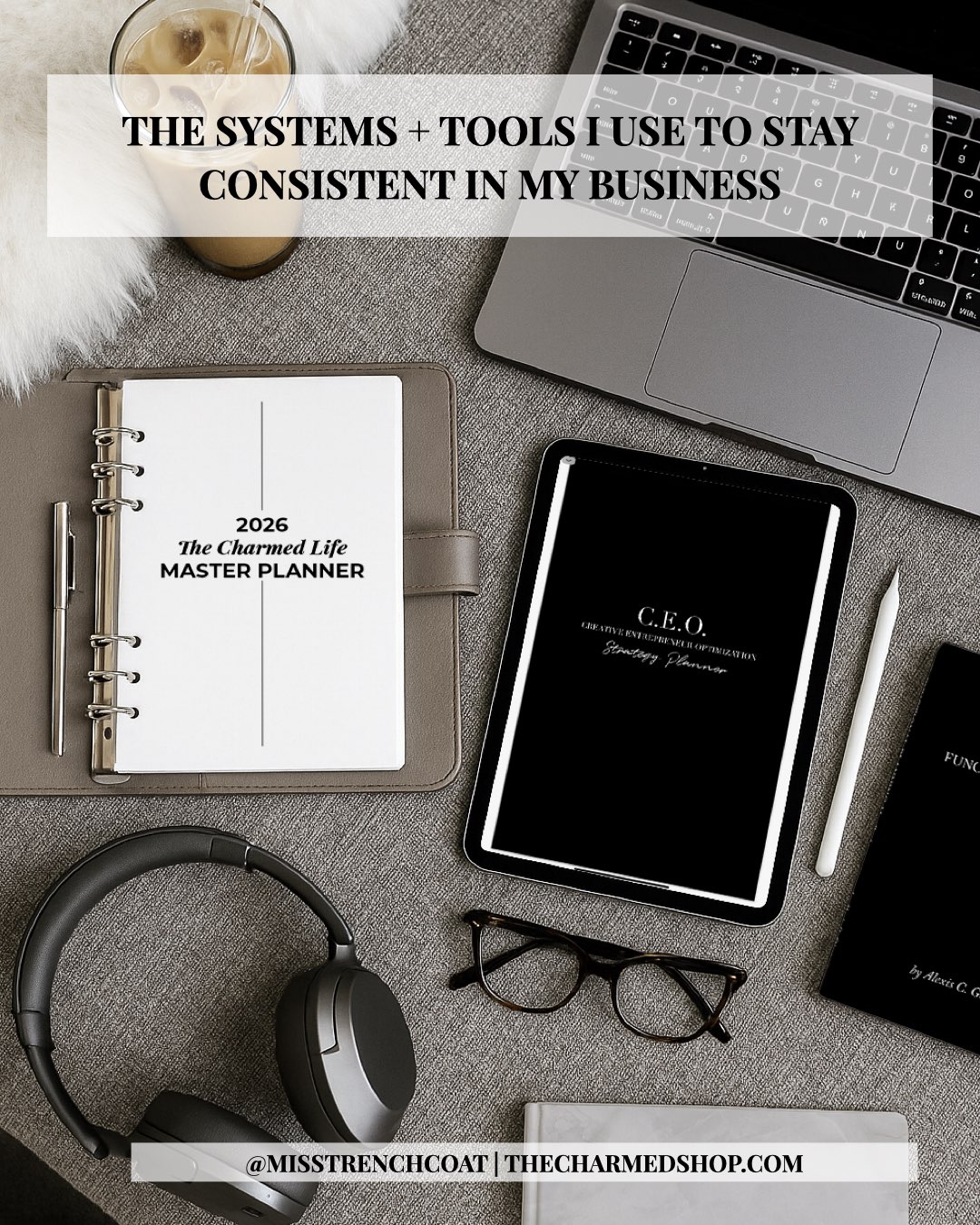
🗓 The Charmed Life Master Planner This is my main life + time management hub. It holds:
My yearly, quarterly, monthly, weekly & daily planning routines
My master task lists, calendars, routines, and habits
My content plans and household systems
📘 The CEO Strategy Planner This is my business planning brain. It holds:
My business goals and revenue plans
Project outlines + task breakdowns
Launch plans, marketing strategies, and performance tracking
The key is integration: tasks from the CEO Strategy Planner always get scheduled into the Master Planner. That’s how I stay consistent and make sure everything gets done.
System 2: Functional Weekly Routines
Once I have my plan, I rely on simple weekly rhythms to help me follow through:
🧠 Weekly CEO Planning Session Every Sunday or Monday, I review my goals, assess last week, and make my plan for the week ahead. I block out time in my calendar and use my Top 3 method to stay focused.
📆 Themed Work Days To stay productive, I group my work into themed days:
Monday: Admin & Operations
Tuesday: Content Creation
Wednesday: Marketing & Visibility
Thursday: Product or Offer Development
Friday: CEO Visioning, Strategy, and Overflow
This helps me batch tasks, reduce decision fatigue, and stay in alignment with my priorities.
System 3: Content Planning Framework
My content doesn’t happen by accident. I use a structured monthly and weekly content calendar to guide what I publish, when, and where.
Each month, I:
Choose a focus or theme tied to my offers
Plan blog posts, email newsletters, and Instagram content
Align my content to introduce or lead into specific offers
I use a content planning template inside my CEO Strategy Planner to keep everything organized, and I repurpose core messages across platforms to work smarter, not harder.
Consistency in content is what builds trust. And trust is what drives sales.
System 4: Automation & Templates
To reduce decision fatigue and free up energy, I use automations and templates for recurring business tasks.
Examples:
Email welcome sequences + nurture funnels
Evergreen sales funnels tied to opt-ins
Social media templates + caption formulas
Client onboarding emails + workflows
These systems work for me while I focus on showing up, serving, and selling.
Inside IN BUSINESS, I share these behind-the-scenes templates and tools so you can copy what works and customize it for your business.
System 5: Reflection & Realignment
The final piece of my consistency system is the part most people skip: reflection.
Each month and quarter, I review:
What worked
What didn’t
What I want to do differently moving forward
This process helps me refine my systems, spot misalignments, and recommit to my vision.
There is no perfect plan. Only a commitment to keep coming back to the work.
Final Thoughts: Build Systems That Support You
You don’t need to be perfect. You don’t need to do it all.
You just need to build systems that support the life and business you actually want.
✨ The right systems give you structure, clarity, and breathing room. ✨ The right tools keep you focused and on track. ✨ The right mindset reminds you that progress happens in cycles.
If you’re ready to create your own systems for consistency, here’s where to start:
Why goal setting isn’t enough—and how to actually follow through.
If you’ve ever found yourself setting ambitious goals for your business and then losing momentum within weeks, you’re not alone.
You’re not broken. You’re not unmotivated. You’re just missing one key ingredient:
Alignment.
Alignment is what turns goals into action. It’s the bridge between the vision you set and the execution that creates results.
In this post, I want to share the real secret to taking consistent action in your business, based on over a decade of running my own business full time. We’ll talk about what alignment looks like, why traditional goal setting often leads to burnout, and how to build a structure that supports sustainable progress.
If you’ve been:
Overplanning but not taking action
Setting goals but falling off track quickly
Or feeling overwhelmed by how to manage your time and energy as a business owner…
This is for you.
Why Traditional Goal Setting Doesn’t Work
Let’s start here: Goal setting isn’t the problem. The way we approach it is.
Most entrepreneurs are taught to dream big and set clear goals—and that’s great. But then they try to tackle everything at once, with no realistic plan for follow-through.
You get excited, make a long to-do list, and try to hustle your way to the finish line.
But without:
A system to break things down
A routine to follow
And a mindset that supports consistency…
…you burn out or lose focus.
This is exactly why I created my IN BUSINESS program—to help women entrepreneurs stop the cycle of starting and stopping, and finally build the rhythm that helps them move forward month after month.
What It Means to Be in Alignment
Alignment in business means your goals, your plans, your schedule, and your energy are working together.
When you’re in alignment:
You know what to focus on each month
Your tasks feel purposeful, not scattered
You feel motivated because your actions are connected to your vision
When you’re not in alignment:
You’re constantly overwhelmed by your to-do list
You procrastinate or avoid the work
You set the same goals every year but never hit them
Alignment doesn’t happen by accident. It’s a system you build.
Here’s how I build that alignment inside my business year after year.
1. Start With a Braindump
Everything starts with clarity. And clarity begins with a braindump.
Before I plan anything, I do a full mental download using the CEO Braindump Triggers List. I use prompts to get all the tasks, ideas, to-dos, and mental clutter out of my head and onto the page.
Once I’ve cleared my mind, I sort my list and look for themes:
What projects are high priority?
What tasks actually move the needle?
What can I delegate, delay, or delete?
From there, I choose 1–3 core priorities to focus on for the month or quarter.
This is key. If everything is important, nothing is.
You don’t need to work on everything at once. You need to move the right things forward.
Inside IN BUSINESS, I walk members through my system for choosing aligned business projects based on their goals, energy, and season of life. This is where real momentum begins.
3. Create Structure That Supports You
Your goals need a home. That means planning routines, systems, and tools that hold your priorities and make space for execution.
My tools of choice:
Charmed Life Master Planner for scheduling and time management
CEO Strategy Planner for organizing my business plans and priorities
Each week, I:
Review my business goals
Set weekly priorities
Block time for action
Use my Top 3 system daily to move forward consistently
This isn’t about working harder. It’s about creating a rhythm that you can show up for even on imperfect days.
4. Anchor Back Into Your Vision
Whenever I feel off-track, I come back to my vision. I revisit my goals. I journal. I check in with how I want to feel.
Business isn’t just strategy. It’s energy. If something feels off, it probably is.
The solution? Reconnect with your why. Then recommit.
Inside IN BUSINESS, we build this reflection into the system. We use mindset tools, prompts, and monthly check-ins to help you come back into alignment and keep moving forward.
Action Follows Alignment
The secret to consistent action isn’t more motivation or more hours in the day. It’s alignment.
When you:
Clear your mental clutter
Choose aligned goals
Build supportive structure
And reconnect with your vision regularly…
You don’t just make progress. You become the kind of person who always follows through.
If that’s who you want to be in your business this year, I invite you to:
A behind-the-scenes breakdown of the functional planning system that helps me manage a multi-offer business and a well-balanced life year after year.
Being productive and organized is something that takes consistency. Like anything else you may want to find success at in life, you have to put systems in place and keep those systems up and running. Being a productive and organized person isn’t something that you set up once and then you’re done forever.
However, the systems you use can be decided on once, and then all you have to do is show up to maintain them. That’s what I’ve created for myself—a full-spectrum functional planning system that supports my business and my life.
Today I’m walking you through the planners and tools I use and the five core routines—yearly, quarterly, monthly, weekly, and daily—that make it all work.
If you’re someone who wants to:
Run your life and business with more ease and intention
Stay consistent and organized with your tasks and goals
Reduce decision fatigue and planning overwhelm
…this post will help you lay the foundation for your most productive and peaceful year yet.
Part 1: Yearly Planning — Setting the Vision
The purpose of my yearly planning routine is to set the vision and direction for the year. You can’t create the life or business you want unless you know what that looks like—and create a plan to get there.
Each December, I:
Set my goals for the new year
Break larger goals into milestones
Define objectives for how I’ll achieve each milestone
Assign major projects to quarters or months
Populate my planner with known events and timelines
This high-level planning ensures that my schedule reflects my priorities. It helps me visualize the big picture while grounding me in what’s most important.
My Tools:
You Got Goals Workshop + Planner: helps me clarify and break down annual goals
CEO Retreat Workshop + Workbook: outlines my business goals and sets strategic monthly focuses
2026 Charmed Life Master Planner (Vertical Digital): holds my schedule, routines, and life management
CEO Strategy Planner (Digital): organizes my business objectives, launch timelines, and offers
I view my CEO Strategy Planner as a supplementary tool. It gives me space to think deeply about business strategy, but the Charmed Life Master Planner is the hub for execution. Any business tasks or deadlines I define in the CEO planner ultimately get scheduled in my Master Planner.
This two-planner system creates a balance of big-picture thinking and daily focus.
Part 2: Quarterly Planning — Creating the 90-Day Focus
The purpose of my quarterly planning routine is to check in on my goals and break them down into manageable, actionable segments.
Too often people try to plan their whole year in detail from the start, but the truth is—you learn and adjust as you go. That’s why I plan my year broadly first, and then plan strategically one quarter at a time.
Each quarter (usually at the end of the previous one), I:
Review progress toward goals and milestones
Adjust any timelines or expectations
Define my business focus for the next 90 days
Break down large projects into smaller tasks
Assign tasks to the appropriate months
This quarterly check-in gives me a moment to breathe and re-align. I get to zoom in and ask:
What’s still relevant?
What’s no longer aligned?
What deserves my focus now?
My Tools:
Charmed Life Master Planner
CEO Strategy Planner
For example, if I scheduled a product launch in April during my yearly planning, my Q2 planning session is where I’ll map out the timeline, prepare assets, and distribute tasks into April’s monthly tracker.
Quarterly planning is also when I take stock of my time capacity. If life feels full or energy is low, I adjust accordingly. I’d rather scale back than push forward misaligned.
Part 3: Monthly Planning — Clarifying the Scope
Monthly planning is about setting clear expectations and managing scope.
It’s so common to see people overloaded with long lists of intentions, habits, and to-dos—and by week two of the month, they’re already overwhelmed and off track. That’s why my monthly routine includes intentional limitations to protect my time, energy, and momentum.
Each month, I:
Brain dump all new ideas, tasks, and obligations
Populate my calendar with key dates, events, and deadlines
Revisit any ongoing project plans
Fill out my monthly master task list
Prioritize the top 1–3 projects or habits to focus on
Begin distributing tasks to weeks of the month
In the Charmed Life Master Planner, I’ve designed structure around how many projects, systems, and habits you can reasonably track. This helps me—and my customers—self-edit.
Instead of juggling a dozen goals or routines at once, I choose a few things that matter. This lets me actually build momentum and success.
Everything I decide on in the CEO Strategy Planner, like launches or campaign prep, gets moved into my Master Planner for day-to-day execution.
This process makes my month feel like a strong container for progress—not a chaotic list of unfinished ideas.
Part 4: Weekly Planning — Structuring the Flow
Weekly planning is where the magic happens. This is how I manage my energy and time across the 168 hours we all get in a week.
Each week, I:
Review my priorities for the month
Choose 3–5 main objectives for the week
Slot tasks and projects into daily blocks
Check my calendar for appointments and commitments
Make space for self-care, rest, and personal rituals
Confirm alignment with my partner, team, or collaborators
At the beginning of the year, I set up an Ideal Weekly Schedule inside my Charmed Life Master Planner. This template includes time blocks for household management, business admin, content creation, CEO work, errands, and personal routines.
Each week, I simply layer my current priorities on top of this template. This saves me time and energy and ensures my most important routines get done—even during busy seasons.
Themed workdays also help. I dedicate specific days for:
Admin and batching
Content creation
Coaching or calls
CEO deep work
Having this rhythm in place makes planning and showing up feel simple.
Part 5: Daily Planning — Taking Aligned Action
This is where it all comes together.
Daily planning is about knowing exactly what needs to happen today—and trusting the plan you’ve created.
Each day, I:
Review my weekly priorities and appointments
Assign a Top 3 for the day (the three tasks that move the needle)
Add any bonus or admin tasks if time allows
Reference my Ideal Daily Routine to keep the day structured
Leave white space for flexibility, rest, or unexpected events
Just like I use a weekly template, I also use a Daily Routine Template to hold the structure of my day. It includes:
Morning routine
Work blocks (deep work, meetings, batching)
Meals and breaks
Self-care and movement
Evening wind-down
This daily plan is flexible, but it creates guardrails. I don’t waste energy deciding what to do—I already know. And because my tasks are scoped and scheduled in advance, my daily list is realistic, achievable, and aligned.
If I ever need to map out a more intensive day, I use a Day on One Page spread from my planner. But most days, my Top 3 + Routine holds me steady.
Final Thoughts: Why This System Works
This system has been the key to building and sustaining my business for over a decade. And not just any business—a spacious business, one that supports my life instead of consuming it.
What makes this system powerful isn’t how much I plan. It’s how intentionally each layer supports the next:
My yearly vision gives me a sense of purpose
My quarterly plan keeps me focused
My monthly scope keeps me grounded
My weekly plan gives me flow
My daily plan drives action
This method is both strategic and self-honoring. It lets me stay productive without hustling. I get things done and I have space to rest, recharge, and enjoy life.
Want to Plan This Way Too?
You don’t need to guess or start from scratch. I’ve created tools to help you:
As the end of the year approaches, I often hear this question from my community:
“How do I set goals that I will actually achieve?”
It’s a question that speaks to the heart of effective planning—wanting not only to dream big but to create a plan you’ll follow through on. If you’re feeling stuck or unsure about how to set goals that truly work, I want to break down some common reasons you aren’t achieving your goals and walk you through the goal setting method I teach and avoids these common pitfalls.
Let’s start with a thought-provoking question: What if the reason you haven’t achieved certain goals before wasn’t due to a lack of motivation or discipline but simply because your goal-setting process wasn’t designed to truly work for you? Many people struggle to reach their goals because they unknowingly fall into common pitfalls:
Setting Arbitrary Goals: Many goal-setting methods encourage us to set goals in predefined categories, like health, career, or finances. While these areas are generally important, focusing on arbitrary categories often leads us to set goals based on what we think we “should” do rather than on what truly matters. When a goal isn’t personally meaningful, it’s difficult to stay committed. My process focuses instead on defining your true priorities, which are unique to you, and using those as the categories to set your goals against.
Mistaking Habits for Goals: It’s common to set habits, like “drink more water” or “work out daily,” as primary goals, but these habits are actually objectives or action steps to take that support a larger goal. For example, if your overarching goal is improved health, drinking more water is a strategy to support that. Reading a specific number of books a year isn’t a goal itself, rather it’s a reflection of the type of person you want to be who may be more informed or considered well read- which is the actual goal you desire. Identifying and linking these habits to a big-picture goal makes it easier to stay motivated and see meaningful progress because you have correctly identified the reason why the habit itself is crucial to your success and self-image.
Relying on Goals to Create Change: Many believe achieving a goal will magically create a sense of accomplishment or transform them into a better version of themselves. The version of themselves who eats right, works out, is great with money etc. In reality, change begins internally and must happen before you achieve the goal. Start by embodying the person you want to become, taking the actions that person would take and then your goals will happen as a natural result of the changes you’ve made.
If you resonate with any of these common mistakes or have used a goal setting method in the past that encouraged these errors to begin with, I am here to tell you that with the right goal setting system you can achieve your goals. Today I want to give you a brief overview of my method and process which has helped hundreds of women set goals they actually end up achieving.
Women like Rose who started using my method years ago and after the first month reported back to me “so far January has been my best month ever regarding productivity, focus, and goal achievement.”
She has been loyal to my method ever since and even purchased the workshops to share with her team because she swears by my method for goal setting and planning!
And Peyton who messaged our accountability group: “I’ve been truly struggling with identifying priorities and narrowing down my goals. I watched the master class and it was game changing for me. Something finally clicked and I was able to identify my true goals and priorities based off my current life situation and I am so proud of this! I think Alexis is a true subject matter expert and I’m so glad I decided to join the master mind!”
Or Karmon who ended up achieving all her goals much earlier than expected one year due to my method and had this to say: “I think this is the 4th of 5th year I’ve goal planned the year with Alexis. The process evolves and refines each year. The break out sessions with the other attendees was a great addition – the additional perspectives and glimpses into others’ goals were inspiring. Definitely the kick start I needed to work on my annual plans. Thanks, Alexis.”
I’m sure you are thinking now, Alexis, what is this unique goal setting process?!
Here’s the step by step process I have used for the last 10 years to set goals that I can achieve and get so much more done than most solo business owners.
Step 1: Choose 1-5 Priorities for the Year The first step in any goal-setting journey is identifying what matters most to you. Think about the core aspects of your life that bring you joy, fulfillment, and purpose—these are your priorities. It could be family, your home, career, or a passion project. By narrowing your focus to 1-5 key priorities, you create a strong foundation for meaningful and impactful goal-setting.
Step 2: Set 1-3 Goals per Priority For each priority, establish up to three specific goals. Each goal should represent an outcome that either raises, changes, or maintains a standard in your life. Make sure these goals are clear and measurable so that you can track your progress. This clarity not only gives you direction but also ensures that every goal aligns with your most valued priorities.
Step 3: Define Objectives for Each Goal With goals in place, now it’s time to create objectives—these are the specific actions that will lead you to your desired outcomes. Think of objectives as your action steps. They should be chosen based on your strengths and interests, so the journey feels engaging and rewarding. And remember, your path can be unique to you; it doesn’t have to follow a conventional approach if there’s a better way that suits you.
Step 4: Assign Objectives Across the Months of the Year Goal-setting is a marathon, not a sprint. Instead of trying to do it all at once, assign your objectives to different months, focusing on just a few at a time. Be realistic here—no more than three objectives per month will allow you to make steady progress without feeling overwhelmed. This pacing is key to creating a sustainable rhythm throughout the year.
Step 5: Use a Functional Planner to Track Your Tasks Finally, your plan will only be as good as your follow-through, so tracking is essential. Using a functional planner (like the Charmed Life Master Planner) allows you to map out each objective, month by month, and track tasks daily and weekly. This approach keeps your goals top of mind, ensuring you make consistent progress toward achieving them.
Why this method works
You are setting goals based on your priorities and where you want to go in life next, not arbitrary goals you feel like you “should” be setting but may not be meaningful for you.
You have a clear roadmap put in place at the start of the year so you can confidently show up in the short term to take actions knowing that by the end of the year everything will add up to the completion of your goal, instead of trying to do it all at once, getting overwhelmed and giving up.
You are limiting the amount of new tasks you can apply to a given month so you don’t take on too much and then fail to complete any single one objective.
You have room for changes and adjustments because your future objectives are penciled into your roadmap but not planned out in depth until you reach the month they belong to. I can’t see the future and neither can you, so our forward planning needs to be a point of reference, not detailed instructions.
Now, it’s one thing to read about the process, but it’s another thing to actually see the activities and steps as you would be performing them all together.
That’s why today I want to give you a look inside my YOU GOT GOALS Planner, including the Annual Review & Goal Prep Workbook!
The video is going to answer another major question I am often asked about my goal planning system…
“Is the YOU GOT GOALS Workshop + Planner only for personal goals or can you also use it for business goals?”
Answer: No, this system isn’t just for personal goals, you can also use it for business goals as well. However, because business goals require more specific types of annual planning including strategic projects, marketing and campaigns, I use another system that is designed specifically for reviewing business data and breaking down business related goals, called the CEO RETREAT!
Both systems are available as on-demand workshops to purchase from my shop individually or as a special bundle.
But of course, Charmed Life Master Mind members get these workshops included in their membership subscription. Master Mind members get to attend the live workshops for direct coaching from me during our class and also get on-demand goal setting support through our private Slack community.
So, if you want to use a goal setting method that increases your chances of success instead of setting you up for unnecessary expectations and failure, I’d love for you to get your hands on one or both of these guided goal planning systems.
February, with its romantic ambiance and Valentine’s Day festivities, provides a unique opportunity for businesses to engage and connect with their audience. Crafting content that resonates with the season can not only boost engagement but also foster a deeper connection with your customers. Here are some popular content ideas tailored to help you make the most of February and the Valentine’s Day season.
1. Share the Love: Customer Appreciation
Content Idea: Express gratitude to your customers with a heartfelt thank-you post. Consider featuring customer testimonials, success stories, or creating a customer appreciation video.
Caption: “Our business is sweetened by your support! Thank you for being the heart of our success. 💕 #CustomerAppreciation #Gratitude”
2. Valentine’s Day Specials and Promotions
Content Idea: Highlight special offers, discounts, or exclusive products/services for Valentine’s Day. Create eye-catching visuals and share the details across your social media platforms.
Caption: “Love is in the air, and so are our Valentine’s Day specials! Treat yourself or your loved ones to something special. ❤️ #ValentinesDayDeals #SpreadTheLove”
3. Behind-the-Scenes Romance
Content Idea: Give your audience a peek behind the scenes of your business, showcasing the people and processes that make everything possible. Share stories that resonate with the theme of love and dedication.
Caption: “Our team is the heart of our operation! Here’s a glimpse behind the scenes of the love and hard work that goes into making your favorite products/services. 💖 #TeamLove #BTS”
4. DIY Valentine’s Day Ideas
Content Idea: Offer your audience do-it-yourself ideas related to your products or services. Whether it’s crafting, cooking, or decorating, provide easy-to-follow guides that align with the Valentine’s Day theme.
Caption: “Get creative this Valentine’s Day with our simple DIY ideas! Share your creations with us using #DIYLove. 💝 #ValentinesCrafts #DIYInspiration”
5. Love-Infused Product/Service Spotlights
Content Idea: Showcase specific products or services that align with the Valentine’s Day theme. Highlight their features, benefits, and how they can add value to your customers’ celebrations.
Caption: “Introducing our Valentine’s Day Collection! From romantic essentials to thoughtful gifts, find the perfect way to express your love. 💘 #ValentinesSpecials #ProductSpotlight”
6. Valentine’s Day Giveaways
Content Idea: Run a Valentine’s Day-themed giveaway or contest. Encourage audience participation by asking them to share love stories, photos, or tag someone special for a chance to win.
Caption: “Spread love and win! Participate in our Valentine’s Day giveaway for a chance to win [prize]. Share your love story below or tag someone special to enter! 🎁💕 #ValentinesGiveaway #SpreadTheLove”
29 Social Media Prompts to Spark Love for Your Brand in February
February is not just about chocolates and roses; it’s a fantastic opportunity for businesses to infuse love into their social media presence. To help you engage with your audience and spread the love for your brand, here are 29 creative prompts for your social media posts throughout the Valentine’s season.
1. #SelfLoveSunday
Share a self-care tip or highlight how your product/service promotes self-love.
2. Throwback Love
Share a memorable moment from the past that holds a special place in your business journey.
3. Valentine’s Day Countdown
Start a countdown to Valentine’s Day with daily posts featuring different aspects of your brand.
4. Meet the Team Monday
Introduce your team members and share what they love most about working for your business.
5. Love-Infused Product Showcase
Spotlight products or services that make the perfect Valentine’s Day gift.
6. Customer Love Stories
Feature customer testimonials or stories that showcase their love for your brand.
7. Valentine’s Day Wishlist
Share a curated list of your favorite products/services for the season.
8. Behind-the-Scenes Love
Give followers a sneak peek behind the scenes, showing the love and effort that goes into your business.
9. #TransformationTuesday
Share a business transformation or success story that inspires love and growth.
10. Love Quotes Inspiration
Share uplifting and love-themed quotes related to your business values.
11. Valentine’s Day Poll
Engage your audience with a poll asking about their Valentine’s Day plans or preferences.
12. Showcase Love for Local Businesses
Collaborate with local businesses and share posts that promote mutual support.
13. Valentine’s Day DIY Tips
Provide DIY tips related to your products or services that followers can try for Valentine’s Day.
14. Spread the Love Giveaway
Host a giveaway and encourage followers to share what they love most about your brand.
15. Fan Feature Friday
Feature user-generated content, showcasing how your products are loved by your audience.
16. Share the Love Playlist
Create a Valentine’s Day playlist that aligns with your brand and share it with your followers.
17. Valentine’s Day Memories
Share a memorable moment from a past Valentine’s Day celebration at your business.
18. Love Your Community
Highlight community involvement or charitable efforts your business supports.
19. Valentine’s Day Discounts
Announce exclusive discounts or promotions for the Valentine’s season.
20. Ask for Recommendations
Seek recommendations for favorite love-themed books, movies, or activities from your audience.
21. Love-Inspired Blog Post
Share a blog post or article that aligns with the Valentine’s season.
22. Valentine’s Day Trivia
Engage your audience with fun Valentine’s Day trivia related to your business.
23. Love Language Quiz
Encourage followers to discover their love language and how your brand caters to it.
24. Valentine’s Day Decorations
Showcase how your business is decorated or themed for the season.
25. Valentine’s Day Recipe
Share a love-themed recipe that your audience can try.
26. Love for Your Industry
Share your passion for your industry and why you love being a part of it.
27. Valentine’s Day Challenges
Create challenges related to your products or services and encourage followers to participate.
28. Heartfelt Thank You
Express gratitude to your followers for their continuous support.
29. Future of Love
Share exciting plans and developments for your brand in the upcoming months.
Remember to tailor these content ideas to your brand’s personality and values. Personalization and authenticity are key to creating meaningful connections with your audience during the romantic vibes of February.
Elevate Your Business with the Charmed Life Master Mind!
Ready to take your content, marketing, and business strategy to new heights this season? Join the Charmed Life Master Mind—a community of ambitious women and female entrepreneurs committed to growth and success.
In the Charmed Life Master Mind, you’ll unlock exclusive insights, strategies, and a supportive network to help you flourish in your entrepreneurial journey. Elevate your brand, enhance your content, and conquer your business goals with the collective wisdom of like-minded women.
Don’t miss out on this opportunity to transform your business into a thriving, charmed venture.
11 Questions to Ask Yourself before You Create a Business Plan for 2024
Hey there, ambitious and empowered women! Are you ready to conquer 2024 with your entrepreneurial spirit? Before you dive headfirst into the year, let’s take a moment to reflect and plan. Creating a business plan is the cornerstone of success, providing direction and purpose for your journey. In this blog post, we’ll explore 11 crucial questions that will guide you in shaping a strategic roadmap for your business. So, grab your favorite notebook and let’s embark on this empowering journey together!
1. What is your business name and tagline?
Your business name and tagline are the first impressions you make on the world. They should encapsulate the essence of your brand and resonate with your target audience. Take a moment to evaluate if your business name and tagline effectively convey your vision and values.
2. What are your business values?
Values are the compass that guides your decisions and actions. Clearly defined values help you build a strong and authentic brand. Reflect on the values that matter most to you and how they align with your business. Integrating your values into your business practices creates a genuine connection with your audience.
3. What is your business Manifesto
Crafting a manifesto allows you to articulate your mission and purpose. It’s a powerful tool that communicates your brand’s identity and motivates both you and your customers. Share your passion and vision through a compelling manifesto that inspires others to join your journey.
4. What does your business offer or sell?
Define your product or service and understand its unique value proposition. How does it solve a problem for your customers? Knowing what sets your offerings apart will help you stand out in the crowded market and attract the right audience.
5. Who are your customers?
Understanding your target audience is crucial. Identify the demographic, psychographic, and behavioral aspects of your ideal customers. This knowledge will enable you to tailor your marketing strategies to effectively reach and resonate with your audience.
6. What outcomes do you produce for your customers?
Shift your focus from features to outcomes. What transformations or solutions do your products or services provide? Clearly defining the benefits your customers receive will enhance your marketing messages and foster customer loyalty.
7. How do you market to your customers?
Explore various marketing channels that align with your audience’s preferences. Social media, content marketing, and influencer collaborations are just a few options. Tailor your marketing approach to your ideal customers, ensuring your messages resonate and create meaningful connections.
8. Where do you see your business in the next year?
Paint a vivid picture of where you want your business to be in the short term. Set realistic and measurable goals that align with your broader vision. This will help you stay focused and motivated throughout the year.
9. Where do you see your business in the next three years?
Look beyond the immediate horizon and envision the growth and evolution of your business. What milestones do you aim to achieve in the next three years? This forward-thinking approach will guide your long-term strategy.
10. Where do you see your business in the next 5 years?
Dream big! Consider the major milestones and achievements you want to reach in the next five years. This perspective will shape your strategic decisions and provide a roadmap for sustained success.
11. Where do you see your business in the next 10 years?
As you look a decade ahead, envision the legacy you want to leave with your business. What impact do you hope to have on your community or industry? This long-term perspective will fuel your determination and passion.
Congratulations! You’ve just laid the foundation for an incredible year and beyond. Now, to make this planning process even smoother, we’re excited to introduce the CEO Strategy Planner—your ultimate business planning companion on your entrepreneurial journey.
Our planner includes over 60 elegantly designed inserts to help you map, plan, and organize every aspect of your business. Whether you prefer a print-at-home version or a digital interactive PDF, the CEO Strategy Planner is tailored to fit your planning style.
Don’t let overwhelm hold you back—take charge of your dreams with the CEO Strategy Planner. Your journey to success starts here!
Here’s to a year of growth, empowerment, and achieving the extraordinary! 🌟
xoxo,
Alexis Giostra @MissTrenchcoat, Founder of Strange & Charmed
P.S. If you’d like my help in answering these questions and creating your 2024 business plans, join me inside the Charmed Life Master Mind. Each month inside the Master Mind we meet for a CEO Power Hour with the other business owners in our group to make our plans for the month ahead and I can help you clarify your business plans live in class or one on one through our private messaging platform!But you have to be a Master Mind member to unlock this level of bonus coaching with me!
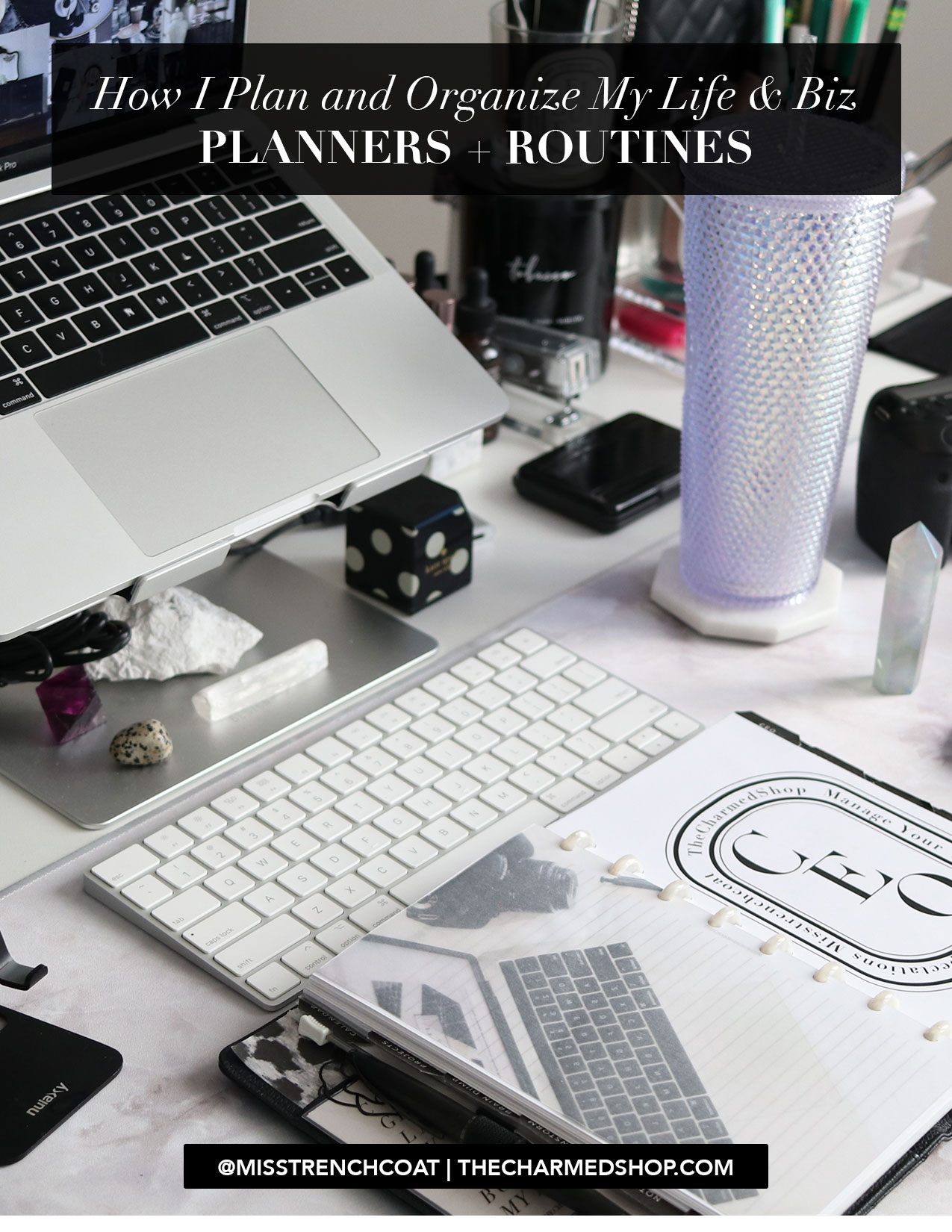
How I Plan and Organize My Life & Business | The Planners and Routines I use Each Year
Being productive and organized is something that takes consistency, like anything else you may want to find success at in life, you have to put systems in place and keep those systems up and running. Being a productive and organized person isn’t something that you set up once and you are done forever. However, the systems you use can be decided on once and then all you have to do is show up to do the regular maintenance routines and it can be as simple as that. So, today I thought it would be helpful if I shared not only the planner and planning tools I’m using to stay productive and organized, but also the functional planning routines and the process I take to plan and organize my life and business on a regular basis.
Part 1: Yearly Plan
The purpose of my yearly planning routine is to set the vision and direction for my year. You can’t create the life you want unless you know what that life is and make a plan to get there and that is the function of my yearly planning routine.
So, on an annual basis, in December, I take the following steps in my Yearly Planning Routine.
I set my goals for the new year
Break larger or longer term goals into milestones
Define objectives for precisely how I will achieve each goal and milestone and assign them to specific quarters and months of my year
Populate my planner with known tasks, events and due dates
The tools I use to complete my Yearly Planning routine are my You Got Goals Workshop and Planner that helps me identify and break down my goals. I also use the CEO Retreat Workshop and Workbook to set my specific business goals and define my business plans for the year in terms of what work I will be focused on each month of the year.
The Master Planner is the where I collect all relevant information for scheduling my time, and managing my tasks functionally.
The CEO Strategy Planner is a tool I use to supplement my main planner that gives me worksheets that help me create, outline and track business related information, but any tasks I define in that planner always get moved to the Master Planner. Yes, it’s a bit of duplication but it helps ensure I get individual tasks accomplished- so while I use the CEO Strategy Planner for working out my business plans and storing some important information, I need to integrate my business plans with the rest of my tasks and schedule in my Master Planner.
This process and these tools become the framework or outline for my plans for the year. Each subsequent step of my planning process is meant to fill out more specific details of plans and to prioritize tasks so my life is balanced and on track.
Part 2: Quarterly Plan
The purpose of my quarterly planning routine is to check my progress towards goals and create a 90 day plan of action to focus on. Many people get overwhelmed by their goals and plans because they try to make a plan to far in advance but in my functional planning system, I create more focused targets for 90 days at a time. 90 days or a quarter of planning at a time is often recognized as being a good amount of time to create more detailed plans for because its enough time to get a lot accomplished and to make adjustments to plans as you begin to take action.
So, on a quarterly basis, I take the following steps in my quarterly planning routine, and yes, this means that I am planning out Q1 not long after I set my goals because I need my 90 day plan in place before the quarter begins.
Check progress towards my goals and milestones (Q2-4)
Adjust plans as necessary to account for progress and obstacles
Generate my quarterly business plan
Populate action plans for objectives in the following quarter
Allocate tasks from project plans to monthly trackers and monthly master task lists
For my quarterly planning routine, I use my Charmed Life Master Planner and my CEO Strategy Planner to fill in the action plans and specific details of plans that I simply assigned to specific quarters or months of the year during my Yearly Planning Routine.
For example: During my Yearly Planning Routine, I may have decided I wanted to put together a launch for a product in a specific month, let’s say January. So, during my Q1 planning session, I would now take the time to create the plan for that launch and once I have the plan made, the tasks would be distributed to the monthly trackers inside the Charmed Life Master Planner for the month they belong to.
So, during our yearly planning we are deciding on things we want to do, and then during the Quarterly Planning session, we actually make the action plans and start assigning the tasks to the right months.
Part 3: Monthly Plan
The purpose of my monthly planning routine is to set reasonable expectations for accomplishing my objectives and tasks each month. Often times, people will overload their monthly to do list with things and then fail to get much of it accomplished because you put too much on your plate at one time. So, this monthly routine is meant to capture all the tasks that belong to the month but also to ensure their is enough time to get it all done.
So, on a monthly basis, I take the following steps in my monthly planning routine.
Brain dump to capture any additional new tasks that belong to my plans for the month
Populate my monthly calendar with important dates
Check the progress of project plans
Fill in my master monthly tasks list and make sure my monthly tracker is fully populated
Start assigning important projects and work to the specific weeks across the month
Something that has always set my functional planning process apart from other planning processes is that I use the month as the basic unit for task management. So, instead of having a long to do list with tasks that apply to various months of the year- I prefer a master monthly task list so as you are working day in and day out, you have a more reasonable to do list to work off of. Projects. systems and habits are also tracked on a monthly basis in my system and limited because when people make their plans for the month, I find they often overplan. They say they want to complete a whole list of projects, they want to start a whole list of new habits, they want to integrate all these new systems at once, but it’s too much and they fail. So, my Charmed Life Master Planner puts limits on how much you can plan for each month in order to help you self-edit and limit the plans you make each month. Because if you get overwhelmed, you will most likely fail to get everything done, and I’d prefer for you to at least get a reasonable amount of things done.
So, for my monthly routine, of course I use my Charmed Life Master Planner, and I will manage work for my business inside the CEO Strategy Planner, but again, any specific tasks are always moved into my master planner for actual scheduling to ensure the task gets done.
Part 4: Weekly Plan
The purpose of my weekly planning routine is to outline a schedule for accomplishing tasks and meeting expectations across the week. I love using the week as my basic unit for time management, similar to the way that I prefer to use the month as the basic unit for task management. We all get 24 hours in a day, but for most of us, 24 hours is just not enough time to plan to get the bulk of our tasks accomplished. Instead, by zooming out from the day to the week, we suddenly have 168 hours to use instead and a place in our week we can schedule in for nearly every priority and habit we want to complete.
So, on a weekly basis, I take the following steps in my weekly planning routine.
Get clear on the weeks objectives/priorities
Assign tasks, events and due dates across the week
Make a weekly to-do list
Ensure I have planned for self-care and other essential habits
Optional but impactful: Check with the important people in your life who have the ability to affect your plans and ensure you are on the same page with expectations.
When it comes to creating my weekly plan, this usually isn’t something I am doing from scratch each week. As part of my Charmed Life Master Planner, I keep my ideal weekly schedule laid out that becomes the template for me to organize my week by. My ideal weekly schedule is a default schedule I create at the start of the year that includes time blocks for priority tasks and habits. On it you will find time blocked off for meal planning, grocery shopping, meal prepping, cleaning, self-care, laundry, and other recurring activities in my week. The ideal weekly schedule also includes the plan for my themed workdays, which are time blocks I use to manage work for my business. So, using this default template, I already have a consistent plan for my week, and so on a weekly basis I just need to fill in specific projects, tasks and appointments that vary.
Part 5: Daily Plan
The purpose of my daily planning routine is to create a prioritized schedule and plan for tasks to accomplish each day. Once we get to the daily planning portion of this process, my tasks have been organized so I know what actions I need to take, my time has been allocated so can feel confident showing up each day knowing that the things on my to do list today are all I need to accomplish to move my plan forward, and so all that’s left for me to do is show up, trust the plan and take action.
So, on a daily basis, I take the following steps in my daily planning routine.
Review my ideal daily schedule plus any scheduled items for the day and my weekly to do list
Assign my top 3 daily tasks
Identify other tasks to worn on to fill my time for the day
Ensure I have white space in my schedule in case new urgent items or interruptions cause delays
When it comes to creating my daily plan, just as my weekly plan is not something built from scratch, neither is my daily routine. In my Charmed Life Master Planner I have an insert for my Ideal Daily Routine- which is the schedule break down for my time each day that includes time blocks for my morning routine, daily work blocks, meals, self-care and other daily non-negotiable tasks. So, that forms the outline for my day that remains consistent day over day, and then all I need to do is fill in my specific top 3 daily tasks for the day and populate a plan for my work blocks. Everything else in my day is part of a system, part of a routine that I show up for consistently and it makes managing my days so much easier because my routine becomes second nature for me. So, I will plan my days usually within my week on two pages agenda in my master planner, since I am using the digital master planner this year, it also has day on a page inserts as well, so if I need to map out a more detailed day, I have the space to do so, but usually working off my daily top 3, my ideal daily routine and my weekly to do list is all I need to stay on top of my tasks.
I will of course use my CEO Strategy Planner for reference if needed, but I don’t plan my day from my business planner, I plan it from my Master Planner.
WATCH: How I Plan and Organize My Life and Business in 2024
So, that is my complete functional planning routine that I perform on a yearly, quarterly, monthly, weekly and daily basis. I realize it may seem like a lot, but this is a complete functional planning system from start to finish, and over time as I’ve used this routine, it’s made planning and getting things done so much easier for me because things are almost formulaic for me. As long as I show up and do these planning routines, I know I’m set to take action fully knowing and trusting that what is on my to do list for a day truly is exactly what I need to do to build the life I want and create all the wonderful things I want to see in the world as part of my business.
Obviously, you know, I do a lot as a solo business owner who creates regular content across multiple platforms, who has multiple different offers and products that I market throughout the year and who hosts live classes and coaching multiple times per month, and this system is what helps me get it all done without working myself to the bone. You know I’m not afraid to hustle when I need to, but thanks to this system, my days are usually very relaxed, I miss very few tasks or obligations in the year, and I make the time for so many lovely things in my life from personal self-care to spending time with friends and family and my own interests and hobbies offline.
So, if the way I manage my life sounds good to you, if you would also like to live your life more intentionally and more balanced, I welcome you to pick up some of my tools, my planners, my Goal Setting classes or even enroll in my Charmed Life Master Mind and spend a year inside my world getting classes, coaching and ready made resources to help you live your version of a Charmed Life as well.
Everything has been linked within this post, and if you have any questions, leave me a comment or feel free to email me, and I’d love to help you discover my products and decide how best you can work with me moving forward into this new year so you can experience a new level of productivity, success and enjoyment from you life!
xoxo,
Alexis Giostra @MissTrenchcoat, Founder of Strange & Charmed
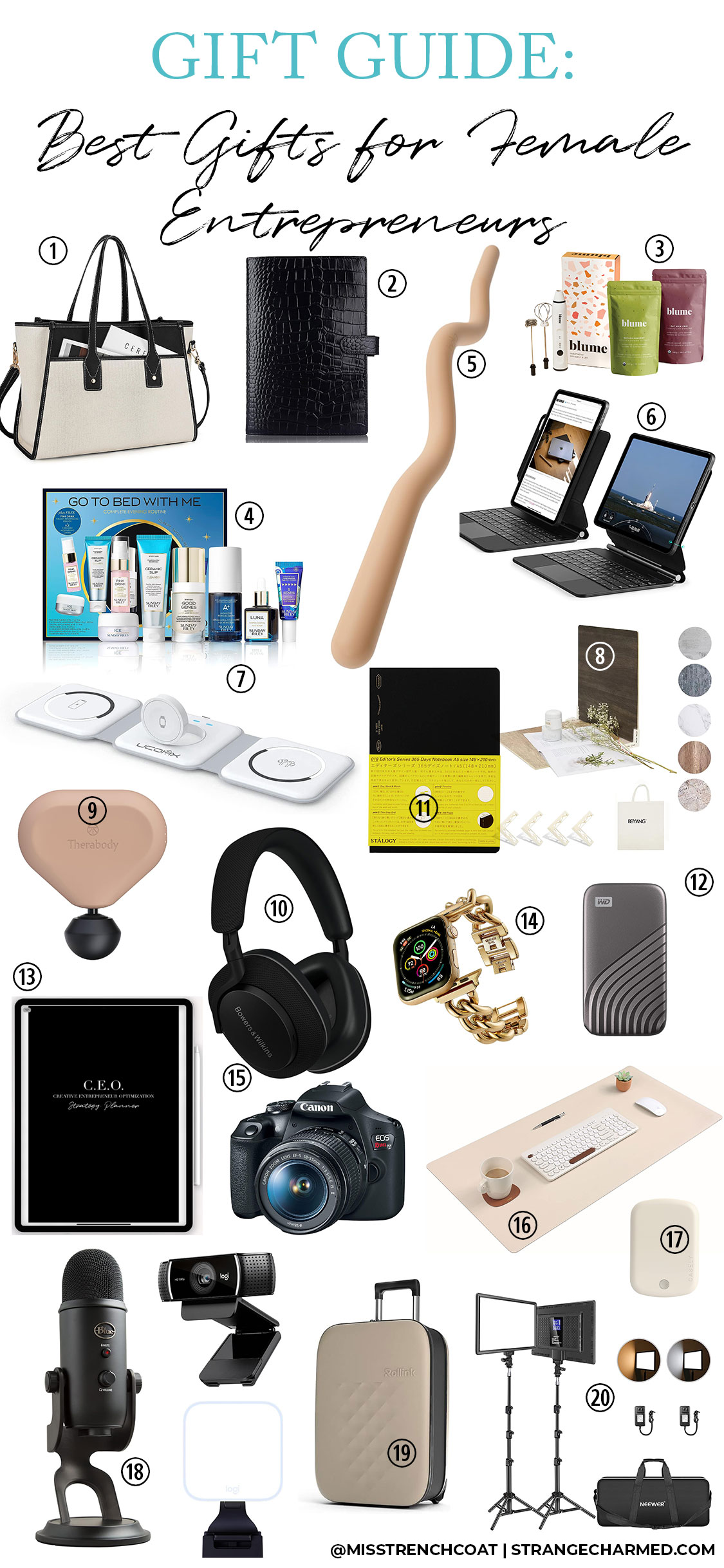
‘Tis the season to celebrate the female entrepreneurs who inspire us with their passion and dedication. Show your appreciation with these thoughtful and practical gifts:
1. Canvas Laptop Bag: A stylish and functional bag for her on-the-go workdays.
Make her holiday season brighter with these carefully curated gifts tailored to her entrepreneurial spirit.
Happy gifting!
Founder, Strange & Charmed 🌟
P.S. If you’re looking for more support in living your best, most organized and successful life, consider joining my inner circle private group coaching community called The Charmed Life Master Mind. Each month we meet for live classes, Q+As and monthly planning sessions, plus you have access to an on-demand resource library with dozens of classes, workbooks, planner inserts and other tools to help you craft the life you want to live. Click here to learn more and enroll today for instant access to all my best content and tools!
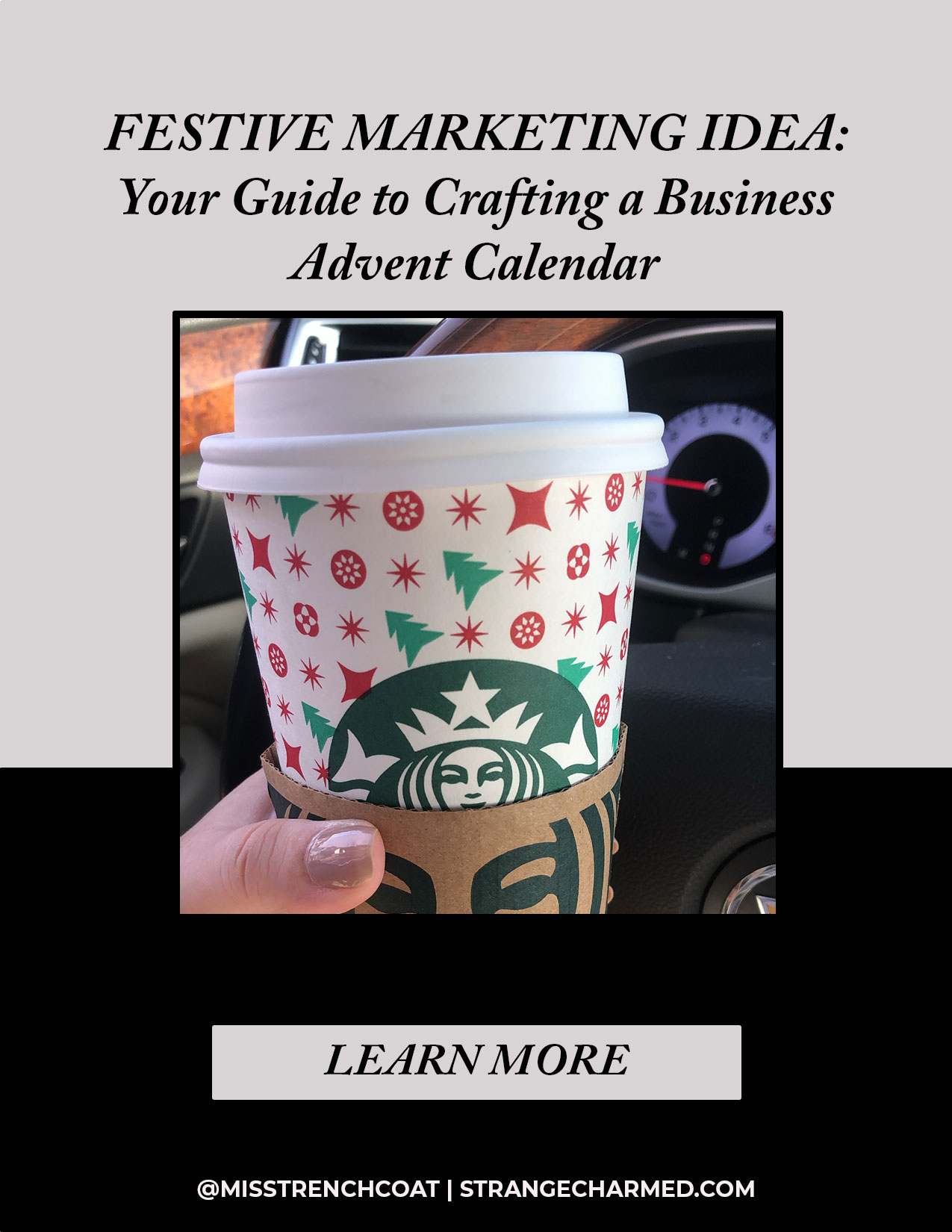
Festive Marketing Idea: Your Guide to Crafting a Business Advent Calendar
The holiday season is not only a time for spreading joy but also a fantastic opportunity for businesses to connect with their audience in creative and meaningful ways. One delightful marketing strategy that has captured the hearts of both businesses and customers alike is the Advent Calendar. Traditionally used to count down the days until Christmas, businesses have ingeniously adapted this concept into a powerful marketing tool.
Unwrapping the Concept: What’s a Business Advent Calendar?
A Business Advent Calendar is a marketing strategy that involves offering daily treats, deals, or content to your audience during the holiday season. It’s not just a countdown; it’s an experience. Whether you’re selling products or aiming to boost engagement on your online platforms, an advent calendar adds a touch of excitement and anticipation, creating a buzz around your brand.
Crafting Your Business Advent Calendar: A Step-by-Step Guide
1. Define Your Goals:
Determine what you want to achieve with your advent calendar. Is it to boost sales, increase website traffic, or enhance social media engagement? Clear goals will guide your content and offers.
2. Choose Your Format:
Decide if you want to offer daily discounts, special product launches, exclusive content, or a mix of these. Tailor the format to your audience’s preferences and your business objectives.
3. Plan Your Content:
Create a content calendar mapping out what you’ll offer each day. For product-based businesses, feature your best-selling items. For content creators, consider exclusive tutorials, behind-the-scenes content, or engaging challenges.
4. Build Anticipation:
Promote your advent calendar in advance. Tease your audience with glimpses of what’s to come. Utilize social media, email marketing, and your website to create anticipation.
5. Engage Your Audience:
Encourage active participation. Run contests, ask questions, and encourage users to share their experiences with your calendar. User-generated content can amplify your reach.
6. Deliver a Memorable Experience:
Ensure that each daily offering provides value. Whether it’s a discount code, a freebie, or exclusive content, make every interaction memorable to leave a lasting impression.
7. Analyze and Adapt:
Track the performance of your advent calendar. Analyze data such as website traffic, engagement rates, and sales. Use these insights to refine your future marketing strategies.
Advent Calendar Ideas for Businesses:
1. Daily Discounts: Offer unique discounts on popular products each day.
2. Limited Edition Products: Introduce exclusive products available only during the advent period.
3. Interactive Challenges: Engage your audience with daily challenges or quizzes.
4. Behind-the-Scenes: Share behind-the-scenes glimpses of your business or personal celebrations
5. Collaborations: Partner with influencers or other businesses for joint promotions.
A Business Advent Calendar is not just a marketing strategy; it’s an opportunity to create a memorable experience for your audience. By adding a touch of holiday magic to your marketing efforts, you’re not only boosting sales but also fostering a sense of community and excitement around your brand.
So, as the festive season approaches, consider unwrapping the potential of an advent calendar for your business. Craft it with care, engage your audience with enthusiasm, and watch as the spirit of the season transforms your marketing efforts into something truly magical.
Get a Strategic Business Planner
Running a small business is a lot! It requires a cohesive strategy for time, task and business management if you want to be successful at it. Which is why tackling and managing all this work with a simple to do list or basic planner just doesn’t cut it.
If you have a hard time deciding what to work on for your business, feel like you’re always behind on tasks and projects, constantly dealing with emergencies and have no clue if what you are spending time on is actually growing your business… You need a better business planning system.
And I don’t just mean your business plan itself.
Sure that’s wonderful to have, but your business plan is the overall structure for the direction of your business- it’s not the strategic plan for you to follow everyday to reach your business goals.
Imagine getting to work each day with a clear plan of action, prioritized tasks, ideas organized at your finger tips, and feeling confident that the work you complete is positively impacting your business growth.
If you are ready to trade overwhelm for clarity, disorganization for structure, and hustle for strategy, I have precisely the tool you need to successfully manage and grow your business!
The CEO Strategy Planner is the Ultimate Business Planning Tool to Help You Organize, Plan and Execute on Your Business Vision. Get your ideas out of your head, onto paper, and get down to business with the CEO Strategy Planner!Click here to purchase your copy now!
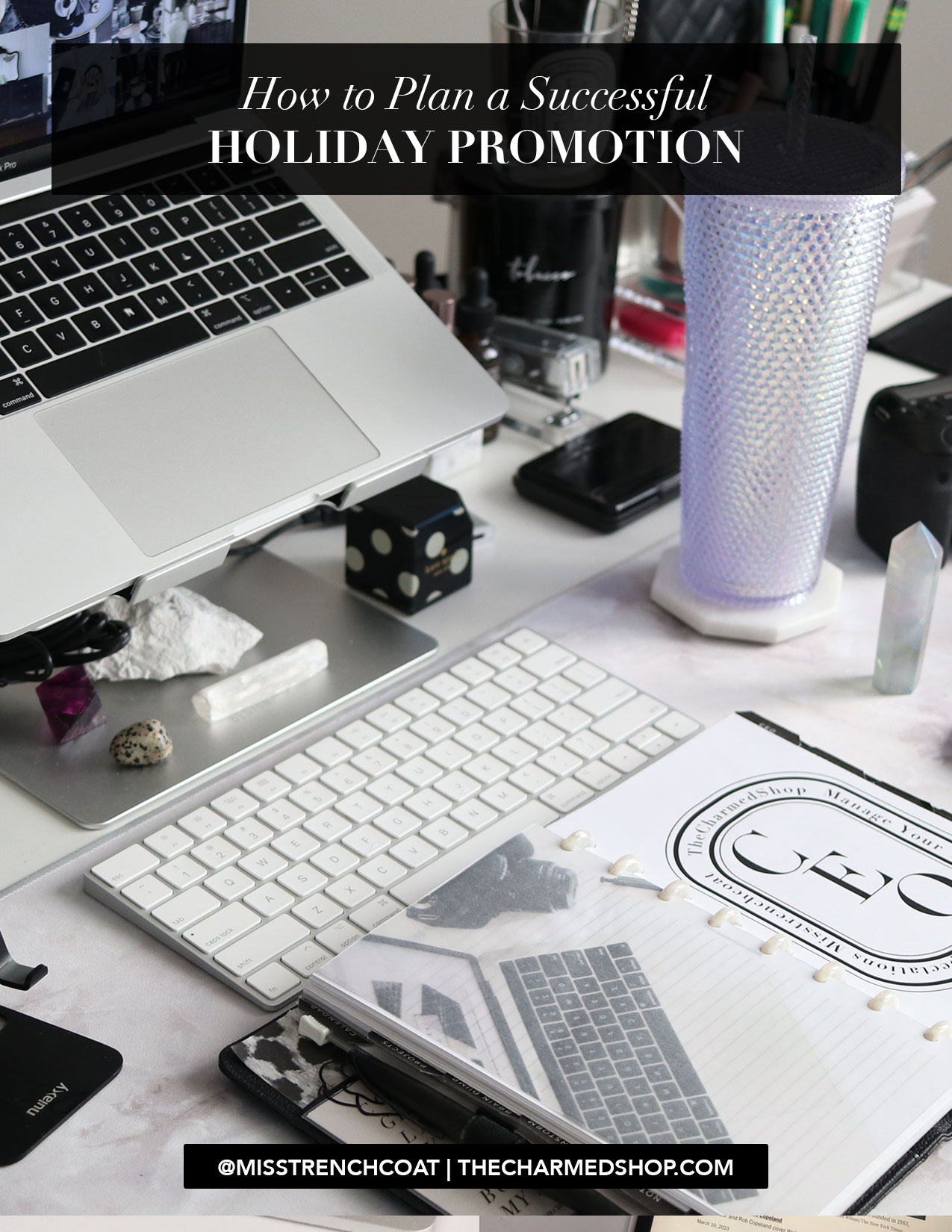
How to Create a Successful Holiday Promotion for Your Business
With the holiday season quickly approaching, now is the perfect time to quickly arrange for a holiday promotion for your business. The Thanksgiving to Christmas time period tends to be an extremely profitable season for online shops and businesses, with many retailers seeing exponential sales and traffic in this time with the aid of some well planned and executed holiday sales.
Now, if you have never planned out a holiday promotion, or have yet to do so this season, I’m here to tell you that the process is much easier than you think and doesn’t have to involve complicated marketing planning or lots of time and effort. You do still have plenty of time to pull off a successful holiday promotion without stress or extra long work days, but you do need to act fast to get your plan in place to maximize sales before Black Friday kicks off in a few weeks! In order to help make this process even more streamlined for you, I have also created a free DIY Holiday Promotion Planning Guide that you can use to plan and keep track of your promotion. CLICK HERE to get the FREE Guide and get started today!
Step # 1: Decide the logistics of your promotion
There are many types of promotions and sales specials you can run during the holiday season to drum up excitement for your business and increase traffic and check totals in your shop. You can do something as simple as create a special coupon code for a percentage off items in your shop, you can put together bundles of popular products that coordinate, or simply discount your best sellers. You can make your sale as simple or complicated as you’d like and do one or more of these things, but decide what works for you and your business and of course, plan out how long you want these promotions to last. I’d highly suggest running a sale on Black Friday at the very least. Personally, this year I plan to create some limited time only bundles, provide a coupon code to VIPs on my email list and social media followers, and I also plan to host a giveaway to entice sales during my promotion which will last 3 days from Black Friday to Sunday. If you don’t want to discount your products due to product constraints, you can also create non-sale promotions that include either a giveaway wherein customers during the time frame are opted in to win a prize. You can offer a digital freebie to drive traffic to your shop or even give a free gift with purchase. Think about what will work for your sales goals and business and outline the details of your promotion asap!
Step #2: Shoot your promotional images
If you run an online business, you know how important great product and styled shots are to driving sales. Once you know the parameters of your promotion, you can arrange for a quick photoshoot and get all your images ready for your shop, social media and any ads you may run. If you don’t feel confident in your photography skills or need help understanding how to take great photos that sell, definitely check out my Charmed Digital Styling Lightroom Photography Course. It’s a video module based course with 3.5 hours of content that you can watch while taking notes and arranging your own photos. In the course I teach you everything you need to know to quickly get your styled photography under control and streamlined to make shooting promotional images a breeze! I’d highly recommend taking the course if you need great photos for your holiday promotions, it will save you time and money in the short term if you are someone who pays for stock photos, and the course even includes photoshop tutorials that will teach you how to create promotional sales graphics and advertisements as well!
Step #3: Start spreading the news
Once you have your promotion planned and your images are ready to go, you can start sharing the news of your promotion through your various communication methods and continue to do so through the duration of your sale. I’d suggest starting to actively promote your holiday sale anywhere from 2-4 days before it begins using any and all methods you use to communicate with your customers. If you have an email list, you will want to send a list to your email a few days before the sale starts and give some previews of the sales to come, and if you use social media or YouTube, make sure you tell your audience in these locations as well. If you use any methods of advertising, you also want to get those set to go for about three days out from the sale to drum up excitement and provide a call to action to get new potential customers onto your list. Finally, if you have an affiliate program or even a network of friends who can help you spread the word, make sure you coordinate with them on promotional messages and details that they can share with their audience as well. It’s the holiday’s after all, so the more the merrier when it comes to cross promoting sales and specials!
That’s it! Three easy steps to a stress free and profitable holiday promotion. You still have time to get your promo planned and off the ground and I’d highly suggest planning something rather than nothing because failing to promote during the holidays means you are leaving a lot of money on the table. Make sure to grab my free DIY Promotion Planning Guide to help keep you on track!
Get a Strategic Business Planner
Running a small business is a lot! It requires a cohesive strategy for time, task and business management if you want to be successful at it. Which is why tackling and managing all this work with a simple to do list or basic planner just doesn’t cut it.
If you have a hard time deciding what to work on for your business, feel like you’re always behind on tasks and projects, constantly dealing with emergencies and have no clue if what you are spending time on is actually growing your business… You need a better business planning system.
And I don’t just mean your business plan itself.
Sure that’s wonderful to have, but your business plan is the overall structure for the direction of your business- it’s not the strategic plan for you to follow everyday to reach your business goals.
Imagine getting to work each day with a clear plan of action, prioritized tasks, ideas organized at your finger tips, and feeling confident that the work you complete is positively impacting your business growth.
If you are ready to trade overwhelm for clarity, disorganization for structure, and hustle for strategy, I have precisely the tool you need to successfully manage and grow your business!
The CEO Strategy Planner is the Ultimate Business Planning Tool to Help You Organize, Plan and Execute on Your Business Vision. Get your ideas out of your head, onto paper, and get down to business with the CEO Strategy Planner!Click here to purchase your copy now!
Wishing you a productive, successful week and holiday season ahead!