
Goal Getter

From Chaos to Clarity: How to Structure Your Goals for the Rest of the Year

As the days grow shorter and the air turns crisp, we enter one of the most pivotal moments of the year: the beginning of fall and the final stretch of the calendar. Q4 has a unique energy. On one hand, it’s full of opportunities—the chance to finally make progress on those lingering goals, to wrap up the year with momentum, to feel proud of what you’ve accomplished. On the other hand, it’s often when overwhelm peaks. Work deadlines pile up, family commitments multiply, and the holidays quickly fill our schedules.

It’s in this season that many of us start asking the same questions: Where did the year go? How will I get it all done? Is there even enough time left?

Here’s the truth: clarity doesn’t come from overthinking your goals or trying to push harder. Clarity comes from structure. When you take your priorities out of your head and give them a system, you instantly reduce overwhelm and gain direction.

That’s exactly what we’ll focus on today—how to transform the chaos of your to-do list into a clear, structured plan for the rest of the year. By the end of this post, you’ll know exactly how to identify your true priorities, map them into achievable goals, and create the routines that will carry you confidently through Q4.


Why Clarity Feels Hard to Find in Q4

If you’ve ever reached September and felt like the year slipped away from you, you’re not alone. Q4 is notorious for creating confusion and overwhelm.

The final months of the year bring a perfect storm of competing priorities: end-of-year deadlines at work, holiday commitments with family, personal goals you still want to achieve, and the never-ending stream of daily responsibilities. Suddenly, it feels like everything is important, everything is urgent, and there’s simply not enough time.

This is where many women get stuck. You have the desire to finish the year strong, but your goals feel scattered. You may even catch yourself falling into the trap of overthinking—replaying ideas in your head, debating what deserves your attention, and waiting for clarity to magically appear.

But here’s the hard truth: clarity doesn’t come from thinking harder. It doesn’t arrive in a burst of motivation or a sudden spark of inspiration. Clarity comes from structure.

When you take the chaos of your thoughts, tasks, and desires and organize them into a clear framework, the overwhelm lifts. Instead of juggling vague hopes, you have a structured system that tells you: Here’s what matters. Here’s what you’re focusing on this month, this week, and this day.

That’s why creating structure in Q4 isn’t just helpful—it’s essential. Without it, you’ll drift through the season in reaction mode. With it, you’ll end the year with direction, progress, and a sense of calm confidence.


The Goal Setting System That Brings Clarity
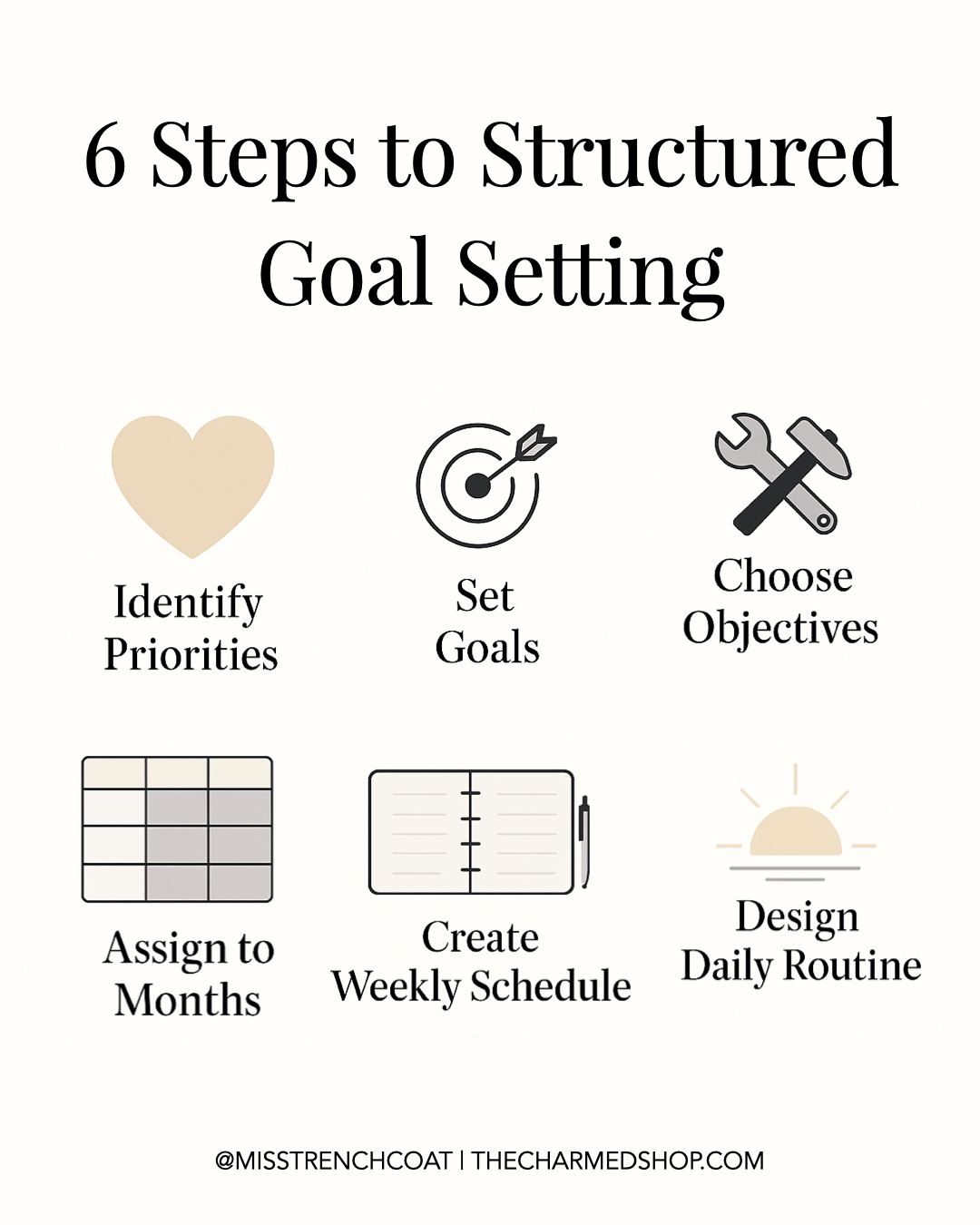
If you want to end the year feeling clear and confident, you can’t just “hope” your goals will come together. You need a structure that translates your big-picture vision into daily, doable actions. That’s exactly what my Goal Setting System is designed to do.

This six-step process takes you from scattered thoughts to a structured roadmap you can actually follow through on.

Step 1: Identify Your 1–5 Priorities

Clarity begins with knowing what matters most. Instead of vague categories like health or career, get specific. Think about the actual people, places, or institutions that deserve your energy right now. Examples:

  • Family
  • Business
  • Home
  • Personal development
  • Finances

👉 Ask yourself: “If I only made progress in a few areas over the next 90 days, what would they be?”

Step 2: Set 1–3 Goals for Each Priority

Once you know your priorities, define what success will look like in each by the end of the year. Keep these goals specific and realistic for the short timeline of Q4.

  • Example: For Business, your goal might be “Complete my website redesign.”
  • Example: For Health, your goal might be “Walk 5,000 steps a day.”

👉 The key is to set no more than 1–3 goals per priority so you don’t stretch yourself too thin.

Step 3: Brainstorm Objectives (The How)

Goals are great, but without a plan, they remain wishes. This step is about breaking each goal down into actionable objectives:

  • Projects → multi-step outcomes with a clear finish line (ex: “Plan holiday content calendar”).
  • Systems → repeatable processes that support progress (ex: “Batch cook lunches every Sunday”).
  • Habits → single actions you repeat consistently (ex: “Read 10 pages before bed”).

👉 Ask: “What projects, systems, or habits will move this goal forward?”

Step 4: Assign 3 Objectives Per Month (October, November, December)

Now it’s time to make your plan realistic by spreading objectives across Q4. Choose three per month, max. This forces you to focus and prevents overwhelm.

  • October: Start strong by launching a system or habit.
  • November: Push forward with a big project.
  • December: Wrap up and review progress.

👉 Think of this as your “90-day game plan” broken into monthly chapters.

Step 5: Create a Default Weekly Schedule

Clarity also comes from knowing when things will get done. A default weekly schedule is your foundation—it makes sure you always have time blocked for your objectives.

  • Example: Mondays = planning + admin, Tuesdays = deep work, Fridays = financial review.
  • Protect time for both work and rest so your goals don’t compete with your energy.

👉 When your week has structure, you no longer wonder where the time will come from—you’ve already made space for progress.

Step 6: Design Your Ideal Daily Routine

Finally, anchor your habits into daily life. What does a day look like when it fully supports your priorities?

  • Example: Morning journaling, daily Top 3, evening reflection.
  • Include small, consistent actions that compound into big results by the end of Q4.

👉 Your routines are the glue that keeps your goals from slipping through the cracks.

✨ When you follow this six-step system, you stop relying on motivation and start relying on structure. Your goals aren’t just intentions anymore—they’re mapped into your months, weeks, and days. That’s where clarity comes from.


Why This System Works

There’s a reason so many people set goals in January and feel lost by September—it’s not because they aren’t motivated or disciplined enough. It’s because their goals were never given a clear structure.

When you build structure around your goals, three powerful things happen:

1. You Reduce Overwhelm

Instead of staring at a vague, endless list of “things I should do,” you’ve narrowed your focus to just a few meaningful priorities. You know where your energy belongs—and where it doesn’t.

2. You Gain Focus

By breaking goals into objectives, and assigning those objectives to specific months, weeks, and days, you always know exactly what to work on next. No more decision fatigue. No more spinning your wheels.

3. You Create Consistency

Structure turns one-time intentions into repeatable actions. With your weekly schedule and daily routines in place, progress stops being random—it becomes inevitable.

4. You Protect Your Energy

Because this system includes white space, rest, and realistic pacing, it supports you instead of draining you. Structure creates sustainability, and sustainability creates long-term success.

Clarity isn’t something you stumble into—it’s the natural outcome of building the right framework. When you know your priorities, have a clear roadmap, and protect the time to execute it, you no longer waste energy on wondering if you’re doing enough. You already know you’re on the right path.

That’s why this system works: it transforms the chaos of “too many goals, not enough time” into a clear plan that will carry you through the end of the year with confidence and calm.


How to Put This Into Action for Q4

Right now, you’re standing at the threshold of the final 90 days of the year. It can feel daunting—like there’s not enough time left to make meaningful progress. But here’s the truth: there is plenty of time to create momentum, as long as you have a structure guiding you.

Start small. This week, choose just 1–2 priorities and walk them through the six steps of the Goal Setting System:

  • Define your priority.
  • Set 1–3 clear goals.
  • Break them down into objectives.
  • Assign those objectives to October, November, and December.
  • Block time in your week.
  • Anchor habits into your daily routine.

Even if you stop there, you’ll feel an immediate shift—from chaos to clarity, from overwhelm to direction.

But imagine what would happen if you didn’t have to do this alone. Imagine sitting down with me to walk through the system together, step by step, so you leave with a Q4 plan you can trust.

That’s exactly what I’ll be teaching inside the Q4 Crescendo Workshop.

On Saturday, September 13th at 12pm EDT, I’m hosting a free live training where I’ll guide you through structuring your priorities, mapping your goals, and creating a personalized plan to carry you through the rest of the year with confidence.

✨ If you want clarity, this is where it starts.

👉 [Sign up for the Q4 Crescendo Workshop here]


The final months of the year don’t have to feel like a race you’re barely keeping up with. When you give your goals a clear structure—when you know your priorities, map your objectives, and create space in your weeks and days to bring them to life—you trade chaos for clarity.

Clarity doesn’t come from thinking harder or doing more. It comes from structure. And once you have that structure, every step you take has purpose.

This Q4 can be the season you finish strong, not by chance, but by design.

✨ Don’t wait for clarity to find you—create it. Join me in the Q4 Crescendo Workshop and let’s build your plan together.

👉 [Sign up here to reserve your spot]

xoxo,

5 Ways a Functional Planning System Heals Your Nervous System (and Makes You More Productive)

When most people think of self-care, they imagine bubble baths and face masks. But true self-care—transformative self-care—starts with nervous system regulation. If you often feel overwhelmed, scattered, or stuck when trying to tackle your to-do list, your sympathetic nervous system may be in overdrive.

The sympathetic nervous system is the part of your body’s stress response system designed to help you survive danger. But in modern life, it’s often misfiring in response to everyday responsibilities. This system triggers one of five trauma responses: Fight, Flight, Freeze, Faint, and Fawn. Each of these reactions can derail your productivity:

  • Fight makes you over-prepare, micromanage, and feel frustrated when things don’t go perfectly.
  • Flight leads to avoidance, procrastination, and jumping from one task to another.
  • Freeze keeps you stuck, unable to start anything because your brain feels foggy or overwhelmed.
  • Faint (also called shutdown) causes exhaustion, disconnection, or a desire to disappear from your responsibilities.
  • Fawn turns into people-pleasing, overcommitting, and abandoning your own priorities.

When your nervous system is reacting instead of regulating, even simple tasks can feel like climbing a mountain.

But here’s the good news: a functional planning system can prevent these responses from hijacking your progress.By helping you clarify your goals, structure your schedule, and focus your attention, a good planner works like a nervous system support tool—keeping you calm, clear-headed, and in control.

In this post, we’ll break down how a functional planner and smart systems (like those found in the Charmed Life Master Planner) directly counteract each of the five nervous system reactions—so you can stay centered, take aligned action, and finally get your to-do list from to-do to done.

1. FIGHT: Calm the Need to Push or Control with Structured Objectives

When your nervous system is in fight mode, you’re operating under the belief that more effort equals more results. You might feel irritable, easily triggered, or hyper-focused on controlling every detail of your day. It’s a stress response that masquerades as productivity—but often leads to burnout, perfectionism, and micromanagement.

A functional planning system helps you channel that drive into structure, not chaos.

The Charmed Life Master Planner includes areas for Weekly Objectives on the daily and weekly agenda pages, where you identify your top 1–3 objectives for the week and break them into actionable steps. This step helps you:

  • Prioritize progress over perfection
  • Focus your energy on what actually matters
  • Reduce anxiety by making outcomes feel achievable and planned

Instead of reacting with force, you’re guided by clarity. You’re no longer driven by stress—you’re led by strategy.

Why it works: Creating clear weekly objectives tells your nervous system, “I’ve got a plan.” This quiets the fight response and replaces the urgency to control with a calm, confident roadmap.

2. FLIGHT: Ease the Urge to Run or Avoid with Strategic Allocation

When your nervous system shifts into flight mode, it’s not that you don’t care—it’s that the overwhelm is so intense, your instinct is to escape. This looks like procrastinating, over-researching, constantly rearranging your to-do list, or bouncing between tasks without finishing anything. You feel like you’re running, but you’re not getting anywhere.

A functional planner meets this reaction with structure that grounds and guides you.

In the Charmed Life Master Planner, the Weekly Planning Spread and Daily Top 3 system are designed to combat this exact pattern. Here’s how:

  • Weekly Planning Spreads allow you to see your entire week at a glance, so you stop reacting and start anticipating.
  • The Daily Top 3 narrows your focus to just three high-priority tasks, removing the anxiety of a never-ending list.

Instead of “I don’t know where to start,” you begin your day with “I know exactly what to do.”

Why it works: Allocating your tasks to specific days and focusing on a manageable few helps your brain feel safe. Your nervous system sees structure instead of chaos, which calms the urge to run and replaces it with purposeful motion.

3. FREEZE: Thaw Paralysis with Prioritized Capture and Processing

When your nervous system enters freeze mode, everything feels too much. Your thoughts are jumbled, your list is overwhelming, and you’re not sure what even matters anymore—so you do nothing. You might find yourself staring at your planner or scrolling endlessly to avoid making decisions.

This is where functional planning becomes your lifeline.

The Brain Dump system in the Charmed Life Master Planner is designed to gently thaw the freeze response by helping you:

  • Capture everything swirling in your head—tasks, ideas, worries—into one clean inbox
  • Label each item by urgency and importance, separating the noise from what truly matters
  • Cross off or defer what’s not relevant, so your mind isn’t carrying unnecessary mental clutter

This process turns a tangled web of thoughts into an organized, prioritized list of next steps.

Why it works: When your brain sees a clear plan of action, it stops shutting down. The planner acts like a warm hand on your shoulder, reminding you: You don’t have to do everything right now. You just need to take the next right step.

4. FAINT: Rebuild Energy with Gentle Routines and Predictable Structure

The faint response—also known as shutdown—is when your nervous system gets so overwhelmed it simply powers down. You might feel exhausted, detached, hopeless, or unable to care. Even simple tasks feel like too much. This isn’t laziness—it’s a biological response to burnout.

Functional planning offers a gentle structure to restart your system without adding pressure.

The Charmed Life Master Planner includes simple, supportive routines designed to bring you back online at your own pace:

  • The My Ideal Daily Routine insert organizes those small, repeatable rituals to anchor your day and stabilize your energy.
  • Even 5 minutes with your planner in the morning can reconnect you to your intentions and give your day a starting point.
  • Planning even one small action—like prepping clothes or scheduling a walk—helps rebuild confidence and agency.

This isn’t about productivity for productivity’s sake. It’s about restoring the rhythm that helps you feel like you again.

Why it works: Gentle routines tell your nervous system: It’s safe to try again. Over time, these small actions become energy-giving rather than energy-draining—and your motivation naturally returns.

5. FAWN: Break People-Pleasing Patterns with Boundaried Planning

The fawn response is when your nervous system tries to stay safe by keeping everyone else happy. You say yes too often, overextend yourself, and end up abandoning your own goals to meet others’ expectations. Your time gets hijacked, and your to-do list is filled with things that aren’t even yours.

Functional planning gives you permission and structure to protect your energy.

In the Charmed Life Master Planner, two key tools are designed to support you in setting healthy boundaries:

  • The Ideal Weekly Schedule helps you block time for what matters to you—your goals, rest, routines, and self-care.
  • The Monthly Habit Trackers give you visual accountability for how often you’re showing up for yourself, not just others.

By pre-planning your time and tracking your habits, you create a schedule that reflects your values—not someone else’s agenda.

Why it works: When your week is already planned and your routines are visible, it becomes easier to say “no” without guilt. Your planner becomes your boundary. Your nervous system feels safe because you’re no longer overexposed—you’re protected by a plan.

From Dysregulated to Deeply Productive

Your productivity isn’t just about tools or time—it’s about how safe and supported your nervous system feels in the process.

When you’re stuck in fight, flight, freeze, faint, or fawn, even the best intentions can stall. But with a functional planning system, you gain more than organization—you gain nervous system regulation. You move through your week with clarity, focus, and a deep sense of calm. You stop reacting and start responding—with aligned action and steady progress.

If you’re ready to get your tasks from to-do to done—without the stress spiral—the Charmed Life Master Planner is here to support you.

🧠 Use code MASTERPLAN2026 at checkout to get 25% off your planner and start building the elegant, energized life you deserve.

Because planning isn’t just about getting things done—it’s about creating a life where you feel safe, seen, and supported every step of the way.

xoxo,

3 Things You Actually Need to Turn Your Year Around in Just 6 Months

You’re Not Behind — You’re at the Turning Point

It’s July. You might feel behind, overwhelmed, or like the year has slipped through your fingers. Maybe you had big goals in January that somehow got buried under the weight of daily life. Maybe you’ve been stuck in survival mode, or chasing your tail with no real traction. If that’s you, take a deep breath — and know that you’re not alone.

Here’s the truth: you’re not behind. You’re simply at the turning point.

The second half of the year isn’t about catching up — it’s about choosing a new path forward. One with clarity. One with strategy. One with the kind of support that keeps you moving when motivation fades.

Because in just six months, your entire life can look different.

You can build a routine that supports your wellbeing. You can finally make progress on that goal that’s been lingering in the back of your mind. You can wake up in December feeling proud, grounded, and clear — instead of exhausted and regretful.

Real change doesn’t require a miracle.
It requires a plan.

Why 6 Months of Focus Works

Six months might not sound like much — but it’s more than enough to completely change your life when you show up with intention.

In fact, science supports this. Studies show it takes an average of 66 days to build a new habit — not a lifetime, not a year, but just over two months of consistent, focused effort. And thanks to neuroplasticity, your brain is wired to change — to build new pathways, reframe old patterns, and adopt more empowering behaviors, especially when reinforced with repetition and structure.

In six months, you can:

  • Build a solid foundation for your business
  • Establish a healthier lifestyle and sustainable wellness routines
  • Get your finances in order and begin building real security
  • Design and stick to a daily schedule that prioritizes what matters most
  • Reconnect with your purpose — and begin acting on it

And I’ve seen it happen firsthand.

One master mind member, Veronica, had been thinking about launching her first in-person retreat for her business — but she wasn’t sure she could actually implement it. During one of our group coaching calls, we talked through her vision, and she realized she’d been overthinking and overcomplicating the entire idea. Once she had clarity on a simple, actionable way to bring it to life, she moved quickly — and had sign-ups almost immediately.

That’s the power of focused momentum.

With the right plan and support, 6 months is more than enough to change your life.

You don’t need more time — you need to use the time you already have differently. That shift starts with how you plan it.

KEY 1: Structure → The Right Planner

Trying to change your life without structure is like trying to build a house with no foundation. You start, stop, and scramble — chasing scattered to-do lists, missing appointments, losing momentum. Days blur together. Time leaks. Goals slip through the cracks.

That’s where the Charmed Life Master Planner comes in.

This planner isn’t just a calendar — it’s a complete planning system designed to help you hold the vision, stay focused, and simplify your life. Whether you’re mapping out your week, time blocking your days, tracking habits, or setting meaningful goals, this is the tool that keeps it all aligned.

Another member, Jennifer, shared that after struggling for years to keep up with her classes, she changed her planning systems using the Master Planner — and it made all the difference. For the first time, she was able to take on a full course load, pass her classes, and raise her GPA.

This planner isn’t a notebook. It’s your foundation — a clear, flexible structure to carry your goals from idea to reality.

🔗 [Link to planner]

KEY 2: Strategy → The Right System

Most women don’t fall off track because they’re lazy — they fall off because they don’t have a system. They don’t know how to break down their goals, how to stay on course, or how to recover when life gets messy.

That’s why I created the Charmed Life Master Mind — a guided path that gives you step-by-step planning support, with live accountability and coaching throughout the month.

Inside, you’ll find planning calls, monthly masterclasses, goal review sessions, and an ever-growing library of tools to help you stay on track — not just for a week, but for the long game.

One member, Luisa, had long struggled with the disconnect between what she knew she needed to do to stay on track — and actually doing it. But after joining the Master Mind, the structure and accountability of the live calls helped her finally implement the systems that work for her. With that consistent support in place, she followed through on one of her biggest dreams: she wrote and self-published her first book on Amazon this year.

You don’t have to figure everything out on your own anymore. We’ll take it one week, one plan, one quarter at a time — together.

You don’t need to DIY your growth anymore. Inside the Master Mind, I’ll guide you through each month, each quarter — step-by-step. All you have to do is show up.

🔗 [Link to Master Mind]

KEY 3: Support → The Right Mentorship

Sometimes you know you’re meant for more — but the how keeps getting in the way. You start, stop, overthink, research, and scroll… but never quite move forward. Not because you’re not capable, but because the path feels too unclear — or too complicated to follow alone.

That’s where The Well Planned and Productive Woman Private Coaching comes in.

This is high-touch, personalized support for the woman who’s ready to move from spinning to streamlined — fast. Sometimes, you don’t need another course or more time. You need clarity, strategy, and someone to walk you through a plan that works for your life.

One of my private clients, Ximena, had been trying to start her own business for years. She dreamed of writing and inspiring others, but found herself stuck — overwhelmed by the pressure to keep up with a blog, Instagram, an email list, and everything else that comes with being visible online. She wasn’t even sure what she was going to sell, and the constant research and indecision kept her from taking action.

After a private coaching session, we mapped out a simple and strategic plan: she’d launch a Substack newsletter to serve as both her blog and email platform, and repurpose that content onto Instagram with ease. This streamlined her entire content strategy, solved her time and task overwhelm, and gave her a clear path forward to start earning income.

She didn’t need a year — or even six months. She just needed clarity and support. And within a few weeks, her new platform was up and running.

If you’re ready to go deeper — to move quickly and powerfully toward the life you’ve imagined — this is for you. You bring the vision. I’ll help you make it real.

🔗 [Link to coaching]

Your Mid-Year Reset Plan

So now that you know change is possible — and that structure, strategy, and support are the keys — let’s talk about how to actually reset your year from where you are right now.

You don’t need to wait for January. You don’t need to overhaul your entire life. You just need to pause with intention and create a new plan for how you want to move through the rest of the year.

Here’s a simple 5-step Mid-Year Reset Ritual you can do this week:

1. Reflect: What’s worked so far?

Take stock of the first half of the year. What routines, decisions, or habits made you feel like your best self? What moved you forward — even a little? Keep those.

2. Release: What’s no longer serving you?

Let go of what isn’t working — outdated goals, draining commitments, overcomplicated routines. Simplify. Create space.

3. Recommit: What actually matters to you right now?

Choose 1–3 key focus areas for the rest of the year. These could be personal, professional, wellness-based — anything that feels aligned and meaningful.

4. Restructure: Design a weekly routine that supports your goals

Create a sustainable structure that reflects your real life. Block time for what matters most. Build in rest. Protect your energy. If you need a tool to help you build this out, the Charmed Life Master Planner is designed for exactly this.

5. Receive: Say yes to the support that will carry you forward

Decide: What kind of support do you need in this season?

  • Do you need a functional planning system to stay on track?
  • A community and strategy framework to help you stay accountable?
  • Or 1:1 coaching to create a fast, personalized action plan?

Give yourself permission to not do this alone.

A reset doesn’t mean you have to start over. It just means you begin again — but this time, with intention and alignment.

And six months from now?
You could be holding your finished book.
Running the business you’ve only dreamed of.
Resting in a life that feels like yours again.

The next six months are going to pass either way.
Let’s make them count.

The Next 6 Months Are Yours to Claim

You’re not behind — you’re at the beginning of something new.

With six months left in the year, you have more than enough time to shift your habits, simplify your routines, and finally bring your goals to life. But you don’t have to do it alone, and you don’t have to figure it all out from scratch.

Whether you’re craving structure, needing a system, or ready for high-level support, the tools are here:

  • The Charmed Life Master Planner will help you plan with clarity and follow through with ease.
  • The Charmed Life Master Mind will walk you step-by-step through each month and quarter so you can stay focused and accountable.
  • And private coaching through The Well Planned and Productive Woman will give you the clarity, direction, and personal support to move fast and confidently toward what you want most.

You already have the desire. You already have the dream.
Now it’s time to create the plan — and walk it forward.

Because six months of focused, aligned action?
It can change everything.

xoxo,

The Sunday Reset Checklist: How to Plan Your Week in 20 Minutes or Less

Sunday is the perfect day to reset, reflect, and prepare for the week ahead. Without a plan, Monday can feel overwhelming, leading to a stressful and unproductive start. But with a simple Sunday Reset Routine, you can set yourself up for success in just 20 minutes.

This checklist will help you organize your schedule, set priorities, and create a clear plan so you can step into the new week feeling calm, prepared, and in control.


Step 1: Reflect on the Past Week (5 Minutes)

Before planning ahead, take a few minutes to review the past week. This reflection will help you recognize your wins, learn from setbacks, and refine your approach for the upcoming week.

✅ What went well? Celebrate small and big wins.
✅ What didn’t go as planned? Identify what felt overwhelming or unproductive.
✅ What adjustments can you make? Look for ways to improve efficiency and balance.

🔹 Pro Tip: Keep a simple journal or planner where you track key insights from each week.


Step 2: Brain Dump & Prioritize (5 Minutes)

Clearing mental clutter is essential for a productive week. Take a few minutes to brain dump everything on your mind—tasks, appointments, deadlines, errands, and ideas.

✅ List out everything you need to do for work, personal life, and self-care.
✅ Categorize tasks by priority: Must-do, should-do, and could-do.
✅ Identify your top 3 priorities for the week—these are your non-negotiables.

🔹 Pro Tip: Keep your list realistic—if everything is a priority, nothing is. Focus on what truly moves the needle.


Step 3: Plan Your Weekly Schedule (5 Minutes)

Now that you have your priorities, it’s time to schedule them into your week.

✅ Block out fixed commitments (meetings, deadlines, appointments).
✅ Assign time slots for top priorities (projects, workouts, meal prep, self-care).
✅ Schedule white space for flexibility and unexpected tasks.
✅ Theme your days (e.g., Monday for deep work, Tuesday for meetings, Friday for catch-up).

🔹 Pro Tip: Use a digital or paper planner to map out your week visually. A weekly overview prevents overloading any single day.


Step 4: Prepare Your Space & Tools (3 Minutes)

A cluttered environment can lead to a cluttered mind. Spend a few minutes resetting your space so you’re starting the week fresh.

✅ Clean and declutter your workspace—a clear desk boosts productivity.
✅ Restock essentials (notebooks, pens, chargers, coffee, etc.).
✅ Check your calendar and to-do list—ensure everything is set up and ready to go.

🔹 Pro Tip: Organizing your space on Sunday helps you avoid the chaotic Monday morning rush.


Step 5: Set Your Mindset for the Week (2 Minutes)

How you approach the week mentally is just as important as how you plan it.

✅ Set an intention for the week (e.g., “I will prioritize focus and balance”).
✅ Choose a mantra or affirmation to keep you motivated.
✅ Visualize your ideal week—imagine yourself handling challenges with ease.

🔹 Pro Tip: Writing down a simple weekly intention in your planner helps reinforce it throughout the week.


Final Thoughts: Make the Sunday Reset a Habit

By taking just 20 minutes every Sunday, you can eliminate stress, reduce decision fatigue, and step into the new week feeling organized and in control.

Use this checklist to make the Sunday Reset Routine a weekly habit. The more consistent you are, the more natural it will become.

Want a more in-depth guide to balancing your schedule and setting up a productive week? Sign up for my free training and workbook, “How to Plan for a Balanced and Successful Life,” and learn how to design a time management system that works for you. Click here to get instant access!

xoxo,

10 Time Management Hacks to Balance Work and Life Without Feeling Overwhelmed

Balancing work, personal life, and everything in between can feel impossible when your to-do list never seems to end. But the secret to managing it all without burnout isn’t about doing more—it’s about doing things more efficiently. The right time management strategies can help you stay productive, protect your energy, and create a sense of balance in your daily life.

Here are 10 powerful time management hacks to help you juggle work and life without feeling overwhelmed.


1. Plan Your Week in Advance

Instead of figuring out what to do each day on the fly, set aside 15–20 minutes at the start of each week to plan your schedule. Outline key deadlines, meetings, personal commitments, and self-care activities so you know exactly where your time is going.

🔹 Pro Tip: Use the Sunday Reset method—review your goals, plan your top priorities, and set up your environment for success.


2. Use Time Blocking to Structure Your Day

Rather than jumping between tasks, assign specific time blocks for different types of work. Dedicate focused blocks for deep work, admin tasks, and meetings, ensuring that each type of activity has its place.

🔹 Pro Tip: Include buffer times between tasks to prevent your schedule from feeling too rigid.


3. Identify Your High-Energy Periods and Work Around Them

Not all hours of the day are equal. Identify when you feel most focused and energized—whether it’s morning, afternoon, or evening—and schedule your most demanding tasks during those peak periods.

🔹 Pro Tip: Use low-energy periods for routine, repetitive tasks like responding to emails or organizing files.


4. Batch Similar Tasks to Minimize Distractions

Constantly switching between tasks wastes mental energy and reduces efficiency. Instead, group similar tasks together and complete them in one dedicated time block.

🔹 Example: Answer emails in one session instead of checking your inbox throughout the day.


5. Create a Default Weekly Schedule

Instead of making decisions about your time every single day, establish a default weekly schedule that assigns specific activities to certain days.

🔹 Example: Mondays for planning and deep work, Tuesdays for meetings, Fridays for personal development and catch-up time.


6. Set Daily Non-Negotiables

Rather than overloading your to-do list, pick three essential tasks that absolutely must get done each day. This keeps you focused on what truly matters instead of feeling scattered.

🔹 Pro Tip: Prioritize tasks based on impact, not urgency—what moves the needle the most?


7. Schedule White Space for Flexibility

An overly packed schedule leads to stress. Leave white space in your day for breaks, unexpected tasks, or spontaneous moments of rest.

🔹 Pro Tip: A 5–10 minute break after 90 minutes of focused work can significantly improve productivity and prevent burnout.


8. Use the Two-Minute Rule for Small Tasks

If something takes two minutes or less, do it immediately rather than adding it to your to-do list. This helps prevent small tasks from piling up and becoming overwhelming.

🔹 Example: Responding to a quick email, filing a document, or tidying up your workspace.


9. Implement Themed Workdays

Assigning a focus to each day of the week can help streamline your workflow and reduce decision fatigue.

🔹 Example:

  • Monday: Deep work and strategic planning
  • Tuesday: Meetings and collaboration
  • Wednesday: Creative tasks
  • Thursday: Marketing and outreach
  • Friday: Catch-up and personal development

10. Protect Your Personal Time Like an Appointment

Work can easily creep into personal life if you don’t set boundaries. Treat personal time—whether it’s exercise, family dinner, or a hobby—like a non-negotiable appointment and schedule it accordingly.

🔹 Pro Tip: Set a hard stop to your workday and create an evening routine that signals it’s time to unwind.


Final Thoughts

Balancing work and personal life isn’t about squeezing more into your day—it’s about being intentional with your time. By using these time management hacks, you can create a schedule that supports your goals, reduces stress, and allows you to focus on what truly matters.

Ready to take the next step in creating a balanced and successful life? Sign up for my free training and workbook, “How to Plan for a Balanced and Successful Life,” and start building a time management system that works for you! Click here to get instant access.

xoxo,

How to Juggle Work, Personal Life, and Other Key Priorities Without Feeling Overwhelmed

Introduction: The Secret to Balance

Balancing work, personal life, and other responsibilities can feel overwhelming, especially when every day seems packed with obligations. The constant pressure to get everything done can leave you feeling drained, scattered, and unproductive. But the secret to true balance isn’t about cramming more into your day—it’s about creating structure in your time.

When you have a clear plan for how you spend your time, you can focus on what truly matters while reducing stress and decision fatigue. Instead of feeling pulled in a dozen different directions, you can move through your day with intention, knowing that each task has its place.

In this post, we’ll focus on two key time management systems that will help you juggle your priorities effectively without feeling overwhelmed:

  1. Your Ideal Daily Routine – A structured yet flexible daily rhythm that supports your productivity and well-being.
  2. Your Default Weekly Schedule – A broader view of your week that ensures all of your key responsibilities fit into your available time.

By implementing these systems, you’ll create a strong foundation for managing your time with clarity and confidence—without sacrificing your health, happiness, or peace of mind. Let’s dive in.

Part 1: Create Your Ideal Daily Routine

Your daily routine is the foundation for maintaining productivity, managing energy, and avoiding burnout. It ensures that your time is structured around what truly matters to you, rather than being dictated by distractions and urgent but unimportant tasks. A well-crafted daily routine helps you stay focused, feel accomplished, and maintain a sense of balance.

The goal isn’t to create a rigid schedule that leaves no room for spontaneity. Instead, it’s about designing a flexible structure that allows you to operate efficiently while still adapting to the inevitable changes that arise throughout the day.

Why You Need an Ideal Daily Routine

A thoughtfully designed daily routine can:

  • Reduce stress by eliminating unnecessary decision-making.
  • Create consistency, making it easier to develop good habits.
  • Maximize energy by aligning activities with your natural rhythms.
  • Ensure time for self-care, personal growth, and essential responsibilities.

Many people find it helpful to create two versions of their routine: one for weekdays and another for weekends or days off. This allows you to maintain structure during the workweek while allowing more flexibility during your personal time.

Key Components of an Effective Daily Routine

A well-balanced daily routine includes the following elements:

  • Morning Routine – A structured start to the day that sets the tone for productivity and focus.
  • Workday Routine – Time blocks for deep work, meetings, and essential tasks.
  • Evening Routine – A winding-down period that helps you transition from work to rest.
  • Daily Planning – A few minutes dedicated to reviewing your tasks and preparing for the next day.
  • Breaks and White Space – Intentional pauses to rest and recharge, preventing burnout.

The Importance of Breaks and White Space

Many people believe that working longer hours leads to greater productivity, but research shows the opposite. Taking short, intentional breaks can help you sustain focus and energy throughout the day. A 5–10 minute break at the first sign of fatigue can restore mental clarity more effectively than pushing through exhaustion.

Develop Your Ideal Daily Routine

To create a routine that truly works for you, consider the following questions:

1. What key activities do you need in your day to feel balanced?

  • Think about the non-negotiable elements of your day: self-care, work tasks, family time, exercise, hobbies, or creative pursuits.
  • Tip: Identify what keeps you physically, mentally, and emotionally aligned.

2. When do you feel most energized and focused?

  • Pay attention to your natural energy rhythms throughout the day. Are you most alert in the morning, afternoon, or evening?
  • Tip: Schedule high-focus tasks during peak energy periods and less demanding tasks during low-energy times.

3. What habits or routines can you stack together?

  • Habit stacking is an effective way to build consistency.
  • Examples: Listen to a podcast while exercising, do your skincare routine while practicing affirmations.
  • Tip: Pairing habits makes it easier to stay on track without adding extra time to your day.

4. How much white space do you need in your day?

  • Consider how much unscheduled time you need to feel relaxed and avoid burnout.
  • Tip: Breaks, reflection time, and flexibility for unexpected tasks are just as important as scheduled activities.

5. What are your top three non-negotiables for an ideal day?

  • These are the anchor points of your day—the things that help you feel grounded no matter how busy you are.
  • Examples: A healthy breakfast, a midday walk, a nightly wind-down routine.
  • Tip: Prioritizing these habits creates stability in your day.

Putting It All Together

Once you’ve answered these questions, start outlining your ideal daily routine. Begin with the key anchor points—morning, work, and evening routines—then add in the supporting elements such as breaks, planning time, and habit stacking.

Your routine doesn’t have to be perfect from the start. Try it out, adjust as needed, and refine it over time to ensure it aligns with your lifestyle and priorities.

By building an intentional daily routine, you create a strong foundation for managing your time efficiently, reducing stress, and achieving balance in your life.

Part 2: Build Your Default Weekly Schedule

Once you have a solid daily routine in place, the next step is to zoom out and look at the bigger picture—your week as a whole. Many people try to fit everything into a single day, which leads to stress and burnout. But when you step back and consider your full 168-hour week, you’ll see that there is more than enough time to balance your priorities without feeling overwhelmed.

default weekly schedule gives structure to your week by assigning dedicated time blocks for your most important responsibilities, ensuring that everything fits without feeling rushed or chaotic. Unlike a strict daily schedule, a weekly schedule provides the flexibility to balance priorities over several days rather than trying to do everything at once.

Why a Weekly Schedule Matters

  • Helps distribute tasks strategically rather than overloading any single day.
  • Ensures time for all key priorities, including work, personal life, self-care, and rest.
  • Reduces decision fatigue by establishing default time blocks for recurring activities.
  • Creates space for both structure and flexibility, allowing you to adapt as needed.

A well-planned week prevents last-minute scrambling and gives you a clear roadmap for where your time is going.

How to Structure Your Weekly Schedule

Your schedule should include:

  • Dedicated time blocks for key responsibilities (work, personal time, self-care, etc.).
  • Themed workdays to group similar tasks and minimize context switching.
  • Time batching to complete similar activities more efficiently.
  • White space and buffer times to handle unexpected events or catch up when needed.

The Power of Themed Workdays and Time Batching

Constantly switching between tasks is one of the biggest productivity killers. Every time you shift from one type of work to another, your brain needs time to adjust, which can cause 20–30 minutes of lost productivity per switch.

A smarter approach is to batch similar tasks and assign them to specific days or dedicated work blocks.

Examples of Themed Workdays:

  • Monday: Deep work, project planning, content creation.
  • Tuesday: Meetings, admin work, team communication.
  • Wednesday: Focused work, creative tasks, writing.
  • Thursday: Marketing, outreach, networking.
  • Friday: Finishing tasks, reviews, personal development.
  • Weekend: Rest, self-care, family time, personal projects.

This system allows you to stay focused on one type of task at a time, improving both efficiency and mental clarity.

Develop Your Default Weekly Schedule

To create a weekly schedule that aligns with your priorities, consider the following:

1. What are your top priorities for the week?

  • Work, family, personal development, fitness, hobbies, social life, etc.
  • Tip: Assign dedicated time blocks for each major priority to ensure they don’t get overlooked.

2. Which tasks can you batch or group together?

  • Examples: Meal prep, errands, meetings, content creation.
  • Tip: Batching similar activities reduces context switching and saves time.

3. What are your recurring obligations?

  • Work hours, meetings, deadlines, appointments.
  • Tip: Anchor these fixed commitments first, then schedule everything else around them.

4. How much time do you need for self-care and personal growth?

  • Exercise, relaxation, creative projects, personal development.
  • Tip: Block off specific time slots for self-care so it doesn’t get pushed aside.

5. How will you plan for flexibility and unexpected events?

  • Leave white space or schedule buffer times.
  • Tip: Having catch-up blocks ensures that setbacks don’t derail your entire week.

Putting It All Together

Once you’ve answered these questions, start drafting your default weekly schedule:

  1. Mark your fixed commitments (work hours, meetings, appointments).
  2. Assign time blocks for top priorities (work, self-care, personal development, social life).
  3. Group similar tasks (batching, themed workdays).
  4. Leave white space for flexibility and unexpected tasks.

Your weekly schedule should act as a framework—not a rigid plan. Adjust as needed and refine over time to find what works best for you.

Final Thoughts

By creating a default weekly schedule, you’ll gain better control over your time, reduce stress, and ensure that all of your key priorities fit into your life. Instead of feeling like you’re constantly juggling everything, you’ll move through your week with greater ease and confidence.

Conclusion: Structure Creates Freedom

Managing work, personal life, and other key priorities doesn’t have to feel overwhelming. The secret isn’t about trying to fit more into each day—it’s about creating a structured yet flexible system that ensures everything important has its place.

By establishing your ideal daily routine, you create a strong foundation that supports productivity, well-being, and balance. This routine helps you maintain consistency, reduce decision fatigue, and keep your energy levels steady throughout the day.

Expanding this structure into a default weekly schedule allows you to distribute your priorities in a way that prevents burnout. Rather than trying to do everything at once, you can batch similar tasks, plan for flexibility, and ensure there’s time for both work and personal life.

The goal isn’t perfection—it’s intentionality. With these systems in place, you’ll be able to approach each day with greater clarity, focus, and peace of mind, knowing that your time is aligned with what truly matters.

Now, take a moment to reflect:
What’s one small change you can make today to bring more balance into your schedule?

Want to go deeper? If you’re ready to create a plan that truly supports your goals and lifestyle, sign up for my free training and workbook, “How to Plan for a Balanced and Successful Life.” Inside, you’ll get a step-by-step guide to mapping out your time, setting realistic priorities, and designing a schedule that works for you.

Click here to sign up and get instant access!

xoxo,

The Daily Planner Alignment Checklist: Align Your To-Do List with Your Long-Term Goals

Do you ever feel like your daily to-do list keeps you busy but not necessarily productive? Like you’re crossing things off but still not getting closer to your big-picture dreams? If this sounds familiar, you’re not alone.

The secret to meaningful progress isn’t just working harder—it’s working smarter by making sure your daily plans are aligned with your long-term goals. And that’s exactly where the Daily Planner Alignment Checklist comes in.

This simple yet powerful tool helps you evaluate whether your daily tasks are truly connected to the things that matter most to you. Let’s dive into the checklist and explore how to use it to create daily plans that drive real results.


The Daily Planner Alignment Checklist

Before you finalize your to-do list, ask yourself these five key questions:

1. Does this task support one of my top priorities for the year?

Your priorities represent the key areas of your life that matter most—whether it’s your health, career, relationships, or personal growth. If a task doesn’t align with at least one of these priorities, it might not deserve a spot on your to-do list.

Tip: Revisit your annual priorities regularly to stay clear on what you’re working toward.

2. Does this task move me closer to one of my goals?

Each priority should have specific goals tied to it—clear outcomes you want to achieve. Review your goals and consider whether your tasks directly support them. Busywork can feel satisfying, but it won’t get you closer to your dreams.

Example: Instead of “reply to random emails,” try “email potential collaborators for my new project.”

3. Have I broken big goals into smaller, actionable steps?

Big goals can feel overwhelming if they’re not broken down into manageable tasks. Instead of adding vague goals to your to-do list (e.g., “write a book”), focus on smaller, actionable steps (e.g., “draft the outline” or “write 500 words today”).

Action: Break down your big goals into projects, systems, or habits that fit your lifestyle.

4. Do my planned actions excite and motivate me?

One of the biggest reasons people procrastinate on their goals is that the tasks they choose don’t inspire them. Ask yourself if the actions on your list feel exciting—or at least manageable. If not, consider tweaking your approach to make it more engaging.

Example: If meal prepping for the week feels like a chore, try creating a playlist or podcast queue to make the process more enjoyable.

5. Is everything organized in one place, so I can see the connection between my goals and daily tasks?

Disorganized planning systems can leave you feeling scattered and disconnected from your goals. Instead of using separate systems for your daily plans and long-term goals, keep everything in one functional planner.

The Charmed Life Master Planner is a perfect example. It combines space for goal-setting, task management, and habit tracking, so you can easily align your daily actions with your long-term vision.


Why Alignment Matters

When your daily plans are aligned with your long-term goals, everything you do has a purpose. You’re no longer just checking items off a list—you’re building momentum, staying motivated, and making real progress toward the life you want to create.

Remember, every small, intentional action adds up over time. By following this checklist, you’ll create a planning system that helps you focus on what truly matters and let go of the rest.


Ready to Take It a Step Further?

If you’re ready to go deeper into aligning your daily plans with your long-term goals, I’ve got something special for you:

🎉 Join my FREE on-demand workshop, How to Plan for a Balanced and Successful Life! 🎉

In this workshop, you’ll learn even more strategies for creating a life of alignment and intention. Plus, you’ll get access to a free workbook filled with actionable exercises to help you implement everything you learn.

👉 Click here to sign up now and take the first step toward creating a life that feels balanced, productive, and deeply fulfilling.

Let’s make your daily plans work for you—and your dreams! 💖


What’s one small change you can make today to align your plans with your goals? Share in the comments below—I’d love to hear your thoughts!

xoxo,

3 Types of Objectives You Can Use to Achieve Any Goal

When it comes to achieving your goals, having a clear plan of action is crucial. But not all goals are the same, and the way you approach them shouldn’t be, either. That’s where objectives come in. Objectives are the actionable steps that help you bridge the gap between where you are now and where you want to be.

The best part? You can customize your approach to fit your goals and lifestyle by using one (or a mix) of these three types of objectives: projects, systems, and habits. Here’s how each works and how to choose the right one for your goals.


1. Projects: Multi-Step Plans with a Clear Endpoint

Projects are great for goals that involve achieving a specific, one-time outcome. They’re multi-step plans that take you from start to finish with a clear result at the end. Once the steps are completed, the project is done.

Examples of Projects:

  • Launching a website for your side business.
  • Planning and hosting a family reunion.
  • Decluttering and organizing your home office.

Projects are ideal for goals that require focus and a well-defined timeline. If you have a goal that feels overwhelming, breaking it into a project can make it more manageable.


2. Systems: Ongoing Processes to Maintain Consistency

Systems are recurring, multi-step processes designed to produce consistent results over time. Unlike projects, systems don’t have an endpoint—they’re about creating sustainable routines to support your goals.

Examples of Systems:

  • Weekly meal planning to maintain a healthy diet.
  • Managing your household budget every month.
  • Maintaining a content calendar for your business’s social media.

Systems are perfect for goals that require regular, repeated effort. By setting up a system, you create structure and eliminate decision fatigue, making it easier to stay consistent.


3. Habits: Small Actions with Big Impact

Habits are the simplest form of objectives, but don’t underestimate their power. Habits are individual actions you perform regularly, and over time, they build momentum toward your goals.

Examples of Habits:

  • Journaling for five minutes each morning to boost mindfulness.
  • Taking a daily walk to stay active.
  • Practicing gratitude before bed to improve your mindset.

Habits are especially effective for goals that benefit from small, incremental progress. The beauty of habits is that they often grow into something bigger over time, making them a powerful tool for personal and professional growth.


How to Choose the Right Objective for Your Goal

The best part about these three types of objectives is their flexibility. You can use one type or combine them depending on the nature of your goal:

  • If your goal has a clear, one-time outcome, go for a project.
  • If your goal requires ongoing effort, establish a system.
  • If your goal needs small, consistent steps, build habits.

By understanding these three types of objectives, you’ll have the tools to create a customized, effective plan for any goal. Whether you’re working on a personal milestone, a career achievement, or building better habits, these approaches will help you stay on track and move closer to your vision.

Which type of objective will you use for your next goal? Let me know in the comments!

Are you ready to take your goal-setting and planning skills to the next level? Aligning your daily plans with your long-term goals is just the beginning!

Join my FREE on-demand workshopHow to Plan for a Balanced and Successful Life, and discover actionable strategies to create a life that feels intentional, productive, and fulfilling. 🎯

✨ In the workshop, you’ll learn:

  • How to prioritize your goals effectively.
  • How to break them into actionable steps that fit your lifestyle.
  • Tools and techniques to stay consistent and motivated.

Plus, you’ll get a FREE workbook packed with exercises to help you implement what you learn right away!

👉 Sign up here to start your journey toward a more balanced and successful life today. Let’s turn your big dreams into your everyday reality! 💖

xoxo,

How to Align Your Daily Plans with Your Long-Term Goals so You Make Progress Every Single Day

Have you ever felt like your long-term goals are slipping further away, no matter how hard you try to focus on them? One of the trickiest challenges in life is figuring out how to stay connected to the big picture while juggling the demands of daily life. It’s easy to lose sight of what truly matters when your days are filled with endless to-do lists and distractions.

But here’s the thing: your long-term goals don’t have to feel distant or out of reach. The secret lies in aligning your daily plans with your bigger vision, ensuring that the small actions you take each day bring you closer to your dreams.

That’s where my annual goal-setting method comes into play. While we don’t have time today to dive into a full goal-planning session, I’ll share the essentials to help you get started on the right track. By the end of this post, you’ll have a simple, actionable framework to stay in touch with your goals and take consistent steps to achieve them. Let’s get started!

Define Your Priorities and Goals for the Year

The first step to aligning your daily plans with your long-term goals is defining your priorities for the year. Think of your priorities as the foundation for everything you want to achieve. They represent the key areas of your life where you want to set or maintain standards. These might include relationships, health, career, personal development, or other areas that are most meaningful to you.

When identifying your priorities, go beyond broad categories. Instead, focus on specific people, institutions, or projects that you want to create or grow. For example, rather than saying “relationships” is a priority, you might identify your partner, your children, or a close friendship you’d like to nurture. Making your priorities tangible gives you a clear vision of what your efforts are building toward and a stronger sense of purpose.

Start with Yourself

Here’s a non-negotiable truth: You should always be your #1 priority. Why? Because if you don’t take care of yourself, you won’t have the energy, clarity, or presence to show up fully for the other priorities in your life. Self-care isn’t selfish—it’s essential.

Limit Your Priorities

After prioritizing yourself, select up to four additional priorities for the year. Why limit it? Because when everything is a priority, nothing is. Narrowing your focus to just a few key areas brings clarity and helps you make meaningful progress.

Set Goals for Each Priority

Once you’ve identified your priorities, the next step is to set clear, achievable goals for each one. Think of goals as the outcomes you want to accomplish within your priorities. For example, if your priority is your career, your goal might be to earn a promotion or start a new business.

To avoid overwhelm, set 1–3 goals for each priority. It’s better to have fewer, focused targets and give them your full attention than to spread your energy too thin.

Action Step: Take a moment to write down your top 1–5 priorities for the year. Then, set 1–3 goals for each priority. Remember to keep these goals specific and meaningful. By defining what matters most, you’ll create a roadmap for your year that aligns with your values and aspirations.

Decide Your Objectives for Each Goal

Now that you’ve defined your priorities and set clear goals for the year, the next step is figuring out how to achieve them. This is where objectives come into play. Objectives are the actionable steps that bridge the gap between where you are now and where you want to be.

Every goal can be broken down into smaller objectives, making it more manageable and less overwhelming. There are three types of objectives you can use: projects, systems, and habits. Let’s break them down.

1. Projects: Clear Multi-Step Plans

Projects are objectives with a clear beginning, middle, and end. They involve completing a series of steps to achieve a specific outcome. Once the steps are done, the project is finished.

Examples:

  • Launching a website.
  • Organizing your home office.
  • Planning and hosting a family event.

If one of your goals involves a significant, one-time outcome, a project is likely the best way to achieve it.

2. Systems: Ongoing Processes

Systems are recurring, multi-step processes designed to maintain a specific result over time. Unlike projects, systems don’t have an endpoint—they’re about creating consistency in your life.

Examples:

  • Weekly meal planning.
  • Managing household finances.
  • Maintaining a consistent content schedule for your business.

If your goal involves maintaining a long-term habit or routine, building a system will keep things running smoothly.

3. Habits: Individual Actions Done Regularly

Habits are the simplest form of objectives. They involve small, repeated actions that you incorporate into your daily life. Over time, these habits build momentum and lead to significant progress.

Examples:

  • Journaling each morning.
  • Taking a daily walk.
  • Practicing gratitude before bed.

Habits are especially powerful when your goal requires daily consistency and incremental improvement.

Choose Objectives That Fit Your Goals

For every goal, there are multiple ways to achieve it. Some may require a project, others a system, and some just a simple habit. The beauty of this approach is its flexibility—you can design your path based on your strengths, resources, and the time you have available.

Action Step: Choose one of the goals you wrote down earlier and brainstorm potential objectives to achieve it. Ask yourself:

  • Is this goal best achieved through a project, system, or habit?
  • What actions can I take to move forward?

Write down your ideas and choose the objectives that feel most aligned with your vision. By breaking your goals into actionable steps, you’ll transform them from abstract ideas into achievable outcomes.

Choose Actions You Feel Excited and Confident About

Once you’ve decided on the objectives for your goals, it’s important to choose actions that you genuinely feel excited about and confident managing. Why? Because the biggest reason people give up on their goals isn’t lack of ambition—it’s choosing actions that don’t align with their interests, strengths, or resources.

Avoid the “One-Size-Fits-All” Trap

Many people fall into the trap of believing there’s only one ‘right way’ to achieve their goals. When that method feels overwhelming, boring, or completely out of alignment with who they are, they lose motivation. The truth is, there’s no universal formula for success. The best way to achieve your goals is the one that works for you.

For example:

  • If your goal is to improve your fitness, and you hate running, don’t force yourself to become a marathoner. Instead, explore activities you enjoy, like dance classes, yoga, or hiking.
  • If your goal is to grow your business, but you dislike creating long-form content, focus on strategies that feel fun, like hosting webinars, making short videos, or networking.

Personalize Your Approach

The most effective actions are those that fit your personality, strengths, and lifestyle. When you choose actions that excite you, you’re far more likely to stay consistent and make meaningful progress.

Here are some tips for creating an approach that works for you:

  • Play to Your Strengths: Focus on actions that leverage what you’re naturally good at. This builds momentum and confidence.
  • Start Small: Choose manageable actions that you can realistically stick to. Small wins add up over time.
  • Be Flexible: If something doesn’t work, adjust your approach. It’s okay to experiment until you find what feels right.

Action Step: Brainstorm Aligned Actions

Think about one of your goals and the objectives you’ve identified. Ask yourself:

  • Which actions feel exciting or motivating?
  • Are there any actions that feel overwhelming or intimidating?
  • How can I adjust the plan to make it more enjoyable or achievable?

Write down a few actions that align with your preferences and strengths. Remember, the journey to achieving your goals doesn’t have to feel like a struggle—it can and should feel rewarding.

By choosing actions you feel excited about, you’ll create a path toward your goals that feels energizing and sustainable. This is how you turn ambition into consistent action.

Use the Right Tools to Stay on Track

Even with clearly defined goals and objectives, staying organized and consistent is key to making progress. This is where the right tools can make all the difference. By using a functional planner that connects your long-term goals with your daily actions, you’ll ensure you’re always moving in the right direction.

The Importance of Staying Organized

Achieving your goals requires more than just intention—it takes consistent, intentional action. Without a system to keep track of your plans, it’s easy to lose focus or forget the steps you need to take. Staying organized gives you clarity, ensures your efforts are aligned, and helps you make the most of your time.

Why You Need a Functional Planner

A functional planner is the ultimate tool for bridging the gap between long-term vision and daily execution. Unlike a traditional planner, which might only include a calendar or to-do list, a functional planner integrates your goals into every part of your planning process.

The Charmed Life Master Planner, for example, is specifically designed to help you:

  • Plan Projects: Break down your big goals into actionable steps with dedicated project planning pages.
  • Stay on Top of Tasks: Use monthly and weekly task lists to keep track of what needs to be done and when.
  • Track Your Progress: Monitor your habits and objectives with built-in trackers that ensure consistency over time.

By combining goal-setting, daily planning, and tracking in one place, you’ll have a clear path forward every day.

Why One Planner is Enough

One common mistake people make is using separate systems for goals and daily plans. While it might seem logical to track your goals in one place and your daily tasks in another, this can actually cause more confusion.

Here’s why: when your goals are disconnected from your day-to-day planning, it’s easy to lose sight of them. To stay aligned, everything should be in one central system. The Charmed Life Master Planner simplifies this process, ensuring your daily tasks are always tied to your long-term priorities.

Action Step: Get Started with a Planner

If you don’t already have a functional planner, now’s the time to invest in one that meets your needs. Start by mapping out your priorities, goals, and objectives in your planner, and use it daily to keep yourself accountable.

By using the right tools to stay organized, you’ll transform your goals from lofty ideas into achievable outcomes. With every task you complete, you’ll be one step closer to living the life you’ve envisioned.

Everything you need to get started is right here. 

Aligning your daily plans with your long-term goals doesn’t have to be overwhelming. By defining your priorities, setting clear goals, creating actionable objectives, choosing aligned actions, and staying organized with the right tools, you can make meaningful progress toward your dreams every single day.

The key is to stay connected to your vision while breaking it down into manageable, realistic steps. When your daily actions reflect your long-term goals, you create a life of balance, intention, and purpose.

If you’re ready to take this even further, I have something special for you. Join my free on-demand workshop, How to Plan for a Balanced and Successful Life. In this workshop, you’ll learn even more strategies for aligning your goals with your daily life, and you’ll receive a free workbook packed with practical exercises to help you put what you’ve learned into action.

Everything you need to create a life that feels balanced and fulfilling is waiting for you. Sign up for the free workshop here.

Your best life starts with a clear plan—let’s create it together!

xoxo,

How to Get More Done in 2025 When Your Life Feels Out of Balance  

Have you ever felt like you’re carrying the weight of the world on your shoulders—juggling work, family, relationships, and personal goals—yet still feel like it’s never enough? If so, you’re not alone. I firmly believe women today have a major productivity problem! We’re running our homes, holding down one (or two) jobs, managing endless responsibilities, and still find ourselves feeling guilty, overwhelmed, and stressed that we haven’t done more.

And here’s the kicker: We’re already the most productive people on the planet. Between raising children, caring for loved ones, tending our homes, volunteering in the community, and excelling at our careers, we often end up sacrificing our own well-being to meet endless external expectations. The result? Exhaustion, self-doubt, and a nagging sense that we’re failing—when in truth, we just need a new perspective on productivity.

Yes, planning can help, but much of the advice out there sends us down the wrong path, glorifying busy schedules and 4am hustle mindsets. Stickers and washi tape won’t fix overwhelm if we don’t address the deeper issues behind our never-ending to-do lists. We need to shift our focus away from doing “all the things” and learn to set meaningful boundaries, honor our priorities, and create balance on our own terms.

In this post, we’re going to challenge the notion that productivity is about cramming more into your day. Instead, we’ll explore how real balance emerges when you get honest about what truly matters, stop measuring your worth against external “shoulds,” and channel your energy into the tasks, goals, and aspirations that light you up. Let’s dig in and discover how to get more done in 2025—without losing yourself in the process.

 Why Women Feel Overwhelmed

Let’s talk about why we, as women, feel so overwhelmed by our obligations—because let’s face it, we wear a lot of hats. We’ve never had so much power, freedom, and opportunity in history, but we’re also facing more expectations than ever before. Women are still expected to be the primary caregivers: raising children, caring for a spouse or aging family, tending the home, and volunteering in the community. And at the same time, many of us work one (or even two) full-time jobs, with more women now serving as head of household or the primary breadwinner. 

So, here we are—quite literally running the world—yet we’re still plagued by the sense that we’re failing. We feel like we’re not doing enough, and that constant stress leads us to continue sacrificing our personal energy everywhere else while ignoring our own well-being. That’s precisely where the overwhelm and guilt start to creep in, and why we end up feeling burnt out or resentful.

Adding fuel to the fire is the fact that society often glamorizes “busy” as if it’s a badge of honor. We’re told we should be able to juggle it all—perfect home, perfect job, perfect family life—without ever slowing down. But here’s the truth: none of us can run nonstop without consequences. We end up drained, anxious, and unsure of how to catch up, and the pressure to “do it all” only perpetuates the cycle.

The real problem is that we aren’t just not doing enough—we’re often doing too much of the wrong things, or at least too many things that don’t serve our genuine priorities. This leaves little room for self-care, rest, or joy. That’s why it’s so important to pause, reflect on what really matters, and cut out the tasks, expectations, and obligations that are keeping us in a perpetual state of overwhelm.

The Misconceptions of Hustle Culture

We’ve all heard it: “Eat, sleep, hustle, repeat!” or “The secret to my success is my 4am morning routine.” or my personal favorite, “You can sleep when you’re dead; the bags under my eyes are Chanel!” It’s all around us—this skewed advice that if we just pushed ourselves harder, managed our time better, and sacrificed more of our peace, we’d magically become super-productive.

But here’s the thing: this hustle culture is not sustainable, and it’s not even aligned with what truly drives productivity. Hustle culture glorifies busyness, and for many women, it becomes a never-ending treadmill of feeling like we need to do more—often to our own detriment. We end up comparing ourselves to those who proudly proclaim they work non-stop, which only leads us to burn out faster.

Yes, I’ve bought into these stereotypes before—and even perpetuated them at times—but not anymore. The truth is, women are already doing so much, and the hustle mindset only piles on additional stress and unrealistic expectations. We end up exhausted, questioning our worth, and wondering why we can’t keep up with this mythical ideal of “doing it all.”

Instead of subscribing to a 24/7 hustle, we need to focus on the results we want to achieve rather than ticking off endless tasks we think we “should” be doing. We have to stop should’ing ourselves to death—because that’s what hustle culture demands: an endless “should” list that never acknowledges our real capacity, needs, or well-being. 

By letting go of the hustle mindset, we make space to prioritize, plan effectively, and set boundaries that safeguard our energy. After all, if we’re already working so hard, shouldn’t we ensure that our efforts align with what truly matters to us? Hustle culture doesn’t teach us that—we need to learn it for ourselves.

The Truth About Finding Balance

Let’s set the record straight: balance doesn’t mean you give equal time and energy to every area of your life. True balance comes from clarity on your priorities and the willingness to make intentional decisions about what you’ll focus on—and what you won’t. It means making space for the work and personal tasks that matter most, rather than running yourself ragged trying to be all things to all people.

The reality is, you don’t need to do everything by yourself. You don’t need to chase every new project or say “yes” to every request that lands on your plate. In fact, trying to play superhero usually results in more stress, less joy, and missed opportunities to do the things that truly fulfill you. It’s easy to get caught up in external pressures and the ever-present fear of letting someone down, but if you never pause to consider your own goals and well-being, you’ll never find that elusive sense of “balance.”

A big piece of this puzzle is self-reflection—taking the time to understand what makes you happy, which tasks are aligned with your authentic values, and where your energy is best spent. That process isn’t always easy, especially if you’ve spent years chasing someone else’s definition of success. But once you recognize that your life is yours to shape, you unlock a powerful truth: you already have permission to prioritize what matters most to you.

Remember: balance doesn’t mean perfection. It doesn’t mean your schedule will always run like clockwork or that you’ll never feel pulled in different directions again. It means you have a compass guiding your decisions, and you can confidently say “no” to demands that don’t serve you. When you learn to stop should’ing yourself and start getting clear on who you are and what you want, real balance becomes a natural outcome—one that empowers you to get more done without sacrificing your well-being in the process.

Shifting Your Mindset to Embrace Your Worth

One of the biggest roadblocks women face on the path to productivity is not believing we’re enough. We tend to measure our worth by how many tasks we accomplish, how perfectly we juggle roles, or how consistently we meet everyone else’s expectations. But here’s the truth: you are already incredibly productive and capable, and no to-do list will ever define your value.

It’s time to give yourself credit for all that you do. You’ve been comparing yourself to others who might have different priorities, resources, or even support systems—yet you never stop to acknowledge the magnitude of what you alone handle every single day. When you’re constantly looking around and thinking “I should be doing more,” you undermine the great work you’re already doing.

Remember, your worth isn’t tied to how many checkmarks appear on your to-do list or how flawlessly you schedule your time. Your worth is inherent. It comes from who you are, not how perfectly you perform. That’s why it’s so essential to stop ‘should’ing yourself to death and start acknowledging that you’re already a strong, capable person who can make your own choices about what truly matters.

One powerful way to shift your mindset is to use daily affirmations—simple, intentional statements that reinforce positive beliefs about yourself. For instance:

> “I am a Smart, Strong, Capable Woman, and I’m Prepared to Get Shit Done!”

Repeating affirmations like this can help rewire your perspective so that, instead of feeling you’re behind or inadequate, you recognize that your productivity and potential are already within you. By embracing your self-worth, you’ll find it easier to filter out unhelpful external expectations, prioritize what genuinely matters, and finally make room for the balanced, fulfilling life you deserve.

Redefining “Getting More Done” in 2025

It’s time to throw out the idea that “getting more done” means adding endless tasks to your day. True productivity isn’t about checking off boxes just to say you did; it’s about aligning your work with what matters most in your life. That’s why I teach a system of defining “Priorities” (with a capital P)—the people, places, and institutions that deserve your focused energy because they help shape the life you truly want to live.

In my system, you limit yourself to 5 Priorities. Why five? Because you can only meaningfully devote yourself to a handful of areas without sacrificing your well-being. And here’s the rule: you must be Priority 1. Think of the airline analogy—if you don’t secure your own oxygen mask first, you can’t effectively help anyone else. It might feel strange to put yourself at the top of the list, but trust me, when you are taken care of, everything else you manage thrives, too.

Your other four Priorities can be anything that genuinely matters to you: your partner, children, job, home, community, religious institution—whatever resonates. But make sure each Priority is something you want to establish, increase, or maintain to a specific standard. The beauty of this approach is that it clarifies where to channel your energy each day. Instead of juggling a million random tasks, you filter your choices based on which Priorities they serve.

Once you have your five, the next step is to set up to three goals per Priority. These goals are tangible benchmarks or outcomes you want to achieve. If “Your Home” is a Priority, maybe one of your goals is to upgrade your living space by decluttering or renovating a particular room. If “Your Business” is a Priority, a goal might be to launch a new product or grow your audience by a certain number.

By defining—and limiting—your Priorities, you’ll see a dramatic shift in how you plan and execute your tasks. You’ll spend less time on meaningless busywork and more time on what truly deserves your attention. That’s how you get more done in 2025: by focusing on the things that deeply matter and giving yourself permission to let the rest go.

Practical Strategies to Bring More Balance

So, how do we take all these insights—about your worth, about redefining “getting more done,” and about setting 5 clear Priorities—and actually put them into practice? The truth is, it starts with getting a handle on the tasks that occupy your days. Here’s a simple yet powerful exercise to guide you toward living in alignment with your true Priorities rather than letting overwhelm rule your life:

1. Identify Your Top 5 Priorities  

   Write them down in order, with you as Priority 1. (Remember, you can’t show up for others if you aren’t showing up for yourself!)

2. Brain Dump Your Tasks  

   Under each Priority, list out every task or responsibility you’re managing—or would like to manage—to establish, increase, or maintain that area of your life. Don’t hold back; get it all on paper. This could be anything from scheduling doctor’s appointments for yourself to brainstorming a new marketing campaign for your business.

3. Apply the Eisenhower Matrix  

   Now, review each task and decide which quadrant of the Eisenhower Matrix it falls into:  

   – Important + Urgent: These tasks go on your to-do list right away; they matter to your Priority and need timely action.  

   – Important + Not Urgent: Schedule these tasks for a later date. They still matter, but there’s no immediate deadline or crisis.  

   – Not Important + Urgent: Delegate these tasks to someone else or find a system to handle them automatically. If it’s urgent to someone else but not significant to your Priority, it’s better not to let it derail your day.  

   – Not Important + Not Urgent: Delete or defer these tasks guilt-free. If they don’t move the needle for you, they’re just cluttering your schedule.

4. Delegate and Delete with Confidence  

   One of the biggest challenges women face is the guilt of handing off or ignoring tasks. But when you see, in black and white, that a task isn’t serving your Priority (or maybe anyone’s priority), it becomes much easier to let it go. The goal is to free up precious time and energy for the tasks that really matter to you.

5. Plan Your Next Moves  

   Finally, reorganize your “Important and Urgent” tasks into your planner or calendar to ensure you’re giving them the attention they deserve. For the “Important but Not Urgent” ones, set realistic deadlines or time blocks in your planner so you can chip away at them without panic.

By following this exercise—especially the Eisenhower Matrix step—you’ll be shocked at how many tasks you’ve been carrying around that don’t truly align with your 5 Priorities. Suddenly, you have permission to delegate, delete, or defer those tasks that aren’t pushing you closer to your goals. And that’s the key to genuine balance: focusing on the few activities that genuinely matter while confidently releasing the clutter that’s been weighing you down.

Finding genuine balance in your life isn’t about pushing yourself to do more. It’s about realigning your mindset around what truly matters, giving yourself permission to focus on fewer things—the right things—and confidently letting go of everything else. You already are a highly productive and capable individual; it’s simply a matter of recognizing your worth, honoring your 5 Priorities, and planning in a way that respects your time and energy.

If you need a quick reminder of just how powerful you are, repeat this affirmation:

> “I am a Smart, Strong, Capable Woman, and I’m Prepared to Get Shit Done!”

Let it guide you as you cultivate new habits, establish better boundaries, and set meaningful goals that push your life forward without burning you out.

 Ready to Take the Next Step?  

Join My How to Plan for a Balanced and Successful Life Workshop

If you’d like deeper, hands-on instruction for balancing personal items, work tasks, and everything in between, I invite you to sign up for my training workshop, How to Plan for a Balanced and Successful Life. In this workshop, you’ll learn:

– Practical methods for combining personal and professional priorities in your planner  

– Step-by-step strategies for creating plans that accommodate all areas of your life  

– Techniques to ensure you’re focusing on your most meaningful goals rather than getting lost in busywork  

Click here to learn more and reserve your spot, and let’s make sure you’re equipped with the tools and mindset to truly thrive!

xoxo,