Functional Planning

Why You Can’t Stick With Planning—And How to Finally Fix It

Why You Can’t Stick With Planning—And How to Finally Fix It

If you’ve ever started the year with the perfect planner, a fresh pen, and high hopes—only to lose momentum a few weeks later—you’re not alone.

So many of us struggle with planning consistently. Not because we’re lazy or disorganized, but because we’ve never been taught how to plan functionally. We’re expected to open up a blank calendar and somehow create structure, progress, and productivity from scratch.

Over the years, I’ve worked with thousands of women who all shared the same frustration: “Why can’t I stick with my planner?”

Through that work, I’ve identified the three most common reasons we fall off our planning routines—and more importantly, I’ve developed a system to fix them.

Whether you’re brand new to planning or have a graveyard of half-used planners in your desk drawer, this post will walk you through exactly what’s getting in your way, and how to make planning a sustainable, empowering part of your life.

💡 And if you’re ready to dive deeper into functional planning, don’t miss the free Functional Planning Dashboard—a downloadable tool that introduces you to the method and helps you implement it in your own life.

Let’s get into it.

🧱 1. You Haven’t Built the Planning Habit (Yet)

Most people don’t realize that planning is a habit, not a personality trait.

You’re not born “good at planning.” It’s not something you either have or don’t have. Like drinking more water, working out, or flossing regularly, planning is a behavior you build over time.

That means it’s completely normal to struggle with consistency at first.
It’s also normal to go through seasons where you’re totally in sync with your planner… and others where it collects dust for weeks.

Falling off isn’t failure—it’s part of the process. What matters most is whether you can pick up where you left off.

🛠️ So how do you actually build the habit?

Here’s what I recommend:

📅 Schedule your planning time.
Add planning to your daily and weekly routines as a non-negotiable appointment with yourself. This can be 10 minutes in the morning to review your day, and 20–30 minutes on Sunday to map out your week.

📲 Set a reminder.
Use your phone or computer to send yourself an alert. You’re more likely to follow through when your tools are helping you stay accountable.

💗 Give yourself grace.
Missed a week? A month? Don’t “start over.” Don’t scrap the entire plan. Just take the next step in your system. Turn the page. Planning is like a book—you don’t go back to chapter one every time you take a break.

“Consistency isn’t about never missing a day. It’s about knowing how to keep going.”

🧠 Functional Planning Supports Habit Formation

When you use a planner that includes built-in routines (like the Charmed Life Master Planner), it actually helps you build this habit more easily.

Instead of wondering what you’re supposed to do, you follow a rhythm. You learn to move through the phases of functional planning: capturing, organizing, and scheduling your tasks in a way that feels natural over time.

This is what makes functional planning different—and why I created the Functional Planning Dashboard as a free tool to help you get started. It introduces you to my 3-phase method and gives you a simple template to implement your first planning habit today.

🔄 2. You Don’t Have a Reliable Planning Routine

Let’s say you do remember to open your planner—but then what?

Do you know what to plan? What to focus on? What’s most important today, this week, or this month?

If you’ve ever found yourself staring at a blank planner page wondering what to write, you’re not alone. One of the biggest reasons people give up on planning is because they don’t have a clear, repeatable routine that guides them.

Instead, they try to figure it out from scratch every time. That’s mentally exhausting—and it’s one of the fastest ways to burn out on planning.

🧠 This is where Functional Planning makes all the difference.

The Functional Planning Methodology is the system I created after years of personal trial, client work, and research. It’s not just about writing to-do lists—it’s about creating a sustainable rhythm for planning your life.

This method gives you a clear structure for what to plan and when to plan it:

📥 Daily: Set your top 3 priorities, schedule your time, and prep for the day ahead
📆 Weekly: Review your accomplishments, reset your priorities, and assign your upcoming tasks
🌙 Monthly: Clarify your focus areas and map your goals
🌱 Quarterly: Set meaningful objectives and break them down into actionable projects and habits

When you use this rhythm consistently, your planner becomes a tool for real progress—not just a place to store reminders.

“A good planning routine doesn’t add work to your day—it organizes the work you already have.”

🧰 Want to start following a reliable planning rhythm?

That’s exactly what the Functional Planning Dashboard was created to help you do. This free download walks you through the 3 phases of functional planning and gives you a simple structure to follow daily, weekly, and monthly—so you never sit down to a blank page again.

And if you want the entire system done for you?
The Charmed Life Master Planner was built around this method. It’s the only planner that doesn’t just help you plan—it teaches you how to think functionally while you use it.

📒 3. You Don’t Have a Functional Planner

Here’s the truth most people don’t realize:

Most planners aren’t actually designed to help you plan.
They’re designed to look pretty, sell quickly, and follow the same old calendar-agenda format that hasn’t changed in decades.

You open them up and find a few monthly spreads, a weekly layout, and maybe a goal page or two if you’re lucky. But where’s the space to:

  • Brain dump all the ideas swirling in your head?
  • Organize your tasks into a step-by-step strategy?
  • Track your progress across long-term projects and goals?

Without that structure, you’re left to figure it out on your own—which means planning feels chaotic instead of clarifying.

“You can’t build a productive life using a planner that only helps you remember, but doesn’t help you think.”

🛠️ That’s Why I Created the Charmed Life Master Planner

The Charmed Life Master Planner isn’t just a set of pages—it’s the only planner built around a complete, proven planning system. It guides you through every phase of the Functional Planning Methodology, helping you:

📥 Capture everything that matters—tasks, goals, ideas, and inspiration
🎯 Set Objectives and map out your priorities with strategy and intention
🗓 Allocate Your Time with smart scheduling tools that align your tasks to your capacity

As you use the planner, you begin to rewire the way you approach your time. You think differently—more clearly, more efficiently, more strategically.

It’s not just planning anymore. It’s functional thinking.

💬 Real Users Say It Best

Don’t just take my word for it—here’s what users of the Charmed Life Master Planner have shared:

“This planner is an absolute necessity. It has helped me plan out projects I thought I would never get around to doing. I’ve struggled with multiple planners, and now I finally feel in control.” — Dominique

“The functionality is unmatched. The system of inserts provides clarity in my daily, weekly, and monthly plans. It’s a game-changer.” — Tonya

“I’ve tried hundreds of dollars’ worth of planners and none of them worked for me—until I found this one. I finally feel like I’m all in.” — Kristie

Whether you prefer a printable planner or a digital one you can carry everywhere, the Master Planner adapts to your life and your style of working. More importantly, it becomes the planning tool that supports your actual growth over time.


🙋‍♀️ How I Stay Consistent With My Planning Routine

Now that we’ve talked about why it’s hard to stick with planning and what you can do about it, I want to share how I personally stay consistent.

Because I’ve been through all the same struggles: skipping weeks, forgetting tasks, and feeling like I was constantly starting over. But once I created the Functional Planning Methodology and built it into my own systems, everything changed.

Here’s what my routine looks like now:

🧭 I follow quarterly and monthly rhythms

Inside my Charmed Life Master Mind, we walk through a full review and reset process every month and quarter. This gives me built-in accountability and helps me course-correct regularly instead of drifting too far off track.

📆 I get weekly reminders

We have a weekly planning post inside our private Slack channel that prompts members (and me!) to review our plans and prep for the week ahead. It’s a small touch—but it keeps planning top of mind and helps the habit stay strong.

🗒 I make planning part of my daily startup routine

Every morning before I dive into work, I sit down with my planner and:

  • Review my schedule
  • Identify my top 3 priorities for the day
  • Make sure I’m aligned with my current goals and objectives

It takes just 10 minutes, but it makes the rest of my day infinitely more focused.

📱 I use tools that support my routine

Right now, I use the digital version of the Charmed Life Master Planner on my iPad Pro. It’s synced across my devices so I can access it anytime, anywhere. But for years I used (and loved) the printable version—and I still recommend it if you prefer pen and paper!

✨ The key isn’t using a “perfect” planner—it’s having a system that makes planning easier to stick with. And that’s exactly what the Charmed Life Master Planner does for me.

🎯 Wrapping Up: Planning Gets Easier When You Have the Right Tools

If you’ve ever struggled to stay consistent with your planner, it’s not a personal failing—and it doesn’t mean you’re not a “planner person.”

You probably just haven’t had the right combination of habit, routine, and tools to support you.

To recap:

🧠 You need a planning habit that’s built into your daily and weekly routines.
🔁 You need a reliable planning method that guides you on what to plan and when.
📒 And you need a functional planner that gives you space to think, organize, and track your life—not just record random reminders.

When you start using a system that reinforces these three things—like the Functional Planning Methodology—you build momentum. You begin to think more strategically, plan more effectively, and move through your days with more intention and clarity.

And the best part? It gets easier over time.


Ready to take the next step?

Start with the free Functional Planning Dashboard—it’s a simple, beautifully designed tool that introduces you to my method and helps you set up your first functional routine today.

If you’re ready to go deeper, the Charmed Life Master Planner is the full system I’ve designed to help you become not just more organized, but more empowered in how you use your time.

And if you’d love support and accountability along the way, join me inside the Charmed Life Master Mind. That’s where the real transformation happens—through guided routines, coaching, and community.
Here’s what members are saying:

“Alexis gives 110%, and you get so much more than you expect.” — C.L.

“I’m no longer afraid to plan—I’m excited!” — D.T.

“It’s amazing to be part of a group where metaphysics and intuition are valued alongside productivity.” — R.M.

Whether you’re rebuilding your routine or starting fresh, everything you need to make planning a powerful part of your life is already here.

✨ You just have to begin.

xoxo,

3 Things You Actually Need to Turn Your Year Around in Just 6 Months

You’re Not Behind — You’re at the Turning Point

It’s July. You might feel behind, overwhelmed, or like the year has slipped through your fingers. Maybe you had big goals in January that somehow got buried under the weight of daily life. Maybe you’ve been stuck in survival mode, or chasing your tail with no real traction. If that’s you, take a deep breath — and know that you’re not alone.

Here’s the truth: you’re not behind. You’re simply at the turning point.

The second half of the year isn’t about catching up — it’s about choosing a new path forward. One with clarity. One with strategy. One with the kind of support that keeps you moving when motivation fades.

Because in just six months, your entire life can look different.

You can build a routine that supports your wellbeing. You can finally make progress on that goal that’s been lingering in the back of your mind. You can wake up in December feeling proud, grounded, and clear — instead of exhausted and regretful.

Real change doesn’t require a miracle.
It requires a plan.

Why 6 Months of Focus Works

Six months might not sound like much — but it’s more than enough to completely change your life when you show up with intention.

In fact, science supports this. Studies show it takes an average of 66 days to build a new habit — not a lifetime, not a year, but just over two months of consistent, focused effort. And thanks to neuroplasticity, your brain is wired to change — to build new pathways, reframe old patterns, and adopt more empowering behaviors, especially when reinforced with repetition and structure.

In six months, you can:

  • Build a solid foundation for your business
  • Establish a healthier lifestyle and sustainable wellness routines
  • Get your finances in order and begin building real security
  • Design and stick to a daily schedule that prioritizes what matters most
  • Reconnect with your purpose — and begin acting on it

And I’ve seen it happen firsthand.

One master mind member, Veronica, had been thinking about launching her first in-person retreat for her business — but she wasn’t sure she could actually implement it. During one of our group coaching calls, we talked through her vision, and she realized she’d been overthinking and overcomplicating the entire idea. Once she had clarity on a simple, actionable way to bring it to life, she moved quickly — and had sign-ups almost immediately.

That’s the power of focused momentum.

With the right plan and support, 6 months is more than enough to change your life.

You don’t need more time — you need to use the time you already have differently. That shift starts with how you plan it.

KEY 1: Structure → The Right Planner

Trying to change your life without structure is like trying to build a house with no foundation. You start, stop, and scramble — chasing scattered to-do lists, missing appointments, losing momentum. Days blur together. Time leaks. Goals slip through the cracks.

That’s where the Charmed Life Master Planner comes in.

This planner isn’t just a calendar — it’s a complete planning system designed to help you hold the vision, stay focused, and simplify your life. Whether you’re mapping out your week, time blocking your days, tracking habits, or setting meaningful goals, this is the tool that keeps it all aligned.

Another member, Jennifer, shared that after struggling for years to keep up with her classes, she changed her planning systems using the Master Planner — and it made all the difference. For the first time, she was able to take on a full course load, pass her classes, and raise her GPA.

This planner isn’t a notebook. It’s your foundation — a clear, flexible structure to carry your goals from idea to reality.

🔗 [Link to planner]

KEY 2: Strategy → The Right System

Most women don’t fall off track because they’re lazy — they fall off because they don’t have a system. They don’t know how to break down their goals, how to stay on course, or how to recover when life gets messy.

That’s why I created the Charmed Life Master Mind — a guided path that gives you step-by-step planning support, with live accountability and coaching throughout the month.

Inside, you’ll find planning calls, monthly masterclasses, goal review sessions, and an ever-growing library of tools to help you stay on track — not just for a week, but for the long game.

One member, Luisa, had long struggled with the disconnect between what she knew she needed to do to stay on track — and actually doing it. But after joining the Master Mind, the structure and accountability of the live calls helped her finally implement the systems that work for her. With that consistent support in place, she followed through on one of her biggest dreams: she wrote and self-published her first book on Amazon this year.

You don’t have to figure everything out on your own anymore. We’ll take it one week, one plan, one quarter at a time — together.

You don’t need to DIY your growth anymore. Inside the Master Mind, I’ll guide you through each month, each quarter — step-by-step. All you have to do is show up.

🔗 [Link to Master Mind]

KEY 3: Support → The Right Mentorship

Sometimes you know you’re meant for more — but the how keeps getting in the way. You start, stop, overthink, research, and scroll… but never quite move forward. Not because you’re not capable, but because the path feels too unclear — or too complicated to follow alone.

That’s where The Well Planned and Productive Woman Private Coaching comes in.

This is high-touch, personalized support for the woman who’s ready to move from spinning to streamlined — fast. Sometimes, you don’t need another course or more time. You need clarity, strategy, and someone to walk you through a plan that works for your life.

One of my private clients, Ximena, had been trying to start her own business for years. She dreamed of writing and inspiring others, but found herself stuck — overwhelmed by the pressure to keep up with a blog, Instagram, an email list, and everything else that comes with being visible online. She wasn’t even sure what she was going to sell, and the constant research and indecision kept her from taking action.

After a private coaching session, we mapped out a simple and strategic plan: she’d launch a Substack newsletter to serve as both her blog and email platform, and repurpose that content onto Instagram with ease. This streamlined her entire content strategy, solved her time and task overwhelm, and gave her a clear path forward to start earning income.

She didn’t need a year — or even six months. She just needed clarity and support. And within a few weeks, her new platform was up and running.

If you’re ready to go deeper — to move quickly and powerfully toward the life you’ve imagined — this is for you. You bring the vision. I’ll help you make it real.

🔗 [Link to coaching]

Your Mid-Year Reset Plan

So now that you know change is possible — and that structure, strategy, and support are the keys — let’s talk about how to actually reset your year from where you are right now.

You don’t need to wait for January. You don’t need to overhaul your entire life. You just need to pause with intention and create a new plan for how you want to move through the rest of the year.

Here’s a simple 5-step Mid-Year Reset Ritual you can do this week:

1. Reflect: What’s worked so far?

Take stock of the first half of the year. What routines, decisions, or habits made you feel like your best self? What moved you forward — even a little? Keep those.

2. Release: What’s no longer serving you?

Let go of what isn’t working — outdated goals, draining commitments, overcomplicated routines. Simplify. Create space.

3. Recommit: What actually matters to you right now?

Choose 1–3 key focus areas for the rest of the year. These could be personal, professional, wellness-based — anything that feels aligned and meaningful.

4. Restructure: Design a weekly routine that supports your goals

Create a sustainable structure that reflects your real life. Block time for what matters most. Build in rest. Protect your energy. If you need a tool to help you build this out, the Charmed Life Master Planner is designed for exactly this.

5. Receive: Say yes to the support that will carry you forward

Decide: What kind of support do you need in this season?

  • Do you need a functional planning system to stay on track?
  • A community and strategy framework to help you stay accountable?
  • Or 1:1 coaching to create a fast, personalized action plan?

Give yourself permission to not do this alone.

A reset doesn’t mean you have to start over. It just means you begin again — but this time, with intention and alignment.

And six months from now?
You could be holding your finished book.
Running the business you’ve only dreamed of.
Resting in a life that feels like yours again.

The next six months are going to pass either way.
Let’s make them count.

The Next 6 Months Are Yours to Claim

You’re not behind — you’re at the beginning of something new.

With six months left in the year, you have more than enough time to shift your habits, simplify your routines, and finally bring your goals to life. But you don’t have to do it alone, and you don’t have to figure it all out from scratch.

Whether you’re craving structure, needing a system, or ready for high-level support, the tools are here:

  • The Charmed Life Master Planner will help you plan with clarity and follow through with ease.
  • The Charmed Life Master Mind will walk you step-by-step through each month and quarter so you can stay focused and accountable.
  • And private coaching through The Well Planned and Productive Woman will give you the clarity, direction, and personal support to move fast and confidently toward what you want most.

You already have the desire. You already have the dream.
Now it’s time to create the plan — and walk it forward.

Because six months of focused, aligned action?
It can change everything.

xoxo,

5 Signs Your Planner Isn’t Working (And What to Do About It)

Are you using a planner but still feeling behind? You’re not alone.

Many people invest in planners hoping to get organized, stay on top of their tasks, and finally feel in control of their time. But what happens when your planner… just doesn’t work?

In this post, we’re breaking down the five most common signs your planner isn’t working — and what you can do to fix it.


Why Your Planner Might Not Be Working

A planner should be more than a notebook or calendar. Ideally, it should help you:

  • Stay focused
  • Prioritize your time
  • Manage projects and goals
  • Build daily and weekly routines

But most planners on the market don’t do that. They give you blank boxes and call it productivity. The result? You’re still overwhelmed, still disorganized — and feeling like the planner is more of a burden than a tool.

Let’s look at the key signs your planner is part of the problem.


1. You Feel Disorganized

You’ve got a planner — maybe even a beautiful one — but you don’t use it consistently. Or you sit down to plan and feel stuck. Your life still feels chaotic.

Why this happens:
Most planners give you pages to fill but no clear process. You’re expected to know how to turn scattered thoughts into a structured plan — with no guidance.

The solution:
Implement functional planning routines. A good planner should guide you step-by-step so that planning becomes automatic and helpful — not another to-do on your list.


2. You’re Always Running Late

If you’re constantly forgetting appointments, showing up late, or scrambling at the last minute, your planner might not be helping you visualize your schedule effectively.

Why this happens:
Your planner likely doesn’t give you enough space to lay out your day or plan ahead meaningfully. You’re not able to seeyour time, so it slips away.

The solution:
You need a planner that allows you to block time, track appointments, and clearly lay out your schedule. Visibility leads to preparation — and peace of mind.


3. You Struggle With Consistency

Do your days feel like a constant reset button? You wake up unsure what to do and spend more time figuring out your day than living it.

Why this happens:
Your planner isn’t helping you build routines. Without structure, you’re reacting to your day rather than leading it.

The solution:
Look for a planner that supports daily and weekly routines — something that brings rhythm to your days so you can build momentum over time.


4. You’re Always Putting Out Fires

Missing deadlines? Rushing to finish things at the last minute? Constantly feeling behind?

Why this happens:
Your planner doesn’t support task prioritization. You may be listing things, but you’re not identifying what’s urgent or important — so things fall through the cracks.

The solution:
Choose a planner that lets you capture all your tasks, sort them strategically, and prioritize what matters most. That way, you’re ahead of deadlines instead of reacting to them.


5. You’re Out of Time for What Matters

You’ve got big ideas and goals… but somehow no time to work on them. Life is full, but it’s not moving in the direction you want.

Why this happens:
Your planner is likely functioning as a basic calendar — not a productivity system. It’s not helping you optimize how you use your time.

The solution:
A functional planner should help you capture, organize, and prioritize. With the right structure, you can reclaim time for your passions, goals, and personal priorities.


Does Using a Planner Really Make You More Productive?

Yes — but only if it gives you a system.

Here’s what most store-bought planners provide:

  • Calendar spreads
  • A to-do list section
  • A few blank pages for notes

What they don’t give you:

  • ✅ Task prioritization tools
  • ✅ Space for idea development and brainstorming
  • ✅ Project planning templates
  • ✅ Goal mapping over time
  • ✅ Support for building habits and routines

A planner without a strategy won’t help you manage your time or progress toward your goals.


Introducing the Charmed Life Master Planner

When I realized these gaps, I created something better — the Charmed Life Master Planner.

It’s the first Functional Planner designed to help you do more than track appointments. It gives you a complete productivity system built around a proven framework.

✅ Phase 1: Capture Brilliant Ideas

  • Brain dumps
  • Brainstorm pages
  • Space for clarity and prioritization

✅ Phase 2: Organize Your Work

  • Project trackers
  • Goal planning templates
  • Yearly vision mapping

✅ Phase 3: Track and Allocate Your Time

  • Daily, weekly, and monthly spreads
  • Habit trackers and routines
  • Strategic space to focus your energy

With over a dozen thoughtfully designed inserts, this planner is built to help you plan smarter, not harder.


Ready to Plan Smarter?

If any of these signs resonated with you, it might be time for a different approach.

✨ Discover the Charmed Life Master Planner — your partner in turning ideas into action.

✨ Not quite ready to switch planners?
Start with my free Functional Planning Dashboard — a simple worksheet that teaches you the three-phase system and helps you start planning more effectively right away.

👉 [Download the Functional Planning Dashboard Here]

Your most productive year starts with the right system — and it can start today.

xoxo,

The Sunday Reset Checklist: How to Plan Your Week in 20 Minutes or Less

Sunday is the perfect day to reset, reflect, and prepare for the week ahead. Without a plan, Monday can feel overwhelming, leading to a stressful and unproductive start. But with a simple Sunday Reset Routine, you can set yourself up for success in just 20 minutes.

This checklist will help you organize your schedule, set priorities, and create a clear plan so you can step into the new week feeling calm, prepared, and in control.


Step 1: Reflect on the Past Week (5 Minutes)

Before planning ahead, take a few minutes to review the past week. This reflection will help you recognize your wins, learn from setbacks, and refine your approach for the upcoming week.

✅ What went well? Celebrate small and big wins.
✅ What didn’t go as planned? Identify what felt overwhelming or unproductive.
✅ What adjustments can you make? Look for ways to improve efficiency and balance.

🔹 Pro Tip: Keep a simple journal or planner where you track key insights from each week.


Step 2: Brain Dump & Prioritize (5 Minutes)

Clearing mental clutter is essential for a productive week. Take a few minutes to brain dump everything on your mind—tasks, appointments, deadlines, errands, and ideas.

✅ List out everything you need to do for work, personal life, and self-care.
✅ Categorize tasks by priority: Must-do, should-do, and could-do.
✅ Identify your top 3 priorities for the week—these are your non-negotiables.

🔹 Pro Tip: Keep your list realistic—if everything is a priority, nothing is. Focus on what truly moves the needle.


Step 3: Plan Your Weekly Schedule (5 Minutes)

Now that you have your priorities, it’s time to schedule them into your week.

✅ Block out fixed commitments (meetings, deadlines, appointments).
✅ Assign time slots for top priorities (projects, workouts, meal prep, self-care).
✅ Schedule white space for flexibility and unexpected tasks.
✅ Theme your days (e.g., Monday for deep work, Tuesday for meetings, Friday for catch-up).

🔹 Pro Tip: Use a digital or paper planner to map out your week visually. A weekly overview prevents overloading any single day.


Step 4: Prepare Your Space & Tools (3 Minutes)

A cluttered environment can lead to a cluttered mind. Spend a few minutes resetting your space so you’re starting the week fresh.

✅ Clean and declutter your workspace—a clear desk boosts productivity.
✅ Restock essentials (notebooks, pens, chargers, coffee, etc.).
✅ Check your calendar and to-do list—ensure everything is set up and ready to go.

🔹 Pro Tip: Organizing your space on Sunday helps you avoid the chaotic Monday morning rush.


Step 5: Set Your Mindset for the Week (2 Minutes)

How you approach the week mentally is just as important as how you plan it.

✅ Set an intention for the week (e.g., “I will prioritize focus and balance”).
✅ Choose a mantra or affirmation to keep you motivated.
✅ Visualize your ideal week—imagine yourself handling challenges with ease.

🔹 Pro Tip: Writing down a simple weekly intention in your planner helps reinforce it throughout the week.


Final Thoughts: Make the Sunday Reset a Habit

By taking just 20 minutes every Sunday, you can eliminate stress, reduce decision fatigue, and step into the new week feeling organized and in control.

Use this checklist to make the Sunday Reset Routine a weekly habit. The more consistent you are, the more natural it will become.

Want a more in-depth guide to balancing your schedule and setting up a productive week? Sign up for my free training and workbook, “How to Plan for a Balanced and Successful Life,” and learn how to design a time management system that works for you. Click here to get instant access!

xoxo,

10 Time Management Hacks to Balance Work and Life Without Feeling Overwhelmed

Balancing work, personal life, and everything in between can feel impossible when your to-do list never seems to end. But the secret to managing it all without burnout isn’t about doing more—it’s about doing things more efficiently. The right time management strategies can help you stay productive, protect your energy, and create a sense of balance in your daily life.

Here are 10 powerful time management hacks to help you juggle work and life without feeling overwhelmed.


1. Plan Your Week in Advance

Instead of figuring out what to do each day on the fly, set aside 15–20 minutes at the start of each week to plan your schedule. Outline key deadlines, meetings, personal commitments, and self-care activities so you know exactly where your time is going.

🔹 Pro Tip: Use the Sunday Reset method—review your goals, plan your top priorities, and set up your environment for success.


2. Use Time Blocking to Structure Your Day

Rather than jumping between tasks, assign specific time blocks for different types of work. Dedicate focused blocks for deep work, admin tasks, and meetings, ensuring that each type of activity has its place.

🔹 Pro Tip: Include buffer times between tasks to prevent your schedule from feeling too rigid.


3. Identify Your High-Energy Periods and Work Around Them

Not all hours of the day are equal. Identify when you feel most focused and energized—whether it’s morning, afternoon, or evening—and schedule your most demanding tasks during those peak periods.

🔹 Pro Tip: Use low-energy periods for routine, repetitive tasks like responding to emails or organizing files.


4. Batch Similar Tasks to Minimize Distractions

Constantly switching between tasks wastes mental energy and reduces efficiency. Instead, group similar tasks together and complete them in one dedicated time block.

🔹 Example: Answer emails in one session instead of checking your inbox throughout the day.


5. Create a Default Weekly Schedule

Instead of making decisions about your time every single day, establish a default weekly schedule that assigns specific activities to certain days.

🔹 Example: Mondays for planning and deep work, Tuesdays for meetings, Fridays for personal development and catch-up time.


6. Set Daily Non-Negotiables

Rather than overloading your to-do list, pick three essential tasks that absolutely must get done each day. This keeps you focused on what truly matters instead of feeling scattered.

🔹 Pro Tip: Prioritize tasks based on impact, not urgency—what moves the needle the most?


7. Schedule White Space for Flexibility

An overly packed schedule leads to stress. Leave white space in your day for breaks, unexpected tasks, or spontaneous moments of rest.

🔹 Pro Tip: A 5–10 minute break after 90 minutes of focused work can significantly improve productivity and prevent burnout.


8. Use the Two-Minute Rule for Small Tasks

If something takes two minutes or less, do it immediately rather than adding it to your to-do list. This helps prevent small tasks from piling up and becoming overwhelming.

🔹 Example: Responding to a quick email, filing a document, or tidying up your workspace.


9. Implement Themed Workdays

Assigning a focus to each day of the week can help streamline your workflow and reduce decision fatigue.

🔹 Example:

  • Monday: Deep work and strategic planning
  • Tuesday: Meetings and collaboration
  • Wednesday: Creative tasks
  • Thursday: Marketing and outreach
  • Friday: Catch-up and personal development

10. Protect Your Personal Time Like an Appointment

Work can easily creep into personal life if you don’t set boundaries. Treat personal time—whether it’s exercise, family dinner, or a hobby—like a non-negotiable appointment and schedule it accordingly.

🔹 Pro Tip: Set a hard stop to your workday and create an evening routine that signals it’s time to unwind.


Final Thoughts

Balancing work and personal life isn’t about squeezing more into your day—it’s about being intentional with your time. By using these time management hacks, you can create a schedule that supports your goals, reduces stress, and allows you to focus on what truly matters.

Ready to take the next step in creating a balanced and successful life? Sign up for my free training and workbook, “How to Plan for a Balanced and Successful Life,” and start building a time management system that works for you! Click here to get instant access.

xoxo,

How to Juggle Work, Personal Life, and Other Key Priorities Without Feeling Overwhelmed

Introduction: The Secret to Balance

Balancing work, personal life, and other responsibilities can feel overwhelming, especially when every day seems packed with obligations. The constant pressure to get everything done can leave you feeling drained, scattered, and unproductive. But the secret to true balance isn’t about cramming more into your day—it’s about creating structure in your time.

When you have a clear plan for how you spend your time, you can focus on what truly matters while reducing stress and decision fatigue. Instead of feeling pulled in a dozen different directions, you can move through your day with intention, knowing that each task has its place.

In this post, we’ll focus on two key time management systems that will help you juggle your priorities effectively without feeling overwhelmed:

  1. Your Ideal Daily Routine – A structured yet flexible daily rhythm that supports your productivity and well-being.
  2. Your Default Weekly Schedule – A broader view of your week that ensures all of your key responsibilities fit into your available time.

By implementing these systems, you’ll create a strong foundation for managing your time with clarity and confidence—without sacrificing your health, happiness, or peace of mind. Let’s dive in.

Part 1: Create Your Ideal Daily Routine

Your daily routine is the foundation for maintaining productivity, managing energy, and avoiding burnout. It ensures that your time is structured around what truly matters to you, rather than being dictated by distractions and urgent but unimportant tasks. A well-crafted daily routine helps you stay focused, feel accomplished, and maintain a sense of balance.

The goal isn’t to create a rigid schedule that leaves no room for spontaneity. Instead, it’s about designing a flexible structure that allows you to operate efficiently while still adapting to the inevitable changes that arise throughout the day.

Why You Need an Ideal Daily Routine

A thoughtfully designed daily routine can:

  • Reduce stress by eliminating unnecessary decision-making.
  • Create consistency, making it easier to develop good habits.
  • Maximize energy by aligning activities with your natural rhythms.
  • Ensure time for self-care, personal growth, and essential responsibilities.

Many people find it helpful to create two versions of their routine: one for weekdays and another for weekends or days off. This allows you to maintain structure during the workweek while allowing more flexibility during your personal time.

Key Components of an Effective Daily Routine

A well-balanced daily routine includes the following elements:

  • Morning Routine – A structured start to the day that sets the tone for productivity and focus.
  • Workday Routine – Time blocks for deep work, meetings, and essential tasks.
  • Evening Routine – A winding-down period that helps you transition from work to rest.
  • Daily Planning – A few minutes dedicated to reviewing your tasks and preparing for the next day.
  • Breaks and White Space – Intentional pauses to rest and recharge, preventing burnout.

The Importance of Breaks and White Space

Many people believe that working longer hours leads to greater productivity, but research shows the opposite. Taking short, intentional breaks can help you sustain focus and energy throughout the day. A 5–10 minute break at the first sign of fatigue can restore mental clarity more effectively than pushing through exhaustion.

Develop Your Ideal Daily Routine

To create a routine that truly works for you, consider the following questions:

1. What key activities do you need in your day to feel balanced?

  • Think about the non-negotiable elements of your day: self-care, work tasks, family time, exercise, hobbies, or creative pursuits.
  • Tip: Identify what keeps you physically, mentally, and emotionally aligned.

2. When do you feel most energized and focused?

  • Pay attention to your natural energy rhythms throughout the day. Are you most alert in the morning, afternoon, or evening?
  • Tip: Schedule high-focus tasks during peak energy periods and less demanding tasks during low-energy times.

3. What habits or routines can you stack together?

  • Habit stacking is an effective way to build consistency.
  • Examples: Listen to a podcast while exercising, do your skincare routine while practicing affirmations.
  • Tip: Pairing habits makes it easier to stay on track without adding extra time to your day.

4. How much white space do you need in your day?

  • Consider how much unscheduled time you need to feel relaxed and avoid burnout.
  • Tip: Breaks, reflection time, and flexibility for unexpected tasks are just as important as scheduled activities.

5. What are your top three non-negotiables for an ideal day?

  • These are the anchor points of your day—the things that help you feel grounded no matter how busy you are.
  • Examples: A healthy breakfast, a midday walk, a nightly wind-down routine.
  • Tip: Prioritizing these habits creates stability in your day.

Putting It All Together

Once you’ve answered these questions, start outlining your ideal daily routine. Begin with the key anchor points—morning, work, and evening routines—then add in the supporting elements such as breaks, planning time, and habit stacking.

Your routine doesn’t have to be perfect from the start. Try it out, adjust as needed, and refine it over time to ensure it aligns with your lifestyle and priorities.

By building an intentional daily routine, you create a strong foundation for managing your time efficiently, reducing stress, and achieving balance in your life.

Part 2: Build Your Default Weekly Schedule

Once you have a solid daily routine in place, the next step is to zoom out and look at the bigger picture—your week as a whole. Many people try to fit everything into a single day, which leads to stress and burnout. But when you step back and consider your full 168-hour week, you’ll see that there is more than enough time to balance your priorities without feeling overwhelmed.

default weekly schedule gives structure to your week by assigning dedicated time blocks for your most important responsibilities, ensuring that everything fits without feeling rushed or chaotic. Unlike a strict daily schedule, a weekly schedule provides the flexibility to balance priorities over several days rather than trying to do everything at once.

Why a Weekly Schedule Matters

  • Helps distribute tasks strategically rather than overloading any single day.
  • Ensures time for all key priorities, including work, personal life, self-care, and rest.
  • Reduces decision fatigue by establishing default time blocks for recurring activities.
  • Creates space for both structure and flexibility, allowing you to adapt as needed.

A well-planned week prevents last-minute scrambling and gives you a clear roadmap for where your time is going.

How to Structure Your Weekly Schedule

Your schedule should include:

  • Dedicated time blocks for key responsibilities (work, personal time, self-care, etc.).
  • Themed workdays to group similar tasks and minimize context switching.
  • Time batching to complete similar activities more efficiently.
  • White space and buffer times to handle unexpected events or catch up when needed.

The Power of Themed Workdays and Time Batching

Constantly switching between tasks is one of the biggest productivity killers. Every time you shift from one type of work to another, your brain needs time to adjust, which can cause 20–30 minutes of lost productivity per switch.

A smarter approach is to batch similar tasks and assign them to specific days or dedicated work blocks.

Examples of Themed Workdays:

  • Monday: Deep work, project planning, content creation.
  • Tuesday: Meetings, admin work, team communication.
  • Wednesday: Focused work, creative tasks, writing.
  • Thursday: Marketing, outreach, networking.
  • Friday: Finishing tasks, reviews, personal development.
  • Weekend: Rest, self-care, family time, personal projects.

This system allows you to stay focused on one type of task at a time, improving both efficiency and mental clarity.

Develop Your Default Weekly Schedule

To create a weekly schedule that aligns with your priorities, consider the following:

1. What are your top priorities for the week?

  • Work, family, personal development, fitness, hobbies, social life, etc.
  • Tip: Assign dedicated time blocks for each major priority to ensure they don’t get overlooked.

2. Which tasks can you batch or group together?

  • Examples: Meal prep, errands, meetings, content creation.
  • Tip: Batching similar activities reduces context switching and saves time.

3. What are your recurring obligations?

  • Work hours, meetings, deadlines, appointments.
  • Tip: Anchor these fixed commitments first, then schedule everything else around them.

4. How much time do you need for self-care and personal growth?

  • Exercise, relaxation, creative projects, personal development.
  • Tip: Block off specific time slots for self-care so it doesn’t get pushed aside.

5. How will you plan for flexibility and unexpected events?

  • Leave white space or schedule buffer times.
  • Tip: Having catch-up blocks ensures that setbacks don’t derail your entire week.

Putting It All Together

Once you’ve answered these questions, start drafting your default weekly schedule:

  1. Mark your fixed commitments (work hours, meetings, appointments).
  2. Assign time blocks for top priorities (work, self-care, personal development, social life).
  3. Group similar tasks (batching, themed workdays).
  4. Leave white space for flexibility and unexpected tasks.

Your weekly schedule should act as a framework—not a rigid plan. Adjust as needed and refine over time to find what works best for you.

Final Thoughts

By creating a default weekly schedule, you’ll gain better control over your time, reduce stress, and ensure that all of your key priorities fit into your life. Instead of feeling like you’re constantly juggling everything, you’ll move through your week with greater ease and confidence.

Conclusion: Structure Creates Freedom

Managing work, personal life, and other key priorities doesn’t have to feel overwhelming. The secret isn’t about trying to fit more into each day—it’s about creating a structured yet flexible system that ensures everything important has its place.

By establishing your ideal daily routine, you create a strong foundation that supports productivity, well-being, and balance. This routine helps you maintain consistency, reduce decision fatigue, and keep your energy levels steady throughout the day.

Expanding this structure into a default weekly schedule allows you to distribute your priorities in a way that prevents burnout. Rather than trying to do everything at once, you can batch similar tasks, plan for flexibility, and ensure there’s time for both work and personal life.

The goal isn’t perfection—it’s intentionality. With these systems in place, you’ll be able to approach each day with greater clarity, focus, and peace of mind, knowing that your time is aligned with what truly matters.

Now, take a moment to reflect:
What’s one small change you can make today to bring more balance into your schedule?

Want to go deeper? If you’re ready to create a plan that truly supports your goals and lifestyle, sign up for my free training and workbook, “How to Plan for a Balanced and Successful Life.” Inside, you’ll get a step-by-step guide to mapping out your time, setting realistic priorities, and designing a schedule that works for you.

Click here to sign up and get instant access!

xoxo,

The Daily Planner Alignment Checklist: Align Your To-Do List with Your Long-Term Goals

Do you ever feel like your daily to-do list keeps you busy but not necessarily productive? Like you’re crossing things off but still not getting closer to your big-picture dreams? If this sounds familiar, you’re not alone.

The secret to meaningful progress isn’t just working harder—it’s working smarter by making sure your daily plans are aligned with your long-term goals. And that’s exactly where the Daily Planner Alignment Checklist comes in.

This simple yet powerful tool helps you evaluate whether your daily tasks are truly connected to the things that matter most to you. Let’s dive into the checklist and explore how to use it to create daily plans that drive real results.


The Daily Planner Alignment Checklist

Before you finalize your to-do list, ask yourself these five key questions:

1. Does this task support one of my top priorities for the year?

Your priorities represent the key areas of your life that matter most—whether it’s your health, career, relationships, or personal growth. If a task doesn’t align with at least one of these priorities, it might not deserve a spot on your to-do list.

Tip: Revisit your annual priorities regularly to stay clear on what you’re working toward.

2. Does this task move me closer to one of my goals?

Each priority should have specific goals tied to it—clear outcomes you want to achieve. Review your goals and consider whether your tasks directly support them. Busywork can feel satisfying, but it won’t get you closer to your dreams.

Example: Instead of “reply to random emails,” try “email potential collaborators for my new project.”

3. Have I broken big goals into smaller, actionable steps?

Big goals can feel overwhelming if they’re not broken down into manageable tasks. Instead of adding vague goals to your to-do list (e.g., “write a book”), focus on smaller, actionable steps (e.g., “draft the outline” or “write 500 words today”).

Action: Break down your big goals into projects, systems, or habits that fit your lifestyle.

4. Do my planned actions excite and motivate me?

One of the biggest reasons people procrastinate on their goals is that the tasks they choose don’t inspire them. Ask yourself if the actions on your list feel exciting—or at least manageable. If not, consider tweaking your approach to make it more engaging.

Example: If meal prepping for the week feels like a chore, try creating a playlist or podcast queue to make the process more enjoyable.

5. Is everything organized in one place, so I can see the connection between my goals and daily tasks?

Disorganized planning systems can leave you feeling scattered and disconnected from your goals. Instead of using separate systems for your daily plans and long-term goals, keep everything in one functional planner.

The Charmed Life Master Planner is a perfect example. It combines space for goal-setting, task management, and habit tracking, so you can easily align your daily actions with your long-term vision.


Why Alignment Matters

When your daily plans are aligned with your long-term goals, everything you do has a purpose. You’re no longer just checking items off a list—you’re building momentum, staying motivated, and making real progress toward the life you want to create.

Remember, every small, intentional action adds up over time. By following this checklist, you’ll create a planning system that helps you focus on what truly matters and let go of the rest.


Ready to Take It a Step Further?

If you’re ready to go deeper into aligning your daily plans with your long-term goals, I’ve got something special for you:

🎉 Join my FREE on-demand workshop, How to Plan for a Balanced and Successful Life! 🎉

In this workshop, you’ll learn even more strategies for creating a life of alignment and intention. Plus, you’ll get access to a free workbook filled with actionable exercises to help you implement everything you learn.

👉 Click here to sign up now and take the first step toward creating a life that feels balanced, productive, and deeply fulfilling.

Let’s make your daily plans work for you—and your dreams! 💖


What’s one small change you can make today to align your plans with your goals? Share in the comments below—I’d love to hear your thoughts!

xoxo,

3 Types of Objectives You Can Use to Achieve Any Goal

When it comes to achieving your goals, having a clear plan of action is crucial. But not all goals are the same, and the way you approach them shouldn’t be, either. That’s where objectives come in. Objectives are the actionable steps that help you bridge the gap between where you are now and where you want to be.

The best part? You can customize your approach to fit your goals and lifestyle by using one (or a mix) of these three types of objectives: projects, systems, and habits. Here’s how each works and how to choose the right one for your goals.


1. Projects: Multi-Step Plans with a Clear Endpoint

Projects are great for goals that involve achieving a specific, one-time outcome. They’re multi-step plans that take you from start to finish with a clear result at the end. Once the steps are completed, the project is done.

Examples of Projects:

  • Launching a website for your side business.
  • Planning and hosting a family reunion.
  • Decluttering and organizing your home office.

Projects are ideal for goals that require focus and a well-defined timeline. If you have a goal that feels overwhelming, breaking it into a project can make it more manageable.


2. Systems: Ongoing Processes to Maintain Consistency

Systems are recurring, multi-step processes designed to produce consistent results over time. Unlike projects, systems don’t have an endpoint—they’re about creating sustainable routines to support your goals.

Examples of Systems:

  • Weekly meal planning to maintain a healthy diet.
  • Managing your household budget every month.
  • Maintaining a content calendar for your business’s social media.

Systems are perfect for goals that require regular, repeated effort. By setting up a system, you create structure and eliminate decision fatigue, making it easier to stay consistent.


3. Habits: Small Actions with Big Impact

Habits are the simplest form of objectives, but don’t underestimate their power. Habits are individual actions you perform regularly, and over time, they build momentum toward your goals.

Examples of Habits:

  • Journaling for five minutes each morning to boost mindfulness.
  • Taking a daily walk to stay active.
  • Practicing gratitude before bed to improve your mindset.

Habits are especially effective for goals that benefit from small, incremental progress. The beauty of habits is that they often grow into something bigger over time, making them a powerful tool for personal and professional growth.


How to Choose the Right Objective for Your Goal

The best part about these three types of objectives is their flexibility. You can use one type or combine them depending on the nature of your goal:

  • If your goal has a clear, one-time outcome, go for a project.
  • If your goal requires ongoing effort, establish a system.
  • If your goal needs small, consistent steps, build habits.

By understanding these three types of objectives, you’ll have the tools to create a customized, effective plan for any goal. Whether you’re working on a personal milestone, a career achievement, or building better habits, these approaches will help you stay on track and move closer to your vision.

Which type of objective will you use for your next goal? Let me know in the comments!

Are you ready to take your goal-setting and planning skills to the next level? Aligning your daily plans with your long-term goals is just the beginning!

Join my FREE on-demand workshopHow to Plan for a Balanced and Successful Life, and discover actionable strategies to create a life that feels intentional, productive, and fulfilling. 🎯

✨ In the workshop, you’ll learn:

  • How to prioritize your goals effectively.
  • How to break them into actionable steps that fit your lifestyle.
  • Tools and techniques to stay consistent and motivated.

Plus, you’ll get a FREE workbook packed with exercises to help you implement what you learn right away!

👉 Sign up here to start your journey toward a more balanced and successful life today. Let’s turn your big dreams into your everyday reality! 💖

xoxo,

How to Align Your Daily Plans with Your Long-Term Goals so You Make Progress Every Single Day

Have you ever felt like your long-term goals are slipping further away, no matter how hard you try to focus on them? One of the trickiest challenges in life is figuring out how to stay connected to the big picture while juggling the demands of daily life. It’s easy to lose sight of what truly matters when your days are filled with endless to-do lists and distractions.

But here’s the thing: your long-term goals don’t have to feel distant or out of reach. The secret lies in aligning your daily plans with your bigger vision, ensuring that the small actions you take each day bring you closer to your dreams.

That’s where my annual goal-setting method comes into play. While we don’t have time today to dive into a full goal-planning session, I’ll share the essentials to help you get started on the right track. By the end of this post, you’ll have a simple, actionable framework to stay in touch with your goals and take consistent steps to achieve them. Let’s get started!

Define Your Priorities and Goals for the Year

The first step to aligning your daily plans with your long-term goals is defining your priorities for the year. Think of your priorities as the foundation for everything you want to achieve. They represent the key areas of your life where you want to set or maintain standards. These might include relationships, health, career, personal development, or other areas that are most meaningful to you.

When identifying your priorities, go beyond broad categories. Instead, focus on specific people, institutions, or projects that you want to create or grow. For example, rather than saying “relationships” is a priority, you might identify your partner, your children, or a close friendship you’d like to nurture. Making your priorities tangible gives you a clear vision of what your efforts are building toward and a stronger sense of purpose.

Start with Yourself

Here’s a non-negotiable truth: You should always be your #1 priority. Why? Because if you don’t take care of yourself, you won’t have the energy, clarity, or presence to show up fully for the other priorities in your life. Self-care isn’t selfish—it’s essential.

Limit Your Priorities

After prioritizing yourself, select up to four additional priorities for the year. Why limit it? Because when everything is a priority, nothing is. Narrowing your focus to just a few key areas brings clarity and helps you make meaningful progress.

Set Goals for Each Priority

Once you’ve identified your priorities, the next step is to set clear, achievable goals for each one. Think of goals as the outcomes you want to accomplish within your priorities. For example, if your priority is your career, your goal might be to earn a promotion or start a new business.

To avoid overwhelm, set 1–3 goals for each priority. It’s better to have fewer, focused targets and give them your full attention than to spread your energy too thin.

Action Step: Take a moment to write down your top 1–5 priorities for the year. Then, set 1–3 goals for each priority. Remember to keep these goals specific and meaningful. By defining what matters most, you’ll create a roadmap for your year that aligns with your values and aspirations.

Decide Your Objectives for Each Goal

Now that you’ve defined your priorities and set clear goals for the year, the next step is figuring out how to achieve them. This is where objectives come into play. Objectives are the actionable steps that bridge the gap between where you are now and where you want to be.

Every goal can be broken down into smaller objectives, making it more manageable and less overwhelming. There are three types of objectives you can use: projects, systems, and habits. Let’s break them down.

1. Projects: Clear Multi-Step Plans

Projects are objectives with a clear beginning, middle, and end. They involve completing a series of steps to achieve a specific outcome. Once the steps are done, the project is finished.

Examples:

  • Launching a website.
  • Organizing your home office.
  • Planning and hosting a family event.

If one of your goals involves a significant, one-time outcome, a project is likely the best way to achieve it.

2. Systems: Ongoing Processes

Systems are recurring, multi-step processes designed to maintain a specific result over time. Unlike projects, systems don’t have an endpoint—they’re about creating consistency in your life.

Examples:

  • Weekly meal planning.
  • Managing household finances.
  • Maintaining a consistent content schedule for your business.

If your goal involves maintaining a long-term habit or routine, building a system will keep things running smoothly.

3. Habits: Individual Actions Done Regularly

Habits are the simplest form of objectives. They involve small, repeated actions that you incorporate into your daily life. Over time, these habits build momentum and lead to significant progress.

Examples:

  • Journaling each morning.
  • Taking a daily walk.
  • Practicing gratitude before bed.

Habits are especially powerful when your goal requires daily consistency and incremental improvement.

Choose Objectives That Fit Your Goals

For every goal, there are multiple ways to achieve it. Some may require a project, others a system, and some just a simple habit. The beauty of this approach is its flexibility—you can design your path based on your strengths, resources, and the time you have available.

Action Step: Choose one of the goals you wrote down earlier and brainstorm potential objectives to achieve it. Ask yourself:

  • Is this goal best achieved through a project, system, or habit?
  • What actions can I take to move forward?

Write down your ideas and choose the objectives that feel most aligned with your vision. By breaking your goals into actionable steps, you’ll transform them from abstract ideas into achievable outcomes.

Choose Actions You Feel Excited and Confident About

Once you’ve decided on the objectives for your goals, it’s important to choose actions that you genuinely feel excited about and confident managing. Why? Because the biggest reason people give up on their goals isn’t lack of ambition—it’s choosing actions that don’t align with their interests, strengths, or resources.

Avoid the “One-Size-Fits-All” Trap

Many people fall into the trap of believing there’s only one ‘right way’ to achieve their goals. When that method feels overwhelming, boring, or completely out of alignment with who they are, they lose motivation. The truth is, there’s no universal formula for success. The best way to achieve your goals is the one that works for you.

For example:

  • If your goal is to improve your fitness, and you hate running, don’t force yourself to become a marathoner. Instead, explore activities you enjoy, like dance classes, yoga, or hiking.
  • If your goal is to grow your business, but you dislike creating long-form content, focus on strategies that feel fun, like hosting webinars, making short videos, or networking.

Personalize Your Approach

The most effective actions are those that fit your personality, strengths, and lifestyle. When you choose actions that excite you, you’re far more likely to stay consistent and make meaningful progress.

Here are some tips for creating an approach that works for you:

  • Play to Your Strengths: Focus on actions that leverage what you’re naturally good at. This builds momentum and confidence.
  • Start Small: Choose manageable actions that you can realistically stick to. Small wins add up over time.
  • Be Flexible: If something doesn’t work, adjust your approach. It’s okay to experiment until you find what feels right.

Action Step: Brainstorm Aligned Actions

Think about one of your goals and the objectives you’ve identified. Ask yourself:

  • Which actions feel exciting or motivating?
  • Are there any actions that feel overwhelming or intimidating?
  • How can I adjust the plan to make it more enjoyable or achievable?

Write down a few actions that align with your preferences and strengths. Remember, the journey to achieving your goals doesn’t have to feel like a struggle—it can and should feel rewarding.

By choosing actions you feel excited about, you’ll create a path toward your goals that feels energizing and sustainable. This is how you turn ambition into consistent action.

Use the Right Tools to Stay on Track

Even with clearly defined goals and objectives, staying organized and consistent is key to making progress. This is where the right tools can make all the difference. By using a functional planner that connects your long-term goals with your daily actions, you’ll ensure you’re always moving in the right direction.

The Importance of Staying Organized

Achieving your goals requires more than just intention—it takes consistent, intentional action. Without a system to keep track of your plans, it’s easy to lose focus or forget the steps you need to take. Staying organized gives you clarity, ensures your efforts are aligned, and helps you make the most of your time.

Why You Need a Functional Planner

A functional planner is the ultimate tool for bridging the gap between long-term vision and daily execution. Unlike a traditional planner, which might only include a calendar or to-do list, a functional planner integrates your goals into every part of your planning process.

The Charmed Life Master Planner, for example, is specifically designed to help you:

  • Plan Projects: Break down your big goals into actionable steps with dedicated project planning pages.
  • Stay on Top of Tasks: Use monthly and weekly task lists to keep track of what needs to be done and when.
  • Track Your Progress: Monitor your habits and objectives with built-in trackers that ensure consistency over time.

By combining goal-setting, daily planning, and tracking in one place, you’ll have a clear path forward every day.

Why One Planner is Enough

One common mistake people make is using separate systems for goals and daily plans. While it might seem logical to track your goals in one place and your daily tasks in another, this can actually cause more confusion.

Here’s why: when your goals are disconnected from your day-to-day planning, it’s easy to lose sight of them. To stay aligned, everything should be in one central system. The Charmed Life Master Planner simplifies this process, ensuring your daily tasks are always tied to your long-term priorities.

Action Step: Get Started with a Planner

If you don’t already have a functional planner, now’s the time to invest in one that meets your needs. Start by mapping out your priorities, goals, and objectives in your planner, and use it daily to keep yourself accountable.

By using the right tools to stay organized, you’ll transform your goals from lofty ideas into achievable outcomes. With every task you complete, you’ll be one step closer to living the life you’ve envisioned.

Everything you need to get started is right here. 

Aligning your daily plans with your long-term goals doesn’t have to be overwhelming. By defining your priorities, setting clear goals, creating actionable objectives, choosing aligned actions, and staying organized with the right tools, you can make meaningful progress toward your dreams every single day.

The key is to stay connected to your vision while breaking it down into manageable, realistic steps. When your daily actions reflect your long-term goals, you create a life of balance, intention, and purpose.

If you’re ready to take this even further, I have something special for you. Join my free on-demand workshop, How to Plan for a Balanced and Successful Life. In this workshop, you’ll learn even more strategies for aligning your goals with your daily life, and you’ll receive a free workbook packed with practical exercises to help you put what you’ve learned into action.

Everything you need to create a life that feels balanced and fulfilling is waiting for you. Sign up for the free workshop here.

Your best life starts with a clear plan—let’s create it together!

xoxo,

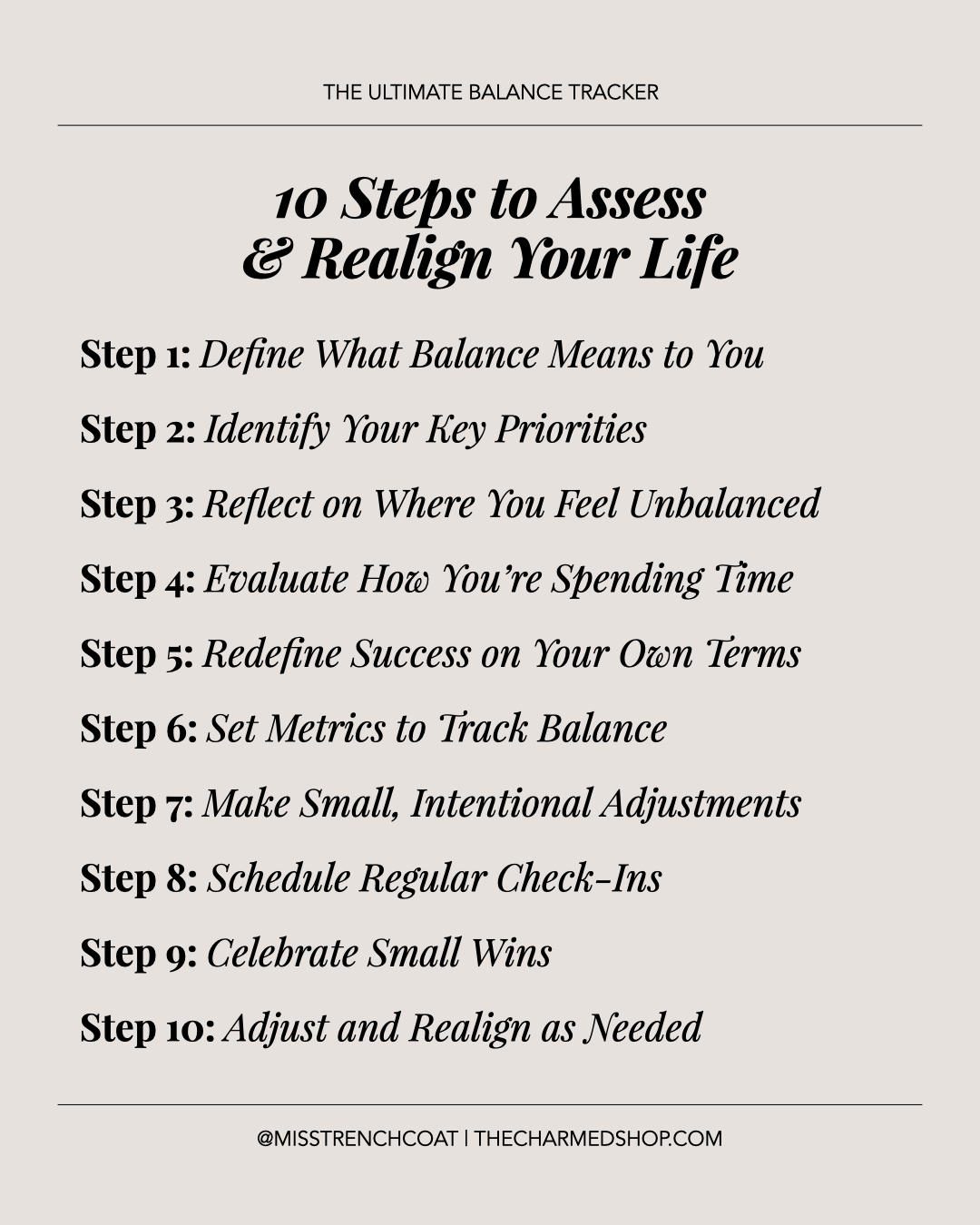
The Ultimate Balance Tracker: 10 Steps to Assess and Realign Your Life

Feeling out of balance is a common struggle, but the good news is that achieving alignment doesn’t require a complete life overhaul. Often, small, intentional changes can help you feel more grounded and in control. Use this step-by-step checklist to assess where you’re at and make meaningful adjustments to realign your life with your priorities and goals.

Step 1: Define What Balance Means to You

Balance looks different for everyone. Start by reflecting on what a balanced life would feel like for you. Is it about spending more time with family? Prioritizing your health? Achieving work-life harmony? Write down your definition.

Step 2: Identify Your Key Priorities

What truly matters to you right now? Your priorities may include relationships, career, health, personal growth, or hobbies. List 3–5 areas that are most important to you.

Step 3: Reflect on Where You Feel Out of Balance

Take stock of your life and identify areas that feel neglected or overwhelming. Ask yourself:

  • Where am I overcommitted?
  • What areas have I been neglecting?
  • Where do I feel stretched too thin?

Write down these areas for a clearer picture of where adjustments are needed.

Step 4: Evaluate How You’re Spending Your Time

Track your time for a week to understand how you’re currently allocating it. Break it down into:

  • Obligatory time (work, household tasks).
  • Routine time (commuting, meal prep).
  • Discretionary time (hobbies, relaxation).

This helps pinpoint where time is being spent on low-priority activities.

Step 5: Redefine Success on Your Own Terms

Let go of societal standards and think about what success means to you. Use prompts like:

  • What would make me feel proud and fulfilled?
  • What have I been striving for that doesn’t truly matter to me?

Write a personal success statement to guide your decisions moving forward.

Step 6: Set Metrics to Track Balance

Choose specific, tangible metrics that align with your vision of balance. Examples include:

  • Hours of sleep.
  • Time spent with loved ones.
  • Number of workouts per week.
  • Hours unplugged from screens.
  • Self-care activities completed.

Write these down to track your progress.

Step 7: Make Small, Intentional Adjustments

Focus on one or two areas where you feel most out of balance and brainstorm small changes you can make. Examples:

  • Set work boundaries by logging off at a specific time.
  • Schedule a weekly date night or family activity.
  • Commit to 10 minutes of daily mindfulness.

Start small—small changes lead to big results.

Step 8: Schedule Regular Check-Ins

Consistency is key. Set a weekly or monthly check-in to review your metrics and reflect on your progress. Ask:

  • Am I spending my time on what matters most?
  • Are my adjustments helping me feel more balanced?
  • What else could I tweak?

Step 9: Celebrate Small Wins

Recognize and celebrate the progress you’re making, no matter how small. Acknowledging wins keeps you motivated and reinforces positive habits.

Step 10: Adjust and Realign as Needed

Life is dynamic, and so is balance. Periodically reassess your priorities and metrics to ensure they still align with your values and goals. Adjustments are part of the process—don’t be afraid to shift focus as needed.

Start Your Journey to Balance Today

This checklist is a powerful tool to help you assess and realign your life, but if you’re ready to go even deeper, join my free on-demand workshop, “How to Plan for a Balanced and Successful Life.” You’ll get access to a free workbook filled with exercises to guide you through these steps—and more!

Sign up now and take the next step toward balance and success!

Your balanced, fulfilling life is within reach—one intentional step at a time. Let’s make it happen!

xoxo,